Showing posts with label paper. Show all posts

Monday, February 2

books books and more books

at the end of last summer, the family gathered on the edge of Idaho and Utah to see my paternal grandmother off on her journey from this world into wherever we find ourselves after. 

from among grandma's things, I was bequeathed an old 70s-style woven and leather bag (I have vague memories of grandma toting her students' papers and homework sheets and such around in it, once). most weeks now, at my house, it is a perfect home to my choir music and a bit of spare lip balm. 

but before I brought it home, more or less just as my dad handed it to me, I found a highlighter pen and a few scraps of notepaper in the bag's many pockets. one little note was a list of medications. the other was a list, in soft, properly-formed cursive pencil, of authors and a few titles:  

G.G Vandagriff
Lynn Austin
Thomas Perry
Linda Nichols - Not a Sparrow Falls 
Chris Stewart - The God of War 
Ted Bell - Nick of Time 
James Kunstler - World Made By Hand, The Long Emergency
Angie Sage
Jessica Richard Draper
Beverly Lewis

and then, in pen at the end, written slightly larger, 

Diana Crawford

when I got home and had a minute, I looked them all up in my local library catalog. of the available options they had for me to put on hold, only one author seemed interesting enough-- James Howard Kunstler. I've read three of his books from the World Made By Hand series now.

they're pretty neat. not all that earth-shattering, as far as post-apocalypses go, but well enough written and engaging. against the premise of oil-shortages and societal collapse, we have a tapestry of colorful characters surviving together. every horse that is mentioned gets described specifically by breed. every antique piece of furniture is given all the fancy labels an auction catalog could ever ask for.  

did grandma ever read these too? I'm not sure.  

I do know we both liked making things by hand from time to time. 

maybe I'll get my hands on some others from her list, eventually.  

more recently, I've been poking around at the short list for this year's Tournament of Books. I got my hands on Bunny so that We Love You, Bunny would have more context. not sure I liked the first-- its ending was pretty interesting though-- and we'll see how much patience I can muster up for the self-absorbed and anxiety-ridden MFA student collective that seems to be narrating the next one. at this rate I won't have time to read anything else at all in advance of the tournament, but so it goes. 

at dear friend Angela's house last month I perused her library for just a few moments and was tempted by a pair of slightly chubby fantasy novels by Naomi Novik: Uprooted and Spinning Silver. they were just the thing to offset the stress and chaos of a new spring semester. good, deep historical fantasy with rich cultural flavor and complexity of character-- I loved them both so much. the second especially so. it would look gorgeous in a video adaptation, I bet.

so of course now I am in a serious obsession with Naomi Novik novels. the other day I finished, too soon, the audiobook of A Deadly Education-- the first in the author's Scholomance trilogy. I loved it so much I think I'm having withdrawals from the world and the voices and the magic of it. it was all so vivid and gritty and perfect. please let the second and third audiobook copies arrive quickly via Libby, please. 

on paper, the series didn't sound that interesting. it is more than easy enough to think we've had enough wizard highschool stories, yeah? 

I'm glad I borrowed it anyway. it is a darker take on the international wizard school trope, but not at all trite or twee or annoying. I found it thoroughly enchanting, with superb world building and expertly balanced first-person narration. we inhabit for 13 well-paced chapters a snippy, mixed-race protagonist named Galadriel (El for short) who somehow, despite being perfectly stubborn and rude to all her classmates, is eloquently self-aware enough with her narrational monologues to come across as relatable and even likeable. I kept thinking of this as Kuang's Babel meets Harry Potter meets Wheel of Time. maybe. not the most apt comparison, I'm sure. ah well. 

books are awesome.

what have you been reading lately? 

Friday, April 28

palimpsest

seasons of 90 days each. seems like plenty of time. one quarter of a full circle, fair time for each mood of the year.
what was I wanting to blog about?

paper and trees. loud noises and how to hear through them.  

-

I've been thinking a lot about my grandma. grandma Ashdown. she comes into my dreams

my coat pockets for the past two winters have held traces of that March funeral three years ago: a whole pecan my dad had given me. bottle of lotion from the hotel. baggage claim slips. 

-

this week the seasons tangibly tilted, almost all at once, one into the other. winter-spring chills are banished by the baking warmth of full-on spring. snow and freezing feel like the smallest of old memories from here.

there are new plants! phlox and day lilies and an easter cactus.

the last day of classes, yesterday. the whole semester at its boiling point, with only grading and emails left before it all simmers away.

for summer break? so many art plans.
and exercise plans.
reading and rereading,
writing and rewriting.
paints and puzzles and games. plenty of sunshine too.

I'd been thinking about all the roles from whatever Goffman theory of something or other... but I'd forgotten the words for it.

my other grandma was a teacher. she taught much younger humans than I get to teach, and I don't know how she had the patience. but if it weren't for her and others like her who somehow do, all the building blocks of reading and writing wouldn't be there for my students to use for anything more advanced.  

-

six years ago, riverside vows in the rain.

now? I must finish all this grading and work. then we'll go lay about in the sunshine. fix my bike. go camping at least 3 times. family reunion adventures in July. rent kayaks every week if we feel like it. 

-

I found this letter in the back of an old mostly-empty journal. it's a letter I never sent, for some reason. there isn't year with the date of Jan 22 in the corner-- but all evidence (the stationery, my careful handwriting and lack of capitalization, the turn of phrase and the doodles at the bottom) points to 2001 or thereabouts.

it is written to yet a different grandma-- step-grandma, if we need to be that specific. it conjures different memories. twenty-two years ago? when I was barely almost kindof a grown-up?

"grandma chesley:
greetings! all the family says hi and wishes you well. i decided that i would write this whole letter just because. [hearts] life's been crazy as it always is. i wonder when it will all settle down. anyway meanwhile i go on through all these crazy experiences, thinking all sorts of crazy things while in so many different moods. it seems like everything changes, but never the way people expect. i really really hope my life turns out well. most of the time it seems like i have no clue and won't amount to anything special. the things i care about can be so ridiculous and yet so serious... that's just more proof that life is a paradox.

for all the wrong in the world, the truth seems extraordinarily unbelievable at times. it certainly is hard to concentrate on the good and the beautiful when so many trivial matters lie in the way. i think i would give anything for an eternity of peace, and i guess that is really what we are reaching for.
[smiley, heart, flower, star, leaf, raindrop, rainbow]"
dear past self, it will not settle down. but you'll learn to settle yourself and settle into yourself. eternity may or may not exist in any meaningful way for these limited human brains of ours, but peace does, at least.


Monday, September 28

minds bodies words and shared responsibilities

this draft has been waiting some time for this day. I'd been thinking for a while to rework it into a post, but something always got in the way of my actually doing it. and then when I realized there was a date on the thing-- today's date-- I put it off yet again just so I could ultimately post it on its anniversary. 

this end-of-September Monday marks five years since I wrote the following five paragraphs for Dr. Thomas Rickert's posthumanism class. it is in a genre of grad school essay called the "paper day paper." (if you're curious for more examples, it just so happens that fellow Purdue student Ryan has impressively assembled all of his paper day papers here. not all of mine would be so easily digitized, though I have repurposed snippets from them before, but maybe it would be cool to follow Ryan's example someday eventually.)

-

Mind and Body are Just Words
28 Sept. 2015

I stole the title there from a recent podcast episode of Krista Tippett’s On Being, where she interviews Dr. Ellen Langer. Dr. Langer’s experiments on wellbeing and mindfulness hinge around an idea that “mind and body are just words,” separation between them is artificial, and there is real power in our expectations and perspectives. I am skeptical about the word just. It carries such belittling dismissiveness. Yes, mind and body are words, but words and meanings surely play into Dr. Langer’s whole point that perceptions can make a physiological difference. We can’t ignore words in all that. As Francesca Ferrando puts it, “futures do not appear out of nowhere: they are based on the presents, the pasts, and the ways they are being envisioned” (1). How we talk about things is part of how things thing for us, after all. How we talk about the future will be part of how the future futures.

One thoughtful listener’s reflection on the podcast’s webpage, from a semi-anonymous Sarah, adds, “Our whole body thinks, it's not a function confined to (that admittedly amazing organ) the brain; and the body, with it's [sic] internal and external senses, is dependant [sic] on it's [sic] environment as part of that thinking process.” Perhaps Sarah has been reading Andy Clark. He and this Sarah person at least seem to share some enthusiasm for the possibilities of describing our selves as inseparably enmeshed with environments and tools. Clark writes, beautifully, that “Minds like ours emerge from this colorful flux as surprisingly seamless wholes: adaptively potent mashups extruded from a dizzying motley of heterogeneous elements and processes” (219). Without all that mess, minds like ours (…if we can call them ours…) may not be possible. But for all we owe to the motley universe, Clark does allow us to own our minds and our agency. He describes these “surprisingly plastic minds” as belonging to “profoundly embodied agents: agents whose boundaries and components are forever negotiable and for whom body, sensing, thinking, and reasoning are all woven flexibly and repeatedly from the accommodating weave of situated, intentional action” (43). According to this model we are individuals, yet also systems and parts-of-systems, with flexible boundaries and all kinds of negotiable bits and pieces.

I wonder who/what has the upper hand in these negotiations. Where exactly does agency live in these woven, mashedup contraptions? Anywhere? I imagine it must be distributed, shared among world and self and materials, just as enmeshed as anything else. And if so, the question of control and responsibility—of agency—begins to feel worryingly and impossibly mystifying. This On Being episode that I have stuck in my head suggests, in its earnest, pop-sciencey way, that if one can just change one’s attitude, one can change one’s whole life (for the better, presumably). What power. What responsibility. Several comments in response to this theme argue with great concern about the ethics of asking, say, a lower-class/minority laborer to adjust their attitudes to their work, as if that should be empowering and liberating enough for any profoundly embodied agent. Is it really? Could it ever be?

Along these lines, Katherine Hayles points out early on in How We Became Posthuman the need to consider “how certain characteristics associated with the liberal subject, especially agency and choice, can be articulated within a posthuman context” (5). It doesn’t seem very easy. She later returns to the concern of subjectivity, recognizing that “As the liberal humanist subject is dismantled, many parties are contesting to determine what will count as (post)human in its wake. For most of the researchers discussed in this chapter [Narratives of Artificial Life, ch 9], becoming a posthuman means much more than having prosthetic devices grafted onto one’s body. It means envisioning humans as information-processing machines” (246). And this, of course, is only one sense of human-ness. We can—and at times already do—conceptualize ourselves as information. Hayles quotes William Gibson on the posthuman body as “data made flesh” (5). But might we reverse this? Will distinctions between information and identity blur as much as those between mind and body and world are blurring? Activist and tech designer Aral Balkan would argue and has argued in numerous talks that they have. In a manifesto-esque blogpost called “Indie Data,” (and elsewhere) Balkan writes about the tools and information and processes that are our digital selves—informational yous and mes—digital selves caught up in a market where human rights don’t necessarily apply, where corporations ask us to trade all our digital fingerprints for free access to technology. Balkan begs his audience to pay attention to the ways we participate in that conversion of self into data, and he hopes “to create, support, and popularise products that empower you to own your digital self; your data, tools, and derived intelligence.” Such ownership is not given. It too must be negotiated. Clamored for and defended and somehow brought into sustainable possibility.

Our texts so far in this class have been prodding us to draw fewer dividing lines and to start recognizing the ways in which every thing is part of a lot of other things. Whether it’s Heidegger’s Being and presencing, or Hayle’s enacted/embodied/empatterned systems and information-processings, or Clark’s EXTENDED models of mind, all these words urge more careful thinking, more open awareness, more inclusive considerations of a good future for humans and non-humans and everywhere they overlap. I’m not sure exactly how much control we have over using our present presencing to carve out space or language where the future will best future for the most people, places, and things, but I hope we have a little bit. Whether we do or don’t, we should keep talking about it and writing about it with words that are just words and words that are more than just words. Whether we do or don’t, we should try not to mess it up, if we can.

Scholarly References
Clark, Supersizing the Brain: Embodiment, Action, and Cognitive Extension
Ferrando, "Is the post-human a post-woman?"
Hayles, How we Became Posthuman: Virtual Bodies in Cybernetics, Literature, and Informatics


Postscript:
I have a new academic idol of sorts. Patricia Roberts-Miller blogs about key principles of argument and rhetoric and how those intersect with politics and demagoguery and it's all gloriously insightful stuff. I might blog more about her work later on, someday


Thursday, July 16

throwback

I like to look back at things my past self was thinking/writing about quite often.

but all my old real paper journals are in storage right now, our apartment being a little bit too tiny and shelf space therein too limited.

so instead I scroll way back through various digital scrapbooks. what random stuff did I link to in 2013? what random photographs did I post?

dorset cereals and their lovely packaging.

aw, this game about squares that I used to be so into.


was this trip to DC really only two years ago?

surely if this lost photo of a quartet of missionaries got shared enough times in enough social media places, someone out there would recognize its subjects and perhaps even its setting, right? I guess someone just has to care enough to do enough sharing. (half-relatedly, should I keep my flickr account? even though I cannot remember the password for it or even the password to the never-used yahoo email account that it is attached to? probably I should.)

I miss our old, first apartment. the balcony. the space, strangely-shaped thought it was. I miss all the windows it had, and the character of the claw-foot tub and the radiators and the tiled fireplace. how beautiful it was to walk almost everywhere from that corner. and how often we had people visit us for games and dinner parties.

will there be dinner parties again? when?

all my old journals and calendar books are in storage. but before we moved I took some photos of the calendar books. they're so eclectic and neat, all in a row. 


ten and a half years of weekly plans of various sorts.

2010 calendar book

taped-together binding. sticky notes. rough-sketched maps.

2012 calendar book

"more yoga, more sleep, more love, more writing, more open," from January, 2012.
 
crannbery chicken salad sandwich $3.89

lists and lists of things to do, things done. I'm sure 84% of all the list items are variations on this one: "write."

2020 (this year's) calendar book

this year's is more than half-full now, just as scribbled in and check-marked as all the others are.

despite all that's going on, the summer feels strangely, blessedly empty. a paradox of having such long days and so few demanding tasks.

some things, thankfully, can stay the same for us, no matter how far away we've moved from everything we now drape in nostalgia.

one last throwback link, trawled up from the ancient depths of my twitter: belong to where you are. the whole album/stream is pretty interesting, too.

Tuesday, April 7

seven: the study of the true sense

I looked up the etymology of the word etymology a few days ago. and then I remixed that etymology into the title of my last paper-day paper for Postmodernism class. this was last week, at the end of March, which feels very long ago now.

the title was:

"the facts of the origin and development of the true sense of the study of the facts of the origin and development of the facts of…"

and then the rest of the page (legal-sized, remember) blathered on about origins and developments and traces and representations and categories and lines and labels. I read this page to my class as I sat on the floor. to add to the performative interactivity of the whole thing, the copies I'd printed for my classmates had been carefully perforated with the edge of an old pair of scissors. while I read, they could peel and tear and open my legal-sized page into a long, twisty ribbonloop.

to reproduce this page as a blogpost changes it quite a lot. you can't peel these bits and pixels apart the same way you can paper. sorry.

but I can add stuff (like this rambly new preface) and tweak bits of it and take things out that don't fit the new medium here, in a way paper and ink do not quite accommodate. so there's that. you'll have to imagine me on the floor, reading to you. and imagine the feeling of paper tearing in your hands.


the etymology of the word perforate takes us back to dear old Latin, as so many etymologies seem to do. via Middle French we arrive at two neat word-trios of infinitive verbs and prepositions: "to bore through.” “to pierce through." pair with these the resulting perforation: "a hole made through something" and that very specific preposition starts to pattern. it’s right there in the per prefix: "through." and it’s implied in the other half too: forare, "to pierce."

the origins and developments of postmodernism... how do those get represented? do they represent themselves? or does someone/something have to step in as representative? we access postmodernism through others’ words and others’ ideas. so far. and even the ideas that cocoon postmodernism are not here in front of us. we can't touch them. we access them through. Saussure through Foucault and Derrida. Foucault and Derrida through Vitanza and Spivak and Berlin. we are looking at a thing (is it a thing?) called postmodernism, but not directly. maybe we’re stuck in a cave. maybe Berlin is putting on a shadow-puppet show. and we are looking at (is it at? along? or into? around? under? which preposition is the best?) an idea called postmodernism through books and essays and art and memes and emoji. we are looking (are we looking?) at this postmodernism mist through our own arguments and faces and looks and voices and brains and time and pencils and paper and chairs and walls and space. does it all become part of postmodernism as we go? I wonder where our lenses and our specimens begin, or end. is there a recipe we can follow when we want to start mixing the message into its medium?

Victor Vitanza, from his article “‘Some More’ Notes, Toward a ‘Third’ Sophistic”:
We have categories so that we might ‘destroy’/’disperse’ them by allowing them to engage in a sophistic-rhetorical ‘diaspora’—that is, to engage in a holiday from any pull toward the infinite or the transcendental—so that we, in turn, might also ‘drift’ freely. We have categorical—‘knowledge,’ as Foucault says, ‘not... for understanding [but] for cutting’ (154). Does perhaps, then, Foucault mean a... ‘cutting loose’? ...does he perhaps mean a ‘drifting’?” (120)
so labels are for peeling very carefully, obsessively, from around the bottles they were glued on. the peeling might ruin them, but it won’t be the end of the world. no worries.

whatever the labels say or don’t say, none of them are neutral. James Berlin is always saying there is no innocent ideology. no innocent pedagogy. no innocence. I should print these introductory and conclusory bits of “Rhetoric and Ideology in the Writing Classroom” on bright posters and hang them in my office someday, I think.
“A rhetoric can never be innocent, can never be a disinterested arbiter of the ideological claims of others because it is always already serving certain ideological claims.” (447)
“Every pedagogy is imbricated in ideology, in a set of tacit assumptions about what is real, what is good, what is possible, and how power ought to be distributed.” (492)
“A rhetoric cannot escape the ideological question, and to ignore this is to fail our responsibilities as teachers and as citizens.” (493)
to “not ignore,” I must notice, is not the same as "to answer." good. if we had an answer, we might stop poking and peeling at things. as it is, we might never reach the end of the world. how exciting! we won’t ever run out of ways to represent and re-represent what all this theory is. we might never run out of mist and thought and media to look/wander/aim/drift through. a perforation, after all, only really pierces part of a thing. part way through. you have to show up with your brain and your hands and do the rest of the work.

Saturday, November 1

refer to the print version of this title

for Modern this semester, I'm reading a book about marginalia. all the bits of writing added to books, in the spaces left unprinted, and what those bits mean or used to mean or could mean. as someone who isn't usually afraid of writing in books (provided they belong to me or to a library and not to any finicky acquaintances who prefer pristine, un-dogeared books on their shelves) I'm enjoying it. finding value in the mundane is always neat, and when the mundanity also has a pinch or two of the subversive in it (writing in library books--heaven forbid!), even better.

the text is called Marginalia: Readers Writing in Books by Helen J. Jackson. her research sounds so dusty and so extensive.

ironically, I'm reading this book via ebrary, a ProQuest interface for online library book access. every few pages, where there should be some kind of awesome illustration of Jackson's examples or descriptions, the ebrary copy gives me this:
I can make a copy of that bracketed instruction. ebrary doesn't make it easy, but the functionality does exist.

[To view this image, refer to the print version of this title.]
Jackson, H. J.. Marginalia : Readers Writing in Books. New Haven, CT, USA: Yale University Press, 2001. ProQuest ebrary. Web. 31 October 2014. Copyright © 2001. Yale University Press. All rights reserved.


and appended to every copy-pasted segment of the text is every shred of bibliographical information you could want, in something sort of like MLA style. useful, eh? or tedious. if you'd like to copy out several passages, having all that meta-data trailing around after each one is a little much.

ebrary will also let me download this book, but I can only have it for fourteen days. and I can then only read that downloaded copy using Adobe Digital Editions. the whole internet complains about Adobe Digital Editions. it might beat ebrary by an inch or two, simple for not requiring both an internet connection and official university credentials... but really it loses by being unfamiliar, un-syncable with anything at all, and that 14-day thing... really? sure, the local library limits my book-borrowing to the same length of time, but this seems more unnecessary than that. none of these digital books needs to be returned so someone else can access it somewhere else.

our library does have a print copy of Marginalia. but it's currently checked out. if I needed, for some reason, to access its illustrations, I'd have to wait until its January due date, or track down whoever must have it checked out, or send a recall request (which is a jerkface thing to do, so nah). I can make do with the electronic version, and trust Jackson's descriptions on their own. it's fine.

I've been reading lots of old Enlightenment stuff via Google Books lately, too. which reminds me of The Art of Google Books. have I mentioned that tumblr before? it's neat. the images there, thankfully, are not only accessible via the print version of their titles.

all this reminds me of this old post and particularly this newsletter referenced there. ebrary and Google Books and Adobe Digital Editions all put up extra doors between a reader and the reading material. they are like fancy schmancy locks and chains around the covers. so many fancy locks and chains, and so many complicated keys. what happens if we lose the keys someday? if I stay in academia, I'll most likely always have the requisite university credentials for getting into these non-dusty but-yes-extensive library databases. but the infrastructure of that system might someday be just as obsolete as a floppy disk is today. and then what?

Saturday, October 25

midterm excerpts


fuel coffeeshop. a few Fridays ago.
not pictured: Divining a Digital Future: Mess and Mythology in Ubiquitous Computing, with accompanying notebook and pen.

somebody asked me the other day what mind-mapping software I liked to use.

I muttered and gestured to all the notebooks in my bag. paper, of course. not sure it counts as software, being made of dead trees, but whatever. I map things into my mind using paper. that way I can doodle in the margins or write sideways or crisscross crazily between this note and that note. for example: the first leaf of the blue spiral notebook I've been keeping notes in this semester has some boxes, some circles, a sketch of an envelope, some numbers, some squiggles, an octothorpe, a non-existent email address, one question mark, four arrows, the word ungrateful in all caps, and the advice to Sing in Your Own Voice, followed immediately by the words blue ink in parentheses. on the verso, there is an overwhelming amount of math. I'm pretty sure all of this was written in late 2010 or early 2011, when I was studying for the GRE.

the rest of that blue spiral notebook is now full of notes from this very fall, 2014, my second year at Purdue University. I've had to start a new notebook mid-semester, which I guess is what comes of using one already half-used-up notebook for three different seminars + lectures + practica. because it's midterm-time, and because looking back at these notes might be a useful thing to do as I begin writing proposals and papers and essays and project reports, and because this blog needs more academic nonsense plastered all over it, here are some snippets from it. they don't always transfer very well to this stringent, linear, typographic medium. ah well. I can add hyperlinks to this version though, so that's something.
what does this mean? more money for ____ / quality +
find out the impact ★ 

agonism / movement
metis / arete / kairos / phusis / hexis

observing with no aim other than
normal/everyday
interaction
why that now
what next

ignoring ≠ not noticing ★ 
how to become sensible to things that are unremarkable? [doodle of fish under water]
ethnographers must join the fish but also remember what water is

tech separating creative process from production process --> bigger businesses
telegraph typewriter filing cabinet railroad copy paper

definitions need definers (+ attendant power structures)
I keep thinking about SUITS.

disconnects between writing/docs and + real expectations
or impossible to articulate things
beyond expertise

work (n)
work (v)
internal + external articulation

writers not writing.
interesting nod to Kant

"elite" / "male" / "western"

nature + functional historical knowledge (a formalist approach)
chronicle > story > mode: plot, argument, ideology

mystical / sociological / cultural models
unities / Weltanshauung, paradigm

★ sentience ★ consciousness
making of the world
torture - "torque"/twisting
terror - "to tremble"/terrible

useful vagueness!
scripts     schema
quantifying "shared knowledge"

rules tacitly learned
instruct > interpret > act > assume > instruct > interpret ....
making the world match the words

digital iterations are quicker
do machine made songs words art get copyrighted?

Taylorism = basic (time) task efficiency -->
Fordism = specialized production
functionalism = prototype prod. line + labor management
art?
passive / normative / or creative / or reactive

could machines cook?

what if actions are our bigger understandings of interlinked systems of interactions all working together? (more philosophically cool)
or we could see interactions as bubbly frothy conglomerations of discrete actions? (more etymologically consistent)

★  ideas precede expression
but we learn names before concepts.....
essence ≠ substance

man = ?
biology?
no immovable boundaries
men make sorts
nature makes qualities/matches

a set of subjects memorizable / polymathical
"tristapaedias"
categories / relationships / authorities

self-evident character of prison
war functioning as if...
prison NOT functioning as if... but pretending to try? <-- a="" br="" does="" how="" media="" play="" role=""> the Last Lecture Randy Pausch

practical advice /  + integrity
"if small faults are to incur such grievous punishments, there can, indeed, be none found sufficiently sever for great crimes." (Edgeworth 245-246)

norms as processes, assumed in forming identities
legible / livable vs unlegible / unlivable lives / spaces
e. exclusion, boundaries exposing limits of constructivism

p 37 - always already material
centering the world symbolically
lack of control = castration

subject
abject

containing multitudes. [I was thinking of Maya Angelou at the time but really, Walt Whitman said this.]
"if the unconscious is the discourse of the Other, the unconscious necessarily exceeds the individual + becomes thinkable as Social + Cultural...

power (opposed to) ornamentation elitist finery
puritan austerity

Com 621 Social Media
Com 605 PW

blending sacred motherhood w/ secular moneymaking

regularity / order / harmony / sense

Beauty   Harmony / this sounds like Hume ^

ch 3 Zuern / "what we seek to master is the control of the cultural meaning of the body ... our offering of our bodies to the world as meaningful" p 62


Friday, September 12

un-rerun

these are my folders full of sketches. (I want to say folderfuls. like handfuls or bucketfuls or something. can we make folderfuls a thing? okay, cool.)
fat, overstuffed, manila folderfuls. I am pretty sure this is most of them. others might be scattered around various other notebooks or piles, but these here constitute the closest thing to a sketch archive that this disorganized amelia girl keeps. the sketches are mainly sorted according to the size and shape of the paper they were drawn on. it would of course make more sense to categorize the things by date or by theme, but I just have this feeling they'd take up too much space that way. they take up enough space already. 
plenty of these things have been digitized at this point. don't ask me which ones. don't ask me when.

there are too many. I have been blogging one every Sunday since 2009.

the digitized versions don't weigh anything... I don't think... (or do they? do stored gigabytes technically have any mass?)

but as I wondered how much the paper-and-ink collection might weigh, I realized that I had the tools with which to answer that wondering.

my little kitchen scale says the whole pile weighs eight pounds and almost twelve ounces. there are entire human newborn babies that don't weigh quite that much. and these are only most of my accumulated sketches. I wonder how many sheets of paper are really in this huge pile. I'm not going to count them though.

there is an almost-memory I keep thinking about, from somewhere in my almost-tween years, when I was a young girl scout. mum and I were visiting neighbors, hawking cookies. I noticed all the similarities in every doorstep conversation, every description of the caramel-nut-cluster Juliettes. I may have even commented, in a clueless, judgey, childlike way, on how silly it seemed for this articulate parent of mine to be so, so tiresomely repetitive.

this memory (half re-upholstered with inaccuracies after all this time, I'm sure) adds to the shame I feel about having eight pounds of sketches to choose from and yet redundantly posting at least a handful of them more than once. as if someone might have missed them the first time. as if I couldn't bear the thought of those particular sketches not being seen by as many eyes as possible. as if the internet is in need of even more multiples of even more images of mediocre quality. none of these as ifs are true. I am not worried about my silly sketches being missed or being lonely. I have no excuse at all for littering my dear blog with duplicates. as yet un-remedied proof of my carelessness is openly available here in exhibits 1A1B, 2A2B, 3A, and 3B. and there have been more cases; sometimes I do catch them and replace the repeats before too much time goes by. but who knows how many I have yet to notice.

tiresome repetition is all in the eyes and ears of the beholder though, really, which is a thing I recognize much more maturely now than I ever did as a not-quite-tween-year-old. if the doorsteps are new and the neighbors lucky enough to be unspoiled by your cookie-spiel, you probably don't need to worry, no matter how clueless your selectively-perceptive daughter might be.

the internet is not a series of separate doorsteps. this blog makes a very different and less forgiving context than a neighborhood, I think. reposting stuff--even if from bouts of inattentive blogpost scheduling, and even if my distracted, forgetful brain does give the stuff a new title--feels intolerably lazy. I might owe my tiny audience here an apology or two. or my tiny audience may not have noticed, since one random ink sketch per week most likely doesn't count as high-priority web content.

nevertheless: I am disappointed in my distracted, forgetful self. one day I'll automate the sunday scribble posts entirely, and then things like this won't keep happening. 

Friday, September 5

grounded

has any one ever written about how headphones have done for music what widespread literacy and silent reading practices have done for books? i.e. make them very private, internal experiences instead of communally shared ones?

speaking of headphones, there is this new podcast (maybe I'm too into podcasts, who knows) by Mike Rugnetta of PBS Idea Channel) called Reasonably Sound, and the newest episode is all about those fancy noise-canceling headphones. the most interesting bits focused on what sorts of biases and assumptions about the world, its contents, other people, etc. had been baked in to the technology. that was his phrase: "baked in." listening to the episode on my way to campus thismorning I learned that noise canceling headphones take all the noise of the world and reverse its own wavelengths to insulate a wearer's ears in a bubble of whatever they want to focus listening on. that is a very interesting technology.

what counts as noise and what counts as signal is always an interesting question. the cicada chorus outside usually fades away while I'm not paying attention to it. if there's more important audio input happening somewhere, that stuff gets tagged signal and everything else doesn't matter so much. it's still there though. ambiance and texture.

we have this cool ability to zoom in and out like that, mushing ground and figure, text and context.

for the writing lab practicum I'm taking this semester, we've done a bit of reading on the differences between polishing writing as a product vs. perfecting writing as a process vs. empowering writers as writers. does the process ever end, leaving us with a solid, finished, unimpeachable product? of course not. and can a writer be a writer with out any writing (whether we mean the verb writing or the noun writing)? your identity can't breathe in a vacuum. everything you are (have been, can be, will be, might be) comes about as a slow event, just like all the other everythings.

despite all the never-ending, brain-stretching, headachey expanse of work this phd thing has in store for me, I am trying to make time for random and non-academic periods of creativity. this blog sort of counts, maybe. the weekly Starcustard ritual Chris and I have engaged in counts too. but really I mean analog creative efforts. messing about with paper and cloth and glue and yarn. making things. growing thingssticking stuff to walls.

I live in my own head so much of the time, listening to the noiseless (hopefully signalful?) words of my own unvoiced thoughts. headphones aren't to blame for this bubble. maybe the crafts and flower pots and randomness won't quite pop the bubble either, but they might give these quiet, interior brain-spaces some different ground, a different frame, or at least a few stimulating bits of new context.

Friday, June 6

you can't dog-ear digital pages

just so you know, I am blogging about my summer academic reading over here. my post this week puts a ridiculous music video in conversation with a rather fat historical text from the eighties: Leviathan and the Air-Pump: Hobbes, Boyle, and the Experimental Life by Steven Shapin and Simon Schaffer.

I say fat because I have experience with the weights and thicknesses of other 450-page books, and fat is an applicable word for them, but I actually read this one in pdf form on a kindle. reading practically weightless digital text isn't very new to me, of course, but the neat little kindle itself is. it has its perks, but some of them are double-edged. the kindle I have isn't only for reading. you can put apps on it. watch videos. skim comics and blogs and any other website. (now part of me wants to say all those activities are their own forms of reading, so how does that change my point? hrmm.) anyway, a little while ago I read a snippet from this Dan Hon fellow on books vs. other media and the self-containment of the former vs. the dependence of the latter. he says,
"in my geeky head, books are their own runtime environment. The bound paper is the interface method. They are self-executing. They have direct-manipulation user interfaces that have been standardised now and are pretty intuitive. [...] You can’t just go to a library and get out a DVD and experience the content on it without also owning or having access to an additional access/interface layer. You can do that with a book."
of course, and he also admits this, you do have to know how to read. it is only because literacy and print publishing have become so standard and efficient and well-oiled that these book technologies work so almost-flawlessly. I could keep thinking out loud here about the infrastructures of all that, but really my reason for bringing in Hon's ramblings here is to say that the one-thing-at-a-time awesomeness of a book contrasts pretty obviously with the complexity and multifaceted shininess of my new kindle. I can take the thing out into the woods and disable its wifi, but even then the kindle won't be one single, self-contained book for me. it has dozens of pdfs on it now, and a feedly RSS app, and a slowly growing collection of half-finished ebooks. all that potential reading material in one slim seven-by-five-inch gadget is spectacularly, dazzlingly, befuddlingly cool and overwhelming.

before I started reading that fat-yet-weightless tome about science and history and such, I began my for-fun summer reading with What's Wrong With Plastic Trees? Artifice and Authenticity in Design by Martin H. Krieger. I found this book using my most favourite book-finding method: wandering library stacks until a title or spine calls out for attention. maybe it was the allusion (intended or not) to that Radiohead song. maybe it was that lovely question mark, or the nice deep green of the cover. once I opened it for a taste-test, the alliterative contradiction of the subtitle latched itself onto my curiosity and I took the thing home.

mostly it got read while I galavanted around Utah last month, sleeping in tents and on various sofas, and gradually beginning to look at all things--even the random spinach plants out by the shed and even the sage brush along the side of the road--as at least partially designed.

I began dog-earing at page 42. luckily, the copy of What's Wrong With Plastic Trees? that I read was a paper-and-ink book, with pages I could gently dog-ear without damaging its inner workings at all.
"Canonical descriptions of the world make sense only in terms of the concrete cases to which they are to apply and the hard cases that resist them. That is why we learn from examples and exemplars rather than from generic principles." 42
some of these bits, now that I look at them, speak to the themes from Leviathan and the Air-Pump, maybe. an experiment can be a way of managing a certain concrete situation of possible learning/knowing. how we shape that case will then shape our perspective, and vice versa... around and around.

this next one fits too:
"When we disagree about values, that disagreement has little to do with arbitrary subjectivity. We disagree because we have different conceptions of a good world, different conceptions of how we might achieve that world, different conceptions of what matters and how much. yet those differences are not simply to be noted; that we disagree sets up the necessity for argument. That we can have such arguments, or that we feel insulted by the claims of others, is a sign of community, and so we speak of a community of architects or scientists or programmers. It is consistent to believe that we share notions of quality and that we disagree in our conceptions of a good world." 58
but Robert Boyle and Thomas Hobbes disagreed about this, too--about knowledge communities and what their boundaries should be. hmmm.

there is a whole section on Niagara Falls that I think I might have my students read in the fall. Niagara is a grand, imposing, natural phenomenon... or is it? do we consider it (or any other "natural" thing) more as a place, as an event, or as a spectacle? can we experience it in more than one mode? how?

later on there were exciting references to technology, originality, and value. my copyright-obsessed academic self will want to keep coming back to this stuff.
"Reproducibility affects rarity. Technologies, which may involve physical processes or social organization, determine how reproducible an object is, for we may be able to make a copy of the original, or we may transfer to another object the significance attached to the original, or we may create virtual environments that are reproductions that acknowledge their lack of identity. Copying natural environments may be easier than copying artistic objects, because the qualities of replicas and forgeries are not as well characterized in the case of the natural environment. And rarity and reproducibility may be a matter of death and the end of production, whether of a photographer or a place." 69
composed reality... perhaps another idea to bring up for my students:
"If reality is a representation or at least a presentation of the world to ourselves, composition is what makes reality satisfying. We show the world to ourselves, and we might say, is is composed, much as God in Genesis saw, it was good." 105
the shifting, relative values of things that are persons and things that are not persons:
"Almost everything has been objectified as a purchasable or at least valuable commodity, human beings included, in slavery, in death, in injury. In modern economies persons are treated in terms of their purchasable capacities, as labor, and their capacities for consumption, as consumers. Things that are not persons may surely be exchanged for each other. Their relative prices are determined in an economy of supply, demand, and to some extent taboo, which restricts the places where they may be exchanged." 114
taboo and convention and tradition... all these factors that influence what we see as possible, or right, or good. will we ever overcome all those limitations?
"When we manage nature we are not forging or destroying a masterpiece untouched since it was originally fabricated. Untouched nature usually means untouched by white men, just as a pristine masterpiece is what has remained untouched for several generations--but has almost surely been deliberately tampered with or preserved at some time in its history." 121
nothing escapes human meddling, I guess. and if anything did, how would we know about it? we wouldn't. as soon as we noticed, we'd have already meddled.

I don't have a list of quotes from the pages of Leviathan and the Air-Pump. there were so many times I wanted to make notes in the margins or tuck bookmarks between certain sections. even though I can keep that pdf forever, it's much more difficult to go back and reference my reading experience of that book. the Krieger had to go back to the library, but my experience with it even still feels so more easily accessible, simply because I could dog-ear the pages.

Saturday, February 1

repurposed tools

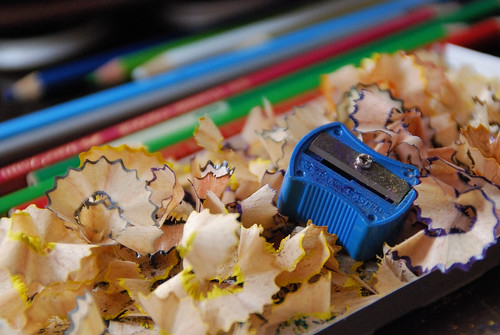
I used to have a little blue pencil sharpener. I kept it in an old emptied box-of-chocolates with my little-used colored pencils. perhaps it is still in that box, which I abandoned last summer in a cabinet in my parents' sunroom.
{image borrowed from Chris RubberDragon on flickr.}

generally, I write and doodle and take notes with ink pens. I learned long ago that having a pencil and eraser in my hand makes me too self-conscious, too primed for seeing mistakes and then fussing over removing them. with a pen, the inevitable sloppy scribbles become part of my work. I am required to confront them and manage them, or sketch around them, or continue ever more determined over the top of them. it suits me better to write and doodle this way. pencils don't grant me access to the same zone of confident creativity for some reason. they are too soft. too easily dulled. too pale. I am more likely to use pencils for holding my hair in a twist than for writing.

sometimes, though, pencils are the tool of choice. sloppy inksplots and scribbly amendments upon amendments (not to mention un-erasable, whimsical curls and squiggles and crosshatching at the edges) are not appropriate everywhere. page proofs, for example--proofs that need proofreading and marking and sending back to an editor + production manager for correction--do not need blue ballpoint scribbles or crosshatching or inksplots. they need a sharp, non-black pencil and as much precision as possible.

for very sharp pencils, of course, you need some sort of tool for sharpening. this is another downside to pencils. they wear themselves down to blunt little nubs every other hour. so impractical. but luckily, you can get these neat little angled blades, fitted just so around your stubby, tapered pencil point, ready to shave away a hundred papery layers of wood and graphite.
{borrowed from arete akarafi on flickr.}

I used to have a little blue pencil sharpener for keeping my colored pencils in a usable state. but I don't anymore.

so last month while I played proofreader and needed a very sharp, non-black pencil, I relied on this pocketknife:

how this pocketknife came into my possession I do not remember. perhaps I unknowingly traded my lost blue pencil sharpener for it in a dream? this pocketknife is a versatile tool. you could use it to skin a chicken, maybe. or for opening boxes or carving your name into fenceposts or trimming your fingernails in a pinch.

I've never used this one for any of that. the only thing I've used it for is sharpening this particular non-black pencil. I kind of like how red graphite is now streaked crazily all over the blade.

they say when the only tool you have is a hammer, all problems start to look like nails. as sensical a proverb as any, this one, but in many ways too smooth, too simple. it might apply best of all to the tiny plastic pencil sharpener. after all, with a pencil sharpener like that, you can't do much beyond sharpening long, slender cylinders of wood. a pencil sharpener would have to ignore and neglect all other differently-shaped problems.

with a sharpened pencil though, you have more options. you can mark 256 pages of that typeset manuscript. you can look out and watch for mistakes in the world, incongruities like hordes of stray animals to be gotten rid of. or you can change your perspective to focus on your hair. all those loose, unkempt tresses begging to be twisted into a lopsided bun.

with the pocketknife? I might wield this pocketknife and want to see sturdy blank fenceposts, ready for cutesy initials to be carved in. certainly pencil-sharpening is not the first task that comes to mind when I heft this folded-up tool in the palm of my hand. nor is fingernail-trimming. maybe in order for a tool to change your world, you need to get familiar with what it can and can't do. you need more practice with the possibilities of a pocketknife.

sometimes I use pens to hold up my hair, too. but most of the time, my pens and I look at the world to see empty pages, full of potential, ready for inksplots and words and scribbly curls.

Tuesday, July 9

memories + more soup

in May I attended a very fancy dinner party hosted by Texas Tech University Press. they served lovely food and had a handful lovely speakers, all introduced by a very distinguished and amusing emcee. I'm very grateful the editors allowed me to make a reappearance and attend in exchange for helping with setup and checkin and such.
{ image by the great TTUP design & production manager Kasey Macbeath, who also makes very fabulous cupcakes. }

if you're a Lubbockite who will be around next spring and you feel like indulging in the arts, supporting small publishers, and being served a very nice three or four course dinner (including various wines, if you're into that kind of stuff), you should check it out, save your pennies, and buy a ticket.

for me it was wonderful to attend after my too-short year of working at the press and see authors whose books I had worked on. I had the pleasure of meeting several of them at this fancy dinner, seeing them sell and sign so many gorgeous hardcover books that when I first read them, almost two years ago, were nothing but stacks and stacks of typescript, bunches of digital word files, and a few paperclipped folders of printed photos. shaking the hands of the writers who gave me so much fun work to do back then was pretty awesome.

this year and last year, there were recipes included in the program.
so I saved mine in my fat yellow folder of recipes, and just got around to making this sweet potato soup a few weeks ago. in an attempt to notch down the spice, I used a few pinches of cayenne instead of chipotle pepper. my dear family hated it anyway.

but I think it turned out just great, though my plated closeup does not look anything like as fancy as the version I was served at Literary Lubbock. I'll probably make it again though and ease up on the cayenne if I must. it will remind me of here, and learning, and a handful of very lovely people.

Tuesday, June 25

honored


the exciting mail I received the other week came in two fancy, important-looking black tubes. in one was a diploma conferring upon me a Master of Arts degree, the other a smaller but just-as-full-of-heavy-black-lettering Graduate Certificate in Publishing and Editing. they are all rolled and curly from living in fancy, important-looking black tubes.

my undergraduate diploma of so many years back did not come in a fancy black tube. all it has to live in is a cardboard envelope. last week I dug it out of a box in the basement so I could lay the two lovely official things next to each other. they aren't remarkably alike in lettering style, logo, or paper size, but the line breaks and language are pretty similar, especially at the end.
after announcing their respective institutional authority and conferring upon this Amelia girl whatever particular degree, each flimsy little slip of paper adds something like: "...with all the rights, responsibilities, honors and privileges which accompany blah blah blah..."

what are all those things, I wonder? what does all that mean, really?

I suppose have the right to call myself an alumna of these two educational dominions. the right to attend even more and more and more grad school. the responsibility to represent my colleagues, this field, and academia in general as well as I can manage. the responsibility of thinking a little more closely and thoroughly about my words and writing. the honor and privilege of associating quite closely with other dedicated, intelligent, and educated folks. 

and the right, responsibility, honor, and privilege of hopefully being able to usefully pass along some fraction of all the things I have learned. maybe I can make the world a better place for a handful of my students or friends or beloved. I'll try, anyway.

Wednesday, April 24

out of your head, on paper

the semester is just over enough that I can start getting reasonably excited and anxious and breathless about the next one. I am emailing people about registering for Fall classes. I am scrounging around internet classifieds and such for somewhere lovely to live in this new place. I have another shiny, empty .edu email address. my fourth, I think. unless I had one in England? I surely did. but I cannot remember. I suppose it might have been .ac.uk anyhow...

hm. remembering things seems like an important skill. but is it that, or is it knowing which things to remember? knowing which things need to be remembered and finding a good way to remember them... that is difficult. perhaps impossible. and perhaps that is why we invented writing and google.

speaking of writing and google and remembering things, I cannot remember how I came across this guy named Craig Oldham or his art project all about handwritten letters. it was probably through one of those british blogging designer folks I still have in my google reader. Ben Terrett or Russell Davies or someone (and no, Brandon slash any other Doctor Who lovers, not that Russell Davies).

anyways. the link to this handwritten letter project has been sitting here as a thing to be blogged about for months, along with...

thoughts on Roland Barthes + Thomas Jefferson
connections between Shakespeare + The Cardigans' "Lovefool"
discussions of God, syntax, + David Hume
something about Marc Chagall + 2 Corinthians 13:1

...and a few other random lists, memories, and photographs. (maybe I should try for a blogger drafts collection of zero this summer, or something.)

now I am blogging about the handwritten letter art project. yeah. I like it. handwritten things are lovely and I think making space for them in all the non-handwritten parts of our lives is very neat.

it would be cool to embark on my own letter-writing project. one year it was a resolution of mine to write one letter every week. not getting responses made it sort of a sad, short-lived project though.

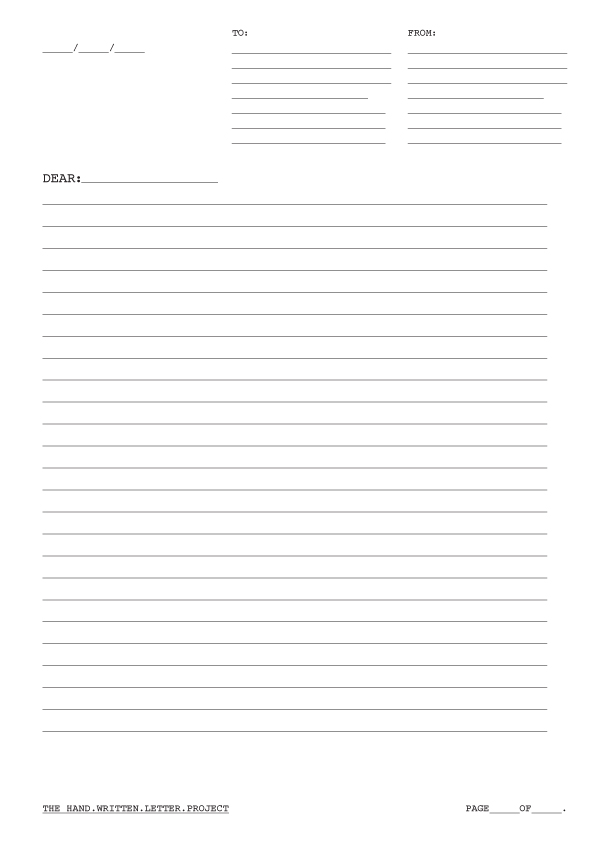
the 'share this' link Mr. Oldham has included on his page about handwritten letters opens a printable letter form:
isn't that amusing and backwards and perfect?

on the project's about page Mr. Oldham describes his project as part of "a visual narrative on the cultural transition in which we find ourselves." hmm. visuals are cool. transitions are cool too. connecting things and people and ideas and stories... I like it.

and as a completely random post-script, the same artist fellow has apparently created this very, very convoluted and strange but intriguing something else. I'm not sure what to make of it other than those adjectives.

Thursday, April 18

fragmented histories

I've mentioned before that I get a bit obsessed with notebooks. most of the blank ones I mentioned way back when are still empty, accompanied now by several new empty notebooks. I'd be happy to acquire more, even at the risk of running out of shelf space. currently, my journaling is nearing the last few pages of a nice little red one with a quote from Marjorie Hinckley embossed on the front: "Everything you are learning now is preparing you for something else."

I guess that must be true. this MA in Technical Communication? it's just a little stepping stone. the PhD in Rhetoric and Composition will be a slightly bigger stepping stone. and then what? we must wait and find out. the other side of that stepping stone is a long way off still.
a while back, colleague Angela, knowing my interest in copyright and the digital world, pointed me in the direction of one Dr. Brendan Riley, who writes this seemingly eclectic blog called Digital Sextant. he does reviews, talks about zombies, throws in occasional amusing photos (some in German?), posts about copyright controversies in the news, and every week or so compiles all the things he's lately posted on twitter.

all my notebooks (the paper kind and the non-paper kind) are just as eclectic, probably. some of them are easier to flip through than others. some of them reveal more of just what was going on in my life at certain times than others. there can be a kind of game in looking back. what sorts of things made it out of my head and onto the page one year ago? or two? is it useful to look for patterns?

so call this a crossover digital notebook flipbook flashback. yes, of course this kind of recycled post is a symptom of my end-of-semester busy-ness. yes, parts of me might feel a bit lame and self-absorbed using this space to puzzle publicly over her very own cryptic past. so what?

courtesy this searchable little javascript trick, built by one Felix Turner (way cool name, that), I've dug around in the past four years and plucked out a medley of past and present Aprils. (I did this lazy sort of thing a few years ago, but in June. maybe medleys-of-past-[blank]s will become a recurring thing. maybe.) I've put the longest-ago bits first, even though that may seem backwards compared to the standard bottom-up chronology of blogland. you may notice some themes. pizza. quotes. pointlessness. questions.

April 2009 - Seattle, Washington
(with a detour through Southern Utah and then California)

shaking the sand out of all my delusions Apr 23
reveling in placelessness Apr 19
i am about to encounter the absence of my grandfather in a house where he has always been Apr 16
"For a divine moment he had poised on the brink of revelation, and now it was gone, as miserably inglorious as a failed sneeze." Apr 16
what are the most important things to bring with you on a trip to california? hmm. answer: notebooks. lots of notebooks. and pens too. Apr 15
who the heck came up with this idea of resumes anyway? Apr 15
nobody told me there was seafood pizza... where can i get some? Apr 14

April 2010 - Salt Lake-ish, Utah
this day feels like three days all wadded together. Apr 19
naptime? Apr 19
to idaho and back in approximately sixteen hours. don't let me forget my toothbrush. Apr 19
lying awake. reliving dreams. Apr 18
i might eat this whole pizza. would that be bad? Apr 17
scanner, why won't you function? Apr 17
still sleepy. dreaming about oceans. Apr 17
i need ice cream. Apr 16
i wonder when this 'woah, the earth is not totally solid' feeling will leave. Apr 16

April 2011 - Salt Lake-ish, Utah
'in such a world... where every connection is so fragile & often so temporary... it makes me wonder how we make promises at all, to anyone.' Apr 18
rainy day retro-blogging. http://plaidsicle.blogspot.com/2006/09/do-or-die.html Apr 18
life. pain. sigh. Apr 18
something just sucked all the optimism out through my nose. what is up with that? Apr 15
eek, as i pace back and forth between precarious what ifs. Apr 13

April 2012 - Lubbock, Texas
what about the costs of inclusion? hmm? Apr 20
i'm going to get pouty and existential from time to time and start saying everything is pointless. just to warn you. Apr 19
so many emails. Apr 17
pajamas. japanese food. yoga. Apr 14, 2012
the anticipation is occasionally just a little bit electrifying. Apr 11, 2012

April 2013 - Lubbock, Texas
hmm. do all essays at this stage feel utterly forced and artificial? or is it just this particular one? Apr 17
i do not really know what this is for in the long run, but: a survey about salsa: https://t.co/BkvQdH7Muc Apr 17
thank you, universe, for this song: "Scandalous" by Hanneke Cassel. Apr 15
this friend-of-a-friend's startup is cool 'Periods can be lame--we're striving to make them a little more enjoyable.' http://t.co/mqecLPczjt Apr 15
so hungry. Apr 15
small car wreck. yay for that. will it turn out to have cured me of this string of awfully pointless-seeming days? we shall see. Apr 15
okay. intercultural values and authorship and plagiarism and copyright. sort yourselves into a brilliant essay-- ready set go. Apr 14
laundry and lunch and procrastinating alltheotherstuff. Apr 12
ich liebe. Apr 12

Tuesday, April 2

mind/body remix

to this question I have no answers. now is too fleeting to ask questions about, isn't it? and as for what now?s cousin what next?... we just have to wait and see. there are always a million possibilities. too many to think about.

last year I happend to have some amazon credit come into my hands just before Austin Kleon's Steal Like an Artist came out, so I ordered it.

and it arrived in the mail and I skimmed happily through at least 6/8 of it before tucking it into neatly the clutter of my nightstand, where it gathered dust for about year.

yesterday I unpacked it, along with the rest of the books I'm not sure why I own.

oh ownership.

what does that even mean?

I came across this Wired article on all the crazy implications of a world so infused with the digital today (via a new friend and future-Purdue-colleague Cody, who--look--has a blog where he talks about games and things). owning intangible digital stuff gets pretty tricky, and in a lot of places, the tangible and the intangible co-exist. I'm tempted to liken this not-really-a-dichotomy to Descartes' persistent philosophy of mind/body dualism, which is probably more to do with the fact that I've been reading about Cartesian models and participatory design than with any real relationship Cartesian philosophy has with digital copyright debates... but you know...

anyway:

Mr. Wiens, in the article, tells us that "the line between hardware and software, physical and digital has blurred." what use is a telephone without an operating system anymore? what's the point of all this plastic without some magic connectivity behind its screen? what use are all those ones and zeros without some buttons to push them around? what good are the pixels and code even, without people to  read and respond? the concrete and the abstract so often seem inextricably connected...

... hm... I wasn't trying to take this post in this direction, but surprisingly the Cartesian connection here is realer than I thought at first. there are plenty of posthumanists who would love to point out that the line between mind and body is getting blurrier and blurrier too. minds don't usually exist without bodies, do they? I need to read more posthumanist things. (and speaking of bodies and minds, I'm reminded all of a sudden about another grad school colleague, Brandon, who also has a blog.) I also just need to read more things. I could get ridiculously carried away talking about the awesome and variable materiality of ideas and the perhaps many and natural inadequacies of all immaterial ideas... but I might also not really know what I'm talking about.

anyway:
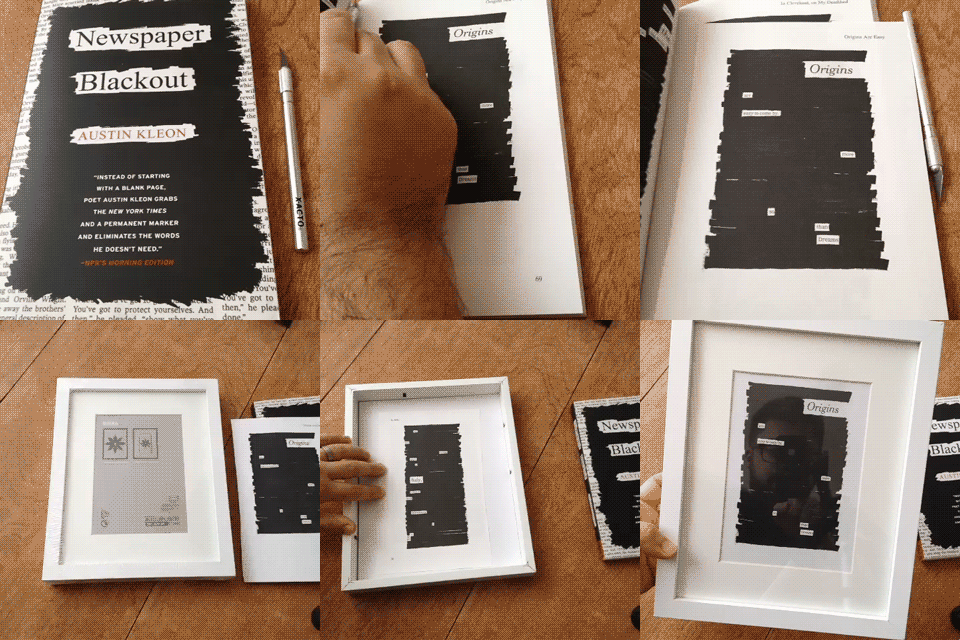
before all this Cartesian nonsense popped up, what I was really thinking about this week was the fun of remixing, oldschool. like this kind of cut-sift-paste-paint collage art I used to spend time reveling in, long ago. repurposing one thing, deconstructing and recontextualizing it, into something just a bit different. Mr. Kleon suggests such cheap cleverness in the gif above, which I borrowed (or perhaps I should say 'stole,' like an artist) from this post.

I thought it was a cool idea.
so when Kleon's Steal Like an Artist resurfaced from the box it was packed in, I set it aside and made a note to attack it with scissors at some point.

the attacking happened this evening. all the best pages from Kleon's little autobiographical advicebook are now hanging willy nilly on my cork boards, among several other repurposed odds and ends.
I like them. especially the one that says
You will need:
_ curiosity
_ kindness
_ stamina
_ a willingness to look stupid
yeah. maybe I will find a little frame for that one.

Wednesday, April 11

take a few guesses

fieldnotes, one of the sponsors for the tournament of books, decided they would send out a few prizes to some lucky people who happened to correctly predict the winning book and its score in the final championship round.

my guess (The Sisters Brothers to win 10 to 6), thrown up in the comments section without much thought, was just a guess. I hadn't read either book, I had no idea what the judges would vote. but I got lucky (much as I did a few months ago with the robotgeek folks), and not only was my guess correct--it was also chosen at random from among all the other correct guesses. and so it came to pass that I received in the mail...

{ image borrowed from these way cool people who make notebooks. }

... one of their specially created rooster notebooks. and a whole lot of other things. field notes pens. pencils. bands of rubber. steno books. a handy 2012 calendar. and a gorgeous trio of Texas field notes, from their county fair installment. on the back of these are lots of interesting Texan facts. did you know the smallest town in Texas is called Telegraph, and its entire population consists of a mere 3 people? crazy.

anyway, I guess you could say I was thoroughly flattered to win this little contest. and getting that package from Chicago last week pretty much made my evening. call me a geek. I'm okay with that. we all know Amelia loves blank paper and writing utensils. I'm only a little bit sad I didn't get a 1-inch button.

but not complaining! I have seven new little notebooks! it's wonderful.

other bits of news:

I am running away to Eastern Europe next month. it'll be a short little study abroad excursion, with one of the geography professors (whose daughter was in my bibliography class last semester). after a few weeks of thorough deliberation I decided it would definitely be worth going on. why not? it's summer. as long as graduate school is eating me alive, I may as well let it take me around the world a bit. Hungary, Romania, Slovakia, and Austria. I'm crossing my fingers we get to do something like this while we're there.

I've been thinking about blogging one of my short stories, in small pieces, once or twice a week, just for you all. but which one? I'm going to ask you, and if you have an opinion please express it to me in some fashion. here are the options (listed not by title, but by vaguely surmised subject/tone):

a. the story about the boy and his goat (quirky)
b. the story about the girl who never woke up (melodramatic)
c. the story about a solipsist princess (freakishly depressing)
d. the story about the mermaid (cold and silent)

thanks in advance for your thoughts.

Tuesday, March 6

lead me


LetterPress - Printing Kahlil Gibran from Callil Capuozzo on Vimeo.

last week, on a tuesday just as lovely as any tuesday in February ever was, this is what I was doing.

only it was here in Texas, not in Rhode Island (if any two states could be more opposite, I do not know how--not that I've ever been to Rhode Island. is it nice there?). and we were not exactly printing poetry. but aside from those technical differences, it was just about the same process. getting all the itty bitty letters to line up. filling in all the gaps (every single weirdly-shaped one. all of them) with leads and spacers and appropriate widths of furniture. tightening the quoin, everso carefully. slathering a sheet of glass with sticky black ink. rolling and rolling and rolling the ink, to get it just exactly right for inking the type... and then the most exciting bit: setting that perfect blank paper down, rolling it under the platen, and letting that press do its simple, heavy work. rolling it back out and peeling that freshly inked page away from the type-block is pretty lovely too. there's a crisp, rippling sound in it. and then you lay that page down gently and scrutinize it for errors.

we found lots of errors. proofing letterpress prints takes ages. getting the balance of the old Washington Press just right takes ages.

but the archaic novelty of it... oh, it's great. one of these days I'll take pictures of our actual letterpress lab on campus. for now, enjoy these semi-random videos that sort of evoke the experience of working in such a place. (the first far more than this last, I confess. but I do love this movie.... love love love.)


this week in 5340, our class is going to be in the lab looking at type and talking about printing presses. such an awesome little class, this has been. I still need to blog about my hand-bound book, sometime. put that on the list. (it's a long list. getting longer. I need to blog more often.)

Saturday, October 22

fourth and flint


I am in the middle of editing an index for a book about Texas wineries. when the book is ready to be published, it'll come out with our spring season--just a few months away now.

there are also checklists on my desk for two manuscripts that still need copyediting. those won't come out till next fall. right now they're waiting on our production department to approve all the artwork. (after the copyediting comes the indexing, the design, the typesetting, the proofing, the printing, the binding, the shipping, and so on. it all takes forever and ever.)

in my inbox are instructions for prepping one of our clothing/textile books book for the compositor and tagging it for a CIP request. this one is right behind the winery book, I think--set to come out sometime in the spring.

earlier this week I did a bit of research for a Finnish fellow who's working on a book about Route 66, and then spent a few days sorting invoices for the finance department, while they all worked on very important royalty-related stuff.

in the short not-even-two-months-yet that I've worked at the Press, I've coded a handful of manuscripts to be sent out to freelance editors, proofed dozens and dozens of pages, sold a few books at the cowboy symposium, met and/or emailed a couple of authors, watered some plants, answered the phones, made plenty of copies, sent a few packages, and compiled a humongous spreadsheet of manufacturing costs for all the books we've published from 2006 up to now.

now I'm editing an index. it's quite fun.

tidbits I have learned so far, from all these various assignments:
given long enough to sit on a shelf or in a file, rubber bands start sticking to paper, and breaking apart, and being useless. 
the press saves every tiny thing in files associated with each book it publishes. every email, every draft, every decision, every review, every order, every shipment.

there is a town called Pittsburg, Texas. 
copyeditors charge about $3.50 per page. 
hardcover books are usually called 'clothbound'--that seems like a thing I ought to have known before, somehow. 
we still use terms like 'compositor' and 'typesetting,' even though it's all digital these days. we also still use words like 'manuscript,' even though none of it's handwritten anymore. hrm.
I'm sure there's a lot more. I wish I could tell you all about these forthcoming books, and how interesting they are, even when you're only skimming through to add type codes, or jumping around checking the references for their indexes. it kind of boggles my mind that I am an impossibly thin slice of the pie chart of effort that goes into producing these published works. I get to see them all in different stages of unfinished, so far. and when a box full of any of these titles finally shows up in the office, each copy all shiny and shrink-wrapped, that will be a pretty cool day.