Showing posts with label goals. Show all posts

Friday, March 14

plans for a tournament of pies

a folded length of blue flannel fabric with butter sticks printed all over

we have been over my haphazard recipe cataloging skills before. did I ever think I'd need to change my habit of just sorting through a pile of recipes-written-on-the-backs-of-whatever to find the one in the handwriting of a lovely Canadian on a square-ish grease-stained piece of blank notepad paper? not really. it's a fine enough system. I know how it works.

but nevertheless, one of my current projects is to sort out all the recipes I really want to keep from the pile where they sometimes mingle with too-ambitious recipe printouts that I only thought I might want to follow someday but never have, to rewrite any that need to be rewritten, and then organize them all into proper usable sections. the fat yellow folder that used to hold them has long ago been repurposed for something else, and I've kept recipes since then in a little black binder. or in a manila folder in the cupboard. or bookmarked in my phone. it's messy.

for my last birthday, Jeremiah bought me some butter-themed fabric with which to cover the new recipe binder, as soon as I might get around to it. there are a handful of savory dinner-esque recipes to finish sorting and writing out to fit. all the more fun things like brownies and brunches and custards and pies are already done and filed in a sort-of-thematic-sort-of-alphabetical way in their sections.

pies are my favorite things to bake. my mother's pie crust recipe almost doesn't need to be in the recipe book, because I've memorized it by now and could probably mix it up blindfolded if I needed to.

and ever since the tournament of RPG books a few summers back, I've been pondering what else to write tournament-style reviews of... so why not pies? it's perhaps not quite as ambitious as this neat pie-baking project (also far less likely to get a book deal, I assume...), but pretty fun anyway.

baking sixteen pies is a lot though. and for a proper tournament experience I might need to bake the winners of opening rounds multiple times as they advance in the bracket... so... I am still not totally sure how I'll plan this out, schedule all the celebratory pie tastings, ration my supply of butter and eggs properly, and all that. but I have gotten as far as choosing eight savory and eight sweet pies which could contend against one another:

chicken pot pie,
shepherd's pie,
mushroom and barley pie,
vegetable cornish pasties,
tomato corn pie,
squash galette (this one or this one? hmmm...),
quiche (not sure what type...),
spanikopita;

and 

pumpkin,
mixed berry,
cherry,
peach,
apple,
key lime,
french silk,
banana cream.

I do not like lemon meringue so it is not invited, even if it is a very classic variety of pie.

what I haven't decided yet is which pies should face which other pies to start with. and should we narrow down all the sweet pies to one, all the savory pies to one, and have those winners face off against each other? or would it really be more fair to have them share the victory?

it hardly matters, since it's all just a silly excuse to bake and eat 1.3 dozen pies (or more) in some too-short span of time. I'll figure it out at some point and see how it goes.

today is pi/e day, which is a great day for baking pies (or for talking about math and Greek letters, a la the legendary Vi Hart-- who seems to have taken down all their great pi- and tau-related youtube videos from back in the day. odd, but I can't say I blame them). but alas, I am not organized enough yet. maybe for next year I can time everything to announce final winners on Saturday, March 14, 2026. let me know if you want to come visit and share the responsibilities of pie-judging and dish-washing with me next year.

Saturday, July 27

wheels and spindles

apparently I haven't blogged about the Tour de Fleece here yet. (you can read a bit more about this July spinning challenge event thing if you like). I've partly kinda-sorta spun along with the bicyclists in past years, but I never focused on it very well or had much of note to show for it at the end.

but this year I had the whole month as free as any summer month could be, and plenty of spinning experience and equipment and goals to work with, so I made some plans. 

seven drop spindles in various states of the spinning process 

starting with Jillian Eve's official Tour de Fleece 2024 bingo card, I narrowed her suggested challenges down to 20 that looked doable/interesting, and determined to let 1d20 pick one for me each day of the tour. here's the full list, with those the dice picked in bold and those I accomplished (whether or not their number got rolled) marked with checks + annotations. I've got a few photos of some of it, too.

1 Spin the oldest fiber in your stash (caliente red Kraemer roving)
2 Spin the newest fiber in your stash (cherry red Kraemer roving)

two colors of red wool drafted and spun together on the bobbin of my antique spinning wheel 

3 Spin outside (my back patio; the parking lot of a busy cafe one morning)
✓ 4 Spin in public (aforementioned parking lot, Fiber Creek, Sharlot Hall, various waiting rooms)
5 Spin a fiber you've never spun before (gorgeous CVM/merino blend from Cactus Hill Farm; BFL from Greenwood Fiberworks)

BFL wool dyed pink-red-green, spun and wound onto a little cross-arm spindle

6 Use a new technique (drafting two rovings together)

red wool spun to fill up the bobbin on my antique spinning wheel

7 Spin more than 1 hour in a day
8 Teach someone else to spin (hurrah for enthusiastic newbies!)
9 Spin a chunky yarn (well, as chunky as I could manage)
✓ 10 Spin a lace-weight yarn (usually my default so pretty easy for me)
11 Spin a plant fiber (glad this one didn't come up actually. I am scared of cotton)
12 Fractal spin (started this one late and haven't quite finished it yet... so it only sort of counts)
13 Spin a textured yarn (the pre-carded Finn was almost too textured, I say)
14 Spin fiber you processed by hand (just a sample of re-carded Albuquerque Finn-- but I tediously and lovingly carded all the rest of it for later)

natural brown wool batts and a small sample of handspun Finn

little drum carder with Finn-carding-in-progress

✓ 15 Spin local wool (llama and alpaca from 2 different local ranches)

drop spindle with a bit of blue-green-purple llama wound onto it

16 Ply with thread (someday I'll try this but I'm not in a hurry to)
17 Create yarn that tells a story (I am still not sure what I want this to mean. we'll see.)
✓ 18 Hold your fiber in the opposite hand (easier with the little e-spinner for some reason)

e-spinner on a messy table, bobbin half-full of brown mystery wool

19 Spin while watching a movie (La La Land. it was alright)
20 Spin while listening to an audiobook (mostly Demon Copperhead. loved it)

in case you're as persistently curious about abbreviations as I am, CVM stands for California Variegated Mutant, a highly regarded and unique breed of American sheep. slightly less interestingly, BFL stands for Blue-faced Leicester, another highly regarded breed of sheep, from the UK. 

it took me a bit longer than the official tour to get anything finished, but that wasn't necessarily part of my game. I'm happy to have tried some new things and stretched my spinning skills in a few different directions. and I have every intention of continuing. who needs the excuse of a cycling tournament going on?

next goals:
finish the 4-ply alpaca (just needs washing and measuring)
wind off the CVM spindle soon-ish
finish the fractal BFL sample
ply the second half of a commissioned spin for Rose
spin more blended red (get 3 bobbinsful at least)


P.S. I also spent a decent chunk of the month working on this fun addition to my spinning arsenal. if I can figure out how old she is I'll see about naming her after another suitable ancestor of mine.

Friday, June 10

pixel art (but not)

two pugs lying on a blue rug, the bigger/closer one with more white fur than the other

this week's main project: 

preparing to cross stitch a photo of our pugs, for a frame or a little stuffed pillow or some other keepsake.

after getting back into cross-stitch a little bit last year, I initially thought about using one of our wedding photos to make a big anniversary piece or something.

much more fun and less self-conscious creating sepia-toned art from a photo of pugs.

pixel-esque print-out of the same photo as a cross stitch pattern

I've trimmed my aida cloth, marked out a border, and acquired most of the floss that I need. it'll be exciting to start this. hopefully it doesn't take multiple years to finish the 9 x 6 piece.

Wednesday, June 1

lines from history (or, happy pride month)

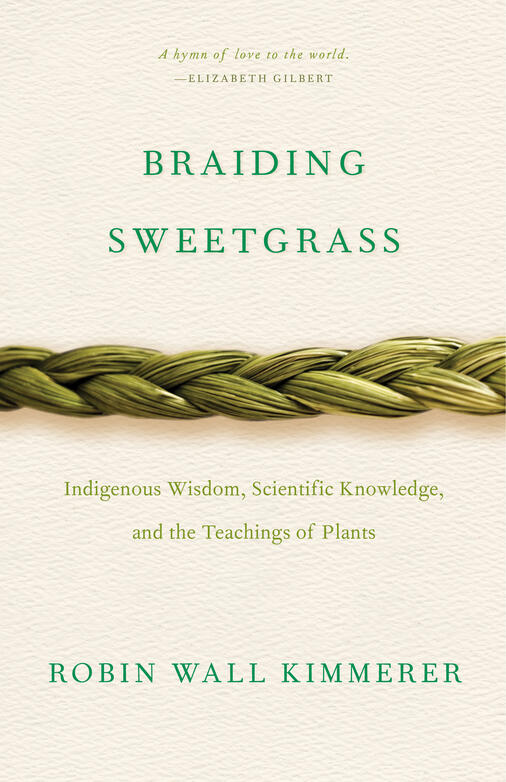
last summer I was quite enamored of Robin Wall Kimmerer's Braiding Sweetgrass. so much of it resonated with elements I hope are part of who I am and plenty that I hope will eventually be part of who I am.book cover-- Braiding Sweetgrass

this is one of the former bits-- "My natural inclination was to see relationships, to seek the threads that connect the world, to join instead of divide." (Kimmerer, p. 42)

how are people, places, things, and ideas like other people, places, things, and ideas? how much can we commune, however briefly, with even the furthest-flung perspective?

I find it fun to connect things that don't seem (to most people) like they go together, just as much as to notice connections among things that do. juxtaposition is a useful direction for thinking. mash this with that, just to see what might happen. some of the weird combinations might not work for everyone. or some of them could be like tuna fish with pears. 

today, I finally finished up the audio edits for the last section of my Librivox recording of Angelina Grimké's Letters to Catherine E. Beecher, in reply to an essay on slavery and abolitionism. the collection was published in 1838, the same year Grimké got married to someone named Theodore Weld (also an abolitionist and writer-- maybe I'll read a Librivox version of his 1839 collection American Slavery As It Is: Testimony of a Thousand Witnesses sometime?)

so 1838 and 1839 must have been busy years for Grimké. but most of the letters are dated the year before that, 1837. 

that was 185 years before this one. almost five of my lifetimes ago, so far.

the penultimate letter, Letter 12, was one of my favorites of this little audiobook-to-be. it is so timeless. along with her abolitionism, Grimké wrote ardently about feminism, women's suffrage, and equality on all counts. race, gender, whatever-- all human rights should apply to all humans. 

none of her sentences out of context are as powerful as they are stacked together in this letter, but it seems silly to paste the whole thing here when you can more easily go read it yourself via Gutenberg.org (or wait a few days and then listen to it via Librivox.org, either way).

so to compromise, I will abridge the letter as best and as meaningfully as I can, keeping in what has been most impactful and resonant to my 21st-century brain. and then, carrying on in my own 185-years-later mode of asynchronous discourse, I'll add a few comments.

...The investigation of the rights of the slave has led me to a better understanding of my own. I have found the Anti-Slavery cause to be the high school of morals in our land—the school in which human rights are more fully investigated, and better understood and taught, than in any other. Here a great fundamental principle is uplifted and illuminated, and from this central light, rays innumerable stream all around. Human beings have rights, because they are moral beings: the rights of all men grow out of their moral nature; and as all men have the same moral nature, they have essentially the same rights. 

.... When human beings are regarded as moral beings, sex, instead of being enthroned upon the summit, administering upon rights and responsibilities, sinks into insignificance and nothingness. My doctrine then is, that whatever it is morally right for man to do, it is morally right for woman to do. Our duties originate, not from difference of sex, but from the diversity of our relations in life, the various gifts and talents committed to our care, and the different eras in which we live.

This regulation of duty by the mere circumstance of sex, rather than by the fundamental principle of moral being, has led to all that multifarious train of evils flowing out of the anti-christian doctrine of masculine and feminine virtues. .... Hitherto, instead of being a help meet to man, in the highest, noblest sense of the term, as a companion, a co-worker, an equal; she has been a mere appendage of his being, an instrument of his convenience and pleasure, the pretty toy with which he wiled away his leisure moments, or the pet animal whom he humored into playfulness and submission. Woman, instead of being regarded as the equal of man, has uniformly been looked down upon as his inferior, a mere gift to fill up the measure of his happiness. .... 

Measure her rights and duties by the unerring standard of moral being, not by the false weights and measures of a mere circumstance of her human existence, and then the truth will be self-evident, that whatever it is morally right for a man to do, it is morally right for a woman to do. I recognize no rights but human rights—I know nothing of men’s rights and women’s rights.... 

If Ecclesiastical and Civil governments are ordained of God, then I contend that woman has just as much right to sit in solemn counsel in Conventions, Conferences, Associations and General Assemblies, as man—just as much right to sit upon the throne of England, or in the Presidential chair of the United States.

Dost thou ask me, if I would wish to see woman engaged in the contention and strife of sectarian controversy, or in the intrigues of political partizans? I say no! never—never. I rejoice that she does not stand on the same platform which man now occupies in these respects; but I mourn, also, that he should thus prostitute his higher nature, and vilely cast away his birthright. I prize the purity of his character as highly as I do that of hers. As a moral being, whatever it is morally wrong for her to do, it is morally wrong for him to do. ....

Thou sayest, ‘an ignorant, a narrow-minded, or a stupid woman, cannot feel nor understand the rationality, the propriety, or the beauty of this relation’—i.e. subordination to man. Now, verily, it does appear to me, that nothing but a narrow-minded view of the subject of human rights and responsibilities can induce any one to believe in this subordination to a fallible being. Sure I am, that the signs of the times clearly indicate a vast and rapid change in public sentiment, on this subject. Sure I am that she is not to be, as she has been, ‘a mere second-hand agent’ in the regeneration of a fallen world, but the acknowledged equal and co-worker with man in this glorious work.... Then will it be seen that nothing which concerns the well-being of mankind is either beyond her sphere, or above her comprehension: Then will it be seen ‘that America will be distinguished above all other nations for well educated women, and for the influence they will exert on the general interests of society.’

I can't know what Angelina Emily Grimké would think about the power and influence of women in American society today. hopefully she'd be a little bit gratified, grateful, impressed by how far we've come.

from reading 13 small letters of hers (and maybe a speech or two in an old rhetoric textbook ten years ago, maybe), I really don't know what Grimké would think about trans and non-binary folks, but from her emphatic defense of human rights not being based on gender, I would like to assume she'd be cool and inclusive. she spent her life advocating for the suffering and marginalized in her world. she'd probably do the same now, in whatever ways she could.

progress pride flag-- white pink blue brown black and rainbow colors

here's to making and seeking relationships, connections, and love-- more and more every single sweet day.

Sunday, April 10

warm weather and vulnerabilities

I love being barefoot.

I love the feeling of clean carpet or tile or concrete under my feet. love walking on cool grass or warm sand or slick mud.

thankfully Arizona gives us plenty of good being-barefoot weather, overall. I avoid socks at all costs unless I'm jogging or hiking in actual shoes.

being-barefoot weather is upon us for good now. spring! summer break mere 3 weeks hence!

it's exhilarating and intimidating, the idea of summer. I won't be teaching. what will I do? how will I choose between all the crafts and writing and projects and excursions and naps I want to fit in? 

maybe I can figure out a way to do it all. (there was a pretty cool podcast episode from Maisie Hill about that, just last month.)

we shall see.

first I need to survive the semester and all its grading, meetings, lesson plans, presentations, and commencement shenanigans. 

I will. we all will. all 97 of my students and I and my colleagues too. 

somehow.

ink sketch: a small roast turkey, a larger apple, an even larger hourglass

April is national poetry month, isn't it? 

I'm not a poet-- not really. but sometimes my brain thinks very poetically.

I like to read poetry. 

even more I like to hear poetry read aloud. seeing it on a page isn't quite good enough usually.

this poem, "The Hill We Climb," from a whole fifteen months ago, is a good and grand tear-jerking hopeful poem to listen to. 

to read it silently-- well, it might still be good. or it might seem long and uneven, or as the post I linked to just there has it, too dense.

what are the best parts? it is hard to choose. and pasting them here won't do any justice to how they sound in Amanda Gorman's own voice.

listen and watch the whole thing first:

and now, here are the most moving sections for me-- these three from near the beginning, middle, and end:

We’ve learned that quiet isn’t always peace, and the norms and notions of what “just” is isn’t always justice.
And yet the dawn is ours before we knew it. Somehow we do it.
Somehow we weathered and witnessed a nation that isn’t broken, but simply unfinished.

and

So, while once we asked, how could we possibly prevail over catastrophe, now we assert, how could catastrophe possibly prevail over us? 

and the last few lines, singed with cliche just at the edges--

When day comes, we step out of the shade of flame and unafraid. The new dawn balloons as we free it.
For there is always light, if only we’re brave enough to see it.
If only we’re brave enough to be it.

maybe I ought to go looking for more of Ms. Gorman's poetry.


for the record, I've been reading various other non-poetry lately, including:

The Echo Wife, by Sarah Gailey  (not the winner of this year's Tournament of Books)

Poet Warrior, by Joy Harjo (recommended via yoga church friends)

Trigger Warning, short stories by Neil Gaiman

The Marvelous Clouds, by John Durham Peters

and 

A Primer for Forgetting, by Lewis Hyde (the same one who wrote Common as Air, which I managed to cite in my dissertation) 


here's to springtime and reading and being barefoot as much as possible. 

Friday, January 29

I, pedagogue (spring semester, 2021)

back in the day, I thought I'd never want to teach. and then I realized that in some ways, everything everyone does can involve a layer of teaching somehow. even if it's a very subtle one.

even still, for these past seven years of wading deeper and deeper into teaching college writing classes of various kinds, the real practice of teaching (with all the planning and record-keeping and decision-making and performing and grading and authority-wielding it typically requires) has not often been my favorite part of academia. it's fine. but it's hard. and I never feel very good at it, so it simply can't be as naturally rewarding as all the other corners of academia where I feel far more skilled.

for better or for worse, my two full-time assistant professor jobs so far have been quite teachingcentric. twelve credit hours of teaching every semester, plus a few during summer semesters, until this year. dozens and dozens of students show up in August or January or June for whichever iteration of professional writing I'm teaching this time, working and sharing and hopefully learning, and then they disappear again.

this year, I have one course release for being brand new in town. it gives me a chance to get used to things a bit.

they also gave all the new faculty a copy of the book What the Best College Teachers Do, by Ken Bain. a few colleagues and I read through it together last fall semester and talked about ways to apply the findings in our own classrooms.

the book and our little faculty discussion group made me think much more intensely about my teaching than I've cared to thus far. it also gave me some concrete hope that maybe I can become better at this thing I don't feel very expert in at all. 

so. what am I trying to do a little better this spring? what have I begun to internalize from Bain's research?

possibly more things than I can articulate very well in a little blogpost. but here are a few:

> talk about your own learning journey with students. model or reenact the kinds of transformation you hope that they will undergo as a result of your class.

> trust students and treat them like whole humans with a million shifting priorities, just like you. this is something I already knew and practice decently, I think. but I took particular comfort in it this past year. my course is a small droplet in the ocean of everything these students are trying to learn and become. if my teaching isn't perfect, they probably won't notice or remember for too long.

> ask students big, meaningful, authentic questions--the kinds of questions that professionals in your field will ask and try to answer. (this is particularly tricky in writing because writing, for most people, in most important contexts, isn't very often about itself. its actual subject is the everything else that we write and communicate about.)

I think I do pretty well being authentic and open and compassionate as a teacher. but I have been guilty in the past of assuming students could never be all that interested in the big questions that I study. we don't have time for that, do we? especially at a fancy aeronautical university where nobody is an English major and everyone mainly wants to design or build or test or fly airplanes and other such contraptions-- how could any of those students care about a communications course?

but if Bain is to be believed, the enthusiasm of a teacher combined with the sparks of a big, meaningful question can draw students in, motivate them a little, even if they didn't think they'd care very much about a communications course. 

and I can be good at questions, surely. 

especially big ones! like: how do you know what anyone means? how do you know what anyone else thinks you mean? how people really ever understand each other enough to make good things happen in the world? and what does it mean to read? to write? or to do those things effectively?

the trick now becomes figuring out how much time to spend getting philosophical about definitions inbetween all the more "practical" work of practicing reading and writing and revising and all that. I still think students learn most from doing things, more than they can from reading about things or discussing them or whatnot.

but anyway, I added this little linguistics video to my list of assigned readings. I opened the first day of class reading from Celeste Headlee's book We Need to Talk, which recounts the tragedy of an ineffective conversation in an airplane cockpit. in technical writing we spent the first day exploring informal crowdsourced technical descriptions on Reddit.

and when I listened to this recent episode of So Many Damn Books with George Saunders I felt more affinity for Saunders's love of teaching writing than perhaps I might once have felt. his advice is to remember that you're never just teaching 20-somethings who barely know what to do with their adulthood when you meet them-- you're also teaching the 40-something-year-olds that they'll become. I like that. (not all college students are 20-somethings, but the concept holds. we are all humans-in-progress.)

maybe I'll go back and give the Pedagogue podcast another chance, too, now that I feel more hopeful and less grumbly about this whole teaching business.

Thursday, July 30

August aspirations

goals, of a sort, for the last two weeks of summer break:

sewing. last weekend I cut out pieces for two sundresses and picked apart a long skirt to transform into a third sundress. I also have some trousers to mend and probably a few other random small projects too.

reading. I'm still working my way through the Audre Lorde collection from the library. I also have five tabs open right now that need the attention of my reading brain. (there are usually much more than five, but I'm trying to be realistic and abandon any that have been open for more than a week; I know deep down I won't get around to them anytime soon after all.) one of those tabs is this article, which I've read already but want to plan on rereading every semester for the rest of time, as a reminder that however lazy or unmotivated students may seem, it's more complicated than that. if there's time, I'll also fit in some more short stories from Tor.com, one of the most useful online venues for new and intriguing short fiction that I've come across.

seeing the Grand Canyon. I haven't visited this landmark since I was fourteen, I think. we're just going to make a day of it. drive two hours north. bring snacks. take photographs. indulge in a moment or two of reverence for nature and its grandeur.

writing. even after this month of blogging-every-day is over, I have chapter revisions to work on for an edited collection on user experience research. I have letters of recommendation to write. there are also a few more editing projects to tidy up in the coming weeks, not to mention syllabi and lesson plans. will there be time for fun writing, too? I hope so.

gaming. I completed my second playthrough of Horizon Zero Dawn not long ago. only one irritatingly difficult hunting task was left incomplete. I'm now working on Detriot: Become Human-- a unique sort of game where almost all the choices you make change how the rest of the game goes. yeah, it's got problematic elements, but it's also thought-provoking and intense, which is interesting to me.


of course at some point I also should probably figure out how I want to arrange my new office-- not that I'll be there that often, since in-person office hours are prohibited this semester-- and make sure I'm as ready as possible for teaching three hybrid face-to-face technical/professional writing courses. it's a lot.

but two weeks is also a lot. fourteen days or so. more than three hundred hours. not counting the hundred-ish I'll spend sleeping, that's an abundance of time. hopefully I end up happy with how I use it all. even if I don't officially accomplish all the things I'm presently imagining I might.

Monday, July 27

editing work and so-called "educational technologies"

it's not the most important volunteer gig in the world, but I am on the official Board of Copy Editors for a scholarly journal in the field of social work.

see? (I still need to have them update my institutional affiliation, I know. soon.)

the article I'm editing now is about perceptions of social work and advocacy organizations in Ireland. it's pretty interesting. part of the fun of this position is getting to dip my brain into current scholarship from another field, from lots of other perspectives. one of the pieces I previously edited was all about volunteerism-- something not unrelated to my own scholarship.

today I've been combing through this forthcoming article's reference list, checking for completeness and formatting. like most social science journals, this one uses APA style, which I'm thankfully pretty familiar with.

my editing process can be a little haphazard for a project like this. but generally it follows these broad strokes:

1. read through the piece once and make notes about persistent issues or anything else that stands out, tidying up a few of the easy things (commas, spelling, other punctuation) along the way
2. check that everything listed in the references is actually cited in the text, and vice versa (this is something I learned from Dr. Hawkins as part of her teaching in Bibliography & Research Methods many years ago)
3. attend to citation formatting (all the periods in the right spots, capitalization as APA dictates, and so on)
4. make sure all the headings and subheadings are styled properly (and I'd usually check tables and figures here too, but this particular article doesn't have any)
5. draft a makeshift style sheet for any judgement calls I get to make about hyphenation or capitalization of terms (these are always really informal sticky-note things, if that)
6. go through again, adding queries for the author where needed, making decisions and changes for the major issues previously noted, watching for consistency and fluency at the word- and sentence-level.
7. spot check one last time for the things on the style sheet, review the queries and comments to make sure they make sense, and then send the whole thing off after appending my initials to the filename.

if it's work for hire, I'll prep an invoice and send that along with my edits. I've done a huge amount of editing for hire this summer, it seems like. dissertation proposals, articles about orthodontics, computer graphics, and GPS, and even several book chapters about analytic software programs. but for this particular job I'm only getting paid in collegial respect and academic clout. it makes a nice line on my CV and boosts my ethos as a person with practical, ongoing experience editing. plus, I enjoy it.

there's about a day or two more of work left on the piece. the references and headings are sorted, so all that's left, roughly, are steps 5 through 7. from this point on, I shouldn't need to keep opening and closing the section on APA style at the Purdue OWL. it's down to the less tedious part of the job now. I could, I know, be a lot more meticulous about how I approach the work and how I track the time I spend on it. for now, this is what works for me.

the tedium of citation-tidying, I'll add, is pretty pleasant tedium. actually one of my favourite things about editing scholarly work like this is replacing all the default hyphens with en-dashes in all the page ranges of the references that have them. APA doesn't strictly care about that detail, but the beautiful differences between hyphens and dashes were irrevocably drilled into me back when I worked with the more comprehensive Chicago style at Texas Tech University Press.

style guides like Chicago and APA and resources like the OWL that grow up around them all count as educational technology, don't they? sure, the term is burdened with connotations of electronics, computers, digital connectivity, and such, but books are technologies too. I'd count these guides' paper-based versions as technologies just as much as I'd count their websites at https://www.chicagomanualofstyle.org/home.html and https://apastyle.apa.org/.

the Purdue OWL has always been a website, though its offline home, the regular Purdue Writing Lab, predates it by almost twenty years.

educational technologies. any technology that serves a process of education, right? well, one would hope.

about a year and a half ago, the dear Purdue OWL entered into a partnership with a purveyor of so-called educational technologies called Chegg. shortly thereafter, citation generator banners appeared all over every page of the OWL, offering quick and easy auto-citations in MLA or APA style. I reacted with great disappointment and irritation at the time. and so did plenty of other people.

since then, the powers-that-be over at the OWL have toned it down a bit. the citation generation tools are still there, but not on every single page. still, it feels odd. one tool, the OWL, gives students valuable reference information and examples and helps them learn to apply that knowledge in their writing. the other just black-boxes it all away and says, more or less, "trust us, we'll handle it, you don't have to think too hard. or at all."

I guess there are probably times when not having to think too hard about some process or technology is perfectly okay, but in academia? it seems thoroughly wrong. this kind of thing doesn't really serve education. does it?

such over-reliance on technology goes beyond students, too. a related "educational technology" here is plagiarism-detection software like Turnitin and other such tools. these companies give lip service to academic integrity and education, but their true goal is profit. they're invested in manufacturing some kind of vague ethical crisis so they can sell software subscriptions.

using software to catch students "cheating" is not education. it's barely relevant to education by any stretch of the imagination. and if you have to rely on such tools to figure out if your students are cheating on their writing assignments or not, then you haven't given your students or their writing enough of your attention, and you haven't designed very good writing assignments.

what has bugged me most about Turnitin and the like is the fact that it copies piles and piles of student work for its own databases and uses those copies as a core part of its function. and I suppose they think that because their terms of service say this is all perfectly fine to do, it is.

I say not. if students had any real choice in the matter, then maybe. but given the power dynamics of your typical college classroom, they don't. if their professor says upload your work via this tool, then students are more or less forced to do so, whether or not they care about the implications.

copyright is a whole mess in itself, but any logical understanding of intellectual property should acknowledge that students own their creative work, even within the relatively convoluted confines of formal education. for a third-party technology company to copy that work and profit from its application is pretty clearly unfair. unjust. messed up. all because some teachers are so worried about cheating they're willing to outsource part of their job to a for-profit company rather than design more robust assignments and trust their students half an inch.


for further reading:


Monday, July 20

more listening

what and who do you find easy to listen to vs. difficult to listen to? I've had reason to ponder this lately, mainly with regard to diversity and tolerance and such. but of course, as I tend to do, I'm getting broad and philosophical about it.

my favourite things to listen to include:
- rainfall
- string instruments
- well-structured podcasts while I'm working with my hands
- chill, lyric-less music while I'm working with my brain
- husband Jeremiah playing the guitar
- vegetables sauteing or sauce simmering on the stove
- soft, gentle pug snoring

there are probably many more that I can't think of right now, too.

sometimes there are voices I get really sick of hearing, or that I'm impatient about listening to. I tell myself that it's not because of the voice itself, but some quality in it or some context around it that makes it insufferable. the ponderous, over-thoughtful droning of too many academic podcasts. the hyper-critical griping of various YouTube reviewer guys. or the two-dudes-talking podcasts that for whatever reason can't seem to edit out even a shred of their blathering (ahem).

I have limited time in my life. I can't be expected to truly listen to everyone. being picky is not a bad thing.

but lately I'm thinking listening as activism. I'm thinking about who we listen to as a crucial moral and political choice. (it isn't always that, I hope, but it can often be that. the personal is political, they say.)

part of what sparked this thinking of late was my slowpokey journey through the Me and White Supremacy workbook. I've been going through each chapter, journaling as earnestly as I can about each prompt (me and tone policing, me and white superiority, me and white silence, and so on). along with a few of the prompts there are a videos from the workbook's author, uploaded back when the book was still just a daily instagram challenge. and the videos are long. some of them are over an hour long.

listening to a stranger talk to me for that long (and about a subject so potentially touchy, at that) takes some discipline. focus. commitment.

in the first section of her book, Layla Saad has said as much. love, truth, and commitment: we won't get through this workbook and its work without those things. and I feel like I need to re-read that section of the book every other day, to help me keep going and stay committed as the discomfort of unpacking all the ways I'm steeped in white supremacy soup intensifies.

listening to a voice that's so different and so passionate isn't easy. the videos that go with the book aren't totally unscripted, but they're conversational. they're personal. it is so easy to say I don't have time for all that.

for me, putting off this set of intense, fine-grained confrontations is convenient. I have every excuse to put it off for next summer or the summer after that, and very little pressure from the outside world to stick with it.

but... as Ms. Saad writes, in address to white people like me and almost everyone else I have ever closely interacted with,
"Whether or not you have known it, [white supremacy] is system that has granted you unearned privileges, protection, and power. It is also a system that has been designed to keep you asleep and 'unaware' of what you having that privilege, protection and power has meant for people who do not hold white privilege. What you receive for your whiteness comes at a steep cost for those who are not white. This may sicken you and cause you to feel guilt, anger and frustration. But you cannot change your white skin colour to stop receiving these privileges, just like I cannot change my black skin colour to stop receiving racism. But what you can do is wake up to what is really going on, challenge your complicity in this system and work to dismantle it within yourself and the world."
there are things I can't change and things I can change.

maybe I can't change my basic inclinations to choose Margaret Atwood's The Testaments off the digital library shelf instead of buying the more 'experimental' Girl, Woman, Other by Bernardine Evaristo's from an airport bookstore. but I for sure can reconsider those basic inclinations and push myself and my brain to include more non-white voices more often. even if (perhaps especially if) those voices seem strange to me.

in this vein of feeding myself more Black voices, I requested some Audre Lorde from the local library the other day. I mostly wanted to read the oft-recommended Sister Outsider, but the copy I found of that collection also included two other works of hers: Zami (semi-autobiographical loveliness) and Undersong (poetry and such). the blurb on the back cover about Zami, the first of the trio, didn't sell it in a way that grabbed me. but as everyone should do with any book they happen to find in their hands, I read the first few lines of it anyway. and it is loveliness. lyrical, thoughtful, evocative, full of allusion and depth and feeling.

previously, the only Audre Lorde I'd ever read was in an Argument Theory class during my first round of grad school: "The Master's Tools Will Never Dismantle the Master's House." (it might actually have only been a section of it; mainly I remember that we discussed-- fitfully-- whether or not one could discuss an argument's structure and effectiveness without discussing the argument's content). I'm looking forward to reading more of her.

I will keep reading and listening to Layla Saad, too. I've also added the more-conversational-than-I-usually-want-to-tolerate Pod Save the People and the deeply educational and impressive 1619 Project to my podcast queue. is it enough? who knows. it feels like barely, barely enough to be beyond tokenism. it's not likely to be enough to thoroughly crack through all the ways I've been conditioned to prefer and validate white voices over any others.

Tuesday, July 14

six pounds of salted butter

about three weeks ago, the store brand of butter was on sale. so I bought six boxes.

and then I realized most of it was salted instead of unsalted. meh. 

but half of it has been used for pie crust by now anyway. some pie crust dough is still in the freezer, and some has been baked into quiches and veggie pot pies. next up: a beet, goat cheese, and kale galette. 

eventually I'll make a dessert with some of the pie crust, instead of all this savory stuff. I have had my eye on this strawberry cheesecake ice cream pie ... but it calls for graham cracker crust, not pastry. perhaps this one instead? it looks like it could do a good job as the consummate dessert pie of the summer.

any other suggestions? favourite summer pie recipes?

{ yes, I intended the title of this post to echo the best line from the 1985 movie adaptation of a specific moment from chapter 25 of Anne of Green Gables, in case you were wondering. }

Saturday, July 4

vengeance vs. leverage

an old facebook friend of mine, a few days ago, shared this Martin Luther King Jr. quote about the inability of violence to bring peace.

I was tempted to respond in a comment, something like "I hope you're using this to denounce all the terrible police violence and other terrible racially-motivated violence in the world, rather than as a shallow move to discredit some or all of the protestors who are speaking out against that violence, just because their response makes you uncomfortable."

but I didn't.

I've only been to one protest event in my life. it was at the end of 2014, during Dr. Jenny Bay's grad seminar on gender, rhetoric, & the body. Dr. Bay suspended our class meeting that day for anyone who wanted to go march, and despite my general hesitance to be seen making any kind of fuss at all, I left my books in my office, joined my peers, and marched. chanted (not loudly). laid down in the street in my red winter coat. listened to others' impassioned speeches and pondered in my highly introspective way what all of it meant.


that was a long time ago. I don't remember everything about that cloudy Indiana winter day but I remember one of the chants:

no justice, no peace.

if violence cannot bring any lasting peace, as MLK has said... well, neither does injustice.

if I ignore the violence and injustice that others experience, that doesn't mean it doesn't exist.

there are plenty of parallels between lyrics from Hamilton and the happenings of now. it's such a rich and tightly-woven work of art that you can look into it for insight and inspiration every morning for the rest of your days, never running out of reminders about what's difficult and crucial and powerful and beautiful about life. the closing number alone! "when my time is up, have I done enough?" it's gorgeous and it's full of heart-wrenching provocation like that.

yesterday we, along with the rest of the internet, watched the Disney+ release of the Hamilton film (thanks to friend Kay who shared her account info with us for the occasion).

these lines from "My Shot" stood out a little bit extra to me as I watched the protagonist take up a place on the soapbox and monologue:
And? If we win our independence?
Is that a guarantee of freedom for our descendants?
Or will the blood we shed begin an endless
Cycle of vengeance and death with no defendants?
I don't think most of the protests going on today are about vengeance. thankfully. and thankfully most of them aren't violent protests either.

there's another thought-provoking line on independence later on at the end of Act I, too. the exchange between Burr and Hamilton before the latter goes on to write a large portion of The Federalist Papers:
Burr: The constitution’s a mess
Hamilton: So it needs amendments
Burr: It’s full of contradictions
Hamilton: So is independence.
and so it is. independence is a neat idea. but we're also all connected. we all depend on so much outside ourselves. what "justice" and "freedom" really mean is a whole other set of questions, I admit. but we have to start somewhere. admit that not everyone is treated so equally as our Declaration of Independence implies they should be. stop ignoring that inequality just because it mostly doesn't affect us. start somewhere. change your perspective. change the way things are.

or at least try.

Sunday, May 31

summer is for being outside


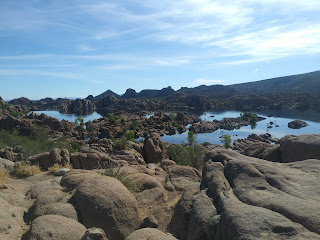
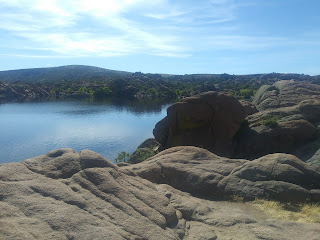
they call this piece of geography The Granite Dells. from a distance, the rock formations look like orange mounded towers guarding the water, huddling together in confident solidarity.

we currently live less than three miles from this gorgeousness. every time we drive within view of it I gape at how striking and beautiful it is. how grateful and happy that view makes me.

on Wednesday we went wandering around some of the trails out there. there were lizards scurrying about, and we saw a few rabbits. also a disc golf course, but that's not as cool.
someday we'll find a canoe to borrow and spend a day out on Watson Lake, hopefully not getting sunburned.
someday we'll plan a weekend of camping somewhere out here in this beautiful desert, whenever the National Parks decide to open their campgrounds up again.

Friday, December 20

commence contentment

it feels like I used to have so much to say. I was just ambitious enough to be confident enough to recognize all my self-doubt and still ignore it.

is ambition something you grow out of? it does seem easier to have when you're young--when you haven't yet heard so much of what other people have said or thought or done, the world feels so much more ripe and open for everything your little human brain could possibly imagine into it.

and then you grow up, and get tired, and everyone around you and before you is doing so much already. how can you keep up?

I know it's a bit silly to worry about keeping up. I'm in my own lane and it isn't a race anyway. 


today I attended fall commencement at NSU. gymnasium full of chairs, lots of bright purple, congratulatory speeches, cheering, decorated mortarboards, lines and lines of accomplished humans, etc. the music was gorgeous, too--a string quartet and a vocal quartet performed excellently during the processional, the anthem, and the alma mater. I came away from it all thinking about the value of letting yourself appreciate things as fully as possible. that might become my mantra for 2020: appreciation.

I never attended my own college or grad school commencements. I probably didn't miss much, really. it just now so happens to be part of my job to go and sit with the other faculty and applaud on cue. it's nice to feel like a part of something and to pay attention to all these students' achievement.

the speaker this year was Denise Lewis Patrick--prolific writer, Natchitoches local, and 1977 alumna (she has a blog too, such as it is). I appreciated her talk for its down-to-earth encouragement and its brevity. she spoke about all the post-college things she'd learned--about people, organizations, and changing technologies. she promised today's graduates that they would similarly need to learn many new things, no matter how prepared they might feel for their futures.

feeling prepared might be a little overrated, anyway. how much ambition does a person really need in their life, after all? I might be just fine with a little contentment now and then and a decent supply of curiosity.

Saturday, August 18

muscle memory

this song by the singer-actor-musician-person Hilary Duff seems to play every time I stop at the local grocery store. you can listen to it over here if you don't remember how it goes.

I, somehow, remember it pretty well now that I keep hearing it.

even on first re-hearing it a few weeks ago, it astonished me how deeply and fully I recognize and remember this song. this song from 2003 that I don't have particular memories connected to or anything. as far as I remember, it was just popular back then. on the radio all the time.

and now it seems to be on all the time again. or the grocery store has limited music on rotation. who knows.

does anyone still listen to music on the radio?

lately I have been biking around town and to campus a little bit. around the neighborhood for exercise. across the river for lunch.

the feeling of being on a bike in a small college town takes me back to the early 2000s in a way similar to the lyrics of "So Yesterday," but it is much less surprising that this happens. muscle memory is supposed to be deep. riding a bike is supposed to be unforgettable.

as a Purdue student, I think I biked to campus a total of six times the whole five years I was there. West Lafayette had too many steep hills in it.

Logan, Utah also had some steep hills (like the one this building sat on), but I was younger back then and it wasn't so hot and humid all the time either.

as an undergraduate, too, I had particularly limited choices about transportation. unless the car-owning people in my life were willing to offer rides, I had to bike or bus or walk myself everywhere. and thankfully there were wide roads and sidewalks and plenty of space for all those things. and free buses, too. (I miss a good handful of things about Indiana now that it's almost 2 months since we left it, and the relatively sleek public transport is among that handful of things.)

the feeling of being on a bike is a somewhat precarious feeling. balancing. weaving. it's familiar, but my muscles and my breathing are still readjusting.

a new fall semester always requires readjusting. remembering, but also putting away the past to face new things. it probably feels more precarious than it really is.

Thursday, September 21

must be seen as

I have been wanting to write something about this newsworthy mess that unfolded in Virginia ever since it happened over a month ago. but what to write? and why? and why now?

my thoughts have needed time to percolate. I still don't know if they are done percolating. is there an ideal thought-percolation time? is there a point at which you have thought enough about something? I kind of don't think so. but probably it depends on what your thinking-goals actually happen to be. are we thinking to do something, or solve something, or...? usually I am thinking for the sake of it, and in that case there is never enough. but I usually have to stop at some point, because only so many things can fit into the whole percolation.

more and more thinking about Charlottesville would also need more and more data about Charlottesville. and while I've been able to get some, there is no way to get it all. I wasn't there. what I have to think with are observations and thoughts that other people have written down on twitter and facebook and other internet spots. such places become the avenues by which I find my news and my sense of newsworthiness. there is so much room in the world for so much news these days. so many stories and voice. this twitter-essay is less directly related to the Charlottesville mess, but it's a story and a message I keep thinking about.

to supply my brain with more informed view, I could, I suppose, listen to more newsy podcasts. or watch some more newsy videos. the podcasts I tend to put on while I wash the dishes are more ponderous, less newsiness. although, in the way of timeliness, 99% Invisible did recently re-run this Memory Palace episode about a statue of Nathan Bedford Forrest.

I don't know if there are any confederate monuments in Indiana anywhere. there is this place, though, just up the road a bit. though it fits the theme of memorials to dead white guys who participated in the general ruination of many, many non-white guys, I don't think anyone is likely to get all enraged about it. I'm not sure though.

it's difficult to think about the complexities of causality and blame. I wonder quite often, what good does blame do? what use is it to spend so much time investigating the precise sources of evils and ills and wrongs and badness, even if we are able to figure it out? does investigating it all make us think we will have any control over the wrong?

maybe just knowing is control enough, in some way. however complex and impossible, we have to try to make things less bad, if we can, right?

sometimes it's hard to see how. sometimes it's easier. sometimes listening is enough. and sometimes listening isn't even that easy.

I've been listening to a few new podcasts lately. Malcolm Gladwell's pet research-and-thinking-aloud project Revisionist History has been a mix of interesting and meh. this very first of the episodes struck me--it's about art and snobbery, patriarchy and sexism, and the concept of "moral licensing." go listen. learning about moral licensing was worth it despite Gladwell's rambling self-important tone.

moral licensing. a justification for keeping all our old and toxic ways of thinking because we spent a little time poking a hole or two in their edges.

so much to think about. I've also been reading a little from a book called Intersectionality. the chapter on how educational institutions play various roles in perpetuating injustice has been thought-provoking for me, now, as I consider my future as a small piece within larger systems of educational institutions. my favourite part of Intersectionality was a quote from Audre Lorde.
"Difference must be not merely tolerated, but seen as a fund of necessary polarities between which our creativity can spark like a dialectic. Only then does the necessity for interdependence become unthreatening." (qtd in Collins & Bilge, p. 169)
necessary polarities. necessary and productive difference. no consensus, no flattened-out unity. difference. to see difference differently changes it. is that what Lorde means? that what might be threatening to us if we resist will transform into a beautiful, wonderful thing is we'd just learn to see it that way?

or is it actually that the threat was all in our heads to begin with?

I'm not sure who the we is. hypothetical we. everyone we.

or me and you. maybe. partly.

and then there is the whole paradox of tolerance to grapple with. what belongs in this world we are creating, and what doesn't? what things are okay, and what things are so bad we shouldn't even look at them? think about them?

Monday, December 19

among other small beauties

a Monday. the first Monday of winter break, post-finals-week.

everything seems quite disorganized. I should be writing, revising, Librivoxing. my to-do list is a frayed tangle, pulling me in a dozen unproductive directions.

I should be writing. drafting a proposal for this and thinking of ideas to submit to an edited collection, prepping course materials for next semester's class-- English 203: Introduction to Research for Professional Writing. I have articles to finish for submission to this journal and maybe that journal.

and I should be finding time to listen to sections of this audiobook and this backlog of podcast episodes. I want to be reading and recording sections of this collection about libraries, and then the narrator's liens for this play, and eventually all of this (except probably not the footnotes).

and then when am I going to stretch out in a warm, quiet room to read or finishing reading Les Miserables, which I got for Christmas at least two Christmases ago, and The Myth of Sisyphus, which I'm still in the middle of, and How We Think: Digital Media and Contemporary Technogenesis?

when when when?

I'm feeling paralyzed by it all, and hence this frenzied blogpost. a selfish little piece of writing that I can get done in half an hour or so, and not stress very much about.

earlier today, browsing the pretty social media land of snapshots that is Instagram, I scrolled onto this simple, homey little image from knitting expert Bonnie Sennott. seeing it-- this beautifully neat, orderly, hand-made piece of art, part of a series she's been working on all year, stitch by stitch, day by day--made me so out-of-nowhere happy. I was so deeply sloshingly at-sea happy for a moment, to glimpse that careful, beautiful thing from inside my tangle of unorganized, unmotivated, unfinishedness.

my tangles of writing and reading and listening will take some time and some dancing with entropy. I'll get somewhere with it all, little by little, day by day.

Thursday, November 10

anti-awfulness

well, my rambly little list of loosely scheduled things-to-review has gotten totally thrown off course.

I'm gonna be defending my dissertation prospectus in 3 weeks or so, if all goes well, and my attention is trying to be pretty laser-focused on that right now.

but I said I'd blog all these days in November, so I'm throwing this together for us today: a link to a 46-part twitter-essay. it is full of advice on being not just a less prejudiced human (which is an alright if somewhat weak-sauce goal, of course), but on being actively anti-bigotry, anti-racist, anti-prejudice. seriously, the whole threaded-together twittery thing is worth reading.


there are lots of complete strangers-to-me saying all kinds of things on twitter. not all of it is understandable or moving or useful. but this 46-part twitter-essay was all those things for me today, and so I thank the feminist blogger who took the time to write it.

Tuesday, November 1

reviews previews

a few weeks back, friend Patti (who is, for your information, the most talented twitter-ist I have had ever the pleasure to follow on twitter) mentioned to me this alternative to National Novel Writing Month: one review of something for every day of November.

and so in a gush of bloggerly excitement, she and I decided to do it. I enjoyed the challenge of blogging every day for a month back in April 2015, and reviews are a thing I occasionally do here anyway. it shouldn't be too difficult.

so I made a list, to make sure I would have enough things to review. 30 whole things. some were very easy to think of, and some took more pondering. stay tuned-- I shall be reviewing shows (both stage and television), places, books, audiobooks, podcasts, food, recipes, restaurants, activities, and maybe some art. every day will be a little slice of something this Amelia has experienced relatively lately.

if I try, I may reach the heights of reviewing skill to which friend Melanie long ago ascended. Melanie's insightful pieces on film and literature always teach me something and urge me toward new interests and new stories. Melanie, you should join in our November review-a-thon blogging challenge too!

I'm kind of cheating today, writing a preview of the month and not technically reviewing anything specific yet (unless we want to count my mini-review of Melanie's reviews? that might count). but anyway, I've got to start somewhere. so here goes. happy November.

Saturday, April 16

one picture, two

the day is ending with gratitude, somewhat diluted. I am trying not to think so much of myself this weekend.

there was something on the radio this afternoon--something ranty and sermonizing, which tone I didn't like so much, but despite that the something still wriggled into my head with enough weight to feel worthwhile anyway--about how many humans these days seem to forget about their own capacity to create and give. why are we so busy seeking, consuming, winding distractions around ourselves? we could be so much happier-busier in making and working.

it's not so easy, of course. a life cannot be all giving. to create we must also consume. constant see-sawing between input, output. read, write. watch, do.

today I really wanted to make some things. so I got out the typewriter friend Sam gave me years ago, and I threaded in its new spools of ribbon, and I stuck in a little blank notepage, and I mashed its keys for a while, trial-and-erroring until it worked as I imagine it was meant to.

I made a card. tomorrow perhaps I will type a letter to somebody. I have stamps. I have a whole box of stationery-esque materials. this month is even National Letter Writing Month.

letters are not pictures, technically, even if they're a thousand words long.

{ gift shop display case - Museum of Fine Art - Houston }

but typing letters and scribbling pictures both count as production. making, creating, tracing after springtime and the new.

I am trying not to think so much of my self this weekend. this month. maybe I'll send you a letter. or some art. or both.

Saturday, March 12

one step at a time

I keep wanting to take weird photographs like this one:
the sidewalk, light and shadow, pocked and smooth. the flat spaces underneath my feet simply mesmerize me these days.

for ten days and no less than 7,781 words (as of yesterday) I have been writing diligently in a file of meta-scholarly writing. it's unpolished writing, somewhat stream-of-consciousness in places, but tethered loosely, along with my brain, to the various scholarly pursuits stretched out in front of me.

writing habits are something every writer tries to get into, and it's seriously time for me to get into one. even beyond emails, writing is my job. a sort-of-weekly-maybe-usually blogging habit is something, and I want to get back to that too. but this is slightly more focused, or at least that's what I'm going for with it. one thousand words a day is my official minimum. it is not hard, unless too many meetings get in the way. I've done fairly well sticking to it. the 2,300-ish words that are missing from the full tally are partially accounted for by a 400-word conference proposal, a 250-word project proposal, and a 500-word reading response that got written elsewhere.

I write in this file about my other writing. I set myself mini writing tasks, like "create an abstract for that article-to-be." it makes it somewhat more fun. the habit will probably evolve, in lots of ways.

and I write about my reading. last week I was reading whole journal issues and finishing Ambient Rhetoric, which is a book whose author has his office around the corner from mine. not only was Dr. Thomas Rickert waving at me from behind the words of his book, he waved when we crossed paths in hallways, or at coffeeshops.

this week I am trying to read a print copy of The Electronic Word, at last. Richard Lanham keeps using the word Arnoldian as if all his readers should know what that means. have you ever heard of the critic Matthew Arnold? maybe you have, and my cluelessness is therefore less excusable. now I have heard of him, courtesy google + wiktionary and also this odd little blog where I also discovered this astonishingly random, exciting teaching activity that I don't know if I could ever pull off. woah.

anyway--these are the main scholarly projects that take up my meta-scholarly writing attention at the moment:

articles
two drafts to work up and submit to somewhere by the end of March, I hope. at least one, I hope.

conference presentations 
I sent out three or four proposals earlier this year, and hopefully will be preparing to present later in the year. the research project I'm a part of just had a paper accepted to the American Society for Engineering Education conference, so that'll be fun.

World Englishes project
I have wild and careening ideas for this paper, and it will involve some of what I've been exploring in the LibriVox catalogue, but I'm not sure exactly what all of that will settle into.

dissertation prospectus seedlings
more LibriVox thoughts. and various other readings and explorations as I search about for a way to frame at least some of the fascination I have with this community/organization/project/artifact.

professional documents
I need a website more up to date than this one. that shouldn't be so hard to work up, but I haven't gotten to it yet.