Showing posts with label random. Show all posts

Thursday, June 25

worth remembering

these are a few delightful sights I have been delighted by on this particular Thursday (in chronological order):

nasturtium buds peeking from gorgeous nasturtium leaves 

blooming cosmos, pink and gold

one hummingbird drinking at the cute clay feeder we have hanging in the backyard

many little quail scurrying across the road, grown-up quail pairs on either side to keep everyone in line

someone trimming public landscaping bushes into nice clean shapes 

a tawny mutt balanced in a little wooden box strapped to the back of somebody's bicycle 


Sunday, May 31

beauty, here and there

I spent a week in California (mostly San Diego) earlier this month. we did lots of beautiful and silly and fun things.

shiny gold and white castle facade against a blue summer sky

twenty years later, Disneyland remains impressively thorough and dedicated to the task of using plastic fakery (and other material/media) to evoke entire worlds of stories. I will confess that walking through the Galaxy's Edge sections was pretty amazing. the novelty of it. the heat and dust and droids and alien-ness, not to mention the actual model of the Millennium Falcon. I'm not even that much of a Star Wars nerd, am I

ornate organ pipes and some of the outdoor pavillion were they live

sprawling fig tree

mosaic on an outdoor wall

close up of an intricate mosaic mural with tree roots and scraps of kids' writing

many various block and tackle sets hanging

table, dishes, violin, sword, in the dining quarters aboard the H.M.S. Surprise

cloudy sunset overlook

then I came home again. things here are no less beautiful and silly and fun, in their turns.
small purple paint splatters on brown paving bricks

five wooden clothespins hanging from the clothesline

top down view of a large gollum jade plant, vibrant green

remember this gollum jade? he is expanded into a family of 5 separate plants now. the main one is doing so well, and hopefully the others will survive one way or another. 

bushy Thai basil and tomato plants 
a small white china bowl on a blue-and-white tablecloth

Friday, February 28

another spring semester

so far, this corner of the world has felt abnormally like spring for the past eight weeks, save for two days of snow-dust several weeks ago. everyone is dreading how dry and fire-prone the whole area is going to be through the summer. let us hope we have a few good monsoons in store at some point. please?

eight weeks since classes started means that half the semester is over by now. but I can still blog about a new semester even when it's halfway over, right? why not?

there isn't much to say. this semester is basically a repeat of two years' ago's with only minor updates. one section of Technical Report Writing (this time with extra usability and UX flavoring), one section of The Art and History of Podcasts (quite a bit improved since my first semester teaching it), and plenty of other academic work on top of the usual teaching: meetings galore, emails that should not be so draining to read and write and manage, various professional development adventures, research and writing of my own in small snippets.

I enjoy this teaching career, such as it has become for me, because it involves so much learning. or at least I always used to think so and say so. am I still learning anything? am I still enchanted by the process of stretching my brain in new directions, of finding little corners of wonder amongst all the mundanity of things, like it seems I always used to be? well yes. mostly yes. students and colleagues say things all the time that make me think new thoughts and appreciate new things. their questions and my questions often join forces in pretty excellent ways. it's fun.

novelty seems rarer, these days, though. there is a lot of sameness, and it feels far too easy to let the sameness subsume everything else. do older brains prefer more sameness, I wonder? or does accumulation of experience just mean that any novelty we find is easier to handwave away as not-really-that-interesting-after-all-actually-kind-of-just-like-that-other-thing-I-already-know-about? or maybe our comprehensive eyesight starts to fade somehow, rendering us less able to appreciate shining novelty even when it's just as plentiful as ever?

I'm not sure. 

what is new and notable for me lately?

with enough time and energy, and given a wide ranging definition of "notable," I could list so many things. an onslaught of information from news and social media and instant messages. knee-jerk reactions and opinions and maybes in response to all of it. the absurd loveliness of a few calm, rich summery days in February. bundles of anticipation accompanying sprouts and buds and new greenery underneath dried leaves. earlier sunrises and later sunsets. a recent trip for work to Albuquerque, including a not-for-work visit to this cute new fiber arts shop. (I bought 300g of a wool/viscose blend called "crumpet tweed." awesome name, eh?)

also, 'tis the season for (a perhaps ridiculous amount of) excitement about the tournament of books. it starts next week!

I've read only four of this year's contestants (which is four more than I usually manage to read before the opening rounds): 

The Book of Love, by Kelly Link

James, by Percival Everett

The Wedding People, by Alison Espach

and Beautyland, by Marie-Helene Bertino

I read them in that order, because that is the order in which the library served them to me--three in nice new hardcovers and one (The Wedding People) as a short and sweet audiobook. now that I've finished Beautyland, I really need to relisten to the So Many Damn Books episode about it

do I have a favourite? do I hope one of these four wins? it's hard to say. James and Beautyland have the most depth, I think; I read them both quickly and could see myself reading them again someday. the other two were excellently enchanting to me though, and both The Wedding People and The Book of Love delighted me with their neat and just-twisty-enough plots. 

but I don't like to make predictions. if I fill out a tournament bracket in the next six days it will be as random as anything might be, and I will not be attached at all to the idea of my random picks matching up with the true official judgements.

let's just see what happens next.

Tuesday, December 17

sidewalk-henge

at a certain time of day, the shadows that fall from the southeasterly sunrise across the somewhat-elevated sidewalk behind our house line up just exactly right with the angles of wide concrete pavement and granite-pebble landscaping and the gully on one side. and for however long the sun and earth match up that way, we get to watch a shadowy parade of me with the pugs, walking with perfect balance on the top of the shadow of the earth against itself. 

I suppose the conditions for this must happen at least twice in a day, whatever times those may be depending on the time of year and the slant of the earth's axis. in the mornings, lately somewhere near 8:00 a.m. or so, the shadows slant northwest. we don't often walk that path during the other half of the day, but I imagine in the early evenings the shadows must slant more to the northeast.   

so what? 


it is a thing to notice. a small event-thing among many other variously-shaped event-things. 

I haven't bothered photographing our shadows. it's nice enough to just notice it when we happen to be out walking at the right set of moments. 

the morning pug walks require more layers this month. hats, gloves, fluffier scarves. I crocheted a new puppy pug coat in red and beige for the skinny little Faramir. his old grey pug coat still barely-kindof fits, but it didn't look as warm all stretched out of his lanky body.


these photographed trees and their shadows are not trees near us (we are quite starved for trees in this neighborhood). but they are very autumnal, aren't they. I took these photographs some years ago, mostly in Chicagoland and perhaps a few in a town near the WisconsinIllinois border, October 2022. 

Friday, October 18

bunny vs. fence

the other day, this lengthy stretch of fencing (branded nicely enough with so much black, white, and red to represent the construction company Sundt, whose slogan seems to be three standalone words, "Skill. Grit. Purpose.") went up all along the drive that goes between my academic office building and various parking lots between here and places off-campus.

I'm told that they'll be building a new dormitory somewhere on top of the rocky, scrub-filled gully on the other side. it'll have more student housing and more classroom space. so cool. so necessary. 

some of us in my academic office building are mildly worried that this new construction will block our most excellent west-facing views of Granite Mountain. we shall see, I guess. I remain hopeful that the slope of this gully will mean the top of the new dorm will be low enough for us to look over from our third floor offices.

as I walked back out from my office to my car last Tuesday, I noticed a little grey-brown bunny frantically searching for a way through the fence, up and down the hill in short bursts, back and forth over the blaring red curb, every so often sprinting for its life all the way across the road back to the unfenced rocks and bushes to the east.

I watched it for a solid few minutes. it hopped away in panic from my slowed footsteps, then dashed in further panic across the path of someone's big white SUV driving up past us both. 

I didn't see the bunny come back that evening. so I studied the fencing as I walked. surely one little bunny would eventually find a gap to squeeze under, I thought. (the creatures seem to squeeze through pretty tiny gaps in our back garden gate, after all.)

if the chainlink were bare of this black branded tarp, then could a little bunny more easily get through? or if the corners of each fence panel were less square and more rounded, that would surely help.

I wonder if any of the planners and facilities and maintenance people worried about the impact of this construction project would have on the non-human critters in the area. hopefully at least a little bit. probably not as much as they worried about other aspects though-- the costs of labor and fencing and other materials; the design and the blueprints and the building's whole physical footprint; and the timing and logistics and how soon they can start selling spots in the new dorm.

at the bottom of the hill, the fence merely ends,. for now. the sidewalks remain open and the parking lots in regular use. for now. if the bunnies are persistent enough, they will find their way back into their hideaways in the scrub-filled gully. 

and hopefully they will all find new hideaways once the gully is dug out and filled with a bunch of concrete and whatever else dormitories are made of.

and if not?

they're just bunnies. some of their cousins, whichever side of whichever fence they've ended up on, will replace them soon enough.

Wednesday, December 20

the tournament of TTRPG books, final round

the final round:
Dungeons & Dragons (5e) vs The One Ring (2e)
 

in the beginning, along with a lot of scribbly scattered notes and spreadsheets of metadata on each RPG book, I mapped out my relative prior experience with each of the 16 systems, like so:  

None-- The One Ring (2e), Cyberpunk RED, and A Song of Ice and Fire
    
Barely any-- Wrath & Glory, Scion: Hero, and Exalted 

Some-- Pathfinder (2e), Shadowrun (5e), Mage: the Awakening, and Changeling: the Lost

More than some-- World of Darkness, Star Wars: Force and Destiny, and 7th Sea (2e)

Lots-- Vampire: the Masquerade (5e) and Dungeons & Dragons (5e) 

there were some idle thoughts about coming up with a color code to go along with this, even. maybe it would've started with grey, then blue, yellow, green, up to a nice purple for the ones I've played most, or something like that? not important, I suppose. arbitrary distinctions to signify those slightly less arbitrary.

in any case, The One Ring has already vanquished one of my most-played RPGs. does it have what it takes to beat the other? 

either way, it will feel like Tolkien wins.

we recently finished listening to The Fellowship of the Ring narrated by Andy Serkis. so excellently done-- all the voices and the singing. I loved it. at least 20 years have gone by since I last read the book myself. I still mean to reread them all at some point, but who knows when. there is such a richness in that story. it is beautiful, touching, deep, and timeless. I'm not saying anything here that hasn't been said a hundred times.

last week, we gathered friends at our table to begin another D&D campaign. I'm still working on putting the finishing touches on my first-ever bard: Ennagold Lindenrill, a wood-elf from Waterdeep. the rest of the party shall include a couple of wizards, a couple of clerics, and a paladin. it's exciting to be gearing up to play once again after about a year and a half spent in other game systems.

judging these two against each other is as expectedly challenging as most of the last few matches have been. which do I value more? the focus, simplicity, and artistry of the newer book, or the flexibility, openness, and mainstream appeal of the older? which deserves this more? the world-changing system that paved the way for pretty much all the others, or the beautiful latecomer based on a world-changing fantasy that paved the way for it in the first place?


SYSTEM Dungeons & Dragons (5e) The One Ring (2e)
cover tagline = "Arm yourself for adventure."
"Enter the world of Middle-earth..."
publisher =
Wizards of the Coast
Free League Publishing
pub. date =
2014 2020
original cost =
$49.95 $49.85
length =
11 chapters / 320 pages
10 chapters / 240 pages
my exp. level =
very much lots
none prior


the easy part is judging these two on aesthetics. The One Ring will probably never lose on that count. I bet the designers of this book put as much attention and effort into its appearance as Tolkien himself put into the elvish language. it seems to me almost as perfect as any functional book could ever be (semi-garish cover notwithstanding). beyond the surface of the pages, too, the aesthetics of this epic storyworld come with all the depth and richness of their source material. it's lovely.

and while The One Ring is soaked in the vibes of deep green-grey forests and cozy, semi-lit hobbit holes, D&D injects all that with a little more brightness. the saturation is turned up, the gleam of adventure a little more polished against a grab-bag stage-set of fantasy. they aren't opposites, but we might say they are different shades of the same hue: The One Ring a deep piney dark-olive, like those magical woven elf-cloaks in shadow; D&D more like new grass, or spring-time oak leaves in the sun, or a green leather satchel freshly polished. you can tell serious, weighty stories in either game, but D&D will always feel lighter to me.

judging on mechanics, I have a harder time choosing which I like more. The One Ring is simple and unique. it's character creation options are very focused, its gameplay processes similarly so. destiny and heritage and lore combine to draw strong lines around the possible story arcs. player characters rotate through adventuring phases and fellowship phases. journeying, counseling, and resting are given just as much attention (if not more) than combat.

D&D divides its gameplay slightly differently into exploration, social interaction, and combat. it's close enough to the same ingredients, but used in a significantly new recipe. and much like an easy, endlessly-adapatible recipe (like this one-- so easy and so fun to mix and match with), D&D feels infinitely flexible. dial down the combat and add more exploration or skill challenges or socializing if you're feeling like it-- it'll still taste awesome. it will still be exciting. 

in terms of approachability, do these games come out equal? as I've said before, D&D has the advantage of being very well known, with an established fan base and a widespread community to help ease new players into it. practically, playing D&D can be as basic or as convoluted as you choose.

without the same relatively longstanding advantages, The One Ring does just fine. I like its organization and approach a bit better, and that beautiful simplicity earns it plenty of points here.

if we wanted to get quantitative about it, we could tally things on a rough scale like so, dividing a pool of 10 points per category between the two systems...

SYSTEM Dungeons
& Dragons
(5e)
The One
Ring
(2e)
points for aesthetics = 2
8
points for mechanics = 6
4
points for approachability = 6
4
total =
14
16


a close match if there ever was one, eh? and honestly, I keep wanting to fudge the points further. (full transparency: I have fudged them up and down and back already a few times. this is my tournament, so it's allowed, right?) I mean, are the aesthetics of D&D so very lackluster in my eye? and maybe shouldn't the mechanics be weighted more heavily, given that's what the game is essentially built out of? 

but beyond my trusty old three-pronged rubric... I wrote last time that I value vividness, simplicity, and consistency in these forms of interactive art. I seem to have the most imaginative fun with a clear framework in which to invent freely, wildly, with all the power of the game's limitations to help me build something cool. 

so which of these truly offers me more of that feeling?  

in another prior match-up, I also wrote that compared to D&D, The One Ring's character creation process seemed so limited, so relatively constrained. this remains pretty much my only grasped-at disappointment with The One Ring, I think. a barely-there complaint. and yet I concede that there is a nice structure to it and to everything else in the game, though. it's fitting, given the game's setting and all that. it's a great framework for narrative gameplay, narrow and vivid in its scope.

on the other hand, D&D has a bigger, wider frame. just as sturdy and serviceable, if far less technically beautiful. 

I think what really makes the most sense, to me today, is to add a fourth category and do a little bit more math. so here we go-- along with aesthetics and mechanics and user-friendliness, I'm going to look quantitatively at flexibility

and there, using this arbitrary system I've suddenly applied across this match, I'd give D&D a whole 7 and The One Ring the remaining 3. it's still awfully close, but D&D ekes out the higher score. 21 to 19. 


imagine approximately three seconds of a low and subtle drumroll for us, please?


the 2023 champion of the Tournament of RPG books: Dungeons & Dragons (5e)


Friday, December 15

two more very unfair comparisons: the semifinals

the semifinals
The One Ring vs Vampire: the Masquerade (5e)
and
Star Wars: Force and Destiny vs Dungeons & Dragons (5e)


initially, I imagined this could be a short post, even with the two matches put together. I'll do my best to be concise. it may not be easy.

for most of the prior match-ups, I had decently strong feelings about the winners. all that changes now. these are the four best RPGs I've ever played. to decide between them is going to be an arbitrary, subjective, and pointless endeavor. that is what it means to model a summer-autumn-almost-winter writing project on the Tournament of Books. (sidenote: the 20th annual ToB itself is very nearly underway! the shortlist of 16 was just recently posted.)

as I pondered this next step in the tournament (inbetween grading final projects and exams and such earlier this week), I thought back on my approach during the opening round, to my not-really-a-rubric, and I tied my brain into knots figuring how to quantify my sense of these games' mechanics, aesthetics, and user-friendliness. while I'd sketched out the rubric categories, I never gave them a metric. am I measuring out of 5 stars? percentage points? some other nice round number of cute somethings?

I re-read my past reviews, hoping to distill the elements I most value in an RPG and build some useful yardstick out of it. obviously, design is important to me, both aesthetically and in terms of user-friendliness. overall style and world-vibes are important, too-- I clearly go more for fantasy than for sci-fi, more for glowing heroism than for grim dystopias. (Vampire seems a glaring exception on this though. hmm...) 

additionally, I value vividness, simplicity, and consistency (not just in games but in most art, now that I think about it). I have the most fun in games that gives me nicely-defined frameworks, clear rules, and then practically infinite freedom to invent within that space. is there a more apt way to describe that? not just the logistics of it all, but the feeling? a feeling of sinking all your imagination into a marvelous, immersive vision but also having the power to make it new and yours? I hope that makes sense to at least somebody.

RPGs are especially tricky to judge because they are more than the sum of their published material. they are not static boxes; so much depends on the storyteller, the game master, not to mention the other players. if I were to judge these four in terms of how much I loved my past gameplay in each system, that might be somewhat easier. but that's not exactly what I'm trying to do here.

nor am I comparing them merely on which story or world I might like best. it is interesting that three of these four are games live solidly within circumscribed gameworlds based on pre-existing lore. D&D is the exception, and even it has more than half its roots in the fantasy of Tolkien, so. that these four have come so far mean that such specific worldbuilding feeds into the sense of vividness and definition I value so much.  

alright, alright-- I'll quit stalling. here we go.


The One Ring vs Vampire: the Masquerade 5e

for months I have worried that Vampire would end up against The One Ring in the final round; both were strong contenders all along, but now here they are, one fated to force the other out of the running.

atwo hardcover game rulebooks-- The One Ring and Vampire: the Masquerade

Vampire has years ago earned my steadfast affection, for whatever reasons (see its prior match-up reviews for more on that), and contrarily The One Ring is a newcomer in my life.

they are so different, aesthetically and mechanically. for approachability I'll rank them as equals. both have plenty of depth and complexity, all made passably navigable with lovely book design. isn't it interesting their covers match so well? black and white and red, with barely-there serifs on those elegantly bold all-caps titles. not many RPG books come with fancy bookmark ribbons, but these both do.

The One Ring sells itself as "rules-light," which is a point in its favor given my preference for simplicity. skimming the book the other day, I did question this label a bit though. there are plenty of rules and guidelines for an epic, detailed, highly-managed roleplaying campaign, even if those rules are designed to sit in the background and let narrative take the stage. 

the striking style of Vampire feels incomparable to me, which is a point or two in its favor. but you all heard me gush about The One Ring's design. that's what makes this so difficult a match. which artfully drawn style is the best one, for me, today? the glossy, bloody, immortal danger of the urban fantasy plot? or the warm, antiqued, semi-rustic valor of the high fantasy adventure?

I still can't decide.

-

now I've written the rest of this post and proofread it twice, still struggling to make up my mind. The One Ring is gorgeous, and simple, and it ticks so many boxes for the kinds of stories and worlds I love to consume. I really hope I get to play it again in the near future, to explore it more as a full game. 

and Vampire is so evocative and unique. as I've explained before, how often do we get a framework to fight against ourselves, to struggle for a lost humanity? it's so interesting and novel to me, despite (and because of?) the potential discomfort and challenge of its dark, gritty, violent settings.

in a truly infuriating Tournament-of-Books-esque manner, I think I'm going to give up on reaching a judgement via all these relevant, fundamental aspects of the two, and grasp desperately at something-- anything-- for which I can easily pinpoint an obvious preference. if I had to choose just based on the two books' covers, for example, Vampire would win. that faux marble look and the shiny embossed title-- it's perfect.

but doesn't that seem so cheap and superficial? I don't hate The One Ring's cover, even if its use of red strikes me as garish. almost to make up for that stark and somewhat depressing first impression, The One Ring has buckets of marvelously good art in the rest of its pages-- all those chapter spreads, the little ink-scraped edging around the call-out boxes, the sepia sketches here and there. it's so neat and fitting and cohesive.

so. 

I think that's it-- the deciding factor. after helplessly trying to compare blood-red apples to elf-grown oranges all day long, I'll choose The One Ring for its artistic and stylistic consistency. that, and the timeless allure of high fantasy.


Star Wars: Force and Destiny vs Dungeons & Dragons (5e) 

where to begin? I love both of these games. I've played the one more than the other in terms of hours at the table, but I'm tempted to say my Star Wars roleplaying took on a quality that could easily outpace the more casual kind I have often tended toward in my quantity of D&D gameplay.

how much does that matter? 

it matters as much as I decide that it does, I suppose.

top-down photo of two game books-- the Players Handbook for D&D and the Force and Destiny rulebook for Star Wars

in terms of aesthetics, neither of these games knocks my socks off entirely. the on-paper designs of each feel equally solid, good but nothing exquisite.

D&D has the simpler mechanics, I think: simpler character creation, fewer charts to reference, and more straightforward dice. altogether it's not more than a few fractions of a point simpler, but it's something.

on the other hand, Star Wars has the more defined world. playing as a Star Wars character has been some of the most vivid, immersive roleplaying I've ever done. perhaps the existence of all the films helps with that, providing my brain with so much visuality to remix. perhaps it's "limits are possibilities" at work once again. Star Wars is a certain kind of story with preset rules and rhymes. that framework and direction help my style of creativity a heck of a lot.

so how do we weigh the merits of a whole multiverse of magical realms and adventure against those of a vast galaxy full of pseudo-magical, destiny-rich alien interactions? which one, for me, today, should win?

relative simplicity and fantasy win again, it seems. if I must-- and in this case I must-- I pick dragons and treasure and potions and spells over any number of futuristic laser swords and spaceships. it isn't fair, but it is my verdict.


next up, the final finals:
The One Ring vs Dungeons & Dragons

Friday, October 20

here there be dragons

opening match #8: Shadowrun 5e vs A Song of Ice and Fire 

this final opening round match-up review one has taken me a bunch of extra time for many reasons, firstly being that our mini-campaign of A Song of Ice and Fire spanned 5 whole weeks, plus a delay or two and a good session zero. thank you very much to friend Caroline for joining in on that game-- it was a most intriguing whirlwind of an adventure!

secondly and thirdly: I had been rather intimidated and hesitant about grappling with the notoriously labyrinthine Shadowrun book again. and I am a tad busier now than I was in August.

I last played Shadowrun many years ago now-- 2018ish I suppose? we and some friends ran through a short 3-session arc once in Indiana and once again in Louisiana; both were quite fun. and since 2019 I've been a fan of a narrative podcast performance version of Shadowrun called Fun City. it's good stuff. Mike Rugnetta is awesome, as are his roleplaying friends, and their voices plus marvelous sound design all come together to make the system look impressively manageable, somehow. (sidenote: I also found their Float City story arc, a pandemic side project using the indie RPG system Stillfleet, extra extra cool. someday I may need to check out Stillfleet properly. I notice it calls itself "grimdark," too. interesting.)

anyway, along with all that in-person and vicarious storytelling fun, I remembered Shadowrun being supremely complicated and overwhelming. it took me a while to work up the energy to face it again with a (hopefully, sort of, somewhat) more open mind.

the A Song of Ice and Fire RPG, conversely, was totally new. I've watched the HBO show (much thanks to all the friends who ever shared their HBO subscriptions and/or couches and homes to facilitate that endeavor), read three of the Game of Thrones books, and this past summer we watched House of the Dragon, too. there is much about Mr. Martin's world that is utterly vivid and iconic. I'd say it deserves its fame. Jeremiah and I were excited to have this tournament as an excuse to actually try out the RPG system based on it all.

once more I've kept the same outline of sorts for this review: a tidy table of metadata, summaries of the few characters I've made in each system, and then thoughts on their aesthetics, mechanics, approachability, and preliminary(ish) judgements.

SYSTEM           
Shadowrun (5e) A Song of Ice and Fire 
tagline = "Everything Has a Price" 
"Adventure, war, and intrigue in George R.R. Martin's World of Westeros"
publisher =
Catlyst Game Labs
Green Ronin Publishing
pub. date =
2019 2014
cost =
$59.99 $49.95
length =
11 major sections
/ 496 pages
13 chapters
/ 320 pages
my exp. level =           
some

none prior


previous characters

sadly, I have very thin memories of my two prior Shadowrun characters. both appeared in different renditions of "Mr. Sandman vs. the Dragon," Jeremiah's tried and true 3-session adventure. and I know both were riggers, created as such on recommendation from my husband GM, for the sake of that character type's relative simplicity.

one was named Kitza and I think her character sheet is kicking around somewhere in a box... likely buried beyond any easy reference. the other was a dwarf, I think? maybe named Pablo... or something like that? I remember something about some family of his being trafficked by a megacorporation and somehow, for better or for worse, were able to crawl free from a shipping container on some crowded docks at the end of the story. maybe. 

all in all, not much to reminisce about here. onward to the fun new stuff!

new characters

when I (finally) got around to re-reading Shadowrun and wading through its differently-unique character creation system, I came up with a mystic adept half-inuit half-Japanese elf chick named Ingyaka. she's sort of secret agent-y in my imagination-- like a stealthy, nature-loving, spirit-whipsering Jason Bourne or something. since we didn't plan a Shadowrun one-shot for this tournament, I have no idea how she'd show up in actual gameplay, and indeed I confess that I called her finished enough once I'd chosen her many magic spells. the tedium of figuring out what gear and eqiupment to purchase with even just six thousand nuyen (6000¥)--the lowest amount you can possibly start with-- didn't seem necessary just to write about it for this review.

-

character creation in A Song of Ice and Fire is much less an individual affair than it is in most other RPG systems where one expects to play as a member of an adventuring party. in this particular game, players first collaborate in creating a noble house-- perhaps one as great and powerful as the Starks or the Baratheons, or perhaps one of lesser renown, one bowing at the feet of some grander pillar of Westerosi history. ours was built along these lines-- a smaller house under the protection of and bound by honor to the great and wealthy Lannisters.

we called ourselves House Portayne, a wealthy house ruling an island of silver mines just off the west coast of the Reach, south of the Iron Islands. Caroline primarily played Lady Alasta Portayne, and I primarily played her second-born child, Tobytha. we had some input on the Lord (the chaste and humble Elrin Portayne) and other children (an older brother, Ethon, and a younger girl, Joryssa), as well as some side characters associated with the family. together we came up with a name and some basic info for our family's maester, Maester Bridon (hailing from house Wylde). later on, for my second official character, I created Gwenna Fallside, a rough castle guard who quickly earns the family's trust and becomes castellan of Silverfont Castle. for a few highly intense B-plot scenes inbetween the primary roleplaying action, Caroline and I played as Gwenna and the Maester. one of us may have gotten forcibly tossed out of a tower window to their death. very Game-of-Thones-y, isn't it? the B-plots were all very neat, adding to the deep and expansive feel of the game. 

our mini-campaign was set to span the reigns of Aegon the Conqueror and Maegor the Cruel, and we knew ahead of time that House Portayne would not survive. it turned out that we were all utterly doomed to be poisoned by jealous Lannisters and chased down by pirates trying to escape the inevitable seige of our island. little Joryssa did grow up and get married off to a son of House Reed, so maybe she and her line will survive to remember her origins. exploring the long-ago past of the Song of Ice and Fire universe like this was incredibly cool, even if all evidence of our House was hopelessly erased in the end.

aesthetics

these two games both come with quite intricate worlds-- one explicitly grown from the richly detailed, sprawling civilizations in Martin's novels and the other from the remix of almost everything else a person could want to tell a story about. both are alternate versions of something like western civilization, in a way. in A Song of Ice and Fire, we have an alternate history of European geopolitical conflicts, with zombies and magic and dragons and extra murder on top. in Shadowrun, it's an alternate near-future, with ruthless megacorporations and magic and dragons and cyberpunks all the way down. 

A Song of Ice and Fire, as an RPG system, seems to me like a vast, ornate, and orderly library of fairly traditional fantasy ideas-- spacious yet organized, and more or less tidy. it may have dozens of secret passages and a skeleton or two hidden in the corners, but generally it's presentable and logical, even if there's a lot going on. its illustrations have a soft realism, not lacking in the violence you'd expect from this particular setting, but lit by torches and candles so it all seems not quite mundane, but not quite so shocking or garish either. the book's design feels monestarial, with a tinge of rennaissance, maybe a little bit fancy-Shakespearean on the edges. there is a lot of all-caps, angular and serifed, strong and delicate at the same time, perfectly high contrast and comfortable to skim through.

conversely, the Shadowrun system feels like a massive kitchen sink full of influences. some of the art reminds me of Paul Kidby's style, which does seem fitting somehow (he's the artist who illustrated plenty of Terry Pratchett's work). other pages and spreads are more evocative of comic book and/or videogame art. like I said-- it is a mishmash. in a good way.

if this system were a physical room it would be a somewhat grimy, mostly abandoned, very magical attic full of random knickknacks, old photo albums, broken electronics, weird porcelain figurines, and wildly colorful posters, all collected over many decades and now surrounded by a tangled sea of wires and cables and spikes and jewelry. it's got all the neon-and-fishnets and glossy high-tech punk style of Cyberpunk mixed in with an animistic spookiness. we could say Pathfinder and Mage and Werewolf got put in a compost heap with all the other urban, cyberpunk techno-fantasies you've ever heard of, and Shadowrun is what crawled out, dripping with lightning and breathing fire. here, orcs and elves and magic and machines coexist with normality just like anything else that ever might have evolved on the planet Earth.

funnily enough, dragons and dragon imagery show up far more prevalently in the Shadowrun book-- little tattoo-ish line-art dragon symbols glow red in the bottom corners of every page, next to blocky page numbers and footer text-- than in A Song of Ice and Fire. Shadowrun gives us 8 lines of index entries under "dragon(s)," whereas "dragon" doesn't even show up as a unique entry in A Song of Ice and Fire's (much shorter) index; over there we only see Dragonbone, Dragonglass, and Dragonstone. that's interesting, eh? what if we wanted to play Targaryens?

mechanics

summing up the game mechanics and rules for these two isn't going to be easy. but I'll do my best. at least they have one wonderfully simple thing in common: rolling a bunch of d6s all at once based on your rating(s) in whatever skill.

for character creation, Shadowrun gives you 5x5 grid of options, across which to prioritize various character elements: metatype, attribute points, skill points, magic abilities, and extra funds for gear/equipment. for each column, you can only choose from the options included at one of the 5 priority levels. 

the Shadowrun priority table, a 5x5 grid labeled horizontally with character elements and vertically with priority levels A through E
{ the Shadowrun 5e priority table. choose one option per priority level A-E }
 

within the basic constraints of those priorities, you'll then assign ratings to 8 core attributes, a few derived stats (Edge, Essence, and Magic) that I still don't totally understand very well, and however many relevant skills you can afford. and good gracious it seems like there is an almost infinite list of skills. the actual rules even allow for making up your own skills if you find that the pre-written lists don't fit what you want to do. so how's that for flexible? if your character uses magic, a you'll also take a magic ability rating and choose some related skills and spells. there are plenty of spells to choose from, too, and they can be learned in any order.

finishing touches for your character will involve choosing qualities and spending some of the 25 Karma you start with. Shadowrun qualities work kind of like the advantages, merits, and flaws in World of Darkness-- adding positive qualities costs you a few Karma, but adding negative qualities (like addiction, a bad reputation, etc.) can earn you some of it back. Karma is one way you'll level up as your game progresses, so you don't have to spend it all at character creation, but you have to spend at least some. 

once gameplay gets going, it's pretty action focused. the whole concept of Shadowrun is that you and your party get hired as Shadowrunners-- fairly unscrupulous folks taking on dangerous semi-legal jobs on the fringes of society, hoping to get away with it every time, earn an excellent reputation, and rake in millions of nuyen (¥ = the currency of this particular dystopian future). no matter how sneaky you might be, things are bound to go wrong.

combat works using very short "combat turns" of 3 seconds each, during which each player acts according to their initiative score. for some reason, there are also 6 types of initiative depending on what kind of combat is going on-- are we in the real world, or in the matrix, or in the astral plane somewhere? the various initiative options provide different numbers of d6s, so you'll roll that number of initiative dice, add your initiative attribute rating, and that total is your initiative score. whoever has the highest score goes first, and so on, til the end of the round. then everyone subtracts 10 from their score, and those who still have a positive number can act again.

actions are divided up into free actions, simple actions, complex actions, and special "interrupting" actions. very Pathfinder-esque, overall. whatever the action or test, you'll add your ability and skill ratings, then roll that many d6s. a 5 or higher is a hit, and depending on the task difficulty, you'll need some number of hits to succeed. rolling a 1 means a glitch in whatever you're trying to do. and usually that's bad.

as your team completes shadowruns for all their shadowy clients, you'll earn cash rewards and Karma, with which you can then purchase more gear and any upgrades that make sense for your story, according to whatever you can afford.  character progression is all quite customizable. 

-

I've briefly mentioned the group House creation aspect of A Song of Ice and Fire already. once you've created your House, each player creates a character, either working from scratch or starting with one of the provided archetypes. the system here reminded me a lot of the Wrath & Glory character creations options, except there are more of them available. I do think having a good range of pre-made templates to which you then add your own flavor is really nice. 

I want to say the individual character sheet for A Song of Ice and Fire is one of the simplest I've ever seen. rather than attributes + skills, we just get one list of 19 abilities, nice and alphabetical all the way from Agility and Animal Handling to Healing, Languages, and Marksmanship, and on to Warfare and Will. scores for each normally start at 2 and go up from there. most abilities also come with a range of specialties (skill with a certain weapon, or a certain approach, etc.) that can grant you bonus dice on relevant rolls.

your characters' age will also play a major role in some of their other stats. younger characters have fewer points to spend on ability ratings, but more destiny points to start with. destiny points can be spent for bonus qualities, or they can be used in various ways during gameplay to add bonus dice or change the outcome of a scene in particularly dire circumstances. as your character ages, they'll gain more experience but also more flaws.

the system allows for free creative decision making with some things, but also gives you fun tables full of options to roll for with others. the dice may dictate which part of the continent your House is from, how established or respected they are, how much land, population, defense, wealth, and influence they have, and whether or not there's an heir or a maester or an army at your disposal. as your game progresses, you'll make House Fortune rolls fairly often to see how all those stats change over months and years of in-game time. this was some of the most fun we had storytelling the big picture-- coming up with the story of a new resource or alliance that could explain the increase of wealth for our House, or imagining the crimes or plagues that would explain a drastic dip in population added to the pure fun of rolling dice for the quantitative stats. 

on the smaller scene-by-scene scale, gameplay in A Song of Ice and Fire involves combining your ratings and speciality bonuses for each ability, rolling that many d6s, then adding up all the results. it's more math than just recognizing the 5+ dice as successes and ignoring the rest, but it also feels a little more dramatic that way too. even if you roll low numbers, if you're rolling enough dice, it might still add up to a success. difficulty levels range from "automatic," requiring no roll at all, or "easy," requiring at least 1, all the way up to "very hard" at 18 or "heroic," requiring a total of 21 or more.

critical successes are a thing only if your total roll when attacking is double the total of your opponent's defense. fumbles are optional, only if your game table is into the higher stakes of something unexpectedly awful happening when all your dice land on 1. 

there are some special rules and procedures for tournaments (jousting and other non-combat contests), battlefields and warfare (large-scale multi-unit combat) and intrigue (social combat in simple, standard, or complex modes)-- most of that is laid out in a pretty clear way as a reference.

for character advancement, A Song of Ice and Fire is an XP system, though you can also earn coin and status through gameplay. during our game at least, leveling up seemed a very gradual process. there are only three ways to spend XP in the book: it costs 10 to add or improve a specialty, 30 to upgrade an ability rating, and 50 to buy an additional destiny points. it seems somewhat limited (and expensive), but not inappropriately so.


approachability

neither of these games sits firmly in a category of those with cozy, simple RPG mechanics. beyond the nice, clean familiarity of the stalwart d6, there are layers of rules and exceptions and variations that make both systems at least a little more daunting for the average player. but with a good GM to guide you through it, the struggle can be minimized a great deal.

the first chapter in A Song of Ice and Fire is a primer on the world of Westeros. the book doesn't assume readers are intimately familiar with the world and in fact rehashes a good amount of the history, the map, and the vibes for us. there's enough here that you could get by without much prior knowledge of the books or show if you had to (though why that would ever be the case is a separate and valid question). 

I found it quite odd that the book uses SIF and SIFRP as its chosen abbreviations, rather than the ASoIaF that I've seen way more often out in the sea of internet discourse about the books. perhaps the 2009 publication of the first RPG edition pre-dated the rise of ASoIaF as the more ubiquitous acronym? or perhaps leaving out the articles and prepositions and conjunctions seemed more official? I have no idea, but so it goes. however odd it seems to me, I suppose it doesn't matter so very much.

the order of things may matter a bit more. the introductory chapters make sense enough-- setting, rules, character creation... but after that we bounce back and forth a bit-- chapters 4 and 5 go over general abilities and specialties, then destiny points and qualities. only then do we get into the chapters on house and lands, with all the procedures and tables for creating our house and determining its history and fortunes. that seems backwards, but I suppose the beautiful affordances of a codex mean we can reference any of its contents in whatever order we like. good crossreferences and wayfinding and beautiful visual hierarchy all make that easy enough, here.

if, despite my general pickiness about the ordering of things, I can forgive the A Song of Ice and Fire RPG book for a bit of wonky ordering, it appears that I (still, these five years later) cannot forgive Shadowrun for similar crimes. 

I hope I'm not belaboring the fact that Shadowrun is pretty intimidating as a book and as a system. the fact that there is so much detailed content pulled from fantasy and sci-fi means that it really ought to be handled and designed as carefully as possible for its readers... and perhaps they did their best? who knows. almost since I first touched this game book I have harbored persistent gripes about the mismatched non-parallel lists here and there and everywhere. on any given page, a trio of stats may be listed out A, B, and C, only to have the same stats or categories printed on a standard character sheet in the opposite order, or scrambled to B, A, C instead. why? for the sake of all the dragon-hoarded treasures in all the universes, why would anyone do this?

adding to that the relatively small text, plenty of jargon, and so many options for customization among various slightly-different categories and subcategories, I'd wager a brand new player would need to fall very deeply and very hard in love with this setting to want to tackle the complexity of learning the system from scratch. or maybe it just takes confidence to bend the system to your own creative will?

preliminary verdicts

Shadowrun, upon my revisiting it this past month, really was a lot cooler than I remembered it. one must appreciate its ambitious scope and uniqueness, if nothing else.

I found A Song of Ice and Fire quite unique as well. I'm less a fangirl of its base media, but I still think it's fair to say this game evokes Martin's novels just as well as The One Ring evoked Tolkien's for me.

my experience levels with both systems are pretty even here. both were fun gameplay experiences, both are interesting, and both are significantly different from some of the more popular or mainstream RPGs I've covered so far.

so... do I let my annoyance at Shadowrun's inconsistencies of arrangement knock it out in this first round?

yes. 

yes, I do. while I recognize my response to these things as (perhaps more than) a little bit nitpicky, those issues have frustrated my practical experience of the game in a real way. and it all could have been avoided with even the merest ounce of designery forethought or technical editing attention. that this version is the 5th edition makes it even less excusable. 

congratulations, A Song of Ice and Fire RPG. for what it's worth, I think most poeple would agree with me on this ruling, even if not for the same reasons.

what's next?  

I'll summarize my 8 quarterfinalists and articulate a few final reasons why they win in a recap post next week. after that, dear Jeremiah can help me match them up for a new round. since all the most extensive exploration and research has already been done, future rounds will probably involve much shorter, broad-strokes reviews for comparison purposes. ideally I'll cut 8 down to 4 before Thanksgiving, and from 4 to 2 shortly thereafter, so perhaps we'll crown a first ever TTRPG champion by the end of the semester. fingers crossed. 

and after that? I'm not sure. there are still so many more RPG books. maybe we do a tournament of expansion content, setting books-- like the new Tal'Dorei setting book I have barely looked at, or individual published campaign adventures? I could explore Stillfleet properly. Coyote and Crow surely deserves some attention. or it could be fun to invite a whole roster of judges besides little old me, but that would also involve a bunch more structure and planning and logistics. we'll see when and how anyone has time and energy for that sort of thing.

in the meantime, let me know-- how would you rank these 16 games if you were the tournament judge?

Monday, June 12

power fantasies

opening match 2: Dungeons & Dragons 5e vs Werewolf: the Forsaken

I had thought to write up Pathfinder 2e vs Mage: the Awakening as match 2 of this opening round, but as I drafted that review I kept tripping myself up with the fact that Pathfinder is basically a Dungeons & Dragons spin-off faction. it would make more sense to write about its predecessor first, so I switched things up. match 3 will likely be up pretty soon though.

this, once again, is a very unbalanced pairing. Dungeons & Dragons has been part of my life for so many years now, while Werewolf is still very brand new.

I've kept the same rough outline going in this review: table of basic metadata, summaries of prior characters and any other past experience relevant to each system, followed by observations on aesthetics, mechanics, and overall approachability. let's go!
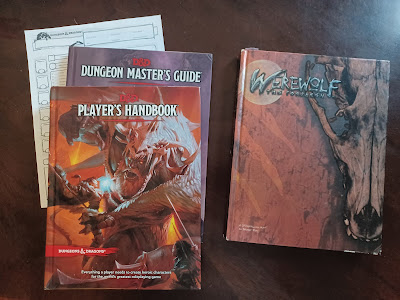
the two core Dungeons & Dragons books stacked next to the first edition of Werewolf: the Foresaken


SYSTEM     Dungeons & Dragons (5e) Werewolf: the Forsaken           
cover tagline = "Arm yourself for adventure."
"A storytelling game of savage fury."
publisher =
Wizards of the Coast
White Wolf
pub. date =
2014 2005
original cost =
$49.95 $34.99
length =
11 chapters / 320 pages
8 major sections / 398 pages
my exp. level =
very much lots
barely any


previous characters and experience

I looked everywhere in our house for my very first D&D character sheet, and I could not find it. and this means I cannot remember or recount to you the mouthful of a dragonesque surname I gave to my dragonborn character who was raised by halflings. her given name was Raffya (like the paper ribbon twine you get at craft stores, but oh so fancily spelled with a y). all I recall of her surname is that started with M and contained multiple Ls and Xs and such.

Dungeons & Dragons was properly introduced to me in early 2016. at the behest of this charming guy I was dating way back then, I obligingly created a practice character (the aforementioned Raffya) as a way of exploring the system and all its creative options. it was interesting enough. meanwhile I watched him run the tail end of an epic Eberron campaign with some Chicagoland friends. there was magic, mystery, love, and looking back I don't think very much of it actually made sense to me as a game with rules. but I would learn.

the first character I actually put into gameplay was called Brickna, a cute little wizarding gnome with colorful hair and rather modest dreams of making it through wizarding school.

around the same time, there was Arxillia Liaholinaii, a talented elf warlock who started out traveling with a local troupe of performers but ended up fighting and adventuring alongside three others for a few months until we had to move and leave that group's campaign. I later heard she was captured by orcs or something, and the DM was toying with the idea of having her return as a villain. I do like to imagine Arxillia's mysterious warlock patron turning her gradually from neutral to evil somewhere along the way... but I lost touch with those friends and never found out her ultimate fate.

not long after that, I built Nadja Gunderson, a human fighter sailor, blonde and tanned and toned, who quested with a band of longtime childhood friends to protect their home from imperial overlords of some sort. when at level 4 or 5 Nadja fell, instantly, regretfully, to a blue lightning dragon, I repurposed the name Raffya for an intrepid dwarf ranger for a little bit in the same campaign.

the next D&D character I made was at least a couple years later, after we'd moved to Louisiana: Juniper Thornspur (June for short), a halfling monk with some alchemy skills. 

much more recently, I played as Lady Lidda Woodsweep, halfling rogue noble carrying on the tradition of arcane trickster magic that flows through her maternal lineage. Lidda had quite an arc, in one of the longest D&D campaigns I've been part of so far. she rescued her elder brother and saw him take up their father's mantel as Lord of Sycamore Keep, liberated (Robin-Hood-style) a ton of gold from a huge corporation, and almost died any number of times. I love her and I loved playing her. I have a bunch of notes for her story's epilogue that I still need to write up one of these days.

then there were three relatively shortlived concepts: Jinxia, an earnest dragonborn barbarian hoping to study more deeply the histories of her tribe; Ilva Ivoryhearth, a vengeful half-elf druid mostly based on Poison Ivy from the Batman comics; and Rylika Aven, a wood elf sorcerer artisan making ends meet with her crafty leatherworking skills. all of these were built for short and sweet one- or two-shot adventures. (why are single-session games called one-shots? I'm not sure. but if anyone has the etymology of the phrase, please do share.)

last but not least, there is Vikki (Victory if anyone's trying to be formal). she's a purple tiefling barbarian entertainer, and she is high in the running for least serious of any of my D&D characters. I modeled her just a little bit on Xena Warrior Princess: showy and brash, forcefully strong and highly acrobatic, awkward at anything that isn't fighting.  

so what does that come to? counting Raffya the first, a total of 11 unique characters. and on top of my player experience, I've helped out with Jeremiah's plans to run one-shot games for family at the holidays, dabbled in running the Curse of Strahd adventure module twice, and presided over my own short and sweet one-shots of Ginny Di's everso whimsical "Bard Behind Bars," once in person and once online, so far.

that's seven years' of experience for you. on top of that, there's all the cultural prevalence of D&D we could pile on, too, from Stranger Things to Critical Role to all the memes that use the basic alignment chart as a frame for funny jokes. also the new movie! have y'all seen Dungeons & Dragons: Honor Among Thieves yet? it's a truly hilarious and wonderful film. go see it. come visit me and we'll watch it together if you want.

on the totally other hand, before this little tournament I had never made any characters for Werewolf, nor even thought about doing so. I hadn't heard much about the game either, just knew it was one of several World of Darkness flavors.
 

new characters etc.

it does feel like overkill to make yet another D&D character, but I gotta be consistent with this, right? I was quick and a little bit slapdash about it, at least. this version of character creation is all too familiar, so thinking through it without writing anything down on paper seemed sufficient. I've never played a cleric or a paladin or a half-orc, so this was a random chance to build something along those lines. let's call her Nyva the Compassionate. she is strong and wise, mostly reserved but with some reputation as a Folk Hero for saving dozens of townsfolk (half-orc and human alike) from a great flood and looking after local orphans. missionaries converted her to an order of extra-selfless paladins just two or three years ago, and Nyva has since traveled the realms doing as many good deeds as she possibly can.

there. will this inspired half-orc appear in any future gameplay? we shall see. she rounds out my dozen D&D characters interestingly, at least.

for Werewolf, I created two brand new characters. since Werewolf is a World-of-Darkness system, it seemed fair enough to shortcut half of this character creation process by repurposing the normal rock-climbing human Briella (previously mentioned in the first match-up) as a template of sorts. (confession: I've used her as a base for my new Mage character, too, and I'll very likely also make her into a changeling and a vampire when the time comes. why not?) 

Ella in this shard of the multiverse is still herself, but Changed by the fate of the half-moon into a sharper, even more driven creature. she knows when you're angry or lying or guilty, and she is not afraid to boss you around. 

I also created Mr. Ryan Booth, a scrawny hacker dude for whom his werewolf powers give him even more charisma, insight, and control of technology.

since I'd never played any of this game at all before, dearest husband was graciously willing to run a short one-shot of Werewolf for us the other day. my two prototype characters + four others were added to a pre-made roster for me and two other friends to choose for the game. I ended up playing a strong, extra-tall, extra-spiritual Taylor Grettig, whom I pictured as a mashup of Brienne of Tarth and Luna Lovegood. my tournament characters Ella and Ryan served as fun NPCs. by the end of the session, after a few gripping battles and cunning investigations, our pack of werewolves restored balance to the natural and supernatural aspects of Jerome, Arizona, but not without almost losing our alpha in the process.

aesthetics

what else can I say about the solidly Tolkein-ish legacy that D&D has been built on? we could call it classic. or maybe neoclassic, in a way. indeed, it reminds me of all the romanticizing of medieval times that goes on in western art and literature (i.e. let's tell stories of gallant knights and fairest ladies and idyllic countrysides, but just for fun ignore all the plagues and injustices that don't fit the picture). this is rather an oversimplification, I know. of course of course games don't have to be "historically accurate," whatever that means, and neither do stories-- not all of the time. I'm making observations here, not logging criticisms quite yet. 

the D&D books exude bright and striking contrasts-- rich shadows and vibrant magics all layered on top of each other. the worlds and realms of this system come with a certain clarity. maybe it's in part because D&D is so popular, so ubiquitous: for whatever reasons, you tend to know what you're getting. it's a sturdy, robust, serviceable high fantasy, with a multitude of opportunities for exploring and fighting as heroes, for saving the town, saving your allies, saving the kingdom, or saving the whole world. it's not a simple or limited fantasy world by any means, but its range flows out within the lines of a culturally predominant kind of storytelling, for the most part. good guys vs. bad guys, rinse, repeat. there are caverns and monsters, magic and danger, but more than enough courage and pluck to vanquish it every time. sometimes there might be poignant costs to pay. but the heroes will always see victory. D&D is an optimistic, mostly cheerful sort of fun.

Werewolf is obviously much more focused and the boundaries of its world are colored with more muted tones: earthy, rusted, teeth and bone. the lore and folklore evoked by Werewolf stretches back eons farther than any pseudo-medieval age of heroes. we're talking ancient, echoing myths, seemingly infinite and inescapable. the moon's subtle glow filters into this world through layers of prehistoric legend. this isn't high fantasy. it leans on the grungy urban fantasy of World of Darkness and gives it an almost pantheistic tinge of spiritualism. everything has an underlying spiritual essence, and that essence has agency and personality of its own.

to play this game, your character must be or become a werewolf: a member of a Changed supernatural people sworn to respect the honorable old ways of their tribe, their pack, their lunar auspice. maybe your werewolf will be a hero, but it's not necessarily the bold, relatively more colorful Tolkein-esque hero D&D would have you play. I wouldn't call Werewolf optimistic in at all the same way. 

what both systems tap into, for me, is a sense of power. physical and supernatural powers are out here for the taking in these two games. for Werewolf it seems a raw, overflowing, barely-civilized power, frightening, at times violent, difficult to control but undeniably holding everything together somehow. part of the vibe of this game is whether or not you can find balance in your existence as part wolf, part human. 

for D&D the power we're playing with seems just a little bit more refined-- a power accessed through just the right steps, through hidden doors, magic books or months of training. the edges are sanded off a little. it's measured and glittering like lightning caught in a shard of crystal or starlight coaxed into a polished jewel. am I working my way into a metaphor where Werewolf is bare-handed street fighting and D&D is olympic fencing or something? well, not quite. but maybe sort of.

mechanics

like World of Darkness, Werewolf uses ten-sided dice and the same basic stats and skills and willpower, with modifications depending on which form the character may shapeshift into (human, near-human, wolf-man, near-wolf, and full wolf). there are also custom advantages and gifts that only werewolves have access to. they channel magic of a sort through contact with spirits and spiritualized objects. each werewolf earns dots of Renown in one of five categories, and these memorable feats contribute to that character's visible reputation, kind of like gang tattoos or ritual scars, but more mystical. they also have points of essence and primal urge that inform how powerful or capable they are. the Virtue and Vice system also functions here just like it does in regular World of Darkness.

health points work a bit differently for werewolves, which I find very cool. werewolves heal fast. even lethal damage goes away naturally within 15 minutes of in-game time, as you regenerate health at the beginning of every turn. if you choose to spend an essence point, you can regenerate even faster.  

this is partly why I have a sense of Werewolf as a game of power. they have heightened senses, buffed strength and speed, magic rituals and innate regenerative powers-- it feels like werewolves can do anything far more easily than anyone else can.

I'm sure in a longer series of play sessions that sense of power would have been tempered by various mechanics we just didn't get a chance to deal with in our one-shot. shapeshifting too carelessly can induce Lunacy in humans around you. essence points don't last forever. and instead of regular human morality, werewolves are bound by the rules of Harmony: an ethics system meant to measure the balance (or lack thereof) between instinct and reason, spirit and beast, tranquility and rage within each werewolf. sins against Harmony might cause derangement. and on top of all that, there's your legendary weakness to any pure silver weapon or bullet.

-

D&D characters are built with three main foundations and some very mathsy framing to hold it up for gameplay. we have 9 basic races (dwarf, elf, halfling, human, dragonborn, gnome, half-elf, half-orc, and tiefling), 12 basic classes (from barbarian to warlock), and various backgrounds (from acolyte to urchin). and this is exactly the order the book would have you choose each element-- race, class, and then background.

the options you choose here will influence your six ability scores (strength, dexterity, constitution, intelligence, wisdom, and charisma), and these, in combination with other proficiency bonuses, will influence all other skill modifiers, maximum hit points, initiative, attacks, and defenses. on top of that you can acquire weapons, armor, and other equipment of mundane and magical aspect, some of which will add bonuses to your skills as well.

the book outlines D&D gameplay using three-ish categories: exploration, social encounters, combat encounters, and downtime. given the flexibility of RPGs, any given session or campaign might have more of some and less of others. in my experience, most players seem to expect and enjoy at least 2/3 (or more) combat encounters, with everything else filling in the other third (or less) around the edges. combat is some of the most exciting gameplay in this system. it can be an intense context for creative, critical thinking. and the dice keep everyone on their toes not knowing exactly what will happen.

the most important random number generator of D&D is the twenty-sided die. for most significant actions in this game, you'll roll a d20 and add a modifier depending on which skills or tools you're using to do the thing. the magic crossbow gives your attack a +8 to hit? add that number to whatever your d20 roll gives you. higher rolls with higher modifiers added are more likely to succeed, but it always depends on how difficult the task is to begin with.

there are other dice, of course. for various other rolls in D&D (damage dealt, hit points regained, hours left until you can cast that spell again, etc.) you need at least one set of seven (1d4, 1d6, 1d8, 2d10, 1d12, and 1d20). friend Patti, I think it must have been back when I was working on the board game version of The Plaid Identity, gave me my first set of dice. they are black with speckles and I still have them all (accompanied by many more at this point). thank you Patti.

approachability

the Player's Handbook for D&D is a slim, easy-to-read, well laid-out manual. decent organization and decent cross references for most stuff that needs it. and though it is not the only D&D book there is-- far, far from it-- it is the only one you really need to play. the rules and mechanics are easy enough to learn, though I do think different classes come with different levels of complexity. not every player is going to love having to keep track of which spells their character decided to prepare every in-game morning, for example.

the ubiquity of D&D of course makes a difference here, too-- there is a ton of support and help and overall enthusiasm for D&D plastered in easy-to-find spots all over the internet, from twenty-year-old forums to yesterday's reddit posts. there are apps that can guide you through character creation and gameplay. there are probably a hundred or more unique actual-play streams or podcasts or youtube shows for you to reference. there is merch of all kinds. almost anything you could ever want to talk yourself into. and the existence of all that is both cause and result of its popularity by now. you probably know at least one person who has done some D&D-related things at some point in their lives. overall it means pretty low barriers to entry for any D&D newbie. if you have any earnest desire to play this game, you have no excuses.

the Werewolf rulebook isn't much longer than the Player's Handbook, and for the most part it is just as well organized. but to be fair, the first edition of Werewolf: the Forsaken isn't so common anymore, nor so widely popular as the opponent I've set it up against. and for Werewolf to work as intended, you'll also need the prerequisite World of Darkness core book to get started. that's a bit of an extra hurdle, but only a bit of one. 

the extra rules of Werewolf are interspersed with plenty of short, moody vignettes and other, shorter introductory sections that set up the ancient gameworld contexts that function as in game mechanics. some of the font choices for one or two vignettes are perhaps a little audacious, the contextualizing lore sections perhaps a little too heavy on the italics. nothing major. I also felt that the order of things wasn't as smooth or intuitive as I might have wanted it to be, but only in quite minor ways. there are a good handful of decisions to make and lists to consult during character creation-- which of five lunar auspices will mark your character? which of five tribes will they belong to? which handful of possible advantages and gifts will you choose? it may seem like a lot for some, but it's all part of customizing the experience.
 

preliminary verdicts

of these two RPG systems, Werewolf is currently a smidge more intriguing because of its relative novelty. but of course it is hard to resist the massive phenomenon that is Dungeons & Dragons. I have already logged hours and hours of fun, engaging, dramatic, moving, often scintillating gameplay with good old standard, core-rulebook-only D&D. it's been around (in general and for me) for so much longer. it has become so ubiquitous, particularly in its 5th edition, for good reasons.

Werewolf though-- it's so unique. and even our basic, zero-XP, no-frills characters were rolling very exciting dicepools of 6 or 7 d10s on a regular basis during our very first encounters, which felt very cool. the spiritualism of the world was intriguing and a little creepy, almost evoking a sort of Studio Ghibli style abundance. and that's what I generally love about all the World of Darkness games I've played-- they get to be so consistently vivid. the imagery of them lingers most satisfyingly in my mind.

so I'll mull over this comparison while I write the rest of my reviews. stay tuned.

next new one-shot (tomorrow!): Scion: Hero

next match-up review (this week, I'm hoping): Pathfinder 2e vs Mage: the Awakening