Showing posts with label peace and quiet. Show all posts

Tuesday, September 30

the good fight

what does an average middleclass person in the developed world have to really fight for? stand up for? do capital-S Something about?

plenty of stuff, surely. but then again... fighting seems dangerous. difficult. as long as we have access to some safe-enough shelter, plentiful-enough groceries, functional-enough plumbing, a little companionship, what else could we need to really worry about? with those basic necessities secured, most of us will be content with the state of things, whatever mild to moderate chaos or metaphorical storm clouds may swirl around on the outskirts of our little routines. 

do I mean "be content with," or "get complacent about"?

photo of an art piece in downtown Indianapolis, with a neon crosswalk sign flashing "DON'T CARE" in blue all caps

both, I guess. the main difference between the terms is in the level of awareness each implies. complacency means ignorance. we can frame our implacable cockroach-like ignorance as blissful and cozy, or as a challenging opportunity to learn more stuff. or maybe as protective wall, willful and resolute. which way we see it (or if we see it at all, I suppose) is a decision to make. a mindset we get to set. more likely, multiple shifting mindsets that we trade in and out as days come and go. 

my list above of all the basics that would be worth fighting for if we had to didn't include any education, but really it should. what kind of teacher would I be if I couldn't say learning and knowledge are worth fighting for, standing up to demand, or working as hard as possible for, after all? we need good food and good information to really survive on this planet. we can't leave our brains out of the game. useful stories are what civilization is made of.

we've watched the newest Superman movie more than a few times this summer. is it a useful story? (perhaps I should ask "useful for what?" or "useful to whom?" here. stories can be made to do many kinds of work in the world. not every storyteller has the same kind of use in mind. not everyone understands their needs for safety, shelter, food, and information in the same terms as other people's.)

despite the comicbook/superhero genre not being my usual cup of tea, I did like the messages this one braided together for us. 

  • your biological family and their cultural values aren't the be-all-end-all of who you are or can be. 
  • seeking peace and justice is not easy; people will probably complain no matter what you try. 
  • success of any kind at almost any level takes a ton of collaboration: there's work for the superheros, for journalists, and maybe for the unruly canines too. 

not all fighting is physical or violent (thank goodness). inasmuch as my daily work might be considered a figurative battle-- to wrangle my modest expertise in technical writing into a series of effective lessons for a bunch of college students every semester-- to apply decently rigorous empirical methods to relevantly articulated research questions in the field of media studies-- and all the other paperwork and collaboration and sitting through meetings that attend my little academic career-- then we can say I've fought to defend my few square feet of shelter and my $600/month grocery budget. perhaps I also fight here and there for recognition, for friendships, for leisure time, for a little peace and quiet. what advocacy my life entails beyond these selfish pursuits is very small. smaller than a pebble thrown into a puddle, it seems.

professionally, I advocate for all the podcasts to have transcripts. for inclusive and non-punitive learning-centered pedagogy where students get to make a lot of decisions for themselves instead of merely following arbitrary instructions. for a rejection of the workaholic mindset that still pervades academic culture. for everyone to do their best to read more and communicate clearly and vote in all the elections.

does all of that make a difference? I'll at least say that it doesn't not make a difference, so that's something. I won't always be able to measure the difference it might be making. there is plenty of hope involved.

could I make more of a difference if I were a scrappy investigative journalist? 

more or less is not the right question here though. it'd be a different kind of difference, on a different stage, but another form of education in any case. keeping people empowered with accurate and relevant information about the present universe. meaningful work, indeed. 

but also... maybe scathing exposés about the far-reaching misdeeds of tech billionaires only bring about lasting consequences in comicbook movies with happy endings. 

what does an average middleclass person in the developed world know, really, about all the bigger things out there to fight for? all the things we could/should/might/ought to/would do capital-S Something about before it's too late? nobody can be rationally informed about everything everywhere all at once. it's too much. even if we are informed enough about reality, learning/knowing/deciding what to do about it is another set of mental battles in itself.

my currently second-most-favorite podcast Never Post published a roundtable episode on this idea, back in May. the host (Mike Rugnetta--the one and only. I know, I know, will I ever shut up about Mike Rugnetta?) notes the tension between how we use the internet and how we might wish we could use the internet. it is a global medium--that's why it was made. one of the coolest things we do with the internet is "to socialize and connect globally, which, you know, that's powerful and that's important," Rugnetta says, "but we can't act globally. [...] it's even hard to act locally given the state of especially American politics.
"And, you know, I feel like even my ability to even know how to act locally has perhaps atrophied a bit because of my focus on the importance of familiarizing myself with national and global events."

are there information diet plans out there, something akin to the handy food pyramid, but for sources of news instead of calories? probably. 

do they teach such things in grade school so everyone grows up knowing that your brain will not thrive on a diet of nonsense and trash? maybe somewhere somehow. bless everyone who dares teach grade school.

there is so much information in the world to be had. maybe I shouldn't say "too much," because that depends. too much for what? for whom? 

sometimes it does seem necessary to just stop for a little while though. to push back on all the information (the firehose, the overload, the deluge, the six-lane highway traffic jam) with a little carefully cultivated ignorance: "I haven't looked into that myself," "that's not my lane," "I trust someone else to be smart about and work on that particular problem" and so on. (this brings to mind some of Hank Green's recent vlogbrothers video in which he touches on the difficult value of trusting our fellow humans.) we can all find our own good fight to fight-- there isn't just one. 

hopefully we aren't all fighting alone and/or at cross purposes though. hopefully we have some kind of justice gang/league/squad to back us up at least some of the time. smart and good people don't only exist in the comicbooks and movies. the Green brothers are on my list of people I admire for trying to make the world better. academic acquaintances are on the list. non-profit organizations managed by people whose names I may never know are on the list. 

its been a week or so since I read this detailed breakdown of "The Dark Internet Forest" as a concept for understanding the possibilities and risks of all our globally mediated connectedness and was thus suddenly enchanted with its author, Erin Kissane. she comes back to the centrality of place-- real or physical or digital or conceptual, place is important to remember. positionality. relationality. places matter. where are you? what other places are within reach right now? who else is there? how can you join forces and do Something?

I especially loved that Kissane cites this beautiful pushback against the classic "tragedy of the commons" idea. Elinor Ostrom's book helped me write my dissertation. I should read it again sometime. 

doing capital-S something is not always (probably not often) gonna be easy even when you have a team of active, collaborative superheros to work with. it's still messy. pebbles in ponds sometimes and big splashing ordeals other times. 

flip a switch somewhere and set your mind to care at least a little. doesn't have to be about everything. just don't get totally complacent.

photo of an art piece in downtown Indianapolis, with a neon crosswalk sign flashing "DON'T CARE" in blue all caps and "CARE" beneath it in white

Tuesday, December 17

sidewalk-henge

at a certain time of day, the shadows that fall from the southeasterly sunrise across the somewhat-elevated sidewalk behind our house line up just exactly right with the angles of wide concrete pavement and granite-pebble landscaping and the gully on one side. and for however long the sun and earth match up that way, we get to watch a shadowy parade of me with the pugs, walking with perfect balance on the top of the shadow of the earth against itself. 

I suppose the conditions for this must happen at least twice in a day, whatever times those may be depending on the time of year and the slant of the earth's axis. in the mornings, lately somewhere near 8:00 a.m. or so, the shadows slant northwest. we don't often walk that path during the other half of the day, but I imagine in the early evenings the shadows must slant more to the northeast.   

so what? 


it is a thing to notice. a small event-thing among many other variously-shaped event-things. 

I haven't bothered photographing our shadows. it's nice enough to just notice it when we happen to be out walking at the right set of moments. 

the morning pug walks require more layers this month. hats, gloves, fluffier scarves. I crocheted a new puppy pug coat in red and beige for the skinny little Faramir. his old grey pug coat still barely-kindof fits, but it didn't look as warm all stretched out of his lanky body.


these photographed trees and their shadows are not trees near us (we are quite starved for trees in this neighborhood). but they are very autumnal, aren't they. I took these photographs some years ago, mostly in Chicagoland and perhaps a few in a town near the WisconsinIllinois border, October 2022. 

Tuesday, March 26

Kingsolver and current events

almost six months ago, my attention was drawn to all the conflict in Palestine more than it ever had been before. a house down the road from us began flying an Israeli flag all of a sudden. half of all the social media posts are still imploring everyone to speak up, to choose a side or else by default choose complicit cowardice. the news of October 7 and all the terrible news since has been rightly hard to ignore.

since December, my old land acknowledgements post from the summer of 2020 has been oddly popular. the basic stats in blogger tell me it's gotten more than 100 views within the last 30 days. by comparison, a typical post here in this random collection of internet musings gets fewer than 20 views and that's it. but this old post has consistently seen around 30 hits per week for several weeks now-- I'm still not sure why. is it because phrases like "colonial ruin" "violent displacement" and "racist horribleness" are highly topical these past months? I've let my proper Google analytics account languish without updates for too long, so I don't really have a way to find out.

also about six months ago, I was reading Barbara Kingsolver's Prodigal Summer. a lush and lovely novel--a braid of stories all about our relationships with land, trees, animals, nature, and each other. biology. ecosystems. extinction or conservation, and all our efforts inbetween.

there is plenty I've so far remembered about this novel, but the thing I've most wanted to blog about here is a pair of sentences in the middle of it. they are sentences about Jewishness and prejudice and history.

Lusa, one of the three point-of-view protagonist characters in this story, is half Polish, half Arab. she marries blissfully into a struggling-but-resourceful family of appalachian tabacco farmers, too soon loses her husband, inherits his parents' old farm house, and faces various tensions and pressures from her local, white, rural in-laws as a result. 

I keep thinking about this line of dialogue from one of Lusa's chapters. she's talking earnestly with the one in-law, a nephew, she feels closest to. 

"That's what I was thinking, too. Families lose their land for a million reasons. My dad's parents had this wonderful farm in Poland, which they lost for being Jewish. And my mother's people got run off their land for not being Jewish. Go figure."

this pair of contradictions struck me, as I read it for the first time in fall of 2023, so much more definitively and potently than it might have at any other time.

and when did Kingsolver write this? my idle curiosity is easily answered: Prodigal Summer was published almost a quarter-century ago. in October, 2000. 

from devouring her other early novels (Pigs in Heaven, Flight Behavior, Unsheltered), I know Kingsolver has a deft way (sometimes subtle, sometimes less so) of commenting on potentially controversial political realities-- like this seemingly endless conflict in the middle east, or like the relative failings of public education, or like the impact of settler colonialism on indigeneous families, or like the nonsensical state of US healthcare systems. 

in October of 2000, I was an almost-17-year-old. what on earth did the words "Israel" or "Palestine" mean to me then? the first I only knew from a bunch of biblical prophecies and hymns, the second from Laurie R. King's A Letter of Mary (1997) and O, Jerusalem (1999), if indeed I'd really heard of Palestine at all. in neither context did I think very critically about what these stories meant. honestly, I was probably quite detached from both versions of the place. their respective peoples. they all may as well have been equally, ineffably, untouchably fictional.

halfway between then and now, I must have seen this rather haunting animation make the rounds on the internet. you've probably seen it, too.

unsurprisingly, there are dozens of new comments on that page since the events of last October.

looking into the piece again this past week, I realized that a full-length film version was produced and likewise donated to the public domain in 2018. do I have the time and spiritual energy to watch it? hopefully someday. (I've also now realized that the artist, as generous as she has been with her artwork, seems to have some not so cool opinions about the social construct of gender, so there is that to grapple with too.) 

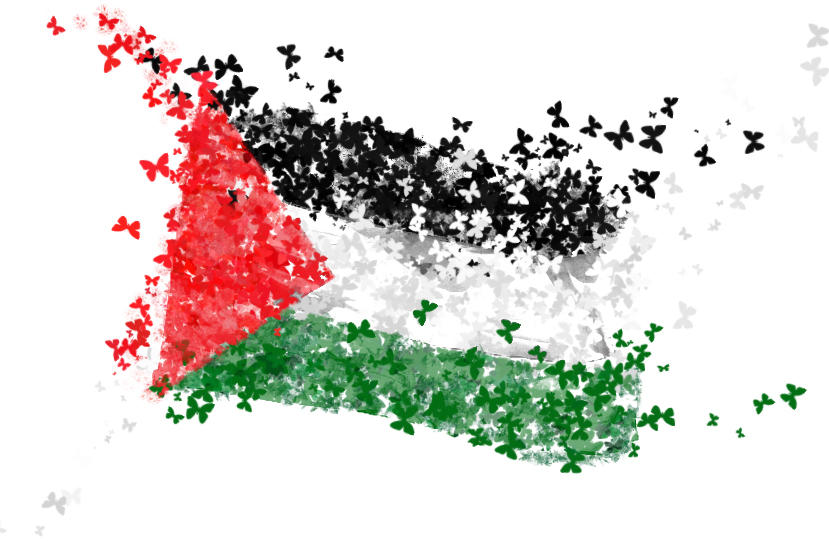
{ the Palestinian flag, as if made of butterflies, borrowed from this kind soul on deviantart }
 

being Jewish. 

not being Jewish. 

we might say Lusa's ficitonal comments here are oversimplifying things.

and yes, I'm usually the first to say (to myself if nowhere else) there must be more to it there's so much we don't know how can anyone have a truly worthwhile opinion what's the use in trying to fully understand it anyway it's so complicated and what can I do about it or about anything, little me with my little blog and my little comfortable life?

what's truly oversimplified is any inkling of a thought that this single roundabout post regarding my country's rather terrible, rather unconscionable involvement in the horrors of this geopolitical situation is anything like enough to counter my general day-to-day silence on the topic. 

no matter how many times I might ponder bringing it up to my students or asking all the ROTC cadets how they feel about Aaron Bushnell or posting something to instagram with a hashtag like #CeasefireNow or #GazaWillBeFree... thinking about a few lines from an old Barbara Kingsolver novel and mentally wringing my hands about all the knotted historical roots of this conflict aren't enough at all. 

I don't know what could be enough. write to congress? to the president? just once? or every month? every weekend? with a few pleading letters or phone calls to these more-powerful-than-me people, can I then say I've done my part? 

I don't know. it doesn't seem like it. no number of letters or public protests, and certainly no ocean of hashtags, no matter how many, seems like enough.

so for now, current events continue to sweep across the world, sort of but not really dragging me with them. even so, we are all connected. we are all somehow jointly creating this world. the fact that I'll never be able to single-handedly fix anything on the other side of the planet doesn't mean I can safely give up, right? even if I don't-- or can't-- truly know if my impact on the sprawling web of the universe is leading to more preservation and less extinction of light and goodness, I have to keep trying. 

is it up to me to decide which side of the scale my feet are on? to judge my own quotas of light vs. dark?

for now, it is. I'm the only one who can. am I doing my best?  

Friday, April 28

palimpsest

seasons of 90 days each. seems like plenty of time. one quarter of a full circle, fair time for each mood of the year.
what was I wanting to blog about?

paper and trees. loud noises and how to hear through them.  

-

I've been thinking a lot about my grandma. grandma Ashdown. she comes into my dreams

my coat pockets for the past two winters have held traces of that March funeral three years ago: a whole pecan my dad had given me. bottle of lotion from the hotel. baggage claim slips. 

-

this week the seasons tangibly tilted, almost all at once, one into the other. winter-spring chills are banished by the baking warmth of full-on spring. snow and freezing feel like the smallest of old memories from here.

there are new plants! phlox and day lilies and an easter cactus.

the last day of classes, yesterday. the whole semester at its boiling point, with only grading and emails left before it all simmers away.

for summer break? so many art plans.
and exercise plans.
reading and rereading,
writing and rewriting.
paints and puzzles and games. plenty of sunshine too.

I'd been thinking about all the roles from whatever Goffman theory of something or other... but I'd forgotten the words for it.

my other grandma was a teacher. she taught much younger humans than I get to teach, and I don't know how she had the patience. but if it weren't for her and others like her who somehow do, all the building blocks of reading and writing wouldn't be there for my students to use for anything more advanced.  

-

six years ago, riverside vows in the rain.

now? I must finish all this grading and work. then we'll go lay about in the sunshine. fix my bike. go camping at least 3 times. family reunion adventures in July. rent kayaks every week if we feel like it. 

-

I found this letter in the back of an old mostly-empty journal. it's a letter I never sent, for some reason. there isn't year with the date of Jan 22 in the corner-- but all evidence (the stationery, my careful handwriting and lack of capitalization, the turn of phrase and the doodles at the bottom) points to 2001 or thereabouts.

it is written to yet a different grandma-- step-grandma, if we need to be that specific. it conjures different memories. twenty-two years ago? when I was barely almost kindof a grown-up?

"grandma chesley:
greetings! all the family says hi and wishes you well. i decided that i would write this whole letter just because. [hearts] life's been crazy as it always is. i wonder when it will all settle down. anyway meanwhile i go on through all these crazy experiences, thinking all sorts of crazy things while in so many different moods. it seems like everything changes, but never the way people expect. i really really hope my life turns out well. most of the time it seems like i have no clue and won't amount to anything special. the things i care about can be so ridiculous and yet so serious... that's just more proof that life is a paradox.

for all the wrong in the world, the truth seems extraordinarily unbelievable at times. it certainly is hard to concentrate on the good and the beautiful when so many trivial matters lie in the way. i think i would give anything for an eternity of peace, and i guess that is really what we are reaching for.
[smiley, heart, flower, star, leaf, raindrop, rainbow]"
dear past self, it will not settle down. but you'll learn to settle yourself and settle into yourself. eternity may or may not exist in any meaningful way for these limited human brains of ours, but peace does, at least.


Wednesday, June 29

sound/less bubbles

a not-so-random memory: 

my first boyfriend, the redhead, putting a pair of earphones in my ears and pushing play on a Smashing Pumpkins song while we just lay there. it's the best, he said. having music right in your ears while you just zone out, your brain totally wrapped up in the sounds.

it's weird now to think of what a novelty cheap earphones were in 2004. for me. him. us. what a novelty having a boyfriend was, too, then.

and what a blip mp3-players were, eh? I never actually had one, unless you count an iPod touch as an mp3 player. but those things seem too internet-enabled and multifeatured to count, I think. 
 
recently I put a bunch of actual mp3 files onto my current phone. I like having a little pocketful of Imogen Heap and Jason Mraz and Death Cab for Cutie to carry around.
 
I must confess though, music doesn't effect me the way it seems to effect others. my brain treats it like wallpaper, most of the time. sometimes rather loud, ugly wallpaper and sometimes quite lovely, attractive wallpaper... but more often just there, on the walls, in the background, drawing very little attention to itself unless the lyrics are particularly striking.
 
falling asleep to white noise of some sort is one thing, but having my brain all wrapped up in any given sound... I don't always find that very pleasant. 
 
my sensitivity to sound seems to deepen the more I think about it. even with music piped directly into my ears, I can still hear the hum of the dishwasher and/or the air conditioning and/or the PlayStation 4 (which has gotten particularly vociferous in its old age). when the neighbor's power tools and the traffic going by and dog park noise from across the way is all piling up around me, I hate this sensitivity. 
 
on the other hand, when little Hamilton is chewing on something he shouldn't be under the bed in the other room, it does come in handy to be able to hear the difference between pug teeth on a proper chew toy and pug teeth on a stolen ballpoint pen.
 
too much sound makes me edgy and irritable. so in pursuit of a world without so much irritation, I acquired a new set of fancy earphones today. they are the wireless bluetooth kind, and they come with two noise-canceling modes. I never thought I'd feel like I needed wireless earphones... but after lots of research and review-reading and consideration, these came out as the most effective and comfortable option.

will they trap me further within a bubble of my own endlessly unvoiced thoughts? I hope not entirely.
 
also I still think someone definitely needs to write about how headphones have done for music what widespread literacy and silent reading practices have done for books-- i.e. make them very private, internal experiences instead of communally shared ones. though perhaps someone somewhere already has and their article is just not on my radar yet.

Friday, October 22

smoke and sunbeams

last week the first cold snap of this autumn season came to town, frosting across everything and showering the night with hailstones.

the chill in the air has since then become less snappish. we're used to it now. the mornings demand scarves and layers and a brisker pace when we walk the little pugs.

last weekend there was a camping trip. it was glorious-- we had such a lovely time. I was so refreshed and grateful for all that time in the woods. we didn't go far, just a 40-minute drive up into the mountains. for both nights the moon was so bright, so round and brilliant behind the tallest pine trees, that it felt like someone was shining a floodlight through the southeast wall of our tent.

during our explorations Friday night, Hamilton and I met the most gloriously gnarled, fat, wise and beautiful juniper tree. my googling has led me to believe it's probably an alligator juniper, aka a checkerbark juniper or Juniperus deppeana. someday I will learn more about dendrology and have more to go on than too-cropped google images or what Wikipedia says.

anyway, she was most gorgeous: grey smooth trunks wrapped in thick scabby layers of bark, reaching out with such balance and grace, her whole being angled just so against the rocky ridge, all shrouded in green sprigs of pokey starlike juniper leaves.

{ that's her, my new favourite tree, on the right. }

that evening as the light faded, we ate the most traditional of camping fare, tin-foil dinners. mine was salmon on top of potatoes, carrots, onion, and red pepper. Jeremiah's was fake-chicken with all the same veggies plus plenty of cheese. tin-foil dinners are my family's tradition. it was great fun to introduce them to my husband after all this time.

once we'd set up camp there was nothing to do but sit and enjoy it all. I found myself quite enchanted by a small stone just across from the campfire-- red lavarock pocked with bubbles. where it sank into the pine-needles and dirt, there was a wisp of greenery twining up, little round frilly leaves bobbing lightly against the dark red. those colors and textures-- lava and leaves-- kept drawing my eye. but I didn't take a photograph.

early Saturday, we watched the sun climb and climb over the mountainside and up through the tall pines. its bright beams streamed visibly through all the boughs and needles, glinting around spider webs and clouds like sunbeams do. the angular softness of them mixed in with the swirling campfire smoke. that image enchanted me too. and the phrase for it-- smoke and sunbeams. 

perhaps I'm pretty easily enchanted. 

Sunday, October 3

waning crescent

this morning we woke up at first light, well enough rested, and after wrapping myself up in a fuzzy robe, I sat outside while the dogs sniffed around, watching the eastern edges of the sky turn colors.

I love seeing this happen. dawn. morning. sunrises. 

this time of year is especially great for it. the sun takes its time, the horizon for me today was obscured by the wall around our property, the tree on the left, more trees beyond that one.

but the sky is all still there, spread out behind everything, changing from dark to light under a mottled scrape of east-to-west cloud.

the cloud turned colors too-- from a grey smudge to grey-blue, then purple, before pink and flaming. I couldn't see the sun itself but I saw all the colors it was throwing around. 

my bare feet got cold. little Hamilton pawed at me to let him up on my lap. early hikers passed by on the trail behind our house. I noticed a mourning dove huddled on the edge of the back wall. a trio of crows swooped overhead. 

after a while, I stood up and walked a ways out from under our back-porch awning. up, up above the treeline and the blazing pink-gold clouds, the brilliant, bright white moon smiled down at us. it hung there tipped over on its side, a slim crescent against the blue morning. it surprised me, how solid and silvery and high it still was, with the sun right there on its tail.

I had to look this up to remind myself properly of the order of all the lunar phases, but as it happens, we're under a waning crescent moon today. at this point in her rhythm, she's pulling all her shine into her other half, turning and shrinking away, saving it for whoever is out on the other side. maybe it's just her, there with all the sunbeams-made-moonbeams. with no obligations to reflect it for anyone else at all. 

I've been thinking about that aspect of the moon for a while now. about how much value there is in that new moon phase-- how through all the never-ending cycles of waxing and waning and shining and spinning, there's plenty of time when the moon seems to keep her light to herself.

maybe that's a lesson I'm learning this year. this season. 

shining full-blast for everyone else all the time is a recipe for burnout and depression and resentment. and it's gotta be okay-- more than okay-- to use your talents just because you feel like it, even if nobody else will see or care or show up for it. my own reasons can be enough.

nature is pretty awesome, even if some portion of what we see as awesome in it is projected personifications and metaphors. so what? we are nature too. all of us and our stories have a place in the wild and shifting colors of the sky, clouds and moonlight and all.

I'm so grateful for cool, crisp morning sunrises and a tidy backyard to enjoy them in. so grateful for this space and time and everything I can learn from it.

not today's sunrise. just one sunrise of many


Tuesday, March 30

springtime words

not very long ago at all I actually stopped and read this poem, "Optimism" by Jane Hirschfield, posted ephemerally somewhere somehow by the instagram account Poetry is Not a Luxury

it is a poem from a collection published in 2005. not very long ago at all. so it isn't in the public domain, or anywhere close, and so I haven't copied it in full for this post.

but I will write out a meandering ode to what I thought about when I read it + what I am still thinking about.

and what I want to remember about it.

it is difficult to explain what's lovely about a poem. is there a truly effective way to make you see or feel the same satisfying resonance or resonant satisfaction that I felt when I read it, or reread it? doubtful, given that even just recalling what it was like to catch myself reading this poem for the first time seems pretty impossible.

part of it is in the journey-- simple, with a first-person subject and her point of view in flux. her admiration evolving. and we get a collection of sturdy nouns as an anchor along the way: resilience, resistance, tenacity, intelligence, persistence.

I'm reminded of friend Trinity once talking with me about the merits of resilient as an alternative to the buzzier buzz-word sustainable. what's the point of something sustainable if it won't resist or withstand a few worst case scenarios? sustaining a system in good times isn't the same at all of sustaining it through a disaster. so we need some more words to talk about more possibilities.

speaking of contrasts, this poem gives us pillows vs. trees. 

the stubbornness of a same shape over and over vs. the sinuous tenacity of remolding yourself to follow the brightest light, wherever you find it

these words. the journey of them.

you can see the pillow, its impermanent dents. perhaps that resistance is worth admiring sometimes too.

and you can see the tree, green and pliant, with branches reaching, shadows falling in its way. 

some part of me, finding herself somehow pausing long enough, focused enough, to let these words in properly-- she relates to the tree, to the feeling of being forced to cast around for different light.

and then the beautiful ending. the contrasting conjunction that breaks down any fear we might have about our blindness preventing any growth.

"But out of such persistence arose turtles, rivers, / mitochondria, figs – all this resinous, unretractable earth."

these words. the tip tapping -ence, -ance, -acity of those nouns, and the -ome, -oam, -uous, -ose, -ous, and -able. the sounds of them and the feel of them.

the words in this order like this evoke so much hope even without the title tying a neat bow around that authorial intent. the hope of small turns, motivated by whatever subtle senses we may or may not understand, leading steadily to so much wild and undeniable beauty.

it feels almost like I've just written some kind of literary analysis of this poem. maybe a third of one, or something. I did not grow up to be a literary scholar, so a third of an analysis is probably just fine.

spring tree branches against blue sky

in other news:

we painted some of the walls of our new house a few weeks ago.

oh yeah-- we bought a house. it feels so very grown-up of us to have done such a thing.

next exciting house project: patio furniture.

I am excited for the end of spring semester. for consistently warmer weather and more time to be outside, to sleep, and to read whatever I want. our new nearest public library looks awesome (though its fairly basic clunky website does not quite match, I must say). it has a little cafe, open 7am - 3pm, and I really hope I can arrange my life in a way that allows a few future mornings here and there sitting with books and notebooks and tea in a library cafe. what could be better than that?

Monday, February 8

early February, now and then

maple leaf, portraits, scribbles

yesterday, on a lark I looked at the date and trawled through my blogpost archive to find all the posts that just happened to be posted on February 7.

there are three:

an untitled Sunday scribbling from 2010.

reflections on who a person is or isn't after they run 5 whole kilometers for the first time (2012).

and these twice(now thrice?)-framed and re-framed ramblings about who a person is or isn't after dying their hair for the first time (2013/2004).

are there coincidences here? a theme of identity and the capacity for novel experience to encroach interestingly upon it. 

while I meandered through this blog archive timewarp (knowing I wouldn't write the rest of this until Monday) I also checked for old posts from today's date, February 8:

a meditation on parts of ourselves that are unknown, occasioned by a book and one verse of a hymn (2011).

and this "nostalgic little rant" about how we store old media and what to do with old dreams (2007). 

so?

present and past and future selves. all of them fluid, none of them ever fully left behind. 

and who am I this week? the sixth full week of this sixteenth year of blogging here? 

I am doing a little bit of yoga every day, pondering what it really means to have a good relationship with my own breath. the snow of late January is mostly melted. teaching and teaching prep are taking up the bulk of my days. our pugs still want to hibernate some mornings. we are soon to be buying a house, and the land under it, which seems both like a very weird, half-unthinkable but simultaneously perfectly logical, sensible life decision. 

what will owning this sliver of earth with a house on it mean for the selves we become over the rest of the year? 

I hope it means more time reading and writing outside on the back patio. I hope it means lovely neighbors and a quiet cul-de-sac. it will mean more responsibility and more space. more food storage, more crafts, more plants! more making. more stargazing. more driving for me but somewhat less for Jeremiah. 

and a lovely ancient volcanic hill down the road for both long and short hikes.

Monday, December 21

deep solstice

it has been almost three years since I last joined a public yoga practice. that's kind of a long time. but also not that long.

I have gotten emails from that downtown yoga studio, Sunshine Yoga, in the meantime. pointless emails, but at least they were not overwhelmingly spam-esque.

there was a yoga studio called Spark in Natchitoches for a moment, but it closed its doors before I could participate. I was sad and a tiny bit angry when that happened. how unfair. what stupid timing.

there are at least fourteen yoga studios here in Prescott, but there is also a pandemic going on.

and so the time since I practiced any good yoga with anyone but my own household stretches longer and longer.

I do still have Yoga with Adriene, thankfully.

and now I also have a weekly yoga church thing, which I joined on strong recommendation from friend Patti.

I met Summer Cushman, the beautiful soul who hosts this event, just once I think-- during a dinner at Black Sparrow at some point during this visit to Indiana. her partner Jeremy Cushman orchestrated my introduction to the graduate program + environs at Purdue that March. 

so for the last three Sunday mornings, I have set aside 90 minutes for a little yoga, a lot of journaling, and a much-needed dose of connection and fellowship. it's over Zoom, which will never quite be the very same thing as an everyone-in-the-same-room-breathing-and-moving-together yoga class, but it is very lovely in its own way. 


{ one of my favorite hand-drawn cards from Christmas 2018 }

yesterday, we turned our journaling and our meditating to the depths of this season. midwinter. cold. darkness. accepting the rhythms of putting down what is ready to die and making room for the new things that might grow when the spring sun comes back. 

we were encouraged the day before to collect and arrange a simple little solstice altar for the occasion. 

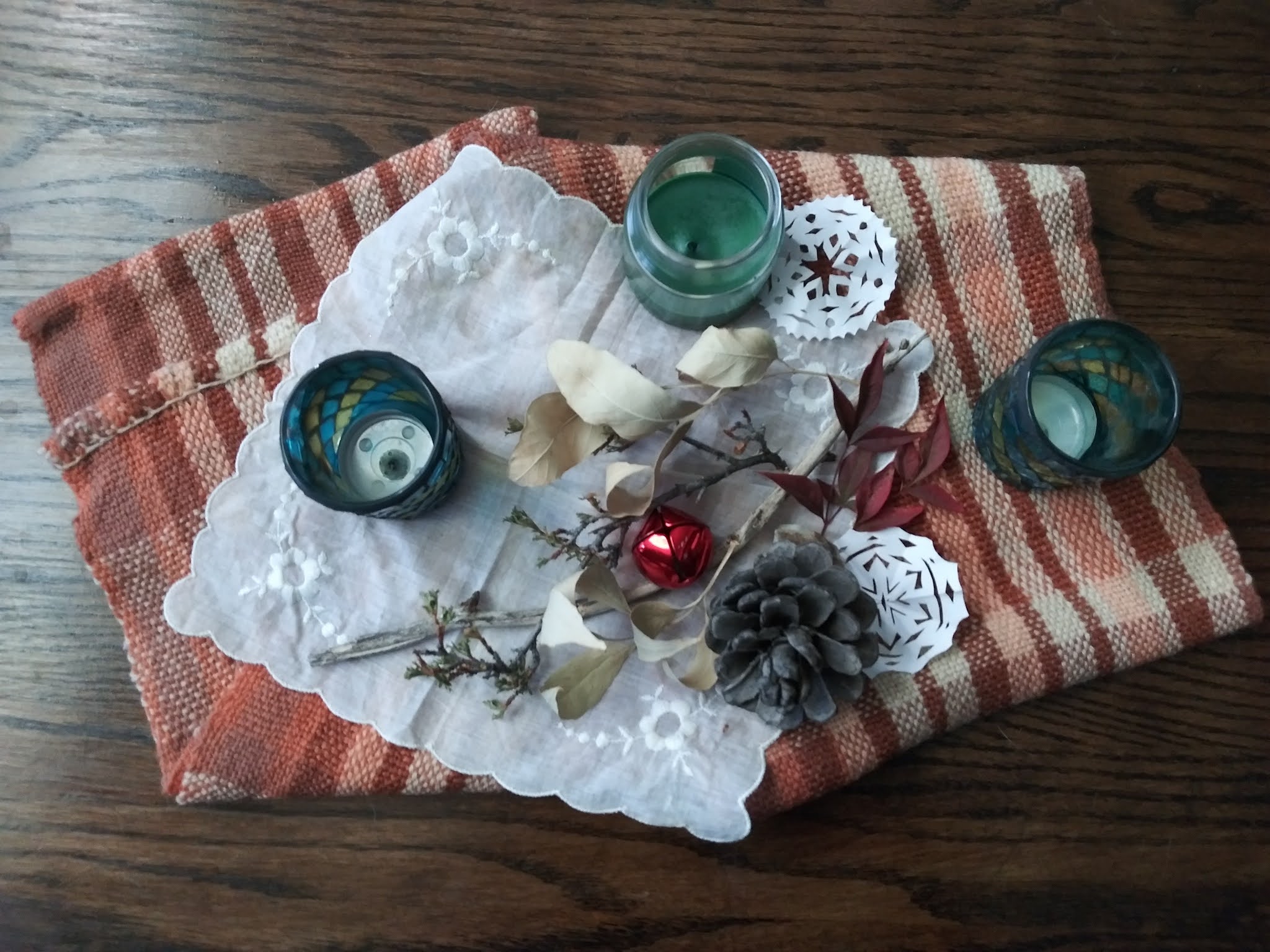
mine is still on the coffee table in our cozy front room. I laid out a hand-woven scarf from my mentor Kelli Cargile Cook, a small wrinkly white handkerchief, three candles (one Christmas-scented), two little paper snowflakes, one red jingle bell, a pine cone and various other plant-bits from the walking trails near our apartment.

while I gathered all these things, I kept thinking about silver and gold. I untangled the bell from a long golden ribbon it had been tied to. the twig I picked up is pale, easily imagined like slightly-tarnished silver. the curled leaves look much more obviously golden in real life. and the brilliant embroidery thread of the handkerchief shines a little bit like precious metal. 


I don't remember the rest of the lyrics to the song, other than the basic title: Silver and Gold.

but I like the idea of using whatever we can to brighten some of the darkness this time of year. candles. sparkles. carols. 

during yoga church we came back a few times to a quote from Glennie Kindred. I don't want to merely regurgitate everything from yesterday into a blogpost here, so I'm posting just two snippets:

"...it is important to realize that this festival is not the beginning, in a linear way of looking at things, but a rebirth within a cycle in which the starting point chosen here is part of a vibrant whole. Therefore it is necessary to make a connection to what has gone before.

"Something old must die in order for something new to be reborn. This period of rest and darkness is a vital link in the cycle of life."

linearity vs. non-linearity is a (fittingly) constant source of pondering for me. it seems that the connotation of linear = straight, one-dimensional, confining, constricting. but I know that lines can be curvy and wild, too. a circle is also made of points on a line, sort of. 

it is easy to forget that, though. to make our stories about ourselves into stair-steps that only go one direction. 

yesterday, taking time to remember the bending arcs of things, the out and in, the back and forth-- that was very nice. our starting points and our ending points can be chosen. there can be palpable connections-- whether we make them ourselves or find them waiting for us-- to an infinite, cyclical, beautiful whole in each seemingly-insignificant little moment.

Monday, August 10

blend in

the last several days seem to have slowed down. August is only ten days old but those ten days have stretched themselves out so far, so languorous.

one week ago, we jaunted up to see this famously vast hole in the ground.

it was a nice little trip. not too far. definitely worth it.

what else?

some sewing (sloppy and frustrating), some reading (poetry and textbooks), plenty of games and naps and long walks with the puppy.

around Willow Lake the other day, we almost stepped on this little snake. it was so still and so camouflaged.


little snake (probably a glossy snake or maybe a gophersnake, according to my bits of googling), what can I learn from your sun-basking stillness?

hopefully when the semester starts I will continue making time to be outside in the sun. hopefully some of that time will be given to a little bit of sweet stillness, too.

Saturday, August 1

birthday weekend, or an excuse for photographs

today, at least according to his paperwork, is Hamilton's birthday.

there are a bunch of August birthdays in my family. my paternal grandma (the one who first taught me to knit) will turn 81 today, I think. my genius brother's birthday is in another week or so. and my sweet husband's is at the end of the month. so much to celebrate.


this is one of the very first photographs I took of the puppy, when we first brought him home in mid-January. he was skinny and timid.

now he is about ten pounds bigger and only very rarely timid. he is a good companion to Wesley and most of the time to us.

Wesley's birthday is sometime in April and I never have been told the precise day. maybe it should be April 1, for symmetry. next April, he'll be a lucky thirteen years old.


even though birthdays are just regular days and they don't really need all the pressure we put on them to be glittery and special, I ordered new nametags for both the pugs today. we've been meaning to acquire them anyway, for almost seven months now, so a birthday may as well be the prompt that gets it done. and hopefully they come in the mail soon, despite all the semi-horrifying corruption etc. that seems to be going on with the US Postal Service lately.


this last photo is Hamilton as of today, in one of his favourite spots under the chair I sit in to work. sometimes he's a perfect angel under there, quiet and content to chew on his toys. sometimes he is a hooligan who can't sit still and just wants to chew on everything but toys. but I guess we all have our angelic moments and our hooligan moments, sometimes quite close together. Hamilton is a good pug anyway.

Wednesday, July 29

steep

this is the sun-smeared peak of Thumb Butte, towering magnanimously above the Thumb Butte trail where we hiked today. thickly pine-scented, steep, and more mountainous than the other trails we've ventured on thus far. it is a popular trail so we weren't the only hikers, but nevertheless it was gloriously peaceful to be up there.
   

the steepness of the trail got me thinking about how I used to hate hiking. I hated being dragged on family excursions to the canyon or the wilderness. I hated the heat and dust and the blisters. I hated feeling slow and out of shape and generally less-cool than all the other girl scouts. I would have much rather been left behind to read books or make art under a tree or at a picnic table.

it was a superficial hate, though. why else did I keep agreeing to go on all these church-sponsored and/or girl-scout-badge-earning hikes?

I went because I find it pretty easy to prioritize novelty and being included over my own usually very individual, isolating interests. as introverted as I can be, I'm a social animal like all the rest of us humans.

so in 2006 when a group of very cool people organized a week of hiking in Zion National Park, I happily and luckily let myself be included. and that's the week when I realized I didn't actually hate hiking as much as I thought. the snow and sun and sandstone changed my mind.

I wrote a little about that week here. I don't have photographs (though some do exist in digital form now) of those hikes. just journal entries.

and I only have a few photographs of these Arizona hikes. a few seems like enough. for now.

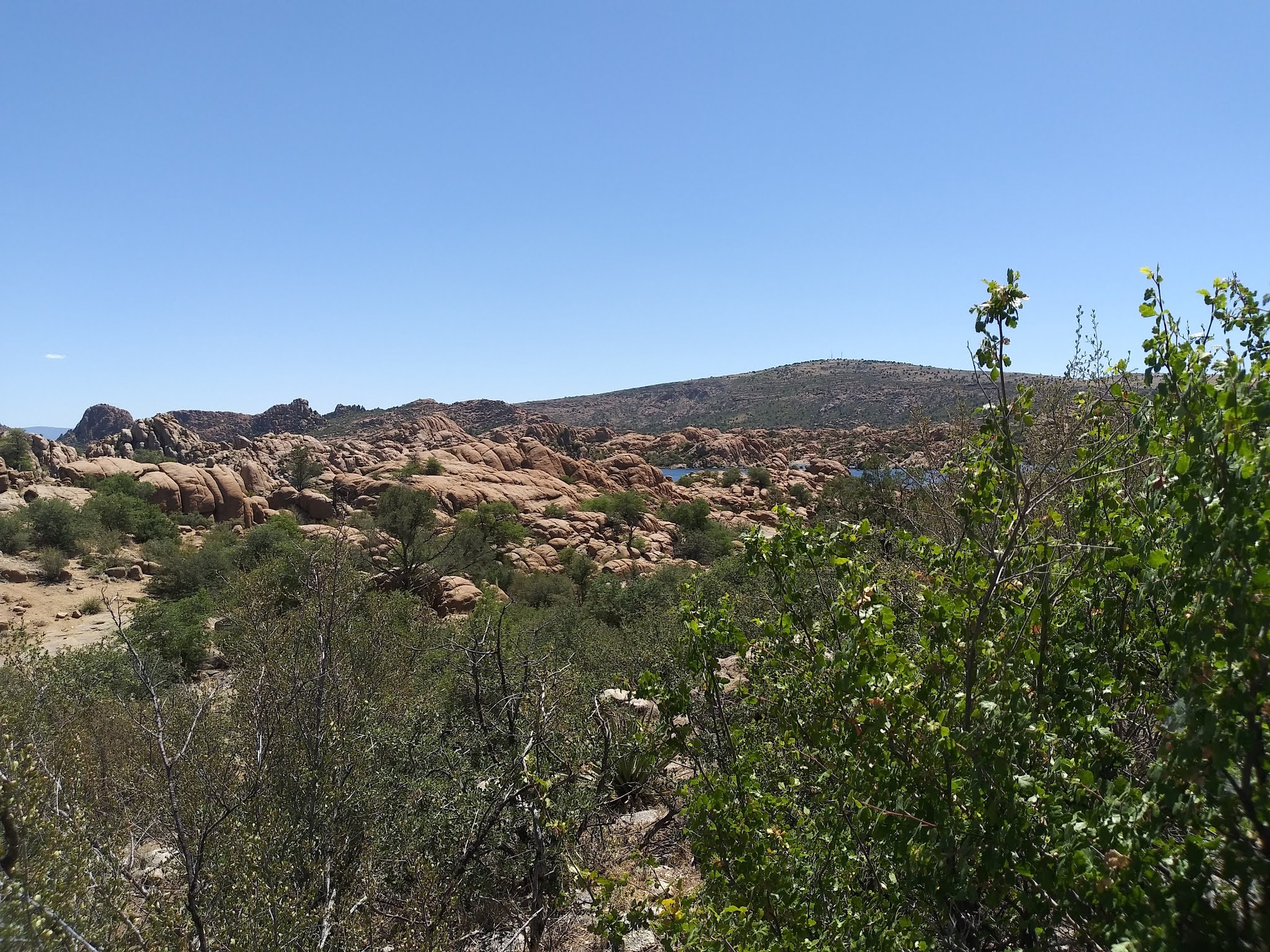
here, looking out from Thumb Butte trail at some of the northwest expanse of Prescott National Forest.

and here, a post-rainstorm shot of Willow Lake.

Saturday, July 11

from the air and from the sun


it was shady on the west face of Badger Mountain this morning. the inward corners between each ridge were especially cool. at the crests of each ridge I could look back north to see the whole town like a set of toy models, framed just so by Thumb Butte and Granite Mountain.


snippets of songs and past conversations and poems-to-be and a whole bunch of other ideas sewed themselves through my thoughts as I climbed. 


how to describe the sensation of one's body breaking spiderwebs. birds--I think it's a female bluejay but I'm not sure.

layers and layers of pine-scented Saturday. the striking, heavy-feeling color of smooth, dry, grey-white, dead trees.

oh how lovely was the morning. but what if there's no way of telling how virtuous or good-intentioned any historical figure truly was?

thinking of the outdoors as sacred. mountains and high places as extra sacred. the striking, smooth, dry, white-grey color of what once was a tree now feels like a symbol. persistence. potency. 

I give myself permission. or I take permission from the air and the sunshine like a plant takes oxygen and energy. permission to decide for myself and say what I want.

and what was the name of that book about forests? How Forests Think, by Eduardo Kohn. we read it for Thomas Rickert's class, almost five years ago. the most memorable thing about it to me now is the story the author tells about seeing a bird near a river and being suddenly, beautifully, drawn out of himself and his troubles.


conincidentally when I sat down to blog for today I found in one of my old drafts a copy of a paper I wrote for that class, mainly drawing on Kohn's book. much of the paper is semi-cringy, flippant grad school pretentiousness, connecting what Kohn writes with my own thoughts about food and food media. but even so, some of it might be worth remixing here.

it starts with food and eating, but then goes beyond that into where all the food comes from.

Kohn’s bit about “managing a variety of ecological assemblages” stood out to me most. at first glance, management has such a one-way connotation... but I want to pick that apart. ecosystems manage us back, after all, and have done for millions of years. we and world are meshworked together. one process.

James Gibson writes that “The possibilities of the environment and the way of life of the animal go together inseparably” (p. 143). my own management of eco-assemblages is pretty indirect these days, unless I’m home digging in my dad’s garden. as a non-hunting, non-fishing academic person, I take advantage of grocery stores and farmers' markets full of already-managed things to cook and eat—things that I will probably never need to learn to procure from the earth or the sea for myself. maybe that means my involvement with ecosystems is less intimate, but maybe not. the groceries I buy and cook and eat still matter, not only to my body and my kitchen but to the world I am a part of. every purchase makes marks and leaves traces in a hundred directions. the infrastructures that support grocery stores afford certain possibilities, and those are inseparable from my way of life, so far.

we could make a long list of specific ways non-human lives support our dietary habits. Ingold makes note of this mutual support in a broader way:
“Moreover, granted that not all producers are human, it is easy to turn the argument around and show how various non-humans contribute, in specific environments, not just to their own growth and development but also to that of human beings. … living beings of all kinds, in what they do, constitute each other’s conditions of existence, both for their own and for subsequent generations” (Ingold, p. 8).
A line before this lovely acknowledgement, Ingold writes rather simply (even naively? nostalgically?) that “The farmer’s work on the fields, for example, creates favourable conditions for the growth of crop plants, and the herdsman’s does the same for domestic animals” (8).

doesn't that just sound so symbiotic and peaceful. idyllic, even. but how exactly do we define favorable? whose favor are we most concerned about? Gibson’s observations on how much humans muck around with what our environments afford reinforce this tragic mess: “In making life easier for himself, of course, he has made life harder for most of the other animals” (p. 130). we don’t think about this very deeply very often. often we sometimes actively avoid thinking about it.

what one does or does not put into one’s body makes marks. dietary strictures may be religious, political, ethnic, personal, health-related, or any combination. the forbidden substances seem to make the deepest, most obvious marks: no dairy, no carbs, no pork, no coffee, no alcohol, because this is who we are.

or is it the other way around—this is who we are, because we can’t eat gluten or we won’t eat meat or we’d rather not support Chick-fil-A?

either way, as Ingold pulls from Marx and José Ortega, “what we are, or what we can be, does not come ready made. We have, perpetually and never-endingly, to be making ourselves” (p. 7). and for Thompson, these processes are about “I-ing,” but it seems just as important to think about “we-ing.” It matters who/what we tend to include in “we” and who/what we do not. our human management of eco-assemblages (and maybe of everything else) has been too shortsightedly human-centric for too long.


and then the paper quotes from Roy Scranton's “Learning How to Die in the Anthropocene,” and I question his rhetorical dichotomization of nations and markets vs. "our sense of what it means to be human."

it's not so separable, I say. organisms and their environments can’t really live without each other. it's too connected.

none of us can deny our intimate interactions with things we eat, even if we don’t think about them very deeply all the time. even if we actively avoid thinking about them.

{ apologies for my incomplete citations throughout this refurbished text. if I get a chance I'll update them here to specify titles and other info that was taken for granted when I wrote this for Posthumanism in 2014. }

Wednesday, July 8

typical wednesday

today, in no particular order, has included:

hiking. even though it is the hottest week of the year so far and even the energetic puppy got really worn out within an hour.


several episodes of Hell's Kitchen. we're on season 14 now I think, and I have plans to blog more about our summer of Gordon Ramsay sometime. 


reading. I'm on page 501 of Dune. it's getting intense. (and just now as I checked what page I was on I may have gotten biscuit crumbs all over the book. forgive me, everyone)


emails. the ATTW email list is abuzz with commentary and reactions to this fully unreasonable notice regarding international students. a student from spring is still trying frantically to finish her editing coursework and replace her Incomplete with a real grade. my new university has re-announced its intentions to teach face-to-face classes in the fall. my new colleagues are forwarding such things and offering all the advice and insight they can. five and a half weeks until fall semester.

Librivoxing. I have seven recorded sections of City of Din to edit and upload before summer is over. totally doable, I hope.

what else?

later, probably pasta and cheese. walking the pugs. prep for more roleplaying games (vampire, pathfinder, star wars). other games too? more reading. more writing. eventually, sleep.

Saturday, July 4

vengeance vs. leverage

an old facebook friend of mine, a few days ago, shared this Martin Luther King Jr. quote about the inability of violence to bring peace.

I was tempted to respond in a comment, something like "I hope you're using this to denounce all the terrible police violence and other terrible racially-motivated violence in the world, rather than as a shallow move to discredit some or all of the protestors who are speaking out against that violence, just because their response makes you uncomfortable."

but I didn't.

I've only been to one protest event in my life. it was at the end of 2014, during Dr. Jenny Bay's grad seminar on gender, rhetoric, & the body. Dr. Bay suspended our class meeting that day for anyone who wanted to go march, and despite my general hesitance to be seen making any kind of fuss at all, I left my books in my office, joined my peers, and marched. chanted (not loudly). laid down in the street in my red winter coat. listened to others' impassioned speeches and pondered in my highly introspective way what all of it meant.


that was a long time ago. I don't remember everything about that cloudy Indiana winter day but I remember one of the chants:

no justice, no peace.

if violence cannot bring any lasting peace, as MLK has said... well, neither does injustice.

if I ignore the violence and injustice that others experience, that doesn't mean it doesn't exist.

there are plenty of parallels between lyrics from Hamilton and the happenings of now. it's such a rich and tightly-woven work of art that you can look into it for insight and inspiration every morning for the rest of your days, never running out of reminders about what's difficult and crucial and powerful and beautiful about life. the closing number alone! "when my time is up, have I done enough?" it's gorgeous and it's full of heart-wrenching provocation like that.

yesterday we, along with the rest of the internet, watched the Disney+ release of the Hamilton film (thanks to friend Kay who shared her account info with us for the occasion).

these lines from "My Shot" stood out a little bit extra to me as I watched the protagonist take up a place on the soapbox and monologue:
And? If we win our independence?
Is that a guarantee of freedom for our descendants?
Or will the blood we shed begin an endless
Cycle of vengeance and death with no defendants?
I don't think most of the protests going on today are about vengeance. thankfully. and thankfully most of them aren't violent protests either.

there's another thought-provoking line on independence later on at the end of Act I, too. the exchange between Burr and Hamilton before the latter goes on to write a large portion of The Federalist Papers:
Burr: The constitution’s a mess
Hamilton: So it needs amendments
Burr: It’s full of contradictions
Hamilton: So is independence.
and so it is. independence is a neat idea. but we're also all connected. we all depend on so much outside ourselves. what "justice" and "freedom" really mean is a whole other set of questions, I admit. but we have to start somewhere. admit that not everyone is treated so equally as our Declaration of Independence implies they should be. stop ignoring that inequality just because it mostly doesn't affect us. start somewhere. change your perspective. change the way things are.

or at least try.

Monday, February 11

professor-ing, spring 2019

there were at least a dozen robins out in our backyard a minute ago, chirping away and pecking things out of the damp dirt.

I didn't notice when they left and I don't know where they've gone now. to someone else's backyard? some other patch of damp ground?

I'm working from home today, with the window in the den half-open and a dish of homemade granola (too crumbly to be bars, but I tried) on the table next to me.
 
there are revisions to focus on, but mainly I've been writing emails to send and posting comments on the blog for my graduate course.

did I write last semester about all the courses I was teaching? it looks like I did not-- not specifically anyway. not the way I've done for all my many semesters as a student. I'll make up for it now.

English 3230: Technical Composition
I taught two sections of this last fall as well, and I'll be teaching 3 sections this semester. Two are face-to-face, Tuesdays and Thursdays, and we've almost reached the end of our first major project. Our next project will be a service-learning/community-engagement project built around a partnership with our university library. who knows if it will spark for my students the kind of gushy enthusiasm I felt about my first service-learning project way back in 2005/2006... but I'm excited about it anyway.

English 6560: Digital Cultures - Theory & Practice
this is my online graduate course, in which four delightful graduate students are enrolled. we are discussing various aspects of and scholarship and theorizings about digital culture over at https://engl6560.hcommons.org/ and meeting for video conferences every other week to discuss further. I'm enjoying it quite a lot and can't wait to see what kinds of projects these students come up with for the rest of the semester.

I have more new and exciting courses (undergraduate and graduate) lined up ahead of me for the next few terms. most of them are technical-writing-related, though I also get to adapt the digital cultures course for undergraduates next fall. I'll get to teach an advanced tech writing and editing sometime in 2020...  lots to look forward to.

being a teacher and not simultaneously a student is pretty much a million times better than doing both at once. teaching is still difficult, but I think I'm somehow slightly more sure of myself now that I have a different focus. my own scholarship has not been set aside, of course (in fact, I should be working on article revisions instead of blogging, probably), but rather than having all the pressure of three reading lists for grad classes + seminar papers to draft + my own scholarship to advance + teaching, it all feels more manageable and spacious and steady.

Monday, July 31

sharing

as of two weeks and three days ago, this is our new place.


it is a very nice place, freshly painted with all the windows and light my plants and I could ask for. and it is where we are finding places to keep our things. old things and new things. some things that once were mine and some that were once his (and a few that were once other people's, too), most of the things don't really need those separate pronouns anymore.


the dog is ours. the furniture is ours. the dishes in the sink are ours. I have hung clocks on at least one wall in every room, and there are piles of books and notebooks on at least three different tables.


we still don't know where (or if?) to keep our bikes, there are shelves that don't have anything on them yet. but most of our things have settled in with us now. and we get to share this balcony and a bench swing here, for one more year of phd-ing.

Tuesday, May 30

briefly, for now

apparently Rosa Parks wrote recipes on the backs of envelopes too. really, is there anything else as useful to do with the back of an envelope? maybe doodling.

just the other week, right before our roadtrip to Utah and back, I wrote this brownie recipe down on the back of a small, greenish envelope. the brownies were baked, and then proceeded to get lost in our box of roadtrip snacks for almost the whole trip. but we found them again, and I ate several alongside the bananas.

speaking of recipes, I've been very much wanting to make this marvelous pie again, but there has hardly been any time inbetween celebrations and driving and driving and more celebrations and more driving. making pie crust is the hold-up today. if only I had pie crust in the freezer, I would be set.

all I have in my freezer by way of crust-esque stuff is phyllo dough at the moment. so I have been prompted to go searching for a phyllo tomato and corn pie recipe. and I found one. my hastily-thrown-together version of it is in the oven now.

unrelatedly, I am recently fascinated by Virginia Woolf's A Room of One's Own. my sister had a copy of it sitting around when I was at her (very cute, new) house in March, and while she hemmed a huge fat white ballgown for me, I read to her from it. we only got to chapter 3 or something, but ever since I have been thinking about it and wanting to keep reading. not long ago, on my little non-LibriVox LibriVox app, I found a free audiobook copy, read by the lovely Cori Samuels, whom I feel like I sort of know from listening to practically every single episode of the LibriVox Community Podcast.

I have a section and a half still to go, I think. I'll finish it soon and then see where my thinking takes me next. I'm especially intrigued by Woolf's section about women writers in the centuries preceding hers. there are so many she cites that I want to go look up and investigate a bit more: Anne Finch, the Countess of Winchilsea. Aphra Behn. George Eliot.

Mary Carmichael is fictional, it turns out, or I would want to look her up too.

but ah well. I do have enough reading to do anyway, without adding fictional novels to my list.

and oh, guess what-- my first audiobook solo has been catalogued! I may work up a whole post for it one of these days, in which I'll have space to outline the tricky process of translating a text into a series of audio files, and comment on the intertwining layers of authorial and narratorial presences. we'll see.

and oh, one more thing-- it did rain, but not too much. I loved it all.

Wednesday, January 25

background signal

what if it were illegal to yell?

part of me almost sort of likes that idea. criminalizing all the obnoxious, excess noise...

101 years ago, a fellow named Dan McKenzie published a book called The City of Din: A Tirade Against Noise. someday I will have time to read it and when that time comes I'll be so excitedly interested I can hardly imagine it. The City of Din is a public domain text (available via the Hathi Trust), so maybe someday I'll read it (calmly and softly and in a lovely, quiet room) for LibriVox.

McKenzie's tirade was made known to me by Russell Davies, who blogged about it in the context of a more recent book: The Age of Noise in Britain. that one also sounds like a fascinating-to-me book. there is always so much and more to read. not enough time.

what I am reading (still), is Benkler's The Wealth of Networks. I'm treading water in this fat, deep treatise, soaking up quarts and quarts of 10-year-old wisdom about humans, technology, ideology, policy, and the economy. this quote stood out to me yesterday, and I transcribed it first into a notebook and then into this blogpost:
“culture operates as a set of background assumptions and common knowledge that structure our understanding of the state of the world and the range of possible actions and outcomes open to us individually and collectively.” (p. 297)
a few pages on he points to a need for us to study how culture works on us, how it influences policies, how it does its structuring and how it draws its lines. he writes, “we must diagnose what makes culture more or less opaque to its inhabitants…” (p. 299). Benkler consistently uses a metaphor of containment and habitation in this discussion. culture is all around us. it's what we swim and breathe and see in.

of course that reminded me of David Foster Wallace's renowned speech (do you remember me blogging about it before, once?)--"This is Water," as it's sometimes called. this video rendition is rather neat. go watch it if you haven't. it isn't that long. not even 9 whole minutes. totally worth it, believe me.

in other related and semi-relevant things-I've-been-reading lately, there is an article (stumbled upon via the smacksy blog) about how powerful it can be to recognize the frames of your own perspective. I'm thinking that the phrase “the story I’m telling myself is…” can easily be adapted into “the culture I’m swimming in says…”. either mental trick can pull us out of our bubbles for a moment or two, help us remember our limits and our contexts, yes, but also our agency and our responsibilities. it's empowering to reflect on the background structure of your whole life. to actively participate and acknowledge your role in either accepting/reinforcing or resisting/revising the culture you swim in--that seems important. that's what it takes to make all of that power and structure more open-book, more readable, more transparent and less like a vice.

today, in my LibriVox researching (I'm almost one year into all ten+ years of these), I wound my way over to this set of slides from a 2007 podcasting conference. I'm curious what the spoken half of the talk must have been like, but the slides do stand alone pretty well. transparency is a theme there, too. openness and empowerment.

I do not think I would really want yelling to be illegal. a quieter culture might be nice, and if I can in some small part bend my world that direction, maybe I should. but then I think about how subjective it will always be. what's horrible noise to me would be awesome entertainment to someone else, and what's perfectly comfortable background music to me could be uselessly inaudible to the next person.

and then there's the whole issue of times when making some serious noise seems useful, meaningful, and lastingly important. it's probably very meaningful and important that yelling is not illegal.