Showing posts with label perspective. Show all posts

Tuesday, September 30

the good fight

what does an average middleclass person in the developed world have to really fight for? stand up for? do capital-S Something about?

plenty of stuff, surely. but then again... fighting seems dangerous. difficult. as long as we have access to some safe-enough shelter, plentiful-enough groceries, functional-enough plumbing, a little companionship, what else could we need to really worry about? with those basic necessities secured, most of us will be content with the state of things, whatever mild to moderate chaos or metaphorical storm clouds may swirl around on the outskirts of our little routines. 

do I mean "be content with," or "get complacent about"?

photo of an art piece in downtown Indianapolis, with a neon crosswalk sign flashing "DON'T CARE" in blue all caps

both, I guess. the main difference between the terms is in the level of awareness each implies. complacency means ignorance. we can frame our implacable cockroach-like ignorance as blissful and cozy, or as a challenging opportunity to learn more stuff. or maybe as protective wall, willful and resolute. which way we see it (or if we see it at all, I suppose) is a decision to make. a mindset we get to set. more likely, multiple shifting mindsets that we trade in and out as days come and go. 

my list above of all the basics that would be worth fighting for if we had to didn't include any education, but really it should. what kind of teacher would I be if I couldn't say learning and knowledge are worth fighting for, standing up to demand, or working as hard as possible for, after all? we need good food and good information to really survive on this planet. we can't leave our brains out of the game. useful stories are what civilization is made of.

we've watched the newest Superman movie more than a few times this summer. is it a useful story? (perhaps I should ask "useful for what?" or "useful to whom?" here. stories can be made to do many kinds of work in the world. not every storyteller has the same kind of use in mind. not everyone understands their needs for safety, shelter, food, and information in the same terms as other people's.)

despite the comicbook/superhero genre not being my usual cup of tea, I did like the messages this one braided together for us. 

  • your biological family and their cultural values aren't the be-all-end-all of who you are or can be. 
  • seeking peace and justice is not easy; people will probably complain no matter what you try. 
  • success of any kind at almost any level takes a ton of collaboration: there's work for the superheros, for journalists, and maybe for the unruly canines too. 

not all fighting is physical or violent (thank goodness). inasmuch as my daily work might be considered a figurative battle-- to wrangle my modest expertise in technical writing into a series of effective lessons for a bunch of college students every semester-- to apply decently rigorous empirical methods to relevantly articulated research questions in the field of media studies-- and all the other paperwork and collaboration and sitting through meetings that attend my little academic career-- then we can say I've fought to defend my few square feet of shelter and my $600/month grocery budget. perhaps I also fight here and there for recognition, for friendships, for leisure time, for a little peace and quiet. what advocacy my life entails beyond these selfish pursuits is very small. smaller than a pebble thrown into a puddle, it seems.

professionally, I advocate for all the podcasts to have transcripts. for inclusive and non-punitive learning-centered pedagogy where students get to make a lot of decisions for themselves instead of merely following arbitrary instructions. for a rejection of the workaholic mindset that still pervades academic culture. for everyone to do their best to read more and communicate clearly and vote in all the elections.

does all of that make a difference? I'll at least say that it doesn't not make a difference, so that's something. I won't always be able to measure the difference it might be making. there is plenty of hope involved.

could I make more of a difference if I were a scrappy investigative journalist? 

more or less is not the right question here though. it'd be a different kind of difference, on a different stage, but another form of education in any case. keeping people empowered with accurate and relevant information about the present universe. meaningful work, indeed. 

but also... maybe scathing exposés about the far-reaching misdeeds of tech billionaires only bring about lasting consequences in comicbook movies with happy endings. 

what does an average middleclass person in the developed world know, really, about all the bigger things out there to fight for? all the things we could/should/might/ought to/would do capital-S Something about before it's too late? nobody can be rationally informed about everything everywhere all at once. it's too much. even if we are informed enough about reality, learning/knowing/deciding what to do about it is another set of mental battles in itself.

my currently second-most-favorite podcast Never Post published a roundtable episode on this idea, back in May. the host (Mike Rugnetta--the one and only. I know, I know, will I ever shut up about Mike Rugnetta?) notes the tension between how we use the internet and how we might wish we could use the internet. it is a global medium--that's why it was made. one of the coolest things we do with the internet is "to socialize and connect globally, which, you know, that's powerful and that's important," Rugnetta says, "but we can't act globally. [...] it's even hard to act locally given the state of especially American politics.
"And, you know, I feel like even my ability to even know how to act locally has perhaps atrophied a bit because of my focus on the importance of familiarizing myself with national and global events."

are there information diet plans out there, something akin to the handy food pyramid, but for sources of news instead of calories? probably. 

do they teach such things in grade school so everyone grows up knowing that your brain will not thrive on a diet of nonsense and trash? maybe somewhere somehow. bless everyone who dares teach grade school.

there is so much information in the world to be had. maybe I shouldn't say "too much," because that depends. too much for what? for whom? 

sometimes it does seem necessary to just stop for a little while though. to push back on all the information (the firehose, the overload, the deluge, the six-lane highway traffic jam) with a little carefully cultivated ignorance: "I haven't looked into that myself," "that's not my lane," "I trust someone else to be smart about and work on that particular problem" and so on. (this brings to mind some of Hank Green's recent vlogbrothers video in which he touches on the difficult value of trusting our fellow humans.) we can all find our own good fight to fight-- there isn't just one. 

hopefully we aren't all fighting alone and/or at cross purposes though. hopefully we have some kind of justice gang/league/squad to back us up at least some of the time. smart and good people don't only exist in the comicbooks and movies. the Green brothers are on my list of people I admire for trying to make the world better. academic acquaintances are on the list. non-profit organizations managed by people whose names I may never know are on the list. 

its been a week or so since I read this detailed breakdown of "The Dark Internet Forest" as a concept for understanding the possibilities and risks of all our globally mediated connectedness and was thus suddenly enchanted with its author, Erin Kissane. she comes back to the centrality of place-- real or physical or digital or conceptual, place is important to remember. positionality. relationality. places matter. where are you? what other places are within reach right now? who else is there? how can you join forces and do Something?

I especially loved that Kissane cites this beautiful pushback against the classic "tragedy of the commons" idea. Elinor Ostrom's book helped me write my dissertation. I should read it again sometime. 

doing capital-S something is not always (probably not often) gonna be easy even when you have a team of active, collaborative superheros to work with. it's still messy. pebbles in ponds sometimes and big splashing ordeals other times. 

flip a switch somewhere and set your mind to care at least a little. doesn't have to be about everything. just don't get totally complacent.

photo of an art piece in downtown Indianapolis, with a neon crosswalk sign flashing "DON'T CARE" in blue all caps and "CARE" beneath it in white

Tuesday, December 17

sidewalk-henge

at a certain time of day, the shadows that fall from the southeasterly sunrise across the somewhat-elevated sidewalk behind our house line up just exactly right with the angles of wide concrete pavement and granite-pebble landscaping and the gully on one side. and for however long the sun and earth match up that way, we get to watch a shadowy parade of me with the pugs, walking with perfect balance on the top of the shadow of the earth against itself. 

I suppose the conditions for this must happen at least twice in a day, whatever times those may be depending on the time of year and the slant of the earth's axis. in the mornings, lately somewhere near 8:00 a.m. or so, the shadows slant northwest. we don't often walk that path during the other half of the day, but I imagine in the early evenings the shadows must slant more to the northeast.   

so what? 


it is a thing to notice. a small event-thing among many other variously-shaped event-things. 

I haven't bothered photographing our shadows. it's nice enough to just notice it when we happen to be out walking at the right set of moments. 

the morning pug walks require more layers this month. hats, gloves, fluffier scarves. I crocheted a new puppy pug coat in red and beige for the skinny little Faramir. his old grey pug coat still barely-kindof fits, but it didn't look as warm all stretched out of his lanky body.


these photographed trees and their shadows are not trees near us (we are quite starved for trees in this neighborhood). but they are very autumnal, aren't they. I took these photographs some years ago, mostly in Chicagoland and perhaps a few in a town near the WisconsinIllinois border, October 2022. 

Monday, November 25

miscellaneous tapestry

the many instantiations of various spinning and weaving arts and crafts consume me. there remains no time for blogging.


these are little tapestry weavings in various sizes. 
and I have a scarf-in-progress too:


so much in the middle of unfinished. which is as it should be I suppose. a merry-go-round of works in progress. 

Wednesday, September 18

three sisters

over the past few months I've been devouring audiobooks on the weekends. I basically listened to Stardust in one long stretch on a Sunday, knitting and gardening and crafting and tidying the house as I did so. (in the meantime, my backlog of podcast subscriptions is somewhere close to 100 hours. trade-offs, eh?)

there was plenty of Tana French and a bunch more Barbara Kingsolver too. and then, friend Michelle recommended Alix E. Harrow's Starling House somewhere around the end of August. I loved this book, despite its few melodramatic tendrils of YA-ness, which honestly I cannot really fault it for anyway. the ending was excellent and poignant and deep and gritty. so, so good.

I'd heard of Alix E. Harrow quite a bit, so I somehow assumed she'd been around for many years and that I was super late to the fangirl party... but nope, her first novel was published only five years ago. (I just finished listening to that one too-- The Ten Thousand Doors of January. it's a most adorable and fun adventure indeed.)

by the grace of my library audiobook app, I ended up making my way through Harrow's novels in reverse order. her latest, Starling House, first, with its echoes here and there of Kingsolver's Appalachia, sketched in words as vibrant, shadowy, heartbeatingly real and more-than-real. 

then Libby handed me The Once and Future Witches.

a fairly trite title with many echoes of its own-- will we get any scraps of Aurthurian ledgend here? 

I wasn't sure what to expect but this story drew me in completely and I was marvelously invested in all of it pretty quick. the book rotates among the points of view of three sisters. eldest, middle, youngest-- maiden, mother, crone-- each with her own ferocious sense of how the world could be, if only... 

and there is real magic. witching. spellcraft bubbling all through this alternate New England at the end of the nineteenth century. so cool. the story as a whole pulls and pries and re-weaves so many other stories into itself. I loved it. and before long it made me think of my own sisters.

I have two sisters. I don't often consciously think about the fact that two sisters means there are three of us. 

I've given us epithets before though, not realizing the cliche of it. one of us is the fearless one. the popular one. the clever one. the pretty one. the smart one. the nice one. or at least it's kind of neat to boil our essences down like that, sometimes.

The Once and Future Witches leans a fair bit on this concept for its central three sisters, and to some extent for the other trios of women who show up along the course of the plot. Bella is the wise one, the scholar, the librarian, the eldest. Agnes is the strong one, the independent one, the middle child about to have a baby of her own. and June, the youngest, is the wild one: rebellious and untamable, and most naturally talented with witching. 

three witches. such a ubiquitous trope. three itself is practically a trope, right? the rule of three. beginnings, middles, and ends. it's a sturdy, solid, sustainable prime number, lending its lovely balance to three-legged stools, three-corner hats, three primary colors, and a bunch of other things. witches. sisters. bears. pigs. amigos. stooges. musketeers. branches of government.

does one of the three being wise mean the others are necessarily less wise? or does the beauty of one necessarily outshine that of the other two? cannot three sisters be more or less equally strong?

yes and no. maybe. maybe not. it depends on how you measure these things, I suppose.

of course I also thought of Pratchett's three witches-- Esmerelda Weatherwax, Nanny Ogg, and young Magrat. perhaps I should reread their books to see how his version of the trope look to my 20-years-older perspective.

what would my sisters and I do if we had magical powers? so many things, I imagine. our circumstances aren't so neatly intertwined and story-arced as those of the sisters in this novel, but I do like to imagine we each have our own ferocity for changing some little segment of the world. 

and I've got brothers too. four of them. how does that change the math and dimensions of the trope, I wonder?


Saturday, September 7

unknown or reknown

thinking about my grandmother lately, off and on, I sometimes puzzle over how close and also how distant she seems. her birthday is coming up in a few days.


this painting (well, this print of a painting) hung over grandma's nice upright piano for as long as I could remember. and now it hangs in my office/craft room/guest room. 

I feel so grateful to have inherited this art, and I do not care one bit that it is a relatively commonplace mass reproduction. the light and shadow and movement of it say something-- something too immediate for words. I don't think my sense of this is just nostalgia, though there are indeed decades of memories sprinkled on whenever I look at it. 

today I looked up the name and artist engraved on the little plaque, for the first time. Moonlight Sea. Peter Ellenshaw. he did a lot of these beautifully peaceful ocean horizon paintings, apparently. prints like mine seem to have been pretty popular in the '50s and '60s. 

before then, Ellenshaw also worked as a matte artist for plenty of old films, inncluding 1959's Darby O'Gill and the Little People and Mary Poppins too. did grandma know that, I wonder? I only know it because the internet and Wikipedia exist at my fingertips. 

but I'm sure my grandma had so many other ways of knowing things. 

it's funny what our brains remember or don't. or think we remember. 

this grandmother was the first person to wink at me, as far as I recall. the full conspiratorial meaning of it was likely lost on me as a child, but it felt fun and silly and made the moment into a story. 

my other memories of grandma are a montage of bright and faded. so many quilts for the chilly basement bedrooms. green grass and a clothesline. frozen whole wheat waffles. cereal on the top shelf of a gaping deep dark pantry. sitting on the cement steps for photographs. plastic toys on a thick, round, stripey rug. and her voice piping up if anyone looked at any corner of that piano--a little raspy but bright and cheerfully insisting-- 'play us a tune, won't you?' 

and usually someone would. 

perhaps the strongest, deepest memory I have of that house, just a stride or two left from the piano and its painting, is the narrow closet full of toys and games and books (among them, this old woven fairytale). 

maybe the closet still has books and toys in it. newer ones, if any. the whole house looks hugely different now from how it did when I was young. there are no photos of the closets in the listing... but a closet of games and books for visiting tourists could make sense, couldn't it? 

I find myself wishing that I knew more about what my grandmother thought of this painting. where did she get it? was it bought, or a gift? did she see the same things in it I think I see? would she have better words for its movement and shadow and light?

she would have been 96 this autumn. 

if I live that long, I'll get at least 56 more autumns (hopefully, anyway. I hope I always live somewhere with a proper autumn.)

.

in other news, there are twenty standard weeks until this little blog turns 20 years old.

and then what?

Tuesday, March 26

Kingsolver and current events

almost six months ago, my attention was drawn to all the conflict in Palestine more than it ever had been before. a house down the road from us began flying an Israeli flag all of a sudden. half of all the social media posts are still imploring everyone to speak up, to choose a side or else by default choose complicit cowardice. the news of October 7 and all the terrible news since has been rightly hard to ignore.

since December, my old land acknowledgements post from the summer of 2020 has been oddly popular. the basic stats in blogger tell me it's gotten more than 100 views within the last 30 days. by comparison, a typical post here in this random collection of internet musings gets fewer than 20 views and that's it. but this old post has consistently seen around 30 hits per week for several weeks now-- I'm still not sure why. is it because phrases like "colonial ruin" "violent displacement" and "racist horribleness" are highly topical these past months? I've let my proper Google analytics account languish without updates for too long, so I don't really have a way to find out.

also about six months ago, I was reading Barbara Kingsolver's Prodigal Summer. a lush and lovely novel--a braid of stories all about our relationships with land, trees, animals, nature, and each other. biology. ecosystems. extinction or conservation, and all our efforts inbetween.

there is plenty I've so far remembered about this novel, but the thing I've most wanted to blog about here is a pair of sentences in the middle of it. they are sentences about Jewishness and prejudice and history.

Lusa, one of the three point-of-view protagonist characters in this story, is half Polish, half Arab. she marries blissfully into a struggling-but-resourceful family of appalachian tabacco farmers, too soon loses her husband, inherits his parents' old farm house, and faces various tensions and pressures from her local, white, rural in-laws as a result. 

I keep thinking about this line of dialogue from one of Lusa's chapters. she's talking earnestly with the one in-law, a nephew, she feels closest to. 

"That's what I was thinking, too. Families lose their land for a million reasons. My dad's parents had this wonderful farm in Poland, which they lost for being Jewish. And my mother's people got run off their land for not being Jewish. Go figure."

this pair of contradictions struck me, as I read it for the first time in fall of 2023, so much more definitively and potently than it might have at any other time.

and when did Kingsolver write this? my idle curiosity is easily answered: Prodigal Summer was published almost a quarter-century ago. in October, 2000. 

from devouring her other early novels (Pigs in Heaven, Flight Behavior, Unsheltered), I know Kingsolver has a deft way (sometimes subtle, sometimes less so) of commenting on potentially controversial political realities-- like this seemingly endless conflict in the middle east, or like the relative failings of public education, or like the impact of settler colonialism on indigeneous families, or like the nonsensical state of US healthcare systems. 

in October of 2000, I was an almost-17-year-old. what on earth did the words "Israel" or "Palestine" mean to me then? the first I only knew from a bunch of biblical prophecies and hymns, the second from Laurie R. King's A Letter of Mary (1997) and O, Jerusalem (1999), if indeed I'd really heard of Palestine at all. in neither context did I think very critically about what these stories meant. honestly, I was probably quite detached from both versions of the place. their respective peoples. they all may as well have been equally, ineffably, untouchably fictional.

halfway between then and now, I must have seen this rather haunting animation make the rounds on the internet. you've probably seen it, too.

unsurprisingly, there are dozens of new comments on that page since the events of last October.

looking into the piece again this past week, I realized that a full-length film version was produced and likewise donated to the public domain in 2018. do I have the time and spiritual energy to watch it? hopefully someday. (I've also now realized that the artist, as generous as she has been with her artwork, seems to have some not so cool opinions about the social construct of gender, so there is that to grapple with too.) 

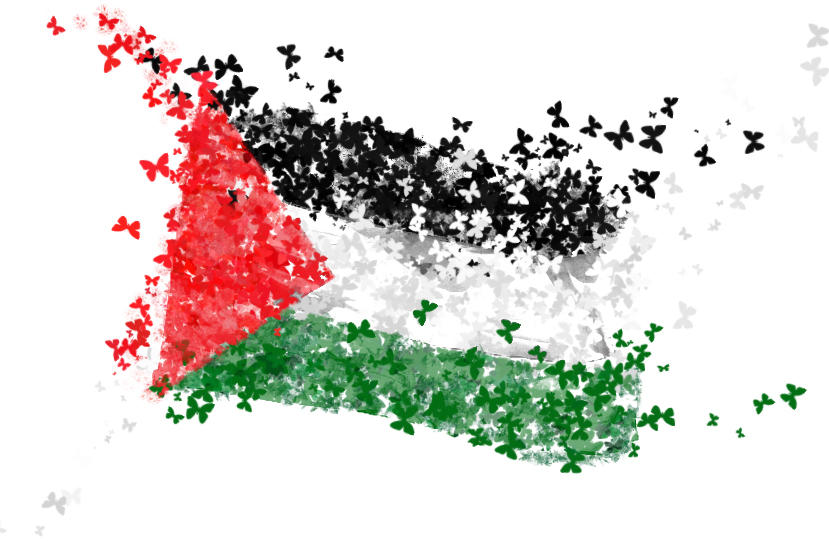
{ the Palestinian flag, as if made of butterflies, borrowed from this kind soul on deviantart }
 

being Jewish. 

not being Jewish. 

we might say Lusa's ficitonal comments here are oversimplifying things.

and yes, I'm usually the first to say (to myself if nowhere else) there must be more to it there's so much we don't know how can anyone have a truly worthwhile opinion what's the use in trying to fully understand it anyway it's so complicated and what can I do about it or about anything, little me with my little blog and my little comfortable life?

what's truly oversimplified is any inkling of a thought that this single roundabout post regarding my country's rather terrible, rather unconscionable involvement in the horrors of this geopolitical situation is anything like enough to counter my general day-to-day silence on the topic. 

no matter how many times I might ponder bringing it up to my students or asking all the ROTC cadets how they feel about Aaron Bushnell or posting something to instagram with a hashtag like #CeasefireNow or #GazaWillBeFree... thinking about a few lines from an old Barbara Kingsolver novel and mentally wringing my hands about all the knotted historical roots of this conflict aren't enough at all. 

I don't know what could be enough. write to congress? to the president? just once? or every month? every weekend? with a few pleading letters or phone calls to these more-powerful-than-me people, can I then say I've done my part? 

I don't know. it doesn't seem like it. no number of letters or public protests, and certainly no ocean of hashtags, no matter how many, seems like enough.

so for now, current events continue to sweep across the world, sort of but not really dragging me with them. even so, we are all connected. we are all somehow jointly creating this world. the fact that I'll never be able to single-handedly fix anything on the other side of the planet doesn't mean I can safely give up, right? even if I don't-- or can't-- truly know if my impact on the sprawling web of the universe is leading to more preservation and less extinction of light and goodness, I have to keep trying. 

is it up to me to decide which side of the scale my feet are on? to judge my own quotas of light vs. dark?

for now, it is. I'm the only one who can. am I doing my best?  

Tuesday, February 20

and spring semester 2024

eleven years ago, back at the very beginning of my academic career, I trekked 6 hours west from Lubbock, Texas, in my very old leper of a car (the paint was all but totally peeled way from its poor hood), to attend my first ever academic conference in Albuquerque.

this week I'm gonna trek 6 hours east and attend the same conference, this time in a rental car, with way more academic experience, an institutional credit card for travel-related purchases, and a significantly different research agenda. I'll be presenting this Saturday all about how I designed and get to teach a fun little class on podcasts. 

slide title with these words over stylized soundwaves: Themes in Humanities, The Art and History of Podcasts: Teaching podcasts as pop culture in a 100-level general education course

 {the title slide, so far anway}


and I'll get to see some of my old professors from USU. very excited for that bit. 

it'll be fun, hopefully. I hope I'll meet some other cool new interesting fellow scholars along the way, too. we shall see, given how sunny and warm it looks to be in Albuquerque this weekend, how much of the conference I actually sit through.

photo of a couple old issues of The Black Box, black and white covers, circa 1990-something

in the more normal weeks of this semester, I'm teaching a couple sections of technical writing. the same old basic tech writing course, only slightly different every time by virtue of new students and a new me and a new world.

besides teaching, I'm also working on a book chapter about podcast transcripts and leading various faculty from various other programs through a series of mushy but important assessment adventures. friend Caroline and I are still working on soliciting content for a new issue of the campus literary arts magazine (the second since we took charge of it last year). maybe we'll have an official reading event at the library with the creative writing class-- fingers crossed. 

it's all nearly haflway over, this set of 16 work weeks called spring semester. at the moment the halfway point feels encouraging. time ticks onward. work gets accomplished. knowledge is made and shared and reinforced. skills are modeled, practiced, learned, forgotten, re-learned.

in other news, I'm also finally getting to see some work from the past year come out in official publication! perhaps the coolest online academic journal of all, Kairos, made space for my multimedia oral history-ish interview piece all about two colleagues who recently retired.

and then colleagues and I have a co-authored piece in the most recent issue of Programmatic Perspectives (the differently cool but still very awesome journal from the Council for Programs in Technical and Scientific Communication). some awesome Purdue colleagues have an article in the same issue, which is quite cool to see. 

time ticks onward. I've been here 4 years. 2 more until hopefully they give me tenure. 

in the meantime, age and experience accumulate. some days I feel older and other days not at all. 

next January, in the auspicious year of 2025, it'll be 20 years since I started this blog for a class. how will we celebrate that, I wonder?

Wednesday, December 20

the tournament of TTRPG books, final round

the final round:
Dungeons & Dragons (5e) vs The One Ring (2e)
 

in the beginning, along with a lot of scribbly scattered notes and spreadsheets of metadata on each RPG book, I mapped out my relative prior experience with each of the 16 systems, like so:  

None-- The One Ring (2e), Cyberpunk RED, and A Song of Ice and Fire
    
Barely any-- Wrath & Glory, Scion: Hero, and Exalted 

Some-- Pathfinder (2e), Shadowrun (5e), Mage: the Awakening, and Changeling: the Lost

More than some-- World of Darkness, Star Wars: Force and Destiny, and 7th Sea (2e)

Lots-- Vampire: the Masquerade (5e) and Dungeons & Dragons (5e) 

there were some idle thoughts about coming up with a color code to go along with this, even. maybe it would've started with grey, then blue, yellow, green, up to a nice purple for the ones I've played most, or something like that? not important, I suppose. arbitrary distinctions to signify those slightly less arbitrary.

in any case, The One Ring has already vanquished one of my most-played RPGs. does it have what it takes to beat the other? 

either way, it will feel like Tolkien wins.

we recently finished listening to The Fellowship of the Ring narrated by Andy Serkis. so excellently done-- all the voices and the singing. I loved it. at least 20 years have gone by since I last read the book myself. I still mean to reread them all at some point, but who knows when. there is such a richness in that story. it is beautiful, touching, deep, and timeless. I'm not saying anything here that hasn't been said a hundred times.

last week, we gathered friends at our table to begin another D&D campaign. I'm still working on putting the finishing touches on my first-ever bard: Ennagold Lindenrill, a wood-elf from Waterdeep. the rest of the party shall include a couple of wizards, a couple of clerics, and a paladin. it's exciting to be gearing up to play once again after about a year and a half spent in other game systems.

judging these two against each other is as expectedly challenging as most of the last few matches have been. which do I value more? the focus, simplicity, and artistry of the newer book, or the flexibility, openness, and mainstream appeal of the older? which deserves this more? the world-changing system that paved the way for pretty much all the others, or the beautiful latecomer based on a world-changing fantasy that paved the way for it in the first place?


SYSTEM Dungeons & Dragons (5e) The One Ring (2e)
cover tagline = "Arm yourself for adventure."
"Enter the world of Middle-earth..."
publisher =
Wizards of the Coast
Free League Publishing
pub. date =
2014 2020
original cost =
$49.95 $49.85
length =
11 chapters / 320 pages
10 chapters / 240 pages
my exp. level =
very much lots
none prior


the easy part is judging these two on aesthetics. The One Ring will probably never lose on that count. I bet the designers of this book put as much attention and effort into its appearance as Tolkien himself put into the elvish language. it seems to me almost as perfect as any functional book could ever be (semi-garish cover notwithstanding). beyond the surface of the pages, too, the aesthetics of this epic storyworld come with all the depth and richness of their source material. it's lovely.

and while The One Ring is soaked in the vibes of deep green-grey forests and cozy, semi-lit hobbit holes, D&D injects all that with a little more brightness. the saturation is turned up, the gleam of adventure a little more polished against a grab-bag stage-set of fantasy. they aren't opposites, but we might say they are different shades of the same hue: The One Ring a deep piney dark-olive, like those magical woven elf-cloaks in shadow; D&D more like new grass, or spring-time oak leaves in the sun, or a green leather satchel freshly polished. you can tell serious, weighty stories in either game, but D&D will always feel lighter to me.

judging on mechanics, I have a harder time choosing which I like more. The One Ring is simple and unique. it's character creation options are very focused, its gameplay processes similarly so. destiny and heritage and lore combine to draw strong lines around the possible story arcs. player characters rotate through adventuring phases and fellowship phases. journeying, counseling, and resting are given just as much attention (if not more) than combat.

D&D divides its gameplay slightly differently into exploration, social interaction, and combat. it's close enough to the same ingredients, but used in a significantly new recipe. and much like an easy, endlessly-adapatible recipe (like this one-- so easy and so fun to mix and match with), D&D feels infinitely flexible. dial down the combat and add more exploration or skill challenges or socializing if you're feeling like it-- it'll still taste awesome. it will still be exciting. 

in terms of approachability, do these games come out equal? as I've said before, D&D has the advantage of being very well known, with an established fan base and a widespread community to help ease new players into it. practically, playing D&D can be as basic or as convoluted as you choose.

without the same relatively longstanding advantages, The One Ring does just fine. I like its organization and approach a bit better, and that beautiful simplicity earns it plenty of points here.

if we wanted to get quantitative about it, we could tally things on a rough scale like so, dividing a pool of 10 points per category between the two systems...

SYSTEM Dungeons
& Dragons
(5e)
The One
Ring
(2e)
points for aesthetics = 2
8
points for mechanics = 6
4
points for approachability = 6
4
total =
14
16


a close match if there ever was one, eh? and honestly, I keep wanting to fudge the points further. (full transparency: I have fudged them up and down and back already a few times. this is my tournament, so it's allowed, right?) I mean, are the aesthetics of D&D so very lackluster in my eye? and maybe shouldn't the mechanics be weighted more heavily, given that's what the game is essentially built out of? 

but beyond my trusty old three-pronged rubric... I wrote last time that I value vividness, simplicity, and consistency in these forms of interactive art. I seem to have the most imaginative fun with a clear framework in which to invent freely, wildly, with all the power of the game's limitations to help me build something cool. 

so which of these truly offers me more of that feeling?  

in another prior match-up, I also wrote that compared to D&D, The One Ring's character creation process seemed so limited, so relatively constrained. this remains pretty much my only grasped-at disappointment with The One Ring, I think. a barely-there complaint. and yet I concede that there is a nice structure to it and to everything else in the game, though. it's fitting, given the game's setting and all that. it's a great framework for narrative gameplay, narrow and vivid in its scope.

on the other hand, D&D has a bigger, wider frame. just as sturdy and serviceable, if far less technically beautiful. 

I think what really makes the most sense, to me today, is to add a fourth category and do a little bit more math. so here we go-- along with aesthetics and mechanics and user-friendliness, I'm going to look quantitatively at flexibility

and there, using this arbitrary system I've suddenly applied across this match, I'd give D&D a whole 7 and The One Ring the remaining 3. it's still awfully close, but D&D ekes out the higher score. 21 to 19. 


imagine approximately three seconds of a low and subtle drumroll for us, please?


the 2023 champion of the Tournament of RPG books: Dungeons & Dragons (5e)


Saturday, December 2

fantasy sprawl

quarterfinals match 4:
The One Ring vs A Song of Ice and Fire

as much as the authors behind these two worlds may match each other for ambition, scope, and nuanced historical detail, the two worlds themselves feel vastly different. both may be vast, rich, strikingly realistic fantasy lands, with some very cool linguistical inventiveness threaded through, but Tolkien and Martin do not tell the same kinds of stories with anything like the same kind of tone, do they? 

I did find the two RPG versions of these literary works equally immersive games, at least. in terms of their layered, evocative gameplay and vibes, the two are very well matched.

in response to my opening round review of The One Ring, friend Chris commented that in no other match thus far had my preference been quite so blatantly obvious from so early on. at the time, I didn't realize how thoroughly, one-sidedly gushing I'd become, even if I did acknowledge that The One Ring had swept me off my feet.  

likewise, the opening round performance of A Song of Ice and Fire may have been just as imbalanced. it certainly didn't have to do very much to beat out Shadowrun (though my one-sided-ness that time ran in the opposite direction).

and now, how does the adventurous-but-still-somehow-cozy epic of Middle-Earth fare against the cut-throat political dances of Westeros? 

I can't say it's quite as simple as it might seem. both games were delightful to play, uniquely engaging, and satisfyingly substantive. the story moments of both felt meaningful, plot lines perfectly in tension among our characters' colorful backstories, current circumstances, and murky reached-for futures.

thankfully, in real life, we don't have to choose between Tolkien and Martin; we can be fans of both stories and make time to play both games. but this is an arbitrary tournament set-up where only one of these sixteen RPG systems can win the prize.


SYSTEM     The One Ring
A Song of Ice and Fire
back cover tagline = "Enter the world of Middle-earth..."
"Adventure, war, and intrigue in George R.R. Martin's World of Westeros"
publisher =
Free League Publishing
Green Ronin Publishing
pub. date =
2020 2014
original cost =
$49.85 $49.95
length =
10 chapters / 240 pages
13 chapters / 320 pages
my exp. level =
none prior  
none prior


and so the cozy version of adventure is going to win. me being me (aspirationally part hobbit, after all), how could I not choose the gameworld where extra meals, singing, and warm baths can be part of your character advancement? 

the only thing I found to mope about with The One Ring is that its character creation options feel so relatively minimal. I mused aloud to Jeremiah the other day that if we could mix just a few more of the classic Dungeons & Dragons classes and races and stats into the simplicity of The One Ring, that might be a perfect combination for me. but upon further thought, I don't think it would actually work that well. it would muddy the beauty and integrity of the game's design just a bit too much. 

likely the only reason I imagine myself wanting such a combination is because I feel so familiar with D&D character creation processes. my brain is latching onto it for comfort more than out of any true preference. and that means the real answer here is to do more character creation using The One Ring, to get familiar with it, and to trust that I'll fall further in love.


semifinals match-ups (coming soon...): 
The One Ring vs Vampire: the Masquerade
Star Wars vs Dungeons & Dragons

Monday, June 12

power fantasies

opening match 2: Dungeons & Dragons 5e vs Werewolf: the Forsaken

I had thought to write up Pathfinder 2e vs Mage: the Awakening as match 2 of this opening round, but as I drafted that review I kept tripping myself up with the fact that Pathfinder is basically a Dungeons & Dragons spin-off faction. it would make more sense to write about its predecessor first, so I switched things up. match 3 will likely be up pretty soon though.

this, once again, is a very unbalanced pairing. Dungeons & Dragons has been part of my life for so many years now, while Werewolf is still very brand new.

I've kept the same rough outline going in this review: table of basic metadata, summaries of prior characters and any other past experience relevant to each system, followed by observations on aesthetics, mechanics, and overall approachability. let's go!
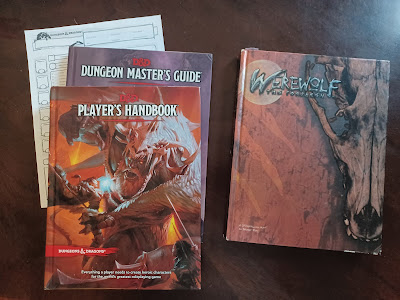
the two core Dungeons & Dragons books stacked next to the first edition of Werewolf: the Foresaken


SYSTEM     Dungeons & Dragons (5e) Werewolf: the Forsaken           
cover tagline = "Arm yourself for adventure."
"A storytelling game of savage fury."
publisher =
Wizards of the Coast
White Wolf
pub. date =
2014 2005
original cost =
$49.95 $34.99
length =
11 chapters / 320 pages
8 major sections / 398 pages
my exp. level =
very much lots
barely any


previous characters and experience

I looked everywhere in our house for my very first D&D character sheet, and I could not find it. and this means I cannot remember or recount to you the mouthful of a dragonesque surname I gave to my dragonborn character who was raised by halflings. her given name was Raffya (like the paper ribbon twine you get at craft stores, but oh so fancily spelled with a y). all I recall of her surname is that started with M and contained multiple Ls and Xs and such.

Dungeons & Dragons was properly introduced to me in early 2016. at the behest of this charming guy I was dating way back then, I obligingly created a practice character (the aforementioned Raffya) as a way of exploring the system and all its creative options. it was interesting enough. meanwhile I watched him run the tail end of an epic Eberron campaign with some Chicagoland friends. there was magic, mystery, love, and looking back I don't think very much of it actually made sense to me as a game with rules. but I would learn.

the first character I actually put into gameplay was called Brickna, a cute little wizarding gnome with colorful hair and rather modest dreams of making it through wizarding school.

around the same time, there was Arxillia Liaholinaii, a talented elf warlock who started out traveling with a local troupe of performers but ended up fighting and adventuring alongside three others for a few months until we had to move and leave that group's campaign. I later heard she was captured by orcs or something, and the DM was toying with the idea of having her return as a villain. I do like to imagine Arxillia's mysterious warlock patron turning her gradually from neutral to evil somewhere along the way... but I lost touch with those friends and never found out her ultimate fate.

not long after that, I built Nadja Gunderson, a human fighter sailor, blonde and tanned and toned, who quested with a band of longtime childhood friends to protect their home from imperial overlords of some sort. when at level 4 or 5 Nadja fell, instantly, regretfully, to a blue lightning dragon, I repurposed the name Raffya for an intrepid dwarf ranger for a little bit in the same campaign.

the next D&D character I made was at least a couple years later, after we'd moved to Louisiana: Juniper Thornspur (June for short), a halfling monk with some alchemy skills. 

much more recently, I played as Lady Lidda Woodsweep, halfling rogue noble carrying on the tradition of arcane trickster magic that flows through her maternal lineage. Lidda had quite an arc, in one of the longest D&D campaigns I've been part of so far. she rescued her elder brother and saw him take up their father's mantel as Lord of Sycamore Keep, liberated (Robin-Hood-style) a ton of gold from a huge corporation, and almost died any number of times. I love her and I loved playing her. I have a bunch of notes for her story's epilogue that I still need to write up one of these days.

then there were three relatively shortlived concepts: Jinxia, an earnest dragonborn barbarian hoping to study more deeply the histories of her tribe; Ilva Ivoryhearth, a vengeful half-elf druid mostly based on Poison Ivy from the Batman comics; and Rylika Aven, a wood elf sorcerer artisan making ends meet with her crafty leatherworking skills. all of these were built for short and sweet one- or two-shot adventures. (why are single-session games called one-shots? I'm not sure. but if anyone has the etymology of the phrase, please do share.)

last but not least, there is Vikki (Victory if anyone's trying to be formal). she's a purple tiefling barbarian entertainer, and she is high in the running for least serious of any of my D&D characters. I modeled her just a little bit on Xena Warrior Princess: showy and brash, forcefully strong and highly acrobatic, awkward at anything that isn't fighting.  

so what does that come to? counting Raffya the first, a total of 11 unique characters. and on top of my player experience, I've helped out with Jeremiah's plans to run one-shot games for family at the holidays, dabbled in running the Curse of Strahd adventure module twice, and presided over my own short and sweet one-shots of Ginny Di's everso whimsical "Bard Behind Bars," once in person and once online, so far.

that's seven years' of experience for you. on top of that, there's all the cultural prevalence of D&D we could pile on, too, from Stranger Things to Critical Role to all the memes that use the basic alignment chart as a frame for funny jokes. also the new movie! have y'all seen Dungeons & Dragons: Honor Among Thieves yet? it's a truly hilarious and wonderful film. go see it. come visit me and we'll watch it together if you want.

on the totally other hand, before this little tournament I had never made any characters for Werewolf, nor even thought about doing so. I hadn't heard much about the game either, just knew it was one of several World of Darkness flavors.
 

new characters etc.

it does feel like overkill to make yet another D&D character, but I gotta be consistent with this, right? I was quick and a little bit slapdash about it, at least. this version of character creation is all too familiar, so thinking through it without writing anything down on paper seemed sufficient. I've never played a cleric or a paladin or a half-orc, so this was a random chance to build something along those lines. let's call her Nyva the Compassionate. she is strong and wise, mostly reserved but with some reputation as a Folk Hero for saving dozens of townsfolk (half-orc and human alike) from a great flood and looking after local orphans. missionaries converted her to an order of extra-selfless paladins just two or three years ago, and Nyva has since traveled the realms doing as many good deeds as she possibly can.

there. will this inspired half-orc appear in any future gameplay? we shall see. she rounds out my dozen D&D characters interestingly, at least.

for Werewolf, I created two brand new characters. since Werewolf is a World-of-Darkness system, it seemed fair enough to shortcut half of this character creation process by repurposing the normal rock-climbing human Briella (previously mentioned in the first match-up) as a template of sorts. (confession: I've used her as a base for my new Mage character, too, and I'll very likely also make her into a changeling and a vampire when the time comes. why not?) 

Ella in this shard of the multiverse is still herself, but Changed by the fate of the half-moon into a sharper, even more driven creature. she knows when you're angry or lying or guilty, and she is not afraid to boss you around. 

I also created Mr. Ryan Booth, a scrawny hacker dude for whom his werewolf powers give him even more charisma, insight, and control of technology.

since I'd never played any of this game at all before, dearest husband was graciously willing to run a short one-shot of Werewolf for us the other day. my two prototype characters + four others were added to a pre-made roster for me and two other friends to choose for the game. I ended up playing a strong, extra-tall, extra-spiritual Taylor Grettig, whom I pictured as a mashup of Brienne of Tarth and Luna Lovegood. my tournament characters Ella and Ryan served as fun NPCs. by the end of the session, after a few gripping battles and cunning investigations, our pack of werewolves restored balance to the natural and supernatural aspects of Jerome, Arizona, but not without almost losing our alpha in the process.

aesthetics

what else can I say about the solidly Tolkein-ish legacy that D&D has been built on? we could call it classic. or maybe neoclassic, in a way. indeed, it reminds me of all the romanticizing of medieval times that goes on in western art and literature (i.e. let's tell stories of gallant knights and fairest ladies and idyllic countrysides, but just for fun ignore all the plagues and injustices that don't fit the picture). this is rather an oversimplification, I know. of course of course games don't have to be "historically accurate," whatever that means, and neither do stories-- not all of the time. I'm making observations here, not logging criticisms quite yet. 

the D&D books exude bright and striking contrasts-- rich shadows and vibrant magics all layered on top of each other. the worlds and realms of this system come with a certain clarity. maybe it's in part because D&D is so popular, so ubiquitous: for whatever reasons, you tend to know what you're getting. it's a sturdy, robust, serviceable high fantasy, with a multitude of opportunities for exploring and fighting as heroes, for saving the town, saving your allies, saving the kingdom, or saving the whole world. it's not a simple or limited fantasy world by any means, but its range flows out within the lines of a culturally predominant kind of storytelling, for the most part. good guys vs. bad guys, rinse, repeat. there are caverns and monsters, magic and danger, but more than enough courage and pluck to vanquish it every time. sometimes there might be poignant costs to pay. but the heroes will always see victory. D&D is an optimistic, mostly cheerful sort of fun.

Werewolf is obviously much more focused and the boundaries of its world are colored with more muted tones: earthy, rusted, teeth and bone. the lore and folklore evoked by Werewolf stretches back eons farther than any pseudo-medieval age of heroes. we're talking ancient, echoing myths, seemingly infinite and inescapable. the moon's subtle glow filters into this world through layers of prehistoric legend. this isn't high fantasy. it leans on the grungy urban fantasy of World of Darkness and gives it an almost pantheistic tinge of spiritualism. everything has an underlying spiritual essence, and that essence has agency and personality of its own.

to play this game, your character must be or become a werewolf: a member of a Changed supernatural people sworn to respect the honorable old ways of their tribe, their pack, their lunar auspice. maybe your werewolf will be a hero, but it's not necessarily the bold, relatively more colorful Tolkein-esque hero D&D would have you play. I wouldn't call Werewolf optimistic in at all the same way. 

what both systems tap into, for me, is a sense of power. physical and supernatural powers are out here for the taking in these two games. for Werewolf it seems a raw, overflowing, barely-civilized power, frightening, at times violent, difficult to control but undeniably holding everything together somehow. part of the vibe of this game is whether or not you can find balance in your existence as part wolf, part human. 

for D&D the power we're playing with seems just a little bit more refined-- a power accessed through just the right steps, through hidden doors, magic books or months of training. the edges are sanded off a little. it's measured and glittering like lightning caught in a shard of crystal or starlight coaxed into a polished jewel. am I working my way into a metaphor where Werewolf is bare-handed street fighting and D&D is olympic fencing or something? well, not quite. but maybe sort of.

mechanics

like World of Darkness, Werewolf uses ten-sided dice and the same basic stats and skills and willpower, with modifications depending on which form the character may shapeshift into (human, near-human, wolf-man, near-wolf, and full wolf). there are also custom advantages and gifts that only werewolves have access to. they channel magic of a sort through contact with spirits and spiritualized objects. each werewolf earns dots of Renown in one of five categories, and these memorable feats contribute to that character's visible reputation, kind of like gang tattoos or ritual scars, but more mystical. they also have points of essence and primal urge that inform how powerful or capable they are. the Virtue and Vice system also functions here just like it does in regular World of Darkness.

health points work a bit differently for werewolves, which I find very cool. werewolves heal fast. even lethal damage goes away naturally within 15 minutes of in-game time, as you regenerate health at the beginning of every turn. if you choose to spend an essence point, you can regenerate even faster.  

this is partly why I have a sense of Werewolf as a game of power. they have heightened senses, buffed strength and speed, magic rituals and innate regenerative powers-- it feels like werewolves can do anything far more easily than anyone else can.

I'm sure in a longer series of play sessions that sense of power would have been tempered by various mechanics we just didn't get a chance to deal with in our one-shot. shapeshifting too carelessly can induce Lunacy in humans around you. essence points don't last forever. and instead of regular human morality, werewolves are bound by the rules of Harmony: an ethics system meant to measure the balance (or lack thereof) between instinct and reason, spirit and beast, tranquility and rage within each werewolf. sins against Harmony might cause derangement. and on top of all that, there's your legendary weakness to any pure silver weapon or bullet.

-

D&D characters are built with three main foundations and some very mathsy framing to hold it up for gameplay. we have 9 basic races (dwarf, elf, halfling, human, dragonborn, gnome, half-elf, half-orc, and tiefling), 12 basic classes (from barbarian to warlock), and various backgrounds (from acolyte to urchin). and this is exactly the order the book would have you choose each element-- race, class, and then background.

the options you choose here will influence your six ability scores (strength, dexterity, constitution, intelligence, wisdom, and charisma), and these, in combination with other proficiency bonuses, will influence all other skill modifiers, maximum hit points, initiative, attacks, and defenses. on top of that you can acquire weapons, armor, and other equipment of mundane and magical aspect, some of which will add bonuses to your skills as well.

the book outlines D&D gameplay using three-ish categories: exploration, social encounters, combat encounters, and downtime. given the flexibility of RPGs, any given session or campaign might have more of some and less of others. in my experience, most players seem to expect and enjoy at least 2/3 (or more) combat encounters, with everything else filling in the other third (or less) around the edges. combat is some of the most exciting gameplay in this system. it can be an intense context for creative, critical thinking. and the dice keep everyone on their toes not knowing exactly what will happen.

the most important random number generator of D&D is the twenty-sided die. for most significant actions in this game, you'll roll a d20 and add a modifier depending on which skills or tools you're using to do the thing. the magic crossbow gives your attack a +8 to hit? add that number to whatever your d20 roll gives you. higher rolls with higher modifiers added are more likely to succeed, but it always depends on how difficult the task is to begin with.

there are other dice, of course. for various other rolls in D&D (damage dealt, hit points regained, hours left until you can cast that spell again, etc.) you need at least one set of seven (1d4, 1d6, 1d8, 2d10, 1d12, and 1d20). friend Patti, I think it must have been back when I was working on the board game version of The Plaid Identity, gave me my first set of dice. they are black with speckles and I still have them all (accompanied by many more at this point). thank you Patti.

approachability

the Player's Handbook for D&D is a slim, easy-to-read, well laid-out manual. decent organization and decent cross references for most stuff that needs it. and though it is not the only D&D book there is-- far, far from it-- it is the only one you really need to play. the rules and mechanics are easy enough to learn, though I do think different classes come with different levels of complexity. not every player is going to love having to keep track of which spells their character decided to prepare every in-game morning, for example.

the ubiquity of D&D of course makes a difference here, too-- there is a ton of support and help and overall enthusiasm for D&D plastered in easy-to-find spots all over the internet, from twenty-year-old forums to yesterday's reddit posts. there are apps that can guide you through character creation and gameplay. there are probably a hundred or more unique actual-play streams or podcasts or youtube shows for you to reference. there is merch of all kinds. almost anything you could ever want to talk yourself into. and the existence of all that is both cause and result of its popularity by now. you probably know at least one person who has done some D&D-related things at some point in their lives. overall it means pretty low barriers to entry for any D&D newbie. if you have any earnest desire to play this game, you have no excuses.

the Werewolf rulebook isn't much longer than the Player's Handbook, and for the most part it is just as well organized. but to be fair, the first edition of Werewolf: the Forsaken isn't so common anymore, nor so widely popular as the opponent I've set it up against. and for Werewolf to work as intended, you'll also need the prerequisite World of Darkness core book to get started. that's a bit of an extra hurdle, but only a bit of one. 

the extra rules of Werewolf are interspersed with plenty of short, moody vignettes and other, shorter introductory sections that set up the ancient gameworld contexts that function as in game mechanics. some of the font choices for one or two vignettes are perhaps a little audacious, the contextualizing lore sections perhaps a little too heavy on the italics. nothing major. I also felt that the order of things wasn't as smooth or intuitive as I might have wanted it to be, but only in quite minor ways. there are a good handful of decisions to make and lists to consult during character creation-- which of five lunar auspices will mark your character? which of five tribes will they belong to? which handful of possible advantages and gifts will you choose? it may seem like a lot for some, but it's all part of customizing the experience.
 

preliminary verdicts

of these two RPG systems, Werewolf is currently a smidge more intriguing because of its relative novelty. but of course it is hard to resist the massive phenomenon that is Dungeons & Dragons. I have already logged hours and hours of fun, engaging, dramatic, moving, often scintillating gameplay with good old standard, core-rulebook-only D&D. it's been around (in general and for me) for so much longer. it has become so ubiquitous, particularly in its 5th edition, for good reasons.

Werewolf though-- it's so unique. and even our basic, zero-XP, no-frills characters were rolling very exciting dicepools of 6 or 7 d10s on a regular basis during our very first encounters, which felt very cool. the spiritualism of the world was intriguing and a little creepy, almost evoking a sort of Studio Ghibli style abundance. and that's what I generally love about all the World of Darkness games I've played-- they get to be so consistently vivid. the imagery of them lingers most satisfyingly in my mind.

so I'll mull over this comparison while I write the rest of my reviews. stay tuned.

next new one-shot (tomorrow!): Scion: Hero

next match-up review (this week, I'm hoping): Pathfinder 2e vs Mage: the Awakening

Friday, August 19

quests

one of my many indulgences this summer was the game Horizon: Forbidden West. I loved the first Horizon game when I played and replayed it some years ago. its sequel is just as great.

the art is most glorious, with characters and cultures designed so carefully, so fascinatingly. and most key of all, the gameplay is fun and challenging and relentlessly open-world. we get to play as the obstinate, fearless Aloy, the redheaded chosen one, journeying through the wilderness to literally save the whole planet, heroically helping everyone she can along the way.

I can't quite tell if Forbidden West is more challenging than its predecessor or if I'm only feeling that way because I've successfully beaten the first one twice but have only made it through maybe two-thirds of the sequel. who knows.

some weeks ago I did make it all the way through the main story, but there are at least half a dozen more side quests. maybe more I haven't even discovered yet. fingers crossed I'll have time to play more once the fall semester starts.

almost since the opening cut scenes of this game made its themes so beautifully clear, I've wanted to blog about the analogue between its plot-setting and our own impending collection of climate disasters.

on this version of earth-- far, far in the future--we venture forth to explore and fight and piece together clues amid poisonous red vines, blighted land, thick storms, and corrupted machines making all of it even worse. the communities Aloy encounters tell of ruined farmlands, deepening scarcity, increased violence among the western tribes. barren sand has swept over most of what was once Las Vegas. the sea level has risen to bury San Fransisco. the earth is becoming less and less hospitable.

the game reinforces these threats in mild but consistent ways for the player. if you set foot on the red blight, your character coughs and sputters, losing health points little by little. it's not uncommon to find the bodies of birds, boar, and other wildlife struck down by those deadly vines. when you hunt, you might harvest blighted meat just as often as rich game.

Horizon: Forbidden West presents an open world, with lots of choices about where and what you'll spend your in-character time and effort. but it has limits, too. structure. boundaries. edges-of-the-map.

in real life, we have fewer of those, in some ways. we have real physics and real mortality, but there are no big blatant textual warnings that "you are now leaving the play area. turn back or your unsaved progress will be lost."

in real life, the consequences aren't spelled out like that. not so neatly. not most of the time. 

... or maybe the warnings for us just look different. maybe they are somehow differently blatant. if we pay close enough attention.

aerial view of Lake Powell -- very low water levels 

in real life, how to prevent the worst disasters of climate change is huge and complicated and uncertain. we know we have to do something, but it's overwhelming to think through which exact actions are really the best.

how nice it might be if we, like Aloy and her determined assembly of allies, had a clearly designed path we could follow to save our planet?

follow these clues,

... learn these facts,

.... bravely collect these specific resources from these dangerous conflict zones,

... simply reupload this set of technologies, programs, protocols to reboot this essential system,

... and then watch the world settle swiftly back into equilibrium with itself.

that would be fun, wouldn't it? so rewarding. so simple. 

but games are not like real life.

yesterday I watched Mr. Hank Green walk his audience through the recently passed Inflation Reduction Bill. Hank Green is smart and optimistic and it's a useful video.

games are not like real life. nobody is out there handing out step-by-step instructions for saving the world. we are not disposable video game characters stuck in the gears of a predetermined plot. 

pros and cons, eh? we get no easy checklist of instructions for succeeding at this or that quest... but nor is our path set in stone. nothing written in the stars or the script or the code of the world no matter what. (also no completely malicious, evil, alien masterminds hellbent on destroying everything, either, thankfully.)

life is life. we have to figure it all out on our own. not easy. but hopefully not pointless. 


did I mention the art of these games is glorious? someday I will buy this art book (ooh, this one will be out next year to accompany it, too...) and be able to admire it all off screen.

Tuesday, July 5

what is in a name?

as promised, I have written up and organized many, many, many photos for a full stand-alone page chronicling my adventures (so far) with this lovely old spinning wheel, now posted neatly alongside my about page and a draft/test page for an audio workshop I hosted once upon a time.

before: a disassembled saxony spinning wheel, dark with grime
{ before all the learning about and cleaning of }


the spinning wheel, all cleaned up, reassembled, and almost functional
{ after all the cleaning and fiddling and reassembling } 

she needs one more replacement part and much more practice before she produces any yarn at all. so in the meantime, I do wish to solicit your opinions on her name. I'm weighing these three options at the moment...

Lydia, (after my father's maternal great-great grandmother Lydia Ann Taylor, 1852-1888),
Charlotte (after another of my father's maternal great-great grandmothers, Charlotte Amelia Van Orden, 1828-1895),
or Phoebe (after my mother's maternal great-grandmother Phoebe Rebecca Reynolds, 1863-1922)

...but at any point I could decide that Selina (after my mother's paternal great-great-grandmother Selina Tibbs, 1817-1891) or Florence (after my father's paternal great-grandmother Florence Charlesworth, 1879-1931) are worth considering. those two remind me a bit too much of a town in Kansas + the famous British nurse, respectively, but who knows if some quirk of my spinning wheel's personality will nudge them into the running.

Wednesday, June 22

the best crochet hat

in December, as part of my end-of-semester/birthday/holiday celebrations, I picked up a simple drop spindle and two 4-ounce packets of Kraemer Mauch roving in two colors-- "pomegranate" and "oregano"-- from my local yarn shop (Fiber Creek).

and then I used all the youtube videos and blog posts to figure out how to turn it into yarn. I'm still learning, practicing, and enjoying the simplicity and beauty of the whole process. add twist to bits of fiber, and it becomes something else.

one mini-skein of lumpy yarn and one medium-small skein of nicer yarn, both pomegranate pink

something differently usable.

and now this is what I'm using that pomegranate pink yarn for. a lovely crochet hat.

mid-June in Arizona is not a time one needs a hat, but that's okay. what else does one do with only 140 yards of handspun pink yarn?

this is the hat pattern I love, from a blog called Yarning for Sanity. I make mine less slouchy than the photos there show, and it fits my head and hair and face just delightfully. I have made several hats from this pattern and at least two (one red, one grey, and maybe a blue one too?) are currently kicking around in our coat closet. 

I love the hat this pattern makes, and I simply love the pattern itself (though on this work-through I have made a few adjustments that make the V-puff stitches line up more thoroughly from beginning to end). this crochet pattern ultimately writes itself into the object you're making as you make it. once you're five rows in, you don't need the words anymore-- the stitches become readable in themselves. it's easy enough to remember what goes where at which intervals. otherwise, just a few quick references to check row counts is really all you need. lovely.

the idea of reading objects is very cool. reading craft projects is especially cool-- at the very least it makes it easier to know what you're crafting and whether it's coming out as it should.

and with regard to others' knitted objects, in if a given piece of knitting is legible enough and a given person is literate enough in knitting stitches, that's magic. inspiration! reverse engineering! creative remixology and all that.

is it silly to think of reading physical crafted objects as a sort of craft forensics? taking a static scene and seeing through it into the preceding processes? all objects, after all, can be considered slow events. we can look at an object, or a piece of content, or a work of art, as just that... or we can try to look through it and see how it came to be.