Showing posts with label futures. Show all posts

Monday, February 2

books books and more books

at the end of last summer, the family gathered on the edge of Idaho and Utah to see my paternal grandmother off on her journey from this world into wherever we find ourselves after. 

from among grandma's things, I was bequeathed an old 70s-style woven and leather bag (I have vague memories of grandma toting her students' papers and homework sheets and such around in it, once). most weeks now, at my house, it is a perfect home to my choir music and a bit of spare lip balm. 

but before I brought it home, more or less just as my dad handed it to me, I found a highlighter pen and a few scraps of notepaper in the bag's many pockets. one little note was a list of medications. the other was a list, in soft, properly-formed cursive pencil, of authors and a few titles:  

G.G Vandagriff
Lynn Austin
Thomas Perry
Linda Nichols - Not a Sparrow Falls 
Chris Stewart - The God of War 
Ted Bell - Nick of Time 
James Kunstler - World Made By Hand, The Long Emergency
Angie Sage
Jessica Richard Draper
Beverly Lewis

and then, in pen at the end, written slightly larger, 

Diana Crawford

when I got home and had a minute, I looked them all up in my local library catalog. of the available options they had for me to put on hold, only one author seemed interesting enough-- James Howard Kunstler. I've read three of his books from the World Made By Hand series now.

they're pretty neat. not all that earth-shattering, as far as post-apocalypses go, but well enough written and engaging. against the premise of oil-shortages and societal collapse, we have a tapestry of colorful characters surviving together. every horse that is mentioned gets described specifically by breed. every antique piece of furniture is given all the fancy labels an auction catalog could ever ask for.  

did grandma ever read these too? I'm not sure.  

I do know we both liked making things by hand from time to time. 

maybe I'll get my hands on some others from her list, eventually.  

more recently, I've been poking around at the short list for this year's Tournament of Books. I got my hands on Bunny so that We Love You, Bunny would have more context. not sure I liked the first-- its ending was pretty interesting though-- and we'll see how much patience I can muster up for the self-absorbed and anxiety-ridden MFA student collective that seems to be narrating the next one. at this rate I won't have time to read anything else at all in advance of the tournament, but so it goes. 

at dear friend Angela's house last month I perused her library for just a few moments and was tempted by a pair of slightly chubby fantasy novels by Naomi Novik: Uprooted and Spinning Silver. they were just the thing to offset the stress and chaos of a new spring semester. good, deep historical fantasy with rich cultural flavor and complexity of character-- I loved them both so much. the second especially so. it would look gorgeous in a video adaptation, I bet.

so of course now I am in a serious obsession with Naomi Novik novels. the other day I finished, too soon, the audiobook of A Deadly Education-- the first in the author's Scholomance trilogy. I loved it so much I think I'm having withdrawals from the world and the voices and the magic of it. it was all so vivid and gritty and perfect. please let the second and third audiobook copies arrive quickly via Libby, please. 

on paper, the series didn't sound that interesting. it is more than easy enough to think we've had enough wizard highschool stories, yeah? 

I'm glad I borrowed it anyway. it is a darker take on the international wizard school trope, but not at all trite or twee or annoying. I found it thoroughly enchanting, with superb world building and expertly balanced first-person narration. we inhabit for 13 well-paced chapters a snippy, mixed-race protagonist named Galadriel (El for short) who somehow, despite being perfectly stubborn and rude to all her classmates, is eloquently self-aware enough with her narrational monologues to come across as relatable and even likeable. I kept thinking of this as Kuang's Babel meets Harry Potter meets Wheel of Time. maybe. not the most apt comparison, I'm sure. ah well. 

books are awesome.

what have you been reading lately? 

Friday, March 14

plans for a tournament of pies

a folded length of blue flannel fabric with butter sticks printed all over

we have been over my haphazard recipe cataloging skills before. did I ever think I'd need to change my habit of just sorting through a pile of recipes-written-on-the-backs-of-whatever to find the one in the handwriting of a lovely Canadian on a square-ish grease-stained piece of blank notepad paper? not really. it's a fine enough system. I know how it works.

but nevertheless, one of my current projects is to sort out all the recipes I really want to keep from the pile where they sometimes mingle with too-ambitious recipe printouts that I only thought I might want to follow someday but never have, to rewrite any that need to be rewritten, and then organize them all into proper usable sections. the fat yellow folder that used to hold them has long ago been repurposed for something else, and I've kept recipes since then in a little black binder. or in a manila folder in the cupboard. or bookmarked in my phone. it's messy.

for my last birthday, Jeremiah bought me some butter-themed fabric with which to cover the new recipe binder, as soon as I might get around to it. there are a handful of savory dinner-esque recipes to finish sorting and writing out to fit. all the more fun things like brownies and brunches and custards and pies are already done and filed in a sort-of-thematic-sort-of-alphabetical way in their sections.

pies are my favorite things to bake. my mother's pie crust recipe almost doesn't need to be in the recipe book, because I've memorized it by now and could probably mix it up blindfolded if I needed to.

and ever since the tournament of RPG books a few summers back, I've been pondering what else to write tournament-style reviews of... so why not pies? it's perhaps not quite as ambitious as this neat pie-baking project (also far less likely to get a book deal, I assume...), but pretty fun anyway.

baking sixteen pies is a lot though. and for a proper tournament experience I might need to bake the winners of opening rounds multiple times as they advance in the bracket... so... I am still not totally sure how I'll plan this out, schedule all the celebratory pie tastings, ration my supply of butter and eggs properly, and all that. but I have gotten as far as choosing eight savory and eight sweet pies which could contend against one another:

chicken pot pie,
shepherd's pie,
mushroom and barley pie,
vegetable cornish pasties,
tomato corn pie,
squash galette (this one or this one? hmmm...),
quiche (not sure what type...),
spanikopita;

and 

pumpkin,
mixed berry,
cherry,
peach,
apple,
key lime,
french silk,
banana cream.

I do not like lemon meringue so it is not invited, even if it is a very classic variety of pie.

what I haven't decided yet is which pies should face which other pies to start with. and should we narrow down all the sweet pies to one, all the savory pies to one, and have those winners face off against each other? or would it really be more fair to have them share the victory?

it hardly matters, since it's all just a silly excuse to bake and eat 1.3 dozen pies (or more) in some too-short span of time. I'll figure it out at some point and see how it goes.

today is pi/e day, which is a great day for baking pies (or for talking about math and Greek letters, a la the legendary Vi Hart-- who seems to have taken down all their great pi- and tau-related youtube videos from back in the day. odd, but I can't say I blame them). but alas, I am not organized enough yet. maybe for next year I can time everything to announce final winners on Saturday, March 14, 2026. let me know if you want to come visit and share the responsibilities of pie-judging and dish-washing with me next year.

Friday, February 28

another spring semester

so far, this corner of the world has felt abnormally like spring for the past eight weeks, save for two days of snow-dust several weeks ago. everyone is dreading how dry and fire-prone the whole area is going to be through the summer. let us hope we have a few good monsoons in store at some point. please?

eight weeks since classes started means that half the semester is over by now. but I can still blog about a new semester even when it's halfway over, right? why not?

there isn't much to say. this semester is basically a repeat of two years' ago's with only minor updates. one section of Technical Report Writing (this time with extra usability and UX flavoring), one section of The Art and History of Podcasts (quite a bit improved since my first semester teaching it), and plenty of other academic work on top of the usual teaching: meetings galore, emails that should not be so draining to read and write and manage, various professional development adventures, research and writing of my own in small snippets.

I enjoy this teaching career, such as it has become for me, because it involves so much learning. or at least I always used to think so and say so. am I still learning anything? am I still enchanted by the process of stretching my brain in new directions, of finding little corners of wonder amongst all the mundanity of things, like it seems I always used to be? well yes. mostly yes. students and colleagues say things all the time that make me think new thoughts and appreciate new things. their questions and my questions often join forces in pretty excellent ways. it's fun.

novelty seems rarer, these days, though. there is a lot of sameness, and it feels far too easy to let the sameness subsume everything else. do older brains prefer more sameness, I wonder? or does accumulation of experience just mean that any novelty we find is easier to handwave away as not-really-that-interesting-after-all-actually-kind-of-just-like-that-other-thing-I-already-know-about? or maybe our comprehensive eyesight starts to fade somehow, rendering us less able to appreciate shining novelty even when it's just as plentiful as ever?

I'm not sure. 

what is new and notable for me lately?

with enough time and energy, and given a wide ranging definition of "notable," I could list so many things. an onslaught of information from news and social media and instant messages. knee-jerk reactions and opinions and maybes in response to all of it. the absurd loveliness of a few calm, rich summery days in February. bundles of anticipation accompanying sprouts and buds and new greenery underneath dried leaves. earlier sunrises and later sunsets. a recent trip for work to Albuquerque, including a not-for-work visit to this cute new fiber arts shop. (I bought 300g of a wool/viscose blend called "crumpet tweed." awesome name, eh?)

also, 'tis the season for (a perhaps ridiculous amount of) excitement about the tournament of books. it starts next week!

I've read only four of this year's contestants (which is four more than I usually manage to read before the opening rounds): 

The Book of Love, by Kelly Link

James, by Percival Everett

The Wedding People, by Alison Espach

and Beautyland, by Marie-Helene Bertino

I read them in that order, because that is the order in which the library served them to me--three in nice new hardcovers and one (The Wedding People) as a short and sweet audiobook. now that I've finished Beautyland, I really need to relisten to the So Many Damn Books episode about it

do I have a favourite? do I hope one of these four wins? it's hard to say. James and Beautyland have the most depth, I think; I read them both quickly and could see myself reading them again someday. the other two were excellently enchanting to me though, and both The Wedding People and The Book of Love delighted me with their neat and just-twisty-enough plots. 

but I don't like to make predictions. if I fill out a tournament bracket in the next six days it will be as random as anything might be, and I will not be attached at all to the idea of my random picks matching up with the true official judgements.

let's just see what happens next.

Friday, October 18

bunny vs. fence

the other day, this lengthy stretch of fencing (branded nicely enough with so much black, white, and red to represent the construction company Sundt, whose slogan seems to be three standalone words, "Skill. Grit. Purpose.") went up all along the drive that goes between my academic office building and various parking lots between here and places off-campus.

I'm told that they'll be building a new dormitory somewhere on top of the rocky, scrub-filled gully on the other side. it'll have more student housing and more classroom space. so cool. so necessary. 

some of us in my academic office building are mildly worried that this new construction will block our most excellent west-facing views of Granite Mountain. we shall see, I guess. I remain hopeful that the slope of this gully will mean the top of the new dorm will be low enough for us to look over from our third floor offices.

as I walked back out from my office to my car last Tuesday, I noticed a little grey-brown bunny frantically searching for a way through the fence, up and down the hill in short bursts, back and forth over the blaring red curb, every so often sprinting for its life all the way across the road back to the unfenced rocks and bushes to the east.

I watched it for a solid few minutes. it hopped away in panic from my slowed footsteps, then dashed in further panic across the path of someone's big white SUV driving up past us both. 

I didn't see the bunny come back that evening. so I studied the fencing as I walked. surely one little bunny would eventually find a gap to squeeze under, I thought. (the creatures seem to squeeze through pretty tiny gaps in our back garden gate, after all.)

if the chainlink were bare of this black branded tarp, then could a little bunny more easily get through? or if the corners of each fence panel were less square and more rounded, that would surely help.

I wonder if any of the planners and facilities and maintenance people worried about the impact of this construction project would have on the non-human critters in the area. hopefully at least a little bit. probably not as much as they worried about other aspects though-- the costs of labor and fencing and other materials; the design and the blueprints and the building's whole physical footprint; and the timing and logistics and how soon they can start selling spots in the new dorm.

at the bottom of the hill, the fence merely ends,. for now. the sidewalks remain open and the parking lots in regular use. for now. if the bunnies are persistent enough, they will find their way back into their hideaways in the scrub-filled gully. 

and hopefully they will all find new hideaways once the gully is dug out and filled with a bunch of concrete and whatever else dormitories are made of.

and if not?

they're just bunnies. some of their cousins, whichever side of whichever fence they've ended up on, will replace them soon enough.

Wednesday, September 18

three sisters

over the past few months I've been devouring audiobooks on the weekends. I basically listened to Stardust in one long stretch on a Sunday, knitting and gardening and crafting and tidying the house as I did so. (in the meantime, my backlog of podcast subscriptions is somewhere close to 100 hours. trade-offs, eh?)

there was plenty of Tana French and a bunch more Barbara Kingsolver too. and then, friend Michelle recommended Alix E. Harrow's Starling House somewhere around the end of August. I loved this book, despite its few melodramatic tendrils of YA-ness, which honestly I cannot really fault it for anyway. the ending was excellent and poignant and deep and gritty. so, so good.

I'd heard of Alix E. Harrow quite a bit, so I somehow assumed she'd been around for many years and that I was super late to the fangirl party... but nope, her first novel was published only five years ago. (I just finished listening to that one too-- The Ten Thousand Doors of January. it's a most adorable and fun adventure indeed.)

by the grace of my library audiobook app, I ended up making my way through Harrow's novels in reverse order. her latest, Starling House, first, with its echoes here and there of Kingsolver's Appalachia, sketched in words as vibrant, shadowy, heartbeatingly real and more-than-real. 

then Libby handed me The Once and Future Witches.

a fairly trite title with many echoes of its own-- will we get any scraps of Aurthurian ledgend here? 

I wasn't sure what to expect but this story drew me in completely and I was marvelously invested in all of it pretty quick. the book rotates among the points of view of three sisters. eldest, middle, youngest-- maiden, mother, crone-- each with her own ferocious sense of how the world could be, if only... 

and there is real magic. witching. spellcraft bubbling all through this alternate New England at the end of the nineteenth century. so cool. the story as a whole pulls and pries and re-weaves so many other stories into itself. I loved it. and before long it made me think of my own sisters.

I have two sisters. I don't often consciously think about the fact that two sisters means there are three of us. 

I've given us epithets before though, not realizing the cliche of it. one of us is the fearless one. the popular one. the clever one. the pretty one. the smart one. the nice one. or at least it's kind of neat to boil our essences down like that, sometimes.

The Once and Future Witches leans a fair bit on this concept for its central three sisters, and to some extent for the other trios of women who show up along the course of the plot. Bella is the wise one, the scholar, the librarian, the eldest. Agnes is the strong one, the independent one, the middle child about to have a baby of her own. and June, the youngest, is the wild one: rebellious and untamable, and most naturally talented with witching. 

three witches. such a ubiquitous trope. three itself is practically a trope, right? the rule of three. beginnings, middles, and ends. it's a sturdy, solid, sustainable prime number, lending its lovely balance to three-legged stools, three-corner hats, three primary colors, and a bunch of other things. witches. sisters. bears. pigs. amigos. stooges. musketeers. branches of government.

does one of the three being wise mean the others are necessarily less wise? or does the beauty of one necessarily outshine that of the other two? cannot three sisters be more or less equally strong?

yes and no. maybe. maybe not. it depends on how you measure these things, I suppose.

of course I also thought of Pratchett's three witches-- Esmerelda Weatherwax, Nanny Ogg, and young Magrat. perhaps I should reread their books to see how his version of the trope look to my 20-years-older perspective.

what would my sisters and I do if we had magical powers? so many things, I imagine. our circumstances aren't so neatly intertwined and story-arced as those of the sisters in this novel, but I do like to imagine we each have our own ferocity for changing some little segment of the world. 

and I've got brothers too. four of them. how does that change the math and dimensions of the trope, I wonder?


Saturday, September 7

unknown or reknown

thinking about my grandmother lately, off and on, I sometimes puzzle over how close and also how distant she seems. her birthday is coming up in a few days.


this painting (well, this print of a painting) hung over grandma's nice upright piano for as long as I could remember. and now it hangs in my office/craft room/guest room. 

I feel so grateful to have inherited this art, and I do not care one bit that it is a relatively commonplace mass reproduction. the light and shadow and movement of it say something-- something too immediate for words. I don't think my sense of this is just nostalgia, though there are indeed decades of memories sprinkled on whenever I look at it. 

today I looked up the name and artist engraved on the little plaque, for the first time. Moonlight Sea. Peter Ellenshaw. he did a lot of these beautifully peaceful ocean horizon paintings, apparently. prints like mine seem to have been pretty popular in the '50s and '60s. 

before then, Ellenshaw also worked as a matte artist for plenty of old films, inncluding 1959's Darby O'Gill and the Little People and Mary Poppins too. did grandma know that, I wonder? I only know it because the internet and Wikipedia exist at my fingertips. 

but I'm sure my grandma had so many other ways of knowing things. 

it's funny what our brains remember or don't. or think we remember. 

this grandmother was the first person to wink at me, as far as I recall. the full conspiratorial meaning of it was likely lost on me as a child, but it felt fun and silly and made the moment into a story. 

my other memories of grandma are a montage of bright and faded. so many quilts for the chilly basement bedrooms. green grass and a clothesline. frozen whole wheat waffles. cereal on the top shelf of a gaping deep dark pantry. sitting on the cement steps for photographs. plastic toys on a thick, round, stripey rug. and her voice piping up if anyone looked at any corner of that piano--a little raspy but bright and cheerfully insisting-- 'play us a tune, won't you?' 

and usually someone would. 

perhaps the strongest, deepest memory I have of that house, just a stride or two left from the piano and its painting, is the narrow closet full of toys and games and books (among them, this old woven fairytale). 

maybe the closet still has books and toys in it. newer ones, if any. the whole house looks hugely different now from how it did when I was young. there are no photos of the closets in the listing... but a closet of games and books for visiting tourists could make sense, couldn't it? 

I find myself wishing that I knew more about what my grandmother thought of this painting. where did she get it? was it bought, or a gift? did she see the same things in it I think I see? would she have better words for its movement and shadow and light?

she would have been 96 this autumn. 

if I live that long, I'll get at least 56 more autumns (hopefully, anyway. I hope I always live somewhere with a proper autumn.)

.

in other news, there are twenty standard weeks until this little blog turns 20 years old.

and then what?

Tuesday, March 26

Kingsolver and current events

almost six months ago, my attention was drawn to all the conflict in Palestine more than it ever had been before. a house down the road from us began flying an Israeli flag all of a sudden. half of all the social media posts are still imploring everyone to speak up, to choose a side or else by default choose complicit cowardice. the news of October 7 and all the terrible news since has been rightly hard to ignore.

since December, my old land acknowledgements post from the summer of 2020 has been oddly popular. the basic stats in blogger tell me it's gotten more than 100 views within the last 30 days. by comparison, a typical post here in this random collection of internet musings gets fewer than 20 views and that's it. but this old post has consistently seen around 30 hits per week for several weeks now-- I'm still not sure why. is it because phrases like "colonial ruin" "violent displacement" and "racist horribleness" are highly topical these past months? I've let my proper Google analytics account languish without updates for too long, so I don't really have a way to find out.

also about six months ago, I was reading Barbara Kingsolver's Prodigal Summer. a lush and lovely novel--a braid of stories all about our relationships with land, trees, animals, nature, and each other. biology. ecosystems. extinction or conservation, and all our efforts inbetween.

there is plenty I've so far remembered about this novel, but the thing I've most wanted to blog about here is a pair of sentences in the middle of it. they are sentences about Jewishness and prejudice and history.

Lusa, one of the three point-of-view protagonist characters in this story, is half Polish, half Arab. she marries blissfully into a struggling-but-resourceful family of appalachian tabacco farmers, too soon loses her husband, inherits his parents' old farm house, and faces various tensions and pressures from her local, white, rural in-laws as a result. 

I keep thinking about this line of dialogue from one of Lusa's chapters. she's talking earnestly with the one in-law, a nephew, she feels closest to. 

"That's what I was thinking, too. Families lose their land for a million reasons. My dad's parents had this wonderful farm in Poland, which they lost for being Jewish. And my mother's people got run off their land for not being Jewish. Go figure."

this pair of contradictions struck me, as I read it for the first time in fall of 2023, so much more definitively and potently than it might have at any other time.

and when did Kingsolver write this? my idle curiosity is easily answered: Prodigal Summer was published almost a quarter-century ago. in October, 2000. 

from devouring her other early novels (Pigs in Heaven, Flight Behavior, Unsheltered), I know Kingsolver has a deft way (sometimes subtle, sometimes less so) of commenting on potentially controversial political realities-- like this seemingly endless conflict in the middle east, or like the relative failings of public education, or like the impact of settler colonialism on indigeneous families, or like the nonsensical state of US healthcare systems. 

in October of 2000, I was an almost-17-year-old. what on earth did the words "Israel" or "Palestine" mean to me then? the first I only knew from a bunch of biblical prophecies and hymns, the second from Laurie R. King's A Letter of Mary (1997) and O, Jerusalem (1999), if indeed I'd really heard of Palestine at all. in neither context did I think very critically about what these stories meant. honestly, I was probably quite detached from both versions of the place. their respective peoples. they all may as well have been equally, ineffably, untouchably fictional.

halfway between then and now, I must have seen this rather haunting animation make the rounds on the internet. you've probably seen it, too.

unsurprisingly, there are dozens of new comments on that page since the events of last October.

looking into the piece again this past week, I realized that a full-length film version was produced and likewise donated to the public domain in 2018. do I have the time and spiritual energy to watch it? hopefully someday. (I've also now realized that the artist, as generous as she has been with her artwork, seems to have some not so cool opinions about the social construct of gender, so there is that to grapple with too.) 

{ the Palestinian flag, as if made of butterflies, borrowed from this kind soul on deviantart }
 

being Jewish. 

not being Jewish. 

we might say Lusa's ficitonal comments here are oversimplifying things.

and yes, I'm usually the first to say (to myself if nowhere else) there must be more to it there's so much we don't know how can anyone have a truly worthwhile opinion what's the use in trying to fully understand it anyway it's so complicated and what can I do about it or about anything, little me with my little blog and my little comfortable life?

what's truly oversimplified is any inkling of a thought that this single roundabout post regarding my country's rather terrible, rather unconscionable involvement in the horrors of this geopolitical situation is anything like enough to counter my general day-to-day silence on the topic. 

no matter how many times I might ponder bringing it up to my students or asking all the ROTC cadets how they feel about Aaron Bushnell or posting something to instagram with a hashtag like #CeasefireNow or #GazaWillBeFree... thinking about a few lines from an old Barbara Kingsolver novel and mentally wringing my hands about all the knotted historical roots of this conflict aren't enough at all. 

I don't know what could be enough. write to congress? to the president? just once? or every month? every weekend? with a few pleading letters or phone calls to these more-powerful-than-me people, can I then say I've done my part? 

I don't know. it doesn't seem like it. no number of letters or public protests, and certainly no ocean of hashtags, no matter how many, seems like enough.

so for now, current events continue to sweep across the world, sort of but not really dragging me with them. even so, we are all connected. we are all somehow jointly creating this world. the fact that I'll never be able to single-handedly fix anything on the other side of the planet doesn't mean I can safely give up, right? even if I don't-- or can't-- truly know if my impact on the sprawling web of the universe is leading to more preservation and less extinction of light and goodness, I have to keep trying. 

is it up to me to decide which side of the scale my feet are on? to judge my own quotas of light vs. dark?

for now, it is. I'm the only one who can. am I doing my best?  

Tuesday, February 20

and spring semester 2024

eleven years ago, back at the very beginning of my academic career, I trekked 6 hours west from Lubbock, Texas, in my very old leper of a car (the paint was all but totally peeled way from its poor hood), to attend my first ever academic conference in Albuquerque.

this week I'm gonna trek 6 hours east and attend the same conference, this time in a rental car, with way more academic experience, an institutional credit card for travel-related purchases, and a significantly different research agenda. I'll be presenting this Saturday all about how I designed and get to teach a fun little class on podcasts. 

slide title with these words over stylized soundwaves: Themes in Humanities, The Art and History of Podcasts: Teaching podcasts as pop culture in a 100-level general education course

 {the title slide, so far anway}


and I'll get to see some of my old professors from USU. very excited for that bit. 

it'll be fun, hopefully. I hope I'll meet some other cool new interesting fellow scholars along the way, too. we shall see, given how sunny and warm it looks to be in Albuquerque this weekend, how much of the conference I actually sit through.

photo of a couple old issues of The Black Box, black and white covers, circa 1990-something

in the more normal weeks of this semester, I'm teaching a couple sections of technical writing. the same old basic tech writing course, only slightly different every time by virtue of new students and a new me and a new world.

besides teaching, I'm also working on a book chapter about podcast transcripts and leading various faculty from various other programs through a series of mushy but important assessment adventures. friend Caroline and I are still working on soliciting content for a new issue of the campus literary arts magazine (the second since we took charge of it last year). maybe we'll have an official reading event at the library with the creative writing class-- fingers crossed. 

it's all nearly haflway over, this set of 16 work weeks called spring semester. at the moment the halfway point feels encouraging. time ticks onward. work gets accomplished. knowledge is made and shared and reinforced. skills are modeled, practiced, learned, forgotten, re-learned.

in other news, I'm also finally getting to see some work from the past year come out in official publication! perhaps the coolest online academic journal of all, Kairos, made space for my multimedia oral history-ish interview piece all about two colleagues who recently retired.

and then colleagues and I have a co-authored piece in the most recent issue of Programmatic Perspectives (the differently cool but still very awesome journal from the Council for Programs in Technical and Scientific Communication). some awesome Purdue colleagues have an article in the same issue, which is quite cool to see. 

time ticks onward. I've been here 4 years. 2 more until hopefully they give me tenure. 

in the meantime, age and experience accumulate. some days I feel older and other days not at all. 

next January, in the auspicious year of 2025, it'll be 20 years since I started this blog for a class. how will we celebrate that, I wonder?

Monday, November 13

long ago and far, far away

quarterfinals match 2:
7th Sea
2e vs Star Wars: Force and Destiny

if these two were movies or television shows, I would for sure pick 7th Sea. why? because oceans, rapier duels, and period costumes are just miles more to my taste than blasters, laser swords, and hyperspace. 

but these are not movies. they’re games: two fascinating RPGs that have beaten out their prior competitors by relatively slim margins. allow me to once again honorably mention Changeling and Cyberpunk RED as I marvel at the chances that have paired two strikingly different alternate/imaginary/far-far-away histories up against each other here. 

when I wrote about these two in the opening round, I noted that both have a pretty straightforward aesthetic of heroism and villainy, light side and dark side, goodness triumphing through even the thickest tangles of temptation. those aren't the only kinds of stories you'd be limited to telling in each system, but the game design lends itself to happy endings, mostly. both worlds ask for brave and impetuous, good-at-heart characters. both types of stories might be highly action oriented, or highly political, or most likely some of both. 

it's easier than anything to see a poetic resonance between the vibe of sailing ships into pirate-infested waters and that of piloting spacecraft through dangerous asteroid fields. and we absolutely must admit that the dashing, caped Lando Calrissian would fit gorgeously in either setting-- just swap those blasters for a pair of revolvers and we'd be set. 

since my earlier review of Star Wars: Force and Destiny we've acquired a brand new copy of Star Wars: Age of Rebellion and are waiting on Edge of the Empire to show up in the mail. then we'll have the whole trilogy of game books, ready for our in-person gaming group to use in the new year for a new collaborative story. so that’s something awesome to look forward to. I think I'll create and play as a human rebel this time... a refugee of Alderaan running headfirst into the difficult question of how far we should go in the fight against the empire...

in plain old down-to-earth reality, Star Wars is actually also a movie (okay, many movies, and shows, and, and, yes, yes, etc.)— but that and its relatively unique and pervasive cultural footprints are not why it's more likely to win this match. I wouldn't call myself a Star Wars fangirl by any means, though I do enjoy plenty of Star Wars media and find much of it quite touching in its way. recently, one of my new favorite podcasts released a really interesting in-depth materialist critique of the whole Star Wars franchise and (to a lesser extent) its fandoms. it's a great episode-- check it out if you have an hour to spare, or at least skim the transcript if you are at all curious and tolerant of such scholarly exuberance. the "behind the episode" bonus content is pretty neat too. there is a Star-Wars-y chart for us at the bottom, even. 

(materialist cultural critique is the coolest. and okay fine, I'll admit to being a hopeless Hannah McGregor fangirl if nothing else.)


SYSTEM     7th Sea 2e    
Star Wars: Force and Destiny           
back cover tagline = "The roleplaying game of swashbuckling and intrigue." "A long time ago in a galaxy far, far away..."
publisher =
John Wick Presents / Chaosium Inc. Fantasy Flight Games
pub. date =
2016
2015
original cost =
$59.99 $59.95
length =
9 chapters / 304 pages 13 chapters / 444 pages
my exp. level =
some 
a bit more than some


Star Wars as an RPG has been a formative sort of game for me— it was one of the first really long and epic stories I got to be a part of with other really dedicated engaged roleplayers (big shoutouts here go to Kay and Shaun and Rhett; y'all were great players for Vampire and Star Wars and bits and pieces of other stuff too). playing as Yahla, being part of her whole story arc and seeing how she faced a dozen dark challenges that I can barely imagine facing in real life, was so cool. it was a chance to play and experience and really lean into what roleplaying games are all about. so it has to win.

7th Sea does deserve plenty of honorable mentions, so let that be known (shout outs to friend Chris and Alyssa for their parts in that campaign, too). Zetallia could've perhaps been something like what Yahla was, if she'd had more time to unfold. hmm... maybe an epilogue to this tournament could be a showdown among all the most formative player characters I've been a part of. that could be interesting.

but for now, may The Force be with us all. the penultimate quarterfinal match is going to be really, really difficult.

next match-up review: World of Darkness vs Vampire: the Masquerade 5e

Friday, September 8

once and future risks

opening match #7: 7th Sea 2e vs. Cyberpunk RED

this one is quite the contrast, isn't it? I almost can't get over how strikingly different these games are. we have one all about heroism and romantic adventures on the wide open seas, where explorers will risk their lives for honor and glory to stand bravely against the shadowy villains of a preindustrial, magical world. and then the other, a game of cybertech and surveillance and hacking and drugs and shady alleyway deals, set in perhaps the most hectic, grimy, yet also sparkly version of the future, where a bunch of tortured, damaged antiheroes emerge from however much generational trauma you want to imagine, just trying to make it through the night under the echoing buzz of a corp-ruined, crime-ridden, chaos-loving city. 

while I didn't have any prior experience with any Cyberpunk RPG before this, there is plenty of cyberpunk-ish content in the world that I have seen. a handful of Gibson novels, of course. various hacker shows and hacker characters. Mr. Robot, Altered Carbon, (still need to finish watching both of those series, someday.) and even The Matrix films in their way. on top of such general pop culture exposure, I've played a little Shadowrun (more about that in the final opening match, soon-ish), and I watched husband Jeremiah playing Cyberpunk 2077 once upon a time, but none of that counts as playing the RPG of Cyberpunk RED. this one was totally new. 

7th Sea, in contrast, is a game I've got some experience with. not a ton, but some. and while we're diving into relevantly themed pop culture, surely I have ingested even more swashbuckling-esque content than I have cyberpunk, since it is often more "mainstream," we might say. all those charming Johnny Depp movies about pirates. The Mask of Zorro. Casanova. Master and Commander. The Princess Bride, even. practically any good classic adventure movie could fit the bill, from Indiana Jones to The Mummy. I'd even count the tv show Firefly, at a stretch. (and could this reenactment gun show festival thing count too, somehow?)

for this penultimate opening round, I've yet again used a similar outline of sorts: quick table of metadata, summaries of prior characters and experience with each system, new characters, then thoughts on their aesthetics, mechanics, and approachability. as I write and revise this post, I'm still deciding which way my preliminary verdicts will lean.

SYSTEM     7th Sea
Cyberpunk RED           
tagline =          
"The roleplaying game of swashbuckling and intrigue."
"The roleplaying game of the dark future."
publisher =
John Wick Presents / Chaosium Inc.
R. Talsorian Games
pub. date =
2016
2020
original cost =
$59.99 $60.00
length =
9 chapters / 304 pages
14 major sections / 456 pages
my exp. level =              
some 
none prior


previous characters + pop culture and such

our online gaming group began a grand swashbuckling 7th Sea adventure somewhere in the murky months of 2020, in which I played the young totally-not-Scottish scholar Effie McIntyre. we sailed from totally-not-Great-Britain all the way to totally-not-the-Caribbean and started exploring some spooky ruins. our storyteller wasn't loving it though, so we switched back to D&D after a bit. 

Effie and her compatriots were fun while they lasted though-- we all sailed out from the troubled Highland Marches on the Righ Eileen, a merchant brigantine captained by Effie's uncle, crewed by a trio of cousins and other NPCs. Effie's brother (Baltair-- played by dear Jeremiah) served as first mate. I remember encounters at sea and along the coasts of the pirate-ruled Atabean Islands. there was vengeance afoot, and secret societies, precious ancient artifacts and supernatural skullduggery.

some years later, we got another 7th Sea game going, this time set more firmly on the continent of Théah and its various totally-not-European nation states. for this one, friend Chris and I created and roleplayed a pair of noble cousins from Castille (i.e. totally-not-Spain)-- Zetallia Fierro Greca de Tomas de Rioja y Carleon (yes I stole her first name from Catherine Zeta-Jones because of Zorro, so what?!) and Baltasar Cabello de Carlos-Miguel de Monte Ciervo (known to and loved by his close friends as Baz). the third in our trio was a mysterious Vodacce (i.e. totally not Italian) woman called Andolina di Amati, Lina for short, played marvelously by friend Alyssa. 

same friend Alyssa happened upon and recommended to us a neat little 7th Sea podcast about the time we were getting the game started, and I jumped into that wholeheartedly. it's not live-streamed/raw-footage play like the Critical Role folks do, but for me the editing and shorter episodes make it far more digestible and enjoyable. do check it out if you like pirates and fabulous voice acting. 

our adventures with Zeta and Baz and Lina only featured a few teaspoons of pirates, relatively speaking. but what a range of adventures we did have! lavish feasts with drinking and dancing in the old castles of the Glamour Isles, deadly intrigue in the dirty streets of Carleon, voyages alongside selkies, and desperate fighting against monsters, inquisitors, and worse. somewhere inbetween all the adventure, Zetallia was given a holy vision of Theus and chosen as a prophet. I wrote a little bit about her reactions to that, and her feelings about home and family and priorities, over here.


new characters

my new 7th Sea character for this tournament is a duelist from the heart of the totally-not-France country of Montaigne. I named her Irène Valois; she is a tall, toned, somewhat vain woman-- a skilled fighter with frizzy dark hair and deeply olive skin. having been raised with all the privilege her noble family could provide, she has trained hard to become a Musketeer, to protect and serve the capital city of Charouse. she also nurtures two competing dreams: to venture east and hunt monsters in the deadly Lock-Horn Woods, or-- perhaps the safer path?-- to join the highly selective Lightning Guard and keep even the mere shadows of any revolutionary assassins far away from l'Empereur's chambers. when she has a night off duty, she loves to spend much of it looking up at the stars.

for Cyberpunk, I made two new imaginary protagonists: Cortessa the lonely, moody Tech and Jaq the brash, vengeful Netrunner. any romance they come with is surely of a very different texture than the classic swords and sorcery of 7th Sea.

Cortessa also goes by Cortex or Tex in their closer circles. I imagine them like an incredibly androgynous mix of Benedict Cumberbatch and Tilda Swinton-- curly, silvery mohawked hair, pale skin with grease stains up to the elbows. as a Tech, Cortessa tinkers and breaks and fixes and builds stuff with bits and wires, hardware and software and cyberware, scraping by as a freelancer and hoping someday to move out of the dingy streets into an actually nice, actually safe apartment somewhere in a corp arcology. will such dreams ever come true? hard to say. even if they do, they might not be as dreamy as anyone hopes.

Jaq "the jungle queen" Aranda is the Netrunner character I decided to play in our very awesome one-shot two Fridays back. she's from the streets too, but not quite so whiny or desperate about it. she is tough. or at least she looks tough enough that it amounts to the same thing.

a photo of a half-colored sketch, in ballpoint ink, sharpie, and highlighter. she's got spiky blue/purple hair, pink sequined overalls, and a chunky gold leather belt
{ a sloppy sketch of Jaq }

Jaq's only ambition is to get by one day at a time and brutally punish anyone who gets in her way. for the last several months she's been tracking down the rotten Arasaka execs who must have been behind the kidnapping of her family and the death of her 4-year-old daughter. she's going to make the corp let the survivors go or she's going to burn it all down.

our one-shot was quite an enjoyable rollercoaster of violence, hacking, stealth, and playing dress-up. it was great. maybe we will write some spin-off short stories someday.

aesthetics

Cyberpunk RED evokes all the slick and glitchy neon you might expect. crazy punk hairstyles. strobe lights. mirror shades. implants and biotech of all shapes. plus a ton of cutting-edge slang, of course. the single best word to describe Cyberpunk is 'attitude.' and we must acknowledge that attitude can never just be a regular, innocuous noun. there is far too much connotation in it now-- it is a word bursting at its seams with tension, negativity, and conflict. that vibe infuses the whole setting of Cyberpunk, setting the stage for some pretty intense stories.

and 'intense' is another good word for Cyberpunk. it is loud. bold. unabashed. aggressively nonchalant. the book itself blends the look of graffiti and old-school monospace computer console typography. there is heavy use of all-caps and small-caps and drop-caps. the setting and the system also seems to be a bit of a catch-all-- this rebooted cyberworld is to Gibson and sci-fi as D&D's ever-expanding world is to Tolkien and fantasy. from its first pages the book takes up a very "choose your own adventure" kind of layout; all the thumbnailed cross-references in the intro chapter want to be hypertext. they want you to click on them and be whisked to the right page.

every little thing has a place here in this overcrowded futuristic hive. but it feels chaotic anyway. there's too much. it will burst into dark and senseless violence at any moment. I'm seeing Cyberpunk RED as a flashier, more disco, more in-your-face version of World of Darkness. of course, it's more high-tech and futuristic, too. there's not much hope, not much safety or goodness-- just survival.

7th Sea may dabble in chaos and darkness, but it's not the senseless kind. it's a dramatic, sweeping, perfectly orchestrated sort of chaos. like the perfect long-take chase scene across a crowded ballroom. there may be villains and darkness in these stories, but none of it stands a chance against our heroes. I was describing this game to a friend last week as "Zorro + Pirates of the Caribbean + a handful of stereotypical renaissance faires" and I think that conjures plenty of the right vibes: swords. ships. lots of nautical imagery strewn about. maps and compasses. coastlines and courtiers and caped crusaders. many fancy costumes, masques, intriguing magical trinkets, and maybe a few fairy wings if you're lucky.

rich shades of brown and sepia, with touches of copper here and there, all keep the relatively simple book design feeling cohesive and authoritative. chapter headings are in nice big loopy, swishy handwritten type. the art is glowing and neat-- almost-but-not-quite like a bunch of actual portraits from the actual 17th century. it's all more like snapshots than portraits: candid moments of drama and danger, a dash of the mystical here and sprinkles of the mythical there, all laid out to evoke vast possibilities for exploration and adventure.

photo of the chapter 3 art from 7th Sea: two figures dueling against a backdrop of a palace room on fire
{ photo of one of 7th Sea's chapter spreads }
 

mechanics

character creation for 7th Sea is fairly involved, but really fun at the same time. there are no templates or sample quick-builds or other shortcuts. instead, the book invites you to start with a concept: a national origin and a shred of personality, and then build from there using a full 20 questions about their backstory, psychology, and connections in the world. from this deeply creative foundation, only then do you move on to choosing Traits and Skills, Advantages, Quirks, a virtue and a hubris, etc. characters are pretty customizable despite the relatively simple set-up of 5 Traits and 16 Skills. the range of backgrounds and advantages to choose from feels just about right-- not so many that it's overwhelming, and not so few that it's boring.

part of the variety comes from the setting itself. there are 10 nations your character might call home-- from the island nations of Avalon and Inismore to Vestenmennavenjar in the far north and Vodacce off to the south-- each one roughly based on some actual part of 17th-century Europe, but far more mystical and far less racist and misogynist, thank goodness. each nation has a few exclusive backgrounds and a few favored advantages, too.

7th Sea uses all d10s, which is familiar enough to us at this point-- 8 of the 12 systems I've reviewed so far do. but in this system they do not work the way dice work in most other RPGs. rather than simply adding up numbers and comparing them against some kind of difficulty level, a player in 7th Sea will roll their handful of d10s (based on ranks in a given Trait + Skill + any bonus dice) and then tally up how many sets of at least 10 can be made from the results. each set of 10 is called a Raise, and that's the important number. bonus dice can come from all kinds of places-- using one of your advantages, spending your own Hero Points, enacting a virtue or a hubris or a quirk, or in receiving help from other characters.

depending on where your story is at, you'll roll dice for either a free-flowing Dramatic Scene or for a more structured Action Scene. each character in the scene will have so many Raises to use to effect change. narrative control for Dramatic Scenes is shared however it makes sense. for Action Scenes, it starts with whoever has the most Raises, then in descending order. how you spend those Raises depends on how your character views the scene, its risks and consequences, opportunities, etc.your traits and skills will guide your approach to any given situation, but the system rewards narrative prowess more than it rewards having a lot of dice to roll (though of course more dice = more Raises = more potential for showing off your narrative prowess). the idea is to spur creative, narrative storytelling and build a dynamic, collaborative epic of your own. maybe it's also less math? or maybe it's just different math. 

over multiple sessions, character advancement happens in lockstep with the narrative-- each character is writing their own story, outlined in smaller "story steps." accomplishing all the steps in your story will let you level-up a Trait or a Skill related to it. Zeta's first story involved finding a mentor to teach her a bit of dueling. once she did, her Skill in Weaponry went up from 1 to 2. 

mechanically, that's pretty much all there is to playing 7th Sea: roll, count up your Raises, and tell a cool story. all the rest is true roleplaying.

-

Cyberpunk RED is also all about the d10, though some d6s show up here and there. we have three options for building a character in this system: one fully custom/from-scratch process and two shortcuts or character templates, which are quite nice as scaffolding, because holy cow there are a lot of aspects to consider. to start, you choose your character's Role, and most things follow from that first decision. there are 10 Roles altogether, from Rockerboy to Nomad (and who on earth knows why they are in the order they are in-- Rockerboy, Solo, Netrunner, Tech, Medtech, Media, Exec, Lawman, Fixer, Nomad-- it's not alphabetical and I can't quite suss out any other organizing principle. is it pure random chaos? who knows). there are nifty flowcharts and tables to help you build your character concept from basically nothing but vibes: pick a Role > Run your Lifepath > Buy your Stats > and so on. it's a pretty fun process too, but does drag on a bit. some of it reminded me of the Wrath & Glory system, where you can choose and archetype and build from there. 

thankfully all the flowcharts and template options make it a little easier to make decisions about all the rest. on top of the 10 different Roles, there are 10 key Stats and like an impossible number of Skills. 30? 40? I don't even want to go count them all again, it's so many!

gameplay proper is a bit more straightforward overall, though there can be plenty going on if you've picked up lots of gear, fancy cyberware, or lots of hacking abilities. each specific Role comes with a key Role Ability. for my Netrunner, Jaq, it was the Interface ability. she starts at rank 4, which unlocks a certain number of sneaky, hacker-y "Net actions" (in contrast to "Meat actions," which are normal actions anyone can take in meatspace). Jaq has a cyberdeck with 7 programs installed-- some offensive and some defensive. in our too-short 3-hour one-shot, she used them to divert power from her sketchy landlord's defense systems, infiltrate a hospital's records and surveillance cameras, and switch a stolen helicopter into autopilot for a while. super cool. 

hacking aside, the basic mechanics of gameplay involve taking your base rating for each skill (the relevant stat plus your skill level) and then adding the result of a d10 roll. rolling a 10 is a critical success, meaning you can re-roll that d10 and add that result to your total. if you roll a 1, that's a critical failure. same deal, but in reverse-- you'll re-roll the d10 and subtract it from the total result. depending on your character build, and how lucky they are, you'll also get a pool of Luck points that you can spend to add, 1 per point, to your result.

specific stats for weapons and armor and other equipment may add bonuses or change the damage for some actions-- those are the trickier things to keep track of along the way (though no tricker than weapons or spell slots and such in D&D, really).


approachability

I mentioned the "choose your own adventure" layout of Cyberpunk earlier. in some ways, that makes navigating the many many sections and options in the book a fairly flexible process, provided you're paying attention to those cross references and the other wayfinding signals in the margins. I didn't always see or properly parse those things until I'd already flipped through three other sections looking for the information I needed. the order of things is a little confusing at times, so I'm glad the writers put some good thought into breaking it down and signalling where to turn. the book does work hard to make itself accessible in plenty of different ways for players with different levels of familiarity. does it always succeed? I think that depends on how each reader's brain works.

{ photo of the margin thumbnail cross-references in the Cyberpunk RED book}

with so many options for character builds, this can feel like a complex system. but much of the complexity is front-loaded, so once you get yourself set up the game itself can be pretty straightforward. basic dice, basic math, lots of fun. my view of this may be a tad skewed, given that our one-shot barely gave us a chance to get used to how our weapons and damage and health points all worked, but so it goes. 

-

7th Sea has its own intricacies, but you can take your time uncovering them as you play. the 20 questions character creation is the most in-depth part of the set-up. with the core book, you've got everything you need in a relatively simple, readable layout. it's a fairly different system, but I'd hardly call it intimidating. it invites a fairly hardcore style of roleplaying and collaborative storytelling, which may not be for everyone. but still, everyone is invited.

if in comparison to other RPGs, 7th Sea seems more difficult or unwieldy as a system, I'm gonna put that down to a general oversaturation in gaming culture of d20 systems like D&D. the abundance of information out there on those systems doesn't inherently make d20 systems easier or more accessible-- it just facilitates an invitational feedback loop of "hey most people are playing these kinds of games, so maybe I'll join the party," on repeat. based on that, D&D may seem easier for most people, and it may in fact be experienced as easier, but mostly for structural reasons rather than game-design reasons (here I'm gonna attempt to cite this scholar on twitter who has made similar arguments somewhere in her feed but I cannot find the exact specific posts).

I suppose it may or may not be useful to talk about structural access vs. inherent access in my review here. but I wanted to mention it. this game is beautiful and it is well-loved and it can be awesome for players who really gel with the roleplaying style. the game seems especially designed for folks who love the voices and the improv and the in-the-moment seeing what a character will do, taking time for describing actions and faces and lines of conversation, reveling in those dramatic moments. it is different from the more broad-strokes, action-for-action's-sake sorts of RPGs in the world, and that means it might require some significant mindset adjustments for players who aren't used to it or who are expecting more quantitative dice-rolling momentum.
 

preliminary verdicts

it's almost hard to imagine more heightened contrast between any two games. no other match thus far has captured such extremely and intensely different worlds and different vibes. 

my 7th Sea experiences have been complicated a bit by interpersonal ups and downs, while my Cyberpunk adventures seem minuscule and rushed in comparison. how to choose? 

there is a sense in which the roleplaying style of 7th Sea is almost-but-not-quite as intimidating and discomfiting to me as the huge, superpowered contexts of Scion and Exalted. its invitation to creative flair within a simple matrix of approaches and dice hasn't totally gripped me as a roleplayer. and yet its setting is intensely alluring. 7th Sea is all the thrilling legends from all my favorite old stories. I think my heart wants this one to win out, even against the attention-grabbing silver chrome neon styles of Cyberpunk, just for the romance of it.

next match-up review: Shadowrun 5e vs A Song of Ice and Fire

Friday, August 19

quests

one of my many indulgences this summer was the game Horizon: Forbidden West. I loved the first Horizon game when I played and replayed it some years ago. its sequel is just as great.

the art is most glorious, with characters and cultures designed so carefully, so fascinatingly. and most key of all, the gameplay is fun and challenging and relentlessly open-world. we get to play as the obstinate, fearless Aloy, the redheaded chosen one, journeying through the wilderness to literally save the whole planet, heroically helping everyone she can along the way.

I can't quite tell if Forbidden West is more challenging than its predecessor or if I'm only feeling that way because I've successfully beaten the first one twice but have only made it through maybe two-thirds of the sequel. who knows.

some weeks ago I did make it all the way through the main story, but there are at least half a dozen more side quests. maybe more I haven't even discovered yet. fingers crossed I'll have time to play more once the fall semester starts.

almost since the opening cut scenes of this game made its themes so beautifully clear, I've wanted to blog about the analogue between its plot-setting and our own impending collection of climate disasters.

on this version of earth-- far, far in the future--we venture forth to explore and fight and piece together clues amid poisonous red vines, blighted land, thick storms, and corrupted machines making all of it even worse. the communities Aloy encounters tell of ruined farmlands, deepening scarcity, increased violence among the western tribes. barren sand has swept over most of what was once Las Vegas. the sea level has risen to bury San Fransisco. the earth is becoming less and less hospitable.

the game reinforces these threats in mild but consistent ways for the player. if you set foot on the red blight, your character coughs and sputters, losing health points little by little. it's not uncommon to find the bodies of birds, boar, and other wildlife struck down by those deadly vines. when you hunt, you might harvest blighted meat just as often as rich game.

Horizon: Forbidden West presents an open world, with lots of choices about where and what you'll spend your in-character time and effort. but it has limits, too. structure. boundaries. edges-of-the-map.

in real life, we have fewer of those, in some ways. we have real physics and real mortality, but there are no big blatant textual warnings that "you are now leaving the play area. turn back or your unsaved progress will be lost."

in real life, the consequences aren't spelled out like that. not so neatly. not most of the time. 

... or maybe the warnings for us just look different. maybe they are somehow differently blatant. if we pay close enough attention.

aerial view of Lake Powell -- very low water levels 

in real life, how to prevent the worst disasters of climate change is huge and complicated and uncertain. we know we have to do something, but it's overwhelming to think through which exact actions are really the best.

how nice it might be if we, like Aloy and her determined assembly of allies, had a clearly designed path we could follow to save our planet?

follow these clues,

... learn these facts,

.... bravely collect these specific resources from these dangerous conflict zones,

... simply reupload this set of technologies, programs, protocols to reboot this essential system,

... and then watch the world settle swiftly back into equilibrium with itself.

that would be fun, wouldn't it? so rewarding. so simple. 

but games are not like real life.

yesterday I watched Mr. Hank Green walk his audience through the recently passed Inflation Reduction Bill. Hank Green is smart and optimistic and it's a useful video.

games are not like real life. nobody is out there handing out step-by-step instructions for saving the world. we are not disposable video game characters stuck in the gears of a predetermined plot. 

pros and cons, eh? we get no easy checklist of instructions for succeeding at this or that quest... but nor is our path set in stone. nothing written in the stars or the script or the code of the world no matter what. (also no completely malicious, evil, alien masterminds hellbent on destroying everything, either, thankfully.)

life is life. we have to figure it all out on our own. not easy. but hopefully not pointless. 


did I mention the art of these games is glorious? someday I will buy this art book (ooh, this one will be out next year to accompany it, too...) and be able to admire it all off screen.

Tuesday, July 5

what is in a name?

as promised, I have written up and organized many, many, many photos for a full stand-alone page chronicling my adventures (so far) with this lovely old spinning wheel, now posted neatly alongside my about page and a draft/test page for an audio workshop I hosted once upon a time.

before: a disassembled saxony spinning wheel, dark with grime
{ before all the learning about and cleaning of }


the spinning wheel, all cleaned up, reassembled, and almost functional
{ after all the cleaning and fiddling and reassembling } 

she needs one more replacement part and much more practice before she produces any yarn at all. so in the meantime, I do wish to solicit your opinions on her name. I'm weighing these three options at the moment...

Lydia, (after my father's maternal great-great grandmother Lydia Ann Taylor, 1852-1888),
Charlotte (after another of my father's maternal great-great grandmothers, Charlotte Amelia Van Orden, 1828-1895),
or Phoebe (after my mother's maternal great-grandmother Phoebe Rebecca Reynolds, 1863-1922)

...but at any point I could decide that Selina (after my mother's paternal great-great-grandmother Selina Tibbs, 1817-1891) or Florence (after my father's paternal great-grandmother Florence Charlesworth, 1879-1931) are worth considering. those two remind me a bit too much of a town in Kansas + the famous British nurse, respectively, but who knows if some quirk of my spinning wheel's personality will nudge them into the running.

Monday, June 20

seven score and seventeen years ago...

today is Juneteenth. well, not really. it was yesterday. but today is the "observed" day of it. so it counts. ish.

I first learned about this holiday from the most Texas-loving Texan I have ever known, whose name is Sarah. I have lost track of this old friend, nearly ten years since moving away from Texas, but I'll never forget her.

now that Juneteenth is an official federal holiday, I shall never forget it either. 1865. Galveston, Texas. the real, actual, official ending of slavery in the US. 

celebrating the day in any concrete manner is different, I suppose. we'll work our way up to that.

about a week ago, I watched Amistad. (it was the fourth McConaughey movie on my list.)

it was a touching and tragic film, nevermind that the ending is technically in the happy category. 

and its cinematic depictions of tragedy, I'm sure, can only in the most thin and whitewashed way compare to the reality of a transatlantic slave ship.

yesterday and today, photos of this underwater sculpture have been circulating as a memorial of Juneteenth. the artist has apparently said he didn't mean his underwater museums to evoke the middle passage and the unthinkable numbers of humans who either chose the sea or were forced into it, but he is open to the fact that it does so anyway.

seeing the photographs brought back the most harrowing scenes from Amistad: scenes of a woman and baby ultimately choosing to drown, rather than wait out the next horror as captured chattel. scenes of chained, naked women being shoved overboard, presumably because the ship's crew miscalculated their rations and could not feed themselves and those women.

Juneteenth means remembering this history, the pain of it (so thin and light and stupidly cinematic compared to the pain of those who lived it, who still live in its repercussions), and the slow, slow progress toward equity and justice.

remember. there is still work to do

Monday, June 6

abundance

it didn't stay in its original sticky-tacked-to-the-wall position for very long, so now it is pinned to leaning corkboard instead-- a big white paper on which I've scribbled All The Things I want to spend time on this summer break.

there's not any order or timeline to it. some words and phrases have little orbiting sub-items around them. and by now, a few have little blobs of oil pastel crayon next to them. I decided that's how I'll keep track of it all. not just checkmarks or crossing-things-out when I've done them-- that's too basic and also presumes some sort of linear pathway to an ending. some inevitable finality. 

my giant scribbly page of summer activities is not really based around accomplishments. these aren't really goals to be working toward but rather ways of being and doing that I want to make space for. it will be okay if I don't finish most of the things. most of them aren't the finishable kind (though some, like the Matthew McConaughey movie marathon* I have planned, are).

oil pastel crayons

{ not my pastels and not my photo. thank you creative commons licenses. }

there are only ten pastel crayons in my little handmedown box, and I've rotated through them a little bit so far, splashing my to-do page with colors. some items have collected two or three colored dots already, representing multiple segments of time I've spent reading or playing or making this or that.

as of today, the things that don't yet have any dots of color include...

camping
clothesline design + installation
bike rides
reupholster bench + ottoman
sunrises
homemade Italian food
third-year review prep
poolside reading

I will get to those things. I have more than 80 whole days of summer left. plenty of time for All The Things and probably a bunch not even on the list.


*for the record, I'm three movies in to this so far, with 15 more to go (...depending on if or how you count True Detective, which is a series and not a movie). will I blog mini-reviews of all the films? maybe. last night was Contact, which did leave me with plenty to think about.

Monday, July 26

places and possibilities

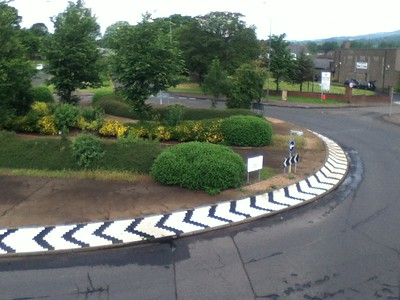
Pitkerro roundabout, Dundee, Scotland

thinking about going places. far away places.

nearby places have their charm... but running errands is mostly tiring; walking the dog is lovely but routine.

summer and travel go together most years. or they have in the past, anyway. lately it seems like so long since I've gone anywhere new just to see what's there and what it looks like.

as i reread some of my old journals, it seems astonishing how much I traveled even just five or six years ago. so much back and forth home for holidays, random cities for conferences or helping friends move, and a few weeks-long adventures for studying abroad. it seems like half my journal entries back then were prefaced with "notes from [insert name of airport here]." 

ink doodle of abstract swirls, a woman's head and shoulders, and the word 'risk' 

there are many reasons for the relative lack of travel these days, of course. there's a pandemic still wandering around mutating and spreading. small, short, careful trips seem best. we also just bought a house, so it's everyone's turn to come visit us now, to see what's here.

here is pretty beautiful, I must say. we have an ancient volcano overlooking some very fine walking and biking trails. we have (unlike last year, during which this rainstorm was practically the only one) an almost-nightly pattern of refreshing monsoons feeding into a bunch of glorious greenery. we have cool mornings and a very serviceable set of patio furniture. and a fire pit too, for roasting things and for cozy evening ambiance.

dutch angle landscape, blue sky and clouds

last week Jeremiah's aunt and uncle stopped by for a night on their way from west to east. they brought a handsome dog named Herschel with them and we had a grand time showing them around, catching up on each others' lives, and playing a bit of mahjong.

who else wants to come visit? we can teach you mahjong if you like. or we can hike up to the top of Glassford Hill and have a picnic.

purple/green pastel oil crayons + black ballpoint on cereal cardboard

what else? 

I've been teaching this summer. small sections of Technical Report Writing over two six-week terms. it's been mostly fun. but I'll be glad for a few weeks' break between summer and fall classes starting up. maybe we'll go camping. maybe we'll squeeze in one more tiny, careful roadtrip. or throw one or two more dinner parties. or just sleep in more and read all the books. 

my other activities for summer have included daily morning walks with our restless little Hamilton pug, pulling weeds out of our rock-covered yard, potting and re-potting succulents (new and old), tending to a dying basil plant and a thriving tomato plant (many thanks to my dad), taking a few bike rides, committing to bits of yoga, baking too much for two people, and reading outside as often as I can get away with.

oh, and I'm running a little game of Dungeons and Dragons-- a pre-written adventure entitled Curse of Strahd. there haven't been any dragons in it yet, but there might be. it's proving quite interesting and entertaining. ostensibly, I am using this set of published ideas to create a backdrop of tension and danger mixed in with meaningful story and fun rewards for the players who roleplay in the foreground of it all. from the first few sessions though, I've felt like my role is equal parts creator and observer. the player characters are out there on a stage that I threw together, putting on fascinating and rich performances for us all. I hope I get better at it so I can keep doing it and find out what happens next.

in other news, I want to soon blog properly about Braiding Sweetgrass and all its lovely messages about paying attention to nature. I should also finish reading and taking some more organized notes on a few books about collaborative writing pedagogy. there is a conference talk to prepare in the next two months, and always more scholarly books to read. one on my mind this afternoon is Against the Romance of Community, the pdf of which is sitting around in at least three digital folders somewhere, waiting with its few scattered annotations for me to get back into it. 

I know it's kind of cheesy to use books as a stand-in for travel, but ah well. if Scotland and Paris and Germany and London and Beijing are out of reach for the next long while, at least I can read and re-read about everywhere else. everyone else. all their connections and intricate influences on one another.

101 Victoria Road and neighboring brick row houses 

and because I needed an excuse to type it all out for myself here, I'm going to include these paragraphs from near the end of Kimmerer's book about indigenous wisdom. this chapter is called "People of Corn, People of Light," all about the marks we are leaving on the earth through our ways of being, our ways of knowing, and our stories.

"Many Indigenous peoples share the understanding that we are each endowed with a particular gift, a unique ability. Birds to sing and stars to glitter, for instance. It is understood that these gifts have a dual nature, though: a gift is also a responsibility. If the bird's gift is song, then it has a responsibility to greet the day with music. It is the duty of birds to sing and the rest of us receive the song as a gift. ....
"Other beings are known to be especially gifted, with attributes that humans lack. Other beings can fly, see at night, rip open trees with their claws, make maple syrup. What can humans do?
"We may not have wings or leaves, but we humans do have words. Language is our gift and our responsibility. I've come to think of writing as an act of reciprocity with the living land. Words to remember old stories, words to tell new ones, stories that bring science and spirit back together to nurture our becoming people made of corn." (p. 347) 

I promise I'll blog more about this lovely book one day soon, blog-all-dogeared-pages style. and if you've read it too, let's have an impromptu book club about it so I can hear all your thoughts. wouldn't that be fun?