Showing posts with label truth. Show all posts

Sunday, January 19

moments and years

I missed the chance to commemorate the true birthday of this little blog, last Monday. but today, January 19, 2025, marks exactly 20 years since the first actual, fully-fledged post: a response to our first key reading assignment about webdesign and such.

what a different world. such a different place it was. or maybe twenty years ago wasn't so very different, and it only seems so because I and my perspective have changed so much since then. 

what happens if I stitch together a few snippets from all the blogged Januaries of each year since 2005? what new montage will spill into this digital page in between them all?

I tried my best to pull from sections nearest to the 13th and 19th of the month (a thing much easier to do from the posts before 2014ish, when the apex of graduate school + its aftermath slowed down my writing here so much).

what I notice amongst these snippets and what you notice will be different, I imagine. I notice the unending pulse of learning and academia. books and thoughts chasing each other in circles. comments about the weather seem to sit neatly in the background with questions of identity and all its tangly unspooling. these words always have been for me more than anything. does all this pontificating from past amelia still sound like useful advice? mostly yes, I think. but I would say that, wouldn't I?

2006

the fact that energy is behind it all is somehow unifying. simple

...

linguistic structures will be a low-key class. it is full of people i don't see in my other classes. the other english majors. non tech writing people: the lit majors, the teaching majors. it's weird.

2007

get used to the fear and the doubt. get used to being faced with new facets of your own ignorance. get used to the pain. embrace humility. you can't always feel in control.

but really, how comforting is that?

I don't know. I'd take humility over false confidence anyday. but then the humble rarely get much respect.

2008-2009 (a pause.)

2010

the world is big.

there's a lot going on in it. even in this mostly empty house, there's me sitting at the table, typing, stretching a bit of CSS out over a half-built website skeleton, scribbling a few what-ifs, listening to Radiohead. and I made banana nut muffins this morning.

2011

in the beginning, this blog was just a place for all my first impressions--all my doubts and worries about the usefulness or meaningfulness of all the stuff I was learning. after that semester, I decided to keep blogging--mainly about writing (Starcustard and random short stories), school (rhetoric, more webdesign, and Isotope), and life (philosophical thoughts about my job, vague complaints about boys, and so forth). and so it continued. I'm still here. I still blog.

...

what do those stories say about me?

I'm thinking about all the texture of my life. all the patterned and patternless history I've collected so far. telling stories is one way to remember it. and on the other hand... telling and retelling and re-remembering these stories is one way to completely revise the past. after a few months or years, it becomes easy to bend the details. to emphasize the funny parts. to leave out the things that make you look like a bit of an idiot.

how I envision myself is pretty complicated, I guess. perspective is weirdly limited like that.

2012


which we am I talking about, anyway? and when? and where? 

2013

it may not make any huge difference in the long run, but even so, the ultimate pointlessness of things should not be dragged up as an excuse for us to stay in bed all day. at least not more than once or twice a year, anyway, right?

2014

this seemingly misnamed semester will inch along to spring in due course. and when that happens, finals and stress will no doubt prevent me from enjoying it as thoroughly as I could, but for now... well for now, the semester is glowing with warm, cozy pillows full of insight and excitement. this might be the best January ever.

2015

I have spent much (but not enough) of this long, mostly-pleasant weekend sitting by the window, trying to focus on readings for classes. 

.... 2015 is here, still all new-feeling. gradually we'll get to see both how it changes my life and how it doesn't.

2016

today it is raining in spurts, like a chilly and unkempt spring. Tuesday's snow is long since melted. it'll be back this weekend. the universe is giving us yo-yo-ing seasons, somewhat drab all the way through, with occasional bright sunset smudges.

the trees are bare. my apartment windows open onto more distant views than they did in summer and fall. at night, more and more streetlights perpetually leak into my bedroom under the edges of the blinds. I notice the faces of buildings I have never seen from such an angle before.

2017

it's empowering to reflect on the background structure of your whole life. to actively participate and acknowledge your role in either accepting/reinforcing or resisting/revising the culture you swim in. and that seems important. that's what it takes to make all of that power and structure more open-book, more readable, more transparent and less like a vice.

2018

if I had the brainpower on this Friday evening to make some additional academicalish comments on how these beautifully-commentated marble races and our fascination with them could link up interestingly with some of the tenets of object-oriented ontology, I would. but I don't know all that much about object-oriented ontology myself, and should probably not let it distract me much more than the Marblelympics already have from writing up nicely finished dissertation chapters about digital ethnography and distributed commons-based peer-production and what that all may mean for technical communication and human culture and such.

2019

and then the speaker said something about facebook hopefully having a major role in someday establishing some kind of global online government. after that, according to my notes, I typed out this:

"eeeeek."

does the world want and need to be connected by a central online platform, really? is the capitalist interest that facebook has in being the medium by which everyone is connected anything we can trust?

2020

all this potent potential meaning curled up in to hold. and then there are all these phrasal verbs, too: hold back, hold up, hold out, hold off, hold against, beholden to...

to be held as a parent holds a young baby is to be safe. comfortable. cared for. right?

to be held is also to be restrained. controlled. and to be restrained isn't usually considered comfortable, though... right?

or is it?

2021

and when I listened to this recent episode of So Many Damn Books with George Saunders I felt more affinity for Saunders's love of teaching writing than perhaps I might once have felt. his advice is to remember that you're never just teaching 20-somethings who barely know what to do with their adulthood when you meet them-- you're also teaching the 40-something-year-olds that they'll become. I like that. (not all college students are 20-somethings, but the concept holds. we are all humans-in-progress.)

2022

why does this small saga of knitting woe and triumph deserve documentation in this little blog of mine? I don't know if there's an answer, other than my typical interest in capturing bits of experience and emotion in as vivid and accurate description as I can. I like to write these vignettes of where and when and how, with all the metaphor and adjectives they need to vibrate satisfyingly from my imagination to yours.

2023

I trust that learning is happening, little by little, in all of our spongey-curious brains.

2024

January, perhaps fittingly, seems so very long. all the transitions it spans-- all the shifting, deepening of the dark season, the post-holiday recoveries, the shiny new beginnings of a calendar year and of an academic semester-- all of that is a lot for 31 average winter days.

I don't know if it really did feel longer for me this year, or if I'm only saying that because it seems like an appropriate thing to sigh into this semi-bleak and impermanent world.

- - -

and now what? do I still blog? 

time will tell. if you'll indulge me, I have one more excerpt, this time from May of 2014, when so much of me was so unsettled and rearranging itself and I clung to my love of writing as if nothing else mattered:

from time to time I wonder what it is I'm trying to do here. does it matter what I'm trying to do here? I write. our reasons for enjoying things are seemingly inarticulable. is there irony in that? I claim that words can make everything better. is that true even when the words crumble into meaninglessness as they fail at encompassing feelings? do I mean that even crumbled words are worth something?

yes. crumbled and halfhearted attempts at capturing it all still beats blank silence. I know only so much stuff fits into one life. there are only so many live possibilities. this is the way it needs to be, I guess. but the way everything is carved up now isn't how it'll always need to be carved. our crumbled communications don't stand still; they change.

.... and even if I can't really say I know exactly what writing means, I can try to explain what I like about my practice of it.

I like the pausing and sifting through potential descriptions and the shuffling of parts of speech. I like the dancing of clauses and punctuation and space. I like the starts and stops and backtracking, the meandering fragments that stretch so subtly for their finish. I like the way these little symbols can twist and mold intangible thoughts into a dozen differently shaded shapes. I like unknotting a tangly draft, picking out the pieces that don't belong and pulling away each piece that does, tidying it all into a hopefully-clean curl of interesting prose. sometimes I save the scraps for later. sometimes I can't. .... I write for the writing's sake. I sketch and wonder and experience plenty of other things for the same reason. they don't have to be means to some other end, these creative processes. maybe all the best things are their own ends, or at least neatly wrapped around something like one.

after twenty years, does this blog count as art? as an end in itself?

doesn't matter. it's here. I'm here. for now.

Wednesday, January 31

goodbye, January

since the eve of 2024 one month ago, it feels like so much has happened. some of it too fast, too soon, too painfully. 

the grief of losing the first little doggo that I ever really shared my longterm day-to-day life with... I cannot describe it. as much as I'd like to keep trying to, the feeling altogether and gargantuanly transcends words. the whole experience is impossible to talk about in any satisfying, accurate, indubitable way. "losing"? "letting go"? that we "had to" say goodbye? what kind of stupid, broken euphemism circus is this? everything about our language-cloaked expressions of such pain just feels utterly inadequate.

pine trees silhouetted against a morning sky: blue above white above orange glowing above the mountain horizon
{ I suppose we can't have sunrises without some sunsets. }

a happy pug, white fur with darker ears and nose, his mouth open as if smiling for the camera
{ and nothing lasts forever; dog-years are too extra short. }

it is probably irrational to think no one else could ever know what I mean, even if the words and metaphors feel so flimsy. it's not like I'm the only person to ever experience this sort of sadness. nor is this the first unexpected loss in my life. but it has been the closest and the sharpest. so far.

on new year's day I wrote something about how the world (a world so embroiled in hate and genocides and ugly senseless conflict!) is an absolutely crushingly horrific mess, how my heart hurts and hurts and hurts, and how this loss seems to prefigure and to threaten-- or, even more, to promise-- every other inevitable loss I will ever have to face for as long as I live.

it's one thing to philosophically observe, in general, that nothing can last forever. okay. of course. to confront and deeply feel it-- specifically-- as one solitary ending to the life of a inimitably cuddly goofy fuzzy little domesticated animal... that is different.

other aspects of this January were plenty normal, whatever that means. most of my activities seem to come with rather suitable words with which to sketch them into sharable imagery: going to bed early and sleeping in. checking out library books. reading and ignoring and sorting and replying to emails. seeing friends. enduring snow and rain and cold. demonstrating crafts at the museum. putting birdseed in the feeder in the backyard. talking with family on the phone. eating quiche. drinking tea. making soup. needing a haircut but not yet ever managing to go out and get my hair cut. sweeping the floor. running errands. craving hot chocolate. writing lists and syllabi and assignment sheets. spending money. making things. existing. 

{ eclipse shadows from October, 2023. Wesley's last weekend camping trip with us. }

sure, nothing lasts forever. change is nature. this too shall pass: all of these phrasings alternatingly as full of solace as they are of tragedy, representative of a fact more solid than perhaps any other so-called fact. death and endings are, from one point of view, more normal, more mundane, more irrefutable than any of the other relatively comfortable, unassuming, smoothly proceeding lifestuff I might casually document and remember about this particular month of the year. that's what feels so difficult and impossible about it.

the vortex of this heartache felt immeasurable, indescribably vast and infinite, from the inside. 

even so, from a day or two or ten beyond, it begins to shrink and fade. all future moments frame it into something more manageable.

but again the words seem to balk and fail me. "manage"? is that what we are meant to do with these feelings? this grief? is that actually possible? the stringy, endless paradoxes curl up inside of each other, confounding my basic little human brain with ineffability.

{ classic pug-under-the-table photo, new year's eve 2023 }

January, perhaps fittingly, seems so very long. all the transitions it spans-- all the shifting, deepening of the dark season, the post-holiday recoveries, the shiny new beginnings of a calendar year and of an academic semester-- all of that is a lot for 31 average winter days.

I don't know if it really did feel longer for me this year, or if I'm only saying that because it seems like an appropriate thing to sigh into this semi-bleak and impermanent world. 

one month ago, as the cold moon began to wane and the spinning earth began to tilt just barely back towards the sun, our little old dog ate his last breakfast and went on his last stumbling walk and took one final car ride, sitting on my lap. I only knew him for half his life. I wasn't sure if I'd get along with such a beast at first. but we did get along, so well. I loved that pug and I'm glad he was here to share so much of the too-short day-to-day of my life for a while.

Wednesday, June 1

lines from history (or, happy pride month)

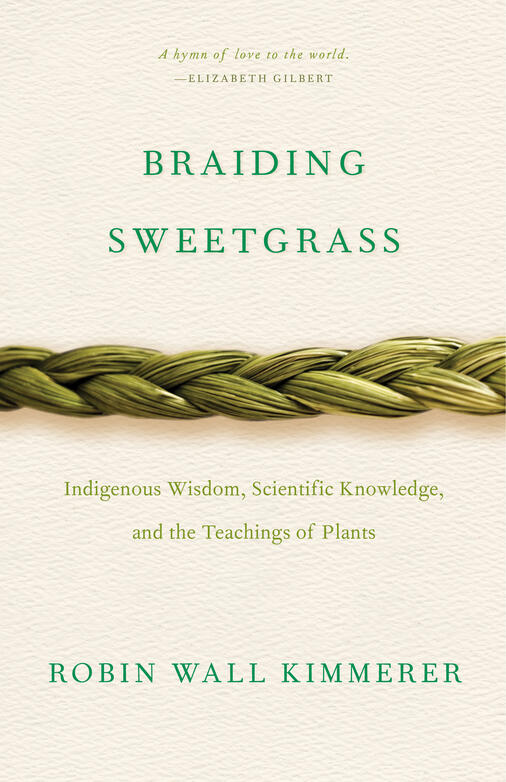
last summer I was quite enamored of Robin Wall Kimmerer's Braiding Sweetgrass. so much of it resonated with elements I hope are part of who I am and plenty that I hope will eventually be part of who I am.book cover-- Braiding Sweetgrass

this is one of the former bits-- "My natural inclination was to see relationships, to seek the threads that connect the world, to join instead of divide." (Kimmerer, p. 42)

how are people, places, things, and ideas like other people, places, things, and ideas? how much can we commune, however briefly, with even the furthest-flung perspective?

I find it fun to connect things that don't seem (to most people) like they go together, just as much as to notice connections among things that do. juxtaposition is a useful direction for thinking. mash this with that, just to see what might happen. some of the weird combinations might not work for everyone. or some of them could be like tuna fish with pears. 

today, I finally finished up the audio edits for the last section of my Librivox recording of Angelina Grimké's Letters to Catherine E. Beecher, in reply to an essay on slavery and abolitionism. the collection was published in 1838, the same year Grimké got married to someone named Theodore Weld (also an abolitionist and writer-- maybe I'll read a Librivox version of his 1839 collection American Slavery As It Is: Testimony of a Thousand Witnesses sometime?)

so 1838 and 1839 must have been busy years for Grimké. but most of the letters are dated the year before that, 1837. 

that was 185 years before this one. almost five of my lifetimes ago, so far.

the penultimate letter, Letter 12, was one of my favorites of this little audiobook-to-be. it is so timeless. along with her abolitionism, Grimké wrote ardently about feminism, women's suffrage, and equality on all counts. race, gender, whatever-- all human rights should apply to all humans. 

none of her sentences out of context are as powerful as they are stacked together in this letter, but it seems silly to paste the whole thing here when you can more easily go read it yourself via Gutenberg.org (or wait a few days and then listen to it via Librivox.org, either way).

so to compromise, I will abridge the letter as best and as meaningfully as I can, keeping in what has been most impactful and resonant to my 21st-century brain. and then, carrying on in my own 185-years-later mode of asynchronous discourse, I'll add a few comments.

...The investigation of the rights of the slave has led me to a better understanding of my own. I have found the Anti-Slavery cause to be the high school of morals in our land—the school in which human rights are more fully investigated, and better understood and taught, than in any other. Here a great fundamental principle is uplifted and illuminated, and from this central light, rays innumerable stream all around. Human beings have rights, because they are moral beings: the rights of all men grow out of their moral nature; and as all men have the same moral nature, they have essentially the same rights. 

.... When human beings are regarded as moral beings, sex, instead of being enthroned upon the summit, administering upon rights and responsibilities, sinks into insignificance and nothingness. My doctrine then is, that whatever it is morally right for man to do, it is morally right for woman to do. Our duties originate, not from difference of sex, but from the diversity of our relations in life, the various gifts and talents committed to our care, and the different eras in which we live.

This regulation of duty by the mere circumstance of sex, rather than by the fundamental principle of moral being, has led to all that multifarious train of evils flowing out of the anti-christian doctrine of masculine and feminine virtues. .... Hitherto, instead of being a help meet to man, in the highest, noblest sense of the term, as a companion, a co-worker, an equal; she has been a mere appendage of his being, an instrument of his convenience and pleasure, the pretty toy with which he wiled away his leisure moments, or the pet animal whom he humored into playfulness and submission. Woman, instead of being regarded as the equal of man, has uniformly been looked down upon as his inferior, a mere gift to fill up the measure of his happiness. .... 

Measure her rights and duties by the unerring standard of moral being, not by the false weights and measures of a mere circumstance of her human existence, and then the truth will be self-evident, that whatever it is morally right for a man to do, it is morally right for a woman to do. I recognize no rights but human rights—I know nothing of men’s rights and women’s rights.... 

If Ecclesiastical and Civil governments are ordained of God, then I contend that woman has just as much right to sit in solemn counsel in Conventions, Conferences, Associations and General Assemblies, as man—just as much right to sit upon the throne of England, or in the Presidential chair of the United States.

Dost thou ask me, if I would wish to see woman engaged in the contention and strife of sectarian controversy, or in the intrigues of political partizans? I say no! never—never. I rejoice that she does not stand on the same platform which man now occupies in these respects; but I mourn, also, that he should thus prostitute his higher nature, and vilely cast away his birthright. I prize the purity of his character as highly as I do that of hers. As a moral being, whatever it is morally wrong for her to do, it is morally wrong for him to do. ....

Thou sayest, ‘an ignorant, a narrow-minded, or a stupid woman, cannot feel nor understand the rationality, the propriety, or the beauty of this relation’—i.e. subordination to man. Now, verily, it does appear to me, that nothing but a narrow-minded view of the subject of human rights and responsibilities can induce any one to believe in this subordination to a fallible being. Sure I am, that the signs of the times clearly indicate a vast and rapid change in public sentiment, on this subject. Sure I am that she is not to be, as she has been, ‘a mere second-hand agent’ in the regeneration of a fallen world, but the acknowledged equal and co-worker with man in this glorious work.... Then will it be seen that nothing which concerns the well-being of mankind is either beyond her sphere, or above her comprehension: Then will it be seen ‘that America will be distinguished above all other nations for well educated women, and for the influence they will exert on the general interests of society.’

I can't know what Angelina Emily Grimké would think about the power and influence of women in American society today. hopefully she'd be a little bit gratified, grateful, impressed by how far we've come.

from reading 13 small letters of hers (and maybe a speech or two in an old rhetoric textbook ten years ago, maybe), I really don't know what Grimké would think about trans and non-binary folks, but from her emphatic defense of human rights not being based on gender, I would like to assume she'd be cool and inclusive. she spent her life advocating for the suffering and marginalized in her world. she'd probably do the same now, in whatever ways she could.

progress pride flag-- white pink blue brown black and rainbow colors

here's to making and seeking relationships, connections, and love-- more and more every single sweet day.

Monday, May 30

blossoms, seeds, and shadows

a close-up of tree branches with some pink flowers, orange seed pods, desert in the background

I think this is a small shrubby redbud tree. not sure though.

it has a neighbor along our walking trail. the two trees are more like bushes, really, reaching not too far above my waist, spindly branches bent toward the road.

some months ago this spring, both trees burst into blossom--crowded little pink frothy blossoms all over--even though so many dried out seed pods still clung to all the branches.

it seemed like such a metaphor. 

last year's efforts, thin and pointless, weighing down the future. new life and color pushing onwards anyway. old baggage, getting in the way of everything you might want to blossom into.

by the time I took this photo, the pink flowery frills had wilted and shriveled quite a bit. the desert sun has taken no vacations this season. but there are still rows of orange seed pods holding fast, refusing to be blown away.

a tree, its seeds, its blossoms, all live in cycles just like everything and everyone else. times for growing and times for resting. times for bare bark, times for buds and leaves and blossoms. but all the parts of that cycle have residue from the others. none of them gets to be a clean slate starting from scratch. dried out seed pods, failures, sadness, winter cold, autumn loss-- all of it gets wrapped into the things that happen next. 

maybe sometimes it feels like so much heaviness to keep hold of, to keep track of. 

maybe it's simple. flowers leave behind seeds, and not all of those seeds go off to grow into anything.

the metaphor is very flawed, of course. the seeds are not the opposite of progress and beauty. just because convention paints pink flowers as more lovely does not mean that's truth.

I'm reminded of the best song from Encanto. things don't need to be perfect; they just need to be. 

that's enough for the scrubby redbud trees, I guess. simply being. why do humans complicate it so?

Monday, July 20

more listening

what and who do you find easy to listen to vs. difficult to listen to? I've had reason to ponder this lately, mainly with regard to diversity and tolerance and such. but of course, as I tend to do, I'm getting broad and philosophical about it.

my favourite things to listen to include:
- rainfall
- string instruments
- well-structured podcasts while I'm working with my hands
- chill, lyric-less music while I'm working with my brain
- husband Jeremiah playing the guitar
- vegetables sauteing or sauce simmering on the stove
- soft, gentle pug snoring

there are probably many more that I can't think of right now, too.

sometimes there are voices I get really sick of hearing, or that I'm impatient about listening to. I tell myself that it's not because of the voice itself, but some quality in it or some context around it that makes it insufferable. the ponderous, over-thoughtful droning of too many academic podcasts. the hyper-critical griping of various YouTube reviewer guys. or the two-dudes-talking podcasts that for whatever reason can't seem to edit out even a shred of their blathering (ahem).

I have limited time in my life. I can't be expected to truly listen to everyone. being picky is not a bad thing.

but lately I'm thinking listening as activism. I'm thinking about who we listen to as a crucial moral and political choice. (it isn't always that, I hope, but it can often be that. the personal is political, they say.)

part of what sparked this thinking of late was my slowpokey journey through the Me and White Supremacy workbook. I've been going through each chapter, journaling as earnestly as I can about each prompt (me and tone policing, me and white superiority, me and white silence, and so on). along with a few of the prompts there are a videos from the workbook's author, uploaded back when the book was still just a daily instagram challenge. and the videos are long. some of them are over an hour long.

listening to a stranger talk to me for that long (and about a subject so potentially touchy, at that) takes some discipline. focus. commitment.

in the first section of her book, Layla Saad has said as much. love, truth, and commitment: we won't get through this workbook and its work without those things. and I feel like I need to re-read that section of the book every other day, to help me keep going and stay committed as the discomfort of unpacking all the ways I'm steeped in white supremacy soup intensifies.

listening to a voice that's so different and so passionate isn't easy. the videos that go with the book aren't totally unscripted, but they're conversational. they're personal. it is so easy to say I don't have time for all that.

for me, putting off this set of intense, fine-grained confrontations is convenient. I have every excuse to put it off for next summer or the summer after that, and very little pressure from the outside world to stick with it.

but... as Ms. Saad writes, in address to white people like me and almost everyone else I have ever closely interacted with,
"Whether or not you have known it, [white supremacy] is system that has granted you unearned privileges, protection, and power. It is also a system that has been designed to keep you asleep and 'unaware' of what you having that privilege, protection and power has meant for people who do not hold white privilege. What you receive for your whiteness comes at a steep cost for those who are not white. This may sicken you and cause you to feel guilt, anger and frustration. But you cannot change your white skin colour to stop receiving these privileges, just like I cannot change my black skin colour to stop receiving racism. But what you can do is wake up to what is really going on, challenge your complicity in this system and work to dismantle it within yourself and the world."
there are things I can't change and things I can change.

maybe I can't change my basic inclinations to choose Margaret Atwood's The Testaments off the digital library shelf instead of buying the more 'experimental' Girl, Woman, Other by Bernardine Evaristo's from an airport bookstore. but I for sure can reconsider those basic inclinations and push myself and my brain to include more non-white voices more often. even if (perhaps especially if) those voices seem strange to me.

in this vein of feeding myself more Black voices, I requested some Audre Lorde from the local library the other day. I mostly wanted to read the oft-recommended Sister Outsider, but the copy I found of that collection also included two other works of hers: Zami (semi-autobiographical loveliness) and Undersong (poetry and such). the blurb on the back cover about Zami, the first of the trio, didn't sell it in a way that grabbed me. but as everyone should do with any book they happen to find in their hands, I read the first few lines of it anyway. and it is loveliness. lyrical, thoughtful, evocative, full of allusion and depth and feeling.

previously, the only Audre Lorde I'd ever read was in an Argument Theory class during my first round of grad school: "The Master's Tools Will Never Dismantle the Master's House." (it might actually have only been a section of it; mainly I remember that we discussed-- fitfully-- whether or not one could discuss an argument's structure and effectiveness without discussing the argument's content). I'm looking forward to reading more of her.

I will keep reading and listening to Layla Saad, too. I've also added the more-conversational-than-I-usually-want-to-tolerate Pod Save the People and the deeply educational and impressive 1619 Project to my podcast queue. is it enough? who knows. it feels like barely, barely enough to be beyond tokenism. it's not likely to be enough to thoroughly crack through all the ways I've been conditioned to prefer and validate white voices over any others.

Saturday, July 4

vengeance vs. leverage

an old facebook friend of mine, a few days ago, shared this Martin Luther King Jr. quote about the inability of violence to bring peace.

I was tempted to respond in a comment, something like "I hope you're using this to denounce all the terrible police violence and other terrible racially-motivated violence in the world, rather than as a shallow move to discredit some or all of the protestors who are speaking out against that violence, just because their response makes you uncomfortable."

but I didn't.

I've only been to one protest event in my life. it was at the end of 2014, during Dr. Jenny Bay's grad seminar on gender, rhetoric, & the body. Dr. Bay suspended our class meeting that day for anyone who wanted to go march, and despite my general hesitance to be seen making any kind of fuss at all, I left my books in my office, joined my peers, and marched. chanted (not loudly). laid down in the street in my red winter coat. listened to others' impassioned speeches and pondered in my highly introspective way what all of it meant.


that was a long time ago. I don't remember everything about that cloudy Indiana winter day but I remember one of the chants:

no justice, no peace.

if violence cannot bring any lasting peace, as MLK has said... well, neither does injustice.

if I ignore the violence and injustice that others experience, that doesn't mean it doesn't exist.

there are plenty of parallels between lyrics from Hamilton and the happenings of now. it's such a rich and tightly-woven work of art that you can look into it for insight and inspiration every morning for the rest of your days, never running out of reminders about what's difficult and crucial and powerful and beautiful about life. the closing number alone! "when my time is up, have I done enough?" it's gorgeous and it's full of heart-wrenching provocation like that.

yesterday we, along with the rest of the internet, watched the Disney+ release of the Hamilton film (thanks to friend Kay who shared her account info with us for the occasion).

these lines from "My Shot" stood out a little bit extra to me as I watched the protagonist take up a place on the soapbox and monologue:
And? If we win our independence?
Is that a guarantee of freedom for our descendants?
Or will the blood we shed begin an endless
Cycle of vengeance and death with no defendants?
I don't think most of the protests going on today are about vengeance. thankfully. and thankfully most of them aren't violent protests either.

there's another thought-provoking line on independence later on at the end of Act I, too. the exchange between Burr and Hamilton before the latter goes on to write a large portion of The Federalist Papers:
Burr: The constitution’s a mess
Hamilton: So it needs amendments
Burr: It’s full of contradictions
Hamilton: So is independence.
and so it is. independence is a neat idea. but we're also all connected. we all depend on so much outside ourselves. what "justice" and "freedom" really mean is a whole other set of questions, I admit. but we have to start somewhere. admit that not everyone is treated so equally as our Declaration of Independence implies they should be. stop ignoring that inequality just because it mostly doesn't affect us. start somewhere. change your perspective. change the way things are.

or at least try.

Monday, October 15

because poetry.

there's a scene in John Green's latest book, Turtles All The Way Down, where two teenagers sit next to an outdoor in-ground pool and the young man's simple bits of poetry, spoken off-the-cuff under the stars, seem to successfully unseat the young woman's (the protagonist's) spiraling, paralyzing anxiety.

it was a very lovely scene. and it made me think back to a headline I'd seen just a day or so earlier: "How Doctors Use Poetry."

upon first clicking that link to that headline, I read as far down as these few lines:
"...reciting poetry engages the primary reward circuitry in the brain, called the mesolimbic pathway. So does music—but, the researchers found, poetry elicited a unique response. While the mechanism is unclear, it’s been suggested that poetic, musical, and other nonpharmacologic adjuvant therapies can reduce pain..."
and then, a week or so later, I finally came back to read the whole thing. and eventually look up the cognitive neuroscience study the author references. I wanted to blog about this. because poetry.

because the idea of communication beyond the 'restricted' language of 'science' is interesting. because feelings and power and pathos and transformation feel important.

perhaps something about this time of year makes poetry feel especially necessary. seasons changing. colder, darker times pressing in upon us. stresses of the semester intensifying...

I often think I should read and savor more poetry more regularly. but sometimes it doesn't seem accessible or convenient. making space for poems isn't always easy.

our lovely local poets here at NSU have offered me an excuse for savoring plenty of poetry lately though. they're participating in a month-long poetry marathon to support a small indie non-profit literary press. one poem every day, for almost all of October. I like it. maybe there's something about knowing that poems have been written under a time constraint that makes them especially delicious and interesting.

almost all of these poems evoke some kind of emotion. some ask more patience of me than others. I like the ones that make me feel pried open, or guided dot by dot around a gallery of newness, or plunged into a deep ocean.

all the poems of the 30/30 poetry-fest are on one webpage, which makes it difficult to send you to the ones I like the most. you'll have to search a little bit for them. some of my favourites so far:
  • A Study in Time and Space / by Rebecca Macijeski
  • God owns a carwash in Iowa / by Ally Schwam
  • Two Heads / by Karen Greenbaum-Maya
  • Camelot’s Redemption / by Chad W. Lutz
  • If I could make this easy / by Jen Stewart Fueston

and there are still 15 more days of poems to be written! if you're into it, you can donate to the press and incentivize our lovely local poets this month, here and/or here.


more poetries, previously:
also, all of this poetical literary mashup film by Yulin Huang is very cool.

Saturday, December 23

stories and truths of many sizes

I was just barely thinking about Jean ­Francois Lyotard, and then about Clay Shirky, and then about blogging, and when I opened up all my draft blogposts I found this one. what an odd little coincidence, it seemed.

this post began as notes copied from a reading response I must have written and turned in for my Postmodernism course several semesters ago. I'm going to revisit it and see what happens.

that semester, I wrote rather candidly that I'd thought I would tiredly skim Lyotard's The Postmodern Condition. it is a short treatise, but nonetheless skimming is fairly expected in graduate school. however, apparently I almost couldn’t put Lyotard down that week. something about his little exploration of The Postmodern Condition sparked against my jumbly thoughts and I just had to finish it. and I wanted more.

my reading response post for the class eventually congealed around two main topics: technology and money. I'm going to reverse the order for this post, and put money first. mostly this is because I'm smiling at the memory of the Megan I met on a train, and I want that very small story to exist here on my blog.

the other reason is that the technology thoughts seem to loop back nicely into the current and future trajectories of my scholarship, and ending with them will perhaps as more light and insight to that trajectory as it continues unfolding for me and my brain.

money
in his section 11, "Research and Its Legitimation through Performativity," Lyotard leads us, his readers, around to a (by now fairly obvious) perspective on power and truth:
“A new problem appears: devices that optimize the performance of the human body for the purpose of producing proof require additional expenditures. No money, no proof—and that means no verification of statements and no truth. The games of scientific language become the games of the rich, in which whoever is wealthiest has the best chance of being right. An equation between wealth, efficiency, and truth is thus established.” (44-45)
I found this obvious then because I'd read various other bits and pieces about the construction of proofs and the materialities of epistemology. I would go on to read more, too. Barad's Meeting the Universe Halfway gets at many of the same conundrums. what it means to know something, to make known something, to verify and prove to others that you have verified it-- these are huge questions. Lyotard says that money makes it easier. money is very persuasive stuff. material. rhetorical. powerful.

and Lyotard puts this thought to us in such a clear, direct way. resigned, almost, but thoughtfully so. I was reminded by this section of a conversation I had with a medical student named Megan on a train from Dundee to Oxford this summer. she sat across the table from me and offered to share her gummy sweets, and eventually we both looked up from our studying and fell into a gloriously fluid conversation about who knows how many interesting thoughts.

one of our many topics was medical research, and Megan explained how unfortunate she found it that most useful, successful medical research is driven by capitalist, consumerist ideals. developing nations don’t have the resources to carry out their own research, nor the resources to pay for research on any of the diseases or treatments that make the most difference to them. the citizens of developing nations won't have the resources to pay for such treatments, so why should medical researchers invest their time there? no money, no science. no truth. and on the other hand, in developed countries, we have plenty of time and money with which to worry about cancers and heart diseases and such, and those are the things that get studied.

I’d never really thought about that manifestation of privilege. and it is just one example of what Lyotard points out about how power and proof and rationality and funding and research are all tied very tightly together. I have been lucky to have funding and support from handfuls of institutions, and having that has allowed all the thinking and making that I've been doing as an adult. so far I think I can count on that support remaining, in some form or another, as long as I can make myself useful in some way to the institutions providing it.

anyway-- I think the “no money, no truth” slogan, paraphrased from Lyotard, should go on an ironic t-shirt or something. somebody make one.

technology
in an earlier section of the book, Lyotard makes a bewilderingly simple (to me) claim about technology-- that it only has two principal purposes. the line appears in section 1 in the context of the sciences/technologies of language and communication, where he says this: “Its two principal functions— research and the transmission of acquired learning—are already feeling the effect, or will in the future” (4). I had to stop there, puzzled and frozen and what? The vague pronoun and the bold claim both held me up for several minutes.

in the margin, I added this note: what?

I wondered and puzzled over this claim. technology is principally for gaining knowledge and sharing knowledge? who says? since when? in what arena?

I wasn't sure, that semester, why I was so skeptical here. (husband dearest would say it's because such a stance is my habit, and I can't help myself. maybe he is right.) mainly it seemed to be because I hadn't thought about the idea before. it was new. while I reveled in the puzzlingness of it, I questioned myself too. if Lyotard means communicative technologies, not all of them, does his claim make more sense then? but then again, which technologies aren’t at least a tiny bit communicative? really? as a rhetorician I take a position that everything sends some kind of message. are those messages always based in "acquired learning" somehow? perhaps they are. everything around us is teaching us, even if we aren't paying attention. perhaps especially then.


as a rhetorician, it is my habit and my training to notice what the everything is teaching us, and then to try analyzing how it does so. right now with my dissertation work I'm pondering what the crowdsourcing work of LibriVoxers may have to teach us, and trying to connect that to professional/technical writing scholarship and practice generally. the ideals and methods of LibriVox are inspiring, I think. every voice is welcome. every tiny contribution valued alongside the tiny (and not so tiny) contributions of thousands of others.


one of Lyotard's more memorable contributions (at least as far as my brain is concerned) is the idea of the petit récit or 'small story' in contrast to the grand narratives of epic myths and stereotypes that sometimes dominate our ways of thinking about ourselves as humans. that idea--many small stories bubbling around, opening up many new perspectives, adding difference and color to places that looked old and flat before--seems important. right now, in this early 21st-century digitally networked time, we have space for millions of small stories. millions of different voices. it can seem an overwhelming abundance sometimes. what do we do with it? how do we handle the abundance? is this a chorus of voices or a chaos of noise? these questions seem worth asking. one person's chaos may be another's chorus, I imagine.

I may need to go reread Lyotard, and this time I might skim.

{ photos taken by Dr. Michael Salvo, over a year ago, in room 306 of Heavilon Hall, where I defended my dissertation prospectus using my voice and some words and chalk } 

Monday, August 21

fall semester, 2017

if all goes as it supposedly should, this will technically be my very last fall semester as a student. I am not sure how I feel about that yet.


I think I feel less optimistic than I was feeling last fall. this year is so different, so pressure-filled. so seemingly monumental in all its changes and changing. a final year. slipping away already. counting itself down from 11 months and a half to only 11 months and a quarter, just like every year but also in an extra-bewildering way now. the idea I can't help but swirl around in my head over and over again is: there will never be enough time.

and maybe that idea is right. but also... maybe... I'll deal with my finite amount of time just fine.

I will have to. we'll all have to, and so it goes.

today's writing music: Solar Fields
today's re-reading: Kathleen Fitzpatrick
and today's prooflistening: poetry

Tuesday, November 8

my job = reading and writing

today I interrupt my rambly little list of loosely scheduled things-to-review to talk about a book I just finished yesterday. my advisor recommended it for me, and I tracked down the ebook version and began devouring it a few weeks ago. it's called After Method: Mess in Social Science Research, by John Law. it was published in 2004, when I had just barely decided to be an English major.

Law's book was like beautiful blue, sparkly pools of intriguing untanglings of theory, critiques of standardized method, and invitations to crack open a bunch of dusty academic assumptions. he asks why we presume the world to be so definite in its being, so discoverable. he wants more scholars to wander around outside the usual boxes. to "find ways of knowing the indistinct."

not all the books I get to read strike me quite like this one seems to have struck me. reading this book is part of my job as a graduate student scholar-in-training, but it didn't feel like work yesterday. sinking my brain into this book was adventure. like wandering through a mountain forest as the sun comes up.

here, have some quotes I highlighted with digital yellow highlighter:
"...the world is not a structure, something we can map with our social science charts. We might think of it, instead, as a maelstrom or a tide-rip. Imagine that it is filled with currents, eddies, flows, vortices, unpredictable changes, storms, and with moments of lull and calm."
and
"The world could always be otherwise. Can we cope with this?"
in Law's opinion, we can cope, and in doing so we'll be better researchers and better humans. imagining and anticipating the many kinds of otherwise is arguably what makes us human. the capacity for conscious change. that seems important.

one more excerpt, from near the end, beautifully validates a belief I have reached for and reached for my whole life, it seems like.
"The answer, of course, is that there is no single answer. There could be no single answer. And, indeed, it is also that the ability to pose the questions is at least as important as any particular answers we might come up with." 
questions and answers are built together, after all. they are each the spaces that the other stretches into, around, across.

Thursday, May 5

the impossibility of defaultlessness

it seems so easy to be in a marvelously good mood when one is recovered from awful sickness. the work of spring semester is over. I have little margins of space all around in which to read whatever I want. and today is the first day in a week that I haven't felt like a half-rotten zombie full of slime.


so today I attended the second half of a Digital Humanities Symposium. it was exciting--interdisciplinary and spark-full--and there were pastries, too.

I might call myself a newly minted fan-girl of Amanda Visconti, a DH scholar with Purdue's libraries, who talked about her dissertation project, Infinite Ulysses. social reading, they call this. digital text, networked, layered with your reactions and my reactions and anyone else's.

socially-mediated, communal reading experience. Michael Widner from Stanford talked about it too, in the context of his project Lacuna. I have so many questions about this tool that I did not ask during the question-time of the last panel. would it work for a technical writing class? would it work for an online class? can I download it and play around with it on my own for a week or so?

during his presentation, Widner made a small aside about default settings. in building Lacuna, he and his team had millions of decisions to make about how it would function for users. as students add reading notes and annotations to these digital texts, what kind of tags should they be able to chose from in categorizing those notes? should annotations be public by default, or private? in their user testing, it turned out that unless a category tag is selected by default, most users won't select any. if readers' annotations are set by default to public, most of them stay that way. if the default setting is private, most of them stay that way. based on these observations, Widner's comment/advice was: "whatever the default is, that's what most users will do, so your defaults should promote the kind of engagement you want to see."

ah, the weight of those decisions. it's arbitrary, to some extent, which little settings are default or not. privileged, or not.

at this little comment, my brain started whirring and wondering. Widner described various options they'd tried out as the defaults for the Lacuna reading environment. only one arrangement of settings can be default at once though--that's just how it seems to work.

and then I wondered, what if we wanted defaultlessness? no defaults at all--nothing privileged or pre-set for anyone... some purely customizable, blank, open, transparent, full-of-possibility canvas of un-made decisions?

it wouldn't work. it wouldn't ever work. nobody would ever get anything done, if they had to set their own defaults from scratch.

what would 'from scratch' even mean, in a default-less world?

these thoughts reminded me of these thoughts. another word for default mode might be dominant. the default orthography for most sentences includes a capitalized first word and a period at the end. the dominant discourse about education is that official degrees from official institutions are pretty darn valuable. these aren't the only ways of working with sentences or the only ways of learning things.

my dad used to tell us, don't live your life on auto-pilot. don't walk around on default. usually the context was some kind of cleaning frenzy, and the subtext swirling around in my memory, at least, implies that a default life is one that won't stay very neat or tidy, one that might not look very respectable to any important visitors who stop by. I'm sure that's not all he meant, though. a default life is one where you give away all your choices. or one where you don't think enough about making any choices at all, even when you have the chance.

for anyone to live a non-default life, there have to be some default settings to start with, I guess. I wonder how many different defaults there are out there. mine probably weren't the same as everybody's.

Wednesday, July 8

blue of kind

I came home from New Orleans to see that the walls of my apartment are no longer yellow, but blue. it's a grey-ish blue, I guess. a light steel blue, you might call it.
I came home from New Orleans on a plane, and while on that plane I read most of Frank Chimero's The Shape of Design, finally. it's not a long book. it's very good though.

chapter 3, "Improvisation and Limitations," begins with a quote from Miles Davis, and some pages later the album Kind of Blue comes up as an iconic example.

which kind of blue? I've got the album playing now, layered on top of a steady rain with accents dripping from the gutters. I don't think it matches the blue of my walls. not quite. if I were Miles Davis, I probably would have named it Kinds of Blue. one kind isn't enough.

Chimero's point in chapter 3 is that improv opens up all kinds of awesome possibilities. it's endless, it's additive, it's "yes, and..." for as long as you have time to imagine things and bounce ideas around. but they need somewhere to bounce around, too, and that's where the limitations come in. they might seem like the subtract, but they don't really. they direct and they push. they add something, too. limits are possibilities.

I was reading brilliant quotes from The Shape of Design aloud to friend Ashley on our plane journey. some of the best bits are in chapter 5, I think. it's called "Fiction and Bridges."
"An alluring, productive untruth is frequently what's necessary to get things going. ... Every untruth forks reality and opens up a gap between what is imagined to exist and what actually does. Each fabrication creates a second version of the world where the untruth is true."
irrealis. flying pigs.

change.

jazz and New Orleans go together, I hear.

while we were there that week, a lot of people in this country of mine were celebrating a certain supreme court ruling. in our explorations of the city, we ran into a rally at the corner of Jackson Square, flags and shirts and paint and placards all rainbowed and colorful. Ashley and I listened for a while. that whole day, she'd been gushing with happiness about this decision.  

and while I may boast disinterestedness, the feeling was contagious. to see so many other people happy and grateful? how could I not be? I might pretend that this court ruling doesn't affect me, not directly anyway, and thus avoid crafting any concrete opinion on the subject. but I do too much pretending.

interestingly, a few days after the decision, The New York Times ran this opinion piece problematizing even this great equality-increasing happy moment. friend Lisa linked to it and emphasized this little excerpt concerning the way things have been and they way they might have been:
"...activists could have pursued a different agenda challenging the need for sexual scrutiny by the state, and the constellation of benefits that belong to marriage-- but they didn’t. Instead of dreaming up new forms of governance, they asked to be ruled by the ones that already exist."
hmm. that's something to think about. but there are so many ways things aren't, we could get lost in them forever. for now, bouncing ideas around in the way things are might be the best we can do.

two more quotes from Chimero's book:
"All design springs from a complex social ecosystem created by multiple parties' interests weaving together..."
"It's the words of others that teach us to speak, the expressions of life by other people that teach us how to express ourselves." 
pretending is useful, sometimes. creating, noticing, articulating gaps and then bridging them seem to be things we humans are good at, perhaps despite all our complexity. or perhaps because of it.

Friday, June 5

storeable

I did mean to write yesterday, but the whole day rushed away around me and there was too much doing to leave time for writing. such is the glory of summer spontaneity. there was music and running-into-colleagues and chatting and sitting in the shade and running errands with dear neighbor Lena and meeting friend Liz for Shakespeare.

93.2% of the things friend Liz and I ever do together involve Shakespeare. that's just how things go. I love it.

last evening it was this performance of Antony and Cleopatra. I hadn't seen the play yet. I probably read it once upon a time but that hardly is the same. words on a page are no real preparation for the passion and humor and blood of live Shakespearean tragedy.

it was an interesting show. characters all impetuous and full-hearted, dancing, proclaiming, vowing and worrying and lamenting. all so mad with feelings. Cleopatra's dramatic, insecure devotion is both hard yet easy to relate to. Antony's love-born madness even harder, but so textured and ragged and tangible in its performance. from the first scene, the two of them looked so wrapped up in happiness and each other. but they are also wrapped up in war, and thus they become a little bit doomed.

today I'm thinking about feelings and stories.

no story is totally accurate. not a single one could ever be as detailed or as messy or as true or immediate as actual life. Marc Antony and Cleopatra were historical figures and they lived real lives. the story we saw on stage last night was not an echo of those lives, not a record or a reenactment. Shakespeare was not trying to be educational. and even if he were, accuracy and exactness are not really the point of stories. or of any kind of art. it's impossible. the idea of a true story seems almost an oxymoron.

I really like telling stories, and I've recently had occasion to wonder why this is. what is so satisfying about lining up moments and drawing little threads of narrative between them? why is piecing together this and that observation into a coherent beginning-middle-end so much fun?

no answers. but I suspect some part of it is because there is a power in it. telling stories is powerful. storyteller and audience both get some sense of mastery over what life might mean. making a story out of a complicated, unorganized set of memories becomes a way of controlling the vastness of the whole universe around us. I think we are allowed to expect some stories from each other, to expect to share and shape all the work of sense-making in whatever modes we can.

and when we can wrap and weave our feelings into these stories, and share some of that visceral, consuming emotional color with other people via some bundled beginnings-middles-ends, that's even more powerful. or it can be. sometimes it doesn't work. feelings are complicated and personal. they don't always translate well.

my own fits and flights of irritation and of delight sometimes fit into amusing and/or poignant stories. it's satisfying when they do. when I can write them and rewrite them and re-explain them all to myself on paper, in words, out loud. it seems very useful to me. I think I've written about this before, in a previous life, from a different sort of crossroads.

and when the feelings and the narratives don't quite seem made for each other, that doesn't stop me from trying. maybe with enough revision, enough rewriting, enough additions as my experiences expand, they will all make useful story-pieces someday.

Thursday, April 23

twentythree: idiomanimals


for the past fifteen Thursdays, I've been assigned to lead a one-hour conversation group for the Writing Lab. it's great fun.

this week's theme was "idioms and slang," so we talked about all the odd, poetical, metaphorical, idomatic phrases that we use in English. a million of them involve animals. to count chickens before they hatch. to let sleeping dogs lie. to open a can of worms. to rain cats and dogs, or let the cat out of the bag. we also noticed a bunch of cloud-themed idioms. on cloud nine. head in the clouds. clouds with silver linings.

I also asked my conversationists about idioms from their own languages. it took them a few minutes to think of some, but I learned three that tickled my brain most delightfully. I feel so grateful to have stumbled into a place where I got to have them explained to me. I wish I could spell them in Chinese or Korean, but these less-than-exact translations will just have to do. they are all animal-related, too. if a dragon counts as an animal, and why wouldn't it?

"a dog catching a mouse" (Chinese)
someone who encroaches on another person's responsibilities, or oversteps their bounds somehow by trying to do more than their own job entails. it's as if the dog doesn't think the cat is doing it right, so he has to but in.

"drawing feet on your picture of a snake" (Chinese)
when you think you can add just a little bit more or keep working a little bit longer on a project, but the extra work you put in ends up ruining the whole thing.

"to paint the dragon's eye" (Korean)
this one is sort of the opposite of the snake-with-feet idiom--it means putting the perfect finishing touch on something. traditionally, the eye of the dragon is painted very last.

I love all of these concepts. aren't they awesome? if you hear me trying to use them in conversation, please play along.

Monday, April 20

twenty: image

before I left Kentucky, I visited a place called Bernheim forest. full name: Bernheim Arboretum and Research Forest.

it was a lovely and interesting place. the photo I slapped up with day eleven's post is from the hike I spent the afternoon in that day.

this photo here is from just outside one of their visitor centers.
imagine a building like a tree. 

there are a lot of ways of imagining a building like a tree. 

there are a lot of ways of imagining most things. 

an old, old post of mine from 2006 came to mind today. I'm thinking about which self is which. which pieces of me are okay how they are, which need polishing, which to accept, and which to shelve.

there are a lot of ways of imagining myself. 

Tuesday, July 29

places to keep

traveling is a thing I very much love, and I've been pretty lucky to find a million excuses for indulging in it, so I am not surprised that the list of places where I've spent time is getting a bit long.

the length of the list does surprise some people though. Canada? and Budapest? and the UK three times now? Paris too? I don't think I mean to sound boastful about it all. everyone has their priorities, and moving around in the world seems to be one of mine.

a more noteworthy and thoroughly more surprising thing, I think, would be to find someone who has never moved around. someone who has lived in one place and soaked up everything of it over years and years and years. wouldn't that be something to boast of? keeping to one, neat, consistent, contained set of spaces?

a few weekends back I stayed in Oxford with the lovely Nicola, and got to see lots of old nooks and corners and pubs and museums and parks. one such museum was the Ashmolean Museum of Art and Archaeology (can we start spelling archeology like that all the time, eh?), where there were displays from almost every corner and time period of the world.

I found myself drawn to the pottery. so different on the surface, all these bowls and urns and cups and vases. but they were all made for a pretty similar purpose: to keep stuff in. for holding water, or preserving food, or arranging flowers in.

there were cabinets full of vases from Greece, Egypt, China, Japan. little plaques listed out the distinctive markings, the stylistic marks and the contexts that give them archaeological significance. I did not read all the descriptions--it would've taken so long. and besides, museums are not only educational. this one is not only for archaeology, but also for art.

Greece, Egypt, China, and Japan are place I haven't been to yet. looking at artifacts could never count as visiting. I might someday find excuses for visiting the middle east and the orient and other far-away realms. I might not. I might have used up my life's traveling quota too soon, too euro-centrically. I hope not.

the day after our stroll through the Ashmolean, Nicola and I saw this exhibit on the Great War at the Bodleian Library. there weren't urns and vases on display there, not this time. the cabinets were mostly full of paper and ink: stories from soldiers and politicians and workers from the first of that infamous pair of long-ago (but not as long ago as some) wars. reading them was eye-opening on several levels.
this war is one I've learned about in school, of course. there are dates and holidays and all that in my head somewhere. but mainly this first world war is framed for US citizens as a prelude to the second, and World War II takes up more space in our cultural memory, for some reason. Pearl Harbor, perhaps, ties us more closely and corporeally to the tragedies of that conflict.

seeing the Great War through a British lens or two or three was so different than seeing it through the lens I'd always seen it through before. I'm not sure I can explain well enough how it was different, but if you think for a moment, you might be able to imagine for yourselves. I don't need to explain that Britain was touched by this war much more deeply and brutally than my own country was. nobody needed to explain that to me, exactly... yet I hadn't thought about it, not really, before. all these manuscripts, bound up for holding memories, preserving moments, arranging experiences in--they made those differences real.

my final night in the UK this year, I got to see Henry V (second time this summer). the Glasgow acting company who's been performing it framed their performance with a 1915 end-of-year school festival, complete with songs of Flanders Fields and letters of condolence filling the silence during simple costume changes. the juxtaposition of the great Battle of Agincourt with all the battles of the Great War, so many on the same French soil, prodded my thoughts further in the direction of war, duty, bravery, and the value of sacrifices. it ended so sadly--Elizabethan armor transformed to early twentieth-century uniforms, the desperate enemies of English and French soldiers transformed to allied casualties.

I've thought before that almost everything we humans ever touch becomes a place for us to keep things. we build shelters and tombs for our bodies, shelves and closets for our things. we use pottery for holding water and poetry for holding feelings. and then we bind books, build museums, raise up theatres, and dedicate monuments to hold those things that do so much holding for us. we can look at all the layers of containment and be grateful, awe-inspired at the combined beauty and utility of them, glad that they do so well at keeping our places as we move through time towards an end we can't quite see past. some shapes and some structures are better for keeping certain kinds of stuff. some museums are less art and more archaeology, or vice versa. plenty of this pottery is different on the outside, but the general purpose seems close enough. these are our necessities, collected and revered, filled to their brims with stories.

Thursday, March 13

scraps of life and truth and such

last week I was losing sleep over a ridiculous little essay about Plato's take on Socrates' take on a mysterious woman named Diotima's take on our deepest, most irrepressible human instincts and motives. that Plato buries his opinions three layers deep in this dialogue probably means something interesting, but I didn't focus on that. I took the words on their own and teased them apart into a giant fraying mess of ideology and metaphor. and then I tried to weave that mess into four thoughtful pages of inexact philological interpretation. maybe this isn't true for everyone else, but when my writerly self is losing sleep over such things, those things usually read like overly-obvious watered-down drivel.

I decided to title this four pages of watered-down drivel "A Supreme and Treacherous Pursuit: Creativity and the Endlessly Cyclical Quest for Immortality," which reads like what it is: a quite wordy and slightly pompous title. I like the contrast there hiding right in the space where Supreme and Treacherous seem to overlap a little. our many grand ideals, so lofty and pure-seeming--how often do they betray us, or turn out not to be so lofty after all?

whether I found whole premise of my essay hiding there in that overlap too, or whether I am only trying to cram my premise by merciless force into the space I thought maybe might be big enough, I am not sure. re-reading the essay now, one week later, lets me see, along with a few pesky typographical mistakes, that it might not be so greatly watered-down as it seemed at 2:29 a.m. the other night.

if you haven't ready any Plato lately, there's a handy translation of the Symposium here for you. the section I tore apart for this class, Diotima's second-hand ramblings on Love and Beauty, as reported to the gathered party by Socrates, come in about two-thirds down. what struck me about this section was its odd emphasis on creative (and procreative) processes.

immortality and endless copies... are those things the same? if we design the technology to make copies of ourselves and our things forever, will we have somehow unlocked the fountain of youth?

I don't quite ask those questions in the essay. I only had four pages. another bit I didn't end up having room for was this tangent into popular biology or genetics or whatever field it is. I wrote and scribbled and excised the following:
This deeply-rooted and almost irrepressible need for continued existence brings to mind Richard Dawkins' allegory of genes and memes. As human genes desire to perpetuate themselves via sexual reproduction, so ideas might be said to desire a similar avenue toward immortality. Dawkins famously introduces this concept in The Selfish Gene, saying,

“Just as genes propagate themselves in the gene pool by leaping from body to body via sperms or eggs, so memes propagate themselves in the meme pool by leaping from brain to brain via a process which, in the broad sense, can be called imitation. If a scientist hears, or reads about, a good idea, he passes it on to his colleagues and students. He mentions it in his articles and his lectures. If the idea catches on, it can be said to propagate itself, spreading from brain to brain. […] When you plant a fertile meme in my mind you literally parasitize my brain, turning it into a vehicle for the meme's propagation in just the way that a virus may parasitize the genetic mechanism of a host cell.” (192)
what would Plato think, seeing me compare him to this raving evolutionary biologist fellow? who knows? I think it works though, even if just barely. there's something in us that seems to be forever stretching to get out, to reach farther, to be more. maybe it comes from Plato's unchanging Form of Beauty or from the stardust in our DNA. I'm not Plato and I'm not an evolutionary biologist either. what do I know?

just for randomness, I'm throwing in a handful of excerpted and carefully un-contextualized sentences that actually did make it into my wordily titled conference paper. I can't decide if they sound better or worse or more or less watery without all the quotes from Plato and associated criticisms stitching them together.
Our desires, which spur us toward the good and beautiful, are themselves spurred by this yearning for an identity and influence beyond the limits of our own. 
To be mortal almost by definition involves ceaseless wanting. 
The desire for immortality prompts a unique and paradoxical creative journey: supreme in the sense that it leads us to ever greater and purer understanding, yet treacherous in its demands for never-ending, Sisyphean progress. 
Somewhere between strength and weakness, between good and bad, progress and learning take place. Desire and pursuit flourish in these middle spaces, spurred by elements on both sides. 
To begin, we must realize and appreciate the times when we are not so ignorant as to have no desire for wisdom, but neither so wise as to have no room for learning. We must remain somewhat stranded between mortality and eternity, in order to sustain the potential for unlimited growth. The processes of meaningful creativity involve recognizing both the inevitability as well as the irrelevance of limitations to this transformative work.
I sound like such a grad student.

Wednesday, September 11

faults or credits

last week on a somewhat breezy Wednesday, I finished my class conferences, threw my notebooks and things in a bag, and walked across the street toward the hair salon I'd seen from the bus that morning. the receptionist asked if I'd need my hair dried and styled, unsure if there would be time between already scheduled appointments--but I said no, I hate hair dryers. so she sat me down in front of a very large mirror.

after some combing and sectioning and chatter, she cut off an eleven inch braid. the rest got trimmed very neatly, layered a bit, and thinned out enough to get me through the last few weeks of this humid Indiana summer. I'm going to mail the snipped off braid to these people and hope it ends up being useful to a wig-maker somewhere.

the last time my hair was anywhere near this short was in sixth grade. 1996 or so? yeah. a neighbor lady had volunteered to cut a more ambitious style than my mum (the usual hair stylist back then) had been willing to inflict, I suppose. I ended up with a bob around my ears, probably some fringe in front. pretty much the only thing I've remembered about that haircut, in all the years since, has been one cruel comment from a boy in my orchestra class. he said it looked as if some fuzzy creature had died on my head.

is that teaspoon of insult the reason I never again (until now) got my hair cut so short?

strangely (is it strange? you tell me) until just now as I wrote out this story (a story I've glossed in many casual self-deprecating conversations with dozens of friends. probably a third of you reading this have heard some version of it before), I always assumed that kid was right. I bought and swallowed that one-line comment completely. what that nameless sixth grade boy said about my hair must have been true.

and now that I am thinking back to all the times I've told the story and the excuses I've tacked on to it. usually I say something about my naive sixth-grade self, who hadn't figured out how to handle her mass of thick dark brown curls, so frizzing and crazy. that girl hadn't heard of mousse. all she knew was ponytails and those flippy triangular metal clip things. she couldn't french braid her own hair. she hadn't developed her current fondness for ribbons. she didn't quite know who she was.

that sixth-grade bob probably did look like something dead. I almost can't imagine it any other way, having attached everything about that haircut to one boy's probably thoughtless comment. no other reality has thus far existed in my head. nothing outside that moment of insult is still around for me to use as a framework for the memory.

of course, outwardly, I shrugged off that moment and went on to finish sixth grade, move away, learn many things, and grow my hair out again. at some point I started waiting longer and longer in between haircuts. I let almost anyone take scissors to it when it started really needing a trim (upstairs dorm friends. sisters. cosmetology students. my hair is not picky.)--and by now I've learned that all my hair really needs is daily washing, a bit of mousse, and space. maybe from time to time it still looks like a monster. oh well.

I do not want to say my everso precious self-image as a sixth grade girl was awfully damaged or ruined by this carefully remembered comment.

I'm just thinking and questioning, suddenly, the ways other people's expressed perceptions--and the expectations and standards of beauty or professionalism or appropriate grooming or whatever ingrained sense of propriety--are and have been shaping the way I remember this moment of my life and the way I have always told this story. how fascinating it is that I built a reality around that insult. I justified it, joined in, looked back with pity on my sixth-grade incompetence and laughed it off, blaming myself for eliciting insults from sixth-grade boys. without even knowing how serious a comment he meant it to be, without even giving room in my head for anyone else's opinions from that year, I made it all the haircut's fault. by extension, my fault. I had trusted that well-meaning neighbor with her hair scissors. if only I hadn't been so inexperienced, no insult would have been warranted. as it was, the insult somehow became a completely valid thing.

how have I never thought about this til now?

what if he was wrong?

I'm not saying he was. if he saw in my glorious mess of brown frizz something dead, okay.

but suddenly I'm pretty sure that's not the only way to look at the world, or my head, or anything else.
he, whoever he was, may have been unreasonably and intentionally mean. he may have been more simply thoughtless and blunt. I don't know.

in revisiting this whole account here, I also do not want to say that insults are never called for or should never happen. free speech, right? you are very welcome to hate my haircut. you are welcome to have fun imagining what kind of deceased thing it most resembles. I probably won't even mind much if you share your opinion.

I just hope that from now on I'll think before I rearrange my memories so I'm at fault for your dislike. the corollary to this, you realize, is that I can't take much credit for your approval either. if anything, the hairdresser at that salon on the corner, she deserves most of the praises for my haircut this time. or we could thank my parents, their genes, and biology. or the physics that make my hair fall this way or catch the light just so. it doesn't matter.