Showing posts with label learning. Show all posts

Friday, February 28

another spring semester

so far, this corner of the world has felt abnormally like spring for the past eight weeks, save for two days of snow-dust several weeks ago. everyone is dreading how dry and fire-prone the whole area is going to be through the summer. let us hope we have a few good monsoons in store at some point. please?

eight weeks since classes started means that half the semester is over by now. but I can still blog about a new semester even when it's halfway over, right? why not?

there isn't much to say. this semester is basically a repeat of two years' ago's with only minor updates. one section of Technical Report Writing (this time with extra usability and UX flavoring), one section of The Art and History of Podcasts (quite a bit improved since my first semester teaching it), and plenty of other academic work on top of the usual teaching: meetings galore, emails that should not be so draining to read and write and manage, various professional development adventures, research and writing of my own in small snippets.

I enjoy this teaching career, such as it has become for me, because it involves so much learning. or at least I always used to think so and say so. am I still learning anything? am I still enchanted by the process of stretching my brain in new directions, of finding little corners of wonder amongst all the mundanity of things, like it seems I always used to be? well yes. mostly yes. students and colleagues say things all the time that make me think new thoughts and appreciate new things. their questions and my questions often join forces in pretty excellent ways. it's fun.

novelty seems rarer, these days, though. there is a lot of sameness, and it feels far too easy to let the sameness subsume everything else. do older brains prefer more sameness, I wonder? or does accumulation of experience just mean that any novelty we find is easier to handwave away as not-really-that-interesting-after-all-actually-kind-of-just-like-that-other-thing-I-already-know-about? or maybe our comprehensive eyesight starts to fade somehow, rendering us less able to appreciate shining novelty even when it's just as plentiful as ever?

I'm not sure. 

what is new and notable for me lately?

with enough time and energy, and given a wide ranging definition of "notable," I could list so many things. an onslaught of information from news and social media and instant messages. knee-jerk reactions and opinions and maybes in response to all of it. the absurd loveliness of a few calm, rich summery days in February. bundles of anticipation accompanying sprouts and buds and new greenery underneath dried leaves. earlier sunrises and later sunsets. a recent trip for work to Albuquerque, including a not-for-work visit to this cute new fiber arts shop. (I bought 300g of a wool/viscose blend called "crumpet tweed." awesome name, eh?)

also, 'tis the season for (a perhaps ridiculous amount of) excitement about the tournament of books. it starts next week!

I've read only four of this year's contestants (which is four more than I usually manage to read before the opening rounds): 

The Book of Love, by Kelly Link

James, by Percival Everett

The Wedding People, by Alison Espach

and Beautyland, by Marie-Helene Bertino

I read them in that order, because that is the order in which the library served them to me--three in nice new hardcovers and one (The Wedding People) as a short and sweet audiobook. now that I've finished Beautyland, I really need to relisten to the So Many Damn Books episode about it

do I have a favourite? do I hope one of these four wins? it's hard to say. James and Beautyland have the most depth, I think; I read them both quickly and could see myself reading them again someday. the other two were excellently enchanting to me though, and both The Wedding People and The Book of Love delighted me with their neat and just-twisty-enough plots. 

but I don't like to make predictions. if I fill out a tournament bracket in the next six days it will be as random as anything might be, and I will not be attached at all to the idea of my random picks matching up with the true official judgements.

let's just see what happens next.

Thursday, September 12

fall semester, 2024

the word semester shows up in at least 130 of my past blogposts, which is a little more than 10% of all the posts I've thus far posted. considering that this little blog has always been roughly half focused on various academic and intellectual pursuits, this makes plenty of sense. semesters are like seasons.

the word itself is not even 200 years old, the etymology dictionary tells me: "...semenstris 'of six months, lasting six months, half-yearly, semi-annual,' from assimilated form of sex 'six' (see six) + mensis "month" (see moon (n.)). The word, and the idea, were picked up in the U.S., where the German higher education system served as a model."

apparently the Latin-y adjective forms semestral and semestrial are a few centuries older. interesting. 

anyway, I'm glad our semesters are not a full six months long these days. four months is plenty. 

and for these upcoming four months, I'm teaching three batches of students, including a few repeats from past semesters. the longer I hang out at this institution, the more that will keep happening I suppose.

COM 221: Technical Report Writing
counting the two sections I have this semester, I've taught practically a million versions of this course (okay, 15 total sections. that is still a lot). it's becoming a bit of a struggle to not get completely burnt out and bored of it, but I'm doing my best to keep it interesting for me. we're only in week 3, so I'm still getting to know the vibe of the students. we'll have some fun together I hope though.

HU 356: Audio Production & Podcasting
this one is going to be interesting no matter what-- it's a brand new class, only recently outlined and designed and proposed by me for our catch-all Humanities & Communication department. I am pretty excited to see how this goes. so far I'm having students practice various little audio recording tasks, then we'll level up to remixing all those clips into some fun story-arc, before finally moving on to pitching and workshoping individual podcast projects. the students all have great ideas so far. (wish me luck persuading the one who simply wants to copy Mr. Rogan's insufferably long-winded (at least it is to me) format into doing something at least slightly more inventive.)


what else? I signed up for a weaving class next month. some family is visiting next week. we have some more camping planned for during fall break. we're having a brand new screen door installed sometime soon. and our Monday evening D&D group is on the brink of moving up to level 8. in November, our crazy puppy will turn 1 year old.

at some point we should work on the mish-mash garden projects and other household tasks that need doing. and eventually figure out our holiday plans. 

or maybe we let go of shoulds for a while and enjoy the almost-autum while it's here.

Saturday, September 7

unknown or reknown

thinking about my grandmother lately, off and on, I sometimes puzzle over how close and also how distant she seems. her birthday is coming up in a few days.


this painting (well, this print of a painting) hung over grandma's nice upright piano for as long as I could remember. and now it hangs in my office/craft room/guest room. 

I feel so grateful to have inherited this art, and I do not care one bit that it is a relatively commonplace mass reproduction. the light and shadow and movement of it say something-- something too immediate for words. I don't think my sense of this is just nostalgia, though there are indeed decades of memories sprinkled on whenever I look at it. 

today I looked up the name and artist engraved on the little plaque, for the first time. Moonlight Sea. Peter Ellenshaw. he did a lot of these beautifully peaceful ocean horizon paintings, apparently. prints like mine seem to have been pretty popular in the '50s and '60s. 

before then, Ellenshaw also worked as a matte artist for plenty of old films, inncluding 1959's Darby O'Gill and the Little People and Mary Poppins too. did grandma know that, I wonder? I only know it because the internet and Wikipedia exist at my fingertips. 

but I'm sure my grandma had so many other ways of knowing things. 

it's funny what our brains remember or don't. or think we remember. 

this grandmother was the first person to wink at me, as far as I recall. the full conspiratorial meaning of it was likely lost on me as a child, but it felt fun and silly and made the moment into a story. 

my other memories of grandma are a montage of bright and faded. so many quilts for the chilly basement bedrooms. green grass and a clothesline. frozen whole wheat waffles. cereal on the top shelf of a gaping deep dark pantry. sitting on the cement steps for photographs. plastic toys on a thick, round, stripey rug. and her voice piping up if anyone looked at any corner of that piano--a little raspy but bright and cheerfully insisting-- 'play us a tune, won't you?' 

and usually someone would. 

perhaps the strongest, deepest memory I have of that house, just a stride or two left from the piano and its painting, is the narrow closet full of toys and games and books (among them, this old woven fairytale). 

maybe the closet still has books and toys in it. newer ones, if any. the whole house looks hugely different now from how it did when I was young. there are no photos of the closets in the listing... but a closet of games and books for visiting tourists could make sense, couldn't it? 

I find myself wishing that I knew more about what my grandmother thought of this painting. where did she get it? was it bought, or a gift? did she see the same things in it I think I see? would she have better words for its movement and shadow and light?

she would have been 96 this autumn. 

if I live that long, I'll get at least 56 more autumns (hopefully, anyway. I hope I always live somewhere with a proper autumn.)

.

in other news, there are twenty standard weeks until this little blog turns 20 years old.

and then what?

Saturday, July 27

wheels and spindles

apparently I haven't blogged about the Tour de Fleece here yet. (you can read a bit more about this July spinning challenge event thing if you like). I've partly kinda-sorta spun along with the bicyclists in past years, but I never focused on it very well or had much of note to show for it at the end.

but this year I had the whole month as free as any summer month could be, and plenty of spinning experience and equipment and goals to work with, so I made some plans. 

seven drop spindles in various states of the spinning process 

starting with Jillian Eve's official Tour de Fleece 2024 bingo card, I narrowed her suggested challenges down to 20 that looked doable/interesting, and determined to let 1d20 pick one for me each day of the tour. here's the full list, with those the dice picked in bold and those I accomplished (whether or not their number got rolled) marked with checks + annotations. I've got a few photos of some of it, too.

1 Spin the oldest fiber in your stash (caliente red Kraemer roving)
2 Spin the newest fiber in your stash (cherry red Kraemer roving)

two colors of red wool drafted and spun together on the bobbin of my antique spinning wheel 

3 Spin outside (my back patio; the parking lot of a busy cafe one morning)
✓ 4 Spin in public (aforementioned parking lot, Fiber Creek, Sharlot Hall, various waiting rooms)
5 Spin a fiber you've never spun before (gorgeous CVM/merino blend from Cactus Hill Farm; BFL from Greenwood Fiberworks)

BFL wool dyed pink-red-green, spun and wound onto a little cross-arm spindle

6 Use a new technique (drafting two rovings together)

red wool spun to fill up the bobbin on my antique spinning wheel

7 Spin more than 1 hour in a day
8 Teach someone else to spin (hurrah for enthusiastic newbies!)
9 Spin a chunky yarn (well, as chunky as I could manage)
✓ 10 Spin a lace-weight yarn (usually my default so pretty easy for me)
11 Spin a plant fiber (glad this one didn't come up actually. I am scared of cotton)
12 Fractal spin (started this one late and haven't quite finished it yet... so it only sort of counts)
13 Spin a textured yarn (the pre-carded Finn was almost too textured, I say)
14 Spin fiber you processed by hand (just a sample of re-carded Albuquerque Finn-- but I tediously and lovingly carded all the rest of it for later)

natural brown wool batts and a small sample of handspun Finn

little drum carder with Finn-carding-in-progress

✓ 15 Spin local wool (llama and alpaca from 2 different local ranches)

drop spindle with a bit of blue-green-purple llama wound onto it

16 Ply with thread (someday I'll try this but I'm not in a hurry to)
17 Create yarn that tells a story (I am still not sure what I want this to mean. we'll see.)
✓ 18 Hold your fiber in the opposite hand (easier with the little e-spinner for some reason)

e-spinner on a messy table, bobbin half-full of brown mystery wool

19 Spin while watching a movie (La La Land. it was alright)
20 Spin while listening to an audiobook (mostly Demon Copperhead. loved it)

in case you're as persistently curious about abbreviations as I am, CVM stands for California Variegated Mutant, a highly regarded and unique breed of American sheep. slightly less interestingly, BFL stands for Blue-faced Leicester, another highly regarded breed of sheep, from the UK. 

it took me a bit longer than the official tour to get anything finished, but that wasn't necessarily part of my game. I'm happy to have tried some new things and stretched my spinning skills in a few different directions. and I have every intention of continuing. who needs the excuse of a cycling tournament going on?

next goals:
finish the 4-ply alpaca (just needs washing and measuring)
wind off the CVM spindle soon-ish
finish the fractal BFL sample
ply the second half of a commissioned spin for Rose
spin more blended red (get 3 bobbinsful at least)


P.S. I also spent a decent chunk of the month working on this fun addition to my spinning arsenal. if I can figure out how old she is I'll see about naming her after another suitable ancestor of mine.

Saturday, June 29

favorite conference

last week, my time was taken up by another academic conference.

I presented on semi-academic podcasts and how awesomely they seem to cultivate discussions about scholarly things for the consumption (and perhaps participation) of non-scholarly audiences. such a thing seems pretty rare, but maybe it's less rare than I'm making it out to be. after all, 

“Podcasting’s bridging of knowledge barriers in an intimate manner is one of its key, and most readily apparent, properties. Thanks to the medium’s wide accessibility— given its general affordability and portability— knowledge in diverse domains can be shared by individuals and groups around the world. Thanks, as well, to their intimate, personal and often-conversational natures, podcast episodes can help individuals of different educational levels cross disciplinary boundaries easily. Audience members need not be enrolled in an educational system in order reap their benefits” (Swiatek, 2018, p. 177-178).​

how's that for a minimalist literature review, eh? Swiatek's chapter is in the collection I used as a textbook for my introductory podcast course last year. good stuff.

bridging knowledge barriers can happen across all kinds of lines, not just those of formal higher education, of course. academia is only one of many domains of learning. 

but for my presentation, I concocted a fairly narrow set of criteria for the four examples I showcased. to fit in properly with what I wanted to talk about, the podcast needed to be...

- officially made by/with credentialed, institutionally-affiliated academics ​
- making use of the ethos and/or expertise of their degrees at least a little
- purposefully talking to and/or translating for non-academic audiences ​to some extent

I also limited my examples to humanities/communication-y topics, because that's my discipline, and a 15-minute conference talk cannot be much more comprehensive than that anyway. I am curious to look at other podcasts in this vein though. eventually. Huberman Labs would count. and probably plenty of others I haven't heard of yet.

my observation, as a fairly high level podcast fangirl, has been that most scholarly podcasts don't bother talking beyond their own discipline, much less beyond the academy in general. in a sense, that might be what "scholarly" means-- by, for, and of scholars. but I also knew of a few counter-examples. a few podcasts that managed to feel more openly, accessibly, publicly academic.

for this little starting-place of a conference talk, I looked at these four: Material Girls; Lingthusiasm; Think Fast, Talk Smart; and Professors Play

according to my proposal for the event, I wanted "to highlight these as particularly valuable examples of public scholars demonstrating from the ivory tower how playfulness, connection, and personality are key ingredients for learning, teaching, and thriving as 21st-century humans."

want to see my little digital handout with transcribed bits from each show? there's a link to my slides from there too, which in turn have a few painstakingly chosen, hopefully entertaining-ish, audio clips. 

it is perhaps silly to turn my little presentation from last week into a blog post here, but (now that I'm halfway through doing it anyway) it does seem to match the spirit of my whole point— academia doesn't need to keep all of its cool conversations to itself.

on top of making that point, my other goal with the talk was to have fun introducing whoever showed up at my 11:00am panel to a few very engaging podcasts. I called it "Public Scholarship as Playful Pedagogy," but the title easily could've been shuffled into “Playful Scholarship as Public Pedagogy”— I'm still not sure which sounds better. the lines between all these things are fairly slippery at the best of times.

the lofty version of my whole argument is something like this: podcasts are conversations, usually quite public ones that can shape the cultures and communities of the world we live in. sometimes they even create new communities, which in turn have their own world-shaping power. so it matters who gets to be part of the conversation. it matters how the conversations are designed. 


Computers & Writing is one of the best conferences. next year it'll be in Athens, Georgia. will I get to be there and keep talking about podcasts as scholarship or pedagogy or public pedagogical artifacts or anything like that? we shall see.

Tuesday, February 20

and spring semester 2024

eleven years ago, back at the very beginning of my academic career, I trekked 6 hours west from Lubbock, Texas, in my very old leper of a car (the paint was all but totally peeled way from its poor hood), to attend my first ever academic conference in Albuquerque.

this week I'm gonna trek 6 hours east and attend the same conference, this time in a rental car, with way more academic experience, an institutional credit card for travel-related purchases, and a significantly different research agenda. I'll be presenting this Saturday all about how I designed and get to teach a fun little class on podcasts. 

slide title with these words over stylized soundwaves: Themes in Humanities, The Art and History of Podcasts: Teaching podcasts as pop culture in a 100-level general education course

 {the title slide, so far anway}


and I'll get to see some of my old professors from USU. very excited for that bit. 

it'll be fun, hopefully. I hope I'll meet some other cool new interesting fellow scholars along the way, too. we shall see, given how sunny and warm it looks to be in Albuquerque this weekend, how much of the conference I actually sit through.

photo of a couple old issues of The Black Box, black and white covers, circa 1990-something

in the more normal weeks of this semester, I'm teaching a couple sections of technical writing. the same old basic tech writing course, only slightly different every time by virtue of new students and a new me and a new world.

besides teaching, I'm also working on a book chapter about podcast transcripts and leading various faculty from various other programs through a series of mushy but important assessment adventures. friend Caroline and I are still working on soliciting content for a new issue of the campus literary arts magazine (the second since we took charge of it last year). maybe we'll have an official reading event at the library with the creative writing class-- fingers crossed. 

it's all nearly haflway over, this set of 16 work weeks called spring semester. at the moment the halfway point feels encouraging. time ticks onward. work gets accomplished. knowledge is made and shared and reinforced. skills are modeled, practiced, learned, forgotten, re-learned.

in other news, I'm also finally getting to see some work from the past year come out in official publication! perhaps the coolest online academic journal of all, Kairos, made space for my multimedia oral history-ish interview piece all about two colleagues who recently retired.

and then colleagues and I have a co-authored piece in the most recent issue of Programmatic Perspectives (the differently cool but still very awesome journal from the Council for Programs in Technical and Scientific Communication). some awesome Purdue colleagues have an article in the same issue, which is quite cool to see. 

time ticks onward. I've been here 4 years. 2 more until hopefully they give me tenure. 

in the meantime, age and experience accumulate. some days I feel older and other days not at all. 

next January, in the auspicious year of 2025, it'll be 20 years since I started this blog for a class. how will we celebrate that, I wonder?

Monday, November 13

long ago and far, far away

quarterfinals match 2:
7th Sea
2e vs Star Wars: Force and Destiny

if these two were movies or television shows, I would for sure pick 7th Sea. why? because oceans, rapier duels, and period costumes are just miles more to my taste than blasters, laser swords, and hyperspace. 

but these are not movies. they’re games: two fascinating RPGs that have beaten out their prior competitors by relatively slim margins. allow me to once again honorably mention Changeling and Cyberpunk RED as I marvel at the chances that have paired two strikingly different alternate/imaginary/far-far-away histories up against each other here. 

when I wrote about these two in the opening round, I noted that both have a pretty straightforward aesthetic of heroism and villainy, light side and dark side, goodness triumphing through even the thickest tangles of temptation. those aren't the only kinds of stories you'd be limited to telling in each system, but the game design lends itself to happy endings, mostly. both worlds ask for brave and impetuous, good-at-heart characters. both types of stories might be highly action oriented, or highly political, or most likely some of both. 

it's easier than anything to see a poetic resonance between the vibe of sailing ships into pirate-infested waters and that of piloting spacecraft through dangerous asteroid fields. and we absolutely must admit that the dashing, caped Lando Calrissian would fit gorgeously in either setting-- just swap those blasters for a pair of revolvers and we'd be set. 

since my earlier review of Star Wars: Force and Destiny we've acquired a brand new copy of Star Wars: Age of Rebellion and are waiting on Edge of the Empire to show up in the mail. then we'll have the whole trilogy of game books, ready for our in-person gaming group to use in the new year for a new collaborative story. so that’s something awesome to look forward to. I think I'll create and play as a human rebel this time... a refugee of Alderaan running headfirst into the difficult question of how far we should go in the fight against the empire...

in plain old down-to-earth reality, Star Wars is actually also a movie (okay, many movies, and shows, and, and, yes, yes, etc.)— but that and its relatively unique and pervasive cultural footprints are not why it's more likely to win this match. I wouldn't call myself a Star Wars fangirl by any means, though I do enjoy plenty of Star Wars media and find much of it quite touching in its way. recently, one of my new favorite podcasts released a really interesting in-depth materialist critique of the whole Star Wars franchise and (to a lesser extent) its fandoms. it's a great episode-- check it out if you have an hour to spare, or at least skim the transcript if you are at all curious and tolerant of such scholarly exuberance. the "behind the episode" bonus content is pretty neat too. there is a Star-Wars-y chart for us at the bottom, even. 

(materialist cultural critique is the coolest. and okay fine, I'll admit to being a hopeless Hannah McGregor fangirl if nothing else.)


SYSTEM     7th Sea 2e    
Star Wars: Force and Destiny           
back cover tagline = "The roleplaying game of swashbuckling and intrigue." "A long time ago in a galaxy far, far away..."
publisher =
John Wick Presents / Chaosium Inc. Fantasy Flight Games
pub. date =
2016
2015
original cost =
$59.99 $59.95
length =
9 chapters / 304 pages 13 chapters / 444 pages
my exp. level =
some 
a bit more than some


Star Wars as an RPG has been a formative sort of game for me— it was one of the first really long and epic stories I got to be a part of with other really dedicated engaged roleplayers (big shoutouts here go to Kay and Shaun and Rhett; y'all were great players for Vampire and Star Wars and bits and pieces of other stuff too). playing as Yahla, being part of her whole story arc and seeing how she faced a dozen dark challenges that I can barely imagine facing in real life, was so cool. it was a chance to play and experience and really lean into what roleplaying games are all about. so it has to win.

7th Sea does deserve plenty of honorable mentions, so let that be known (shout outs to friend Chris and Alyssa for their parts in that campaign, too). Zetallia could've perhaps been something like what Yahla was, if she'd had more time to unfold. hmm... maybe an epilogue to this tournament could be a showdown among all the most formative player characters I've been a part of. that could be interesting.

but for now, may The Force be with us all. the penultimate quarterfinal match is going to be really, really difficult.

next match-up review: World of Darkness vs Vampire: the Masquerade 5e

Tuesday, January 31

spring semester, 2023 + attendant miscellany

there's not been much of anything new in my courses for several semesters now... but at long last, this spring, I am teaching a very brand new course-- brand new both to me and to everyone:

HU 145: Themes in Humanities (the art and history of podcasts) 

HU 145 is a sort of catch-all lower-level Humanities credit, required of all students so we can make sure our pilots and engineers have some well-roundedness about them. I have specifically themed my version of this course around "the art and history of podcasts," because why the heck not. it has been so, so fun to plan for this little 100-level intro course. nothing like it has ever been taught on this campus. and maybe nothing like it has been taught anywhere, since I have been making it all up as I go.  

the welcome note / course description I wrote for students / the course catelog goes more or less like this:

This semester, we will explore podcasts and other audio productions from a critical perspective. We will practice our listening skills while examining the conventions of radio and audio production, analyzing the styles and genres of specific productions, and thinking carefully about the cultural contexts in which audio media circulate ideas and contribute to public (or not so public) discourse. Tracing similarities and differences across the history of recorded sound, we will discuss how audio media has been used to record historical events and stories, to foster fandoms and communities, and to shape or re-shape human cultures.
alongside two sections of that awesomeness, I've got one good old standard section of COM 221: Technical Report Writing. 

my students all seem pretty cool so far. it's early in the semester-- we're all still getting to know each other. I trust that learning is happening, little by little, in all of our spongey curious brains.

--

relatively unrelatedly, I'm gonna toss some recent photo bits in this post. do enjoy the randomness.

foggy winter morning, not long ago

weaving, upside down

red toenails, contemplative pug puppy

the sun and the sky and the mountains somewhere down near Tuscon

blooming orchid. light-starved succulents.


my first Tunisian crochet project: a shawlette of ruffles. (this is the yarn-- isn't it lovely?)

Tuesday, July 5

what is in a name?

as promised, I have written up and organized many, many, many photos for a full stand-alone page chronicling my adventures (so far) with this lovely old spinning wheel, now posted neatly alongside my about page and a draft/test page for an audio workshop I hosted once upon a time.

before: a disassembled saxony spinning wheel, dark with grime
{ before all the learning about and cleaning of }


the spinning wheel, all cleaned up, reassembled, and almost functional
{ after all the cleaning and fiddling and reassembling } 

she needs one more replacement part and much more practice before she produces any yarn at all. so in the meantime, I do wish to solicit your opinions on her name. I'm weighing these three options at the moment...

Lydia, (after my father's maternal great-great grandmother Lydia Ann Taylor, 1852-1888),
Charlotte (after another of my father's maternal great-great grandmothers, Charlotte Amelia Van Orden, 1828-1895),
or Phoebe (after my mother's maternal great-grandmother Phoebe Rebecca Reynolds, 1863-1922)

...but at any point I could decide that Selina (after my mother's paternal great-great-grandmother Selina Tibbs, 1817-1891) or Florence (after my father's paternal great-grandmother Florence Charlesworth, 1879-1931) are worth considering. those two remind me a bit too much of a town in Kansas + the famous British nurse, respectively, but who knows if some quirk of my spinning wheel's personality will nudge them into the running.

Thursday, June 30

one week later

top-down closeup of my old spinning wheel

from what I've seen around the internet this week, plenty of people name their spinning wheels. I'm still thinking about what this one might want to be called. Angelica? Penelope? suggestions are welcome. 

both wheel posts on a drop cloth-- one black with grime, one clean(er) wood

almost every day in the past week, I've spent at least a little time scrubbing grime off of her various parts. there's actually paint underneath-- a yellow/tan sort of color. 

don't worry-- I'm plotting a comprehensive, photo-filled documentation of the whole "cleaning/fixing/learning-to-use my antique spinning wheel" process. stay tuned. 

spinning wheel drive wheel, partially cleaned

so far, from a group of antique wheel experts and aficionados on Ravelry, I've learned that this wheel was likely made in Canada by a family of wheelmakers called Paradis. I haven't dug much deeper into them yet, but one kind commenter estimated a date between 1860‐1870. 

if it is that old, it is in pretty remarkable shape for its 150 years. well cared for, I imagine. 

I hope I can also care for it well enough for it to last at least one more lifetime. 

Monday, June 27

repost rewrite rethink

today I'm revisiting a lot of old writing-- not really for any reason, just because. I always think there's possibilities for remix in a lot of those old notebooks. my 13- 18- and 24- and 37-year old selves wrote a lot. mostly questions. in retyping it, I get to half-remember the past and half-imagine it through a bunch of differently-colored lenses. what if it weren't my past self writing, but an excessively introspective character in an epic science fiction novel?

who knows what will become of it. 

on top of the notebooks, there are these digital writing spaces too. so many of them.

for randomness and miscellaneous academic commentary.
for studying abroad.
for an independent study course.
for studying abroad again
.

who knows when I shall next get to go abroad. in the meantime, I can continue sifting through old posted snippets from myself, re-framing and remixing them however I might feel like it. present me has new thoughts to add. and editorial scissors with which to cut things up.


I failed to take any photographs of all the signs I noticed in Edinburgh eight years ago now, so all I can give you are brief descriptive sketches of the plain sandwich boards propped up under glossy window grates or simple laminated sheets of paper zip-tied onto open window shutters, all declaring "wet paint" and implying "please don't touch or smudge or disturb this area."

in Cockburn Street there was a man on a ladder, with bucket and brush, putting in a few lines of bright pink detailing behind the words "Pie"and "Sky" above a shop door. he was not accompanied (when I saw him at least) by any printed "wet paint" notice. his presence (and the ladder's) was enough of a warning, and perhaps the height of his hand-painted sign would exempt it from the need of any other.

all these signs, linguistic or not, are a subtle and temporary form of crowd control. I have noticed plenty of other methods, less subtle, but presumably almost as temporary, for reasons beyond wet paint: airport hallways halved by plywood enclosures, whole streets closed off and walkways blocked by aluminum fences or orange cones. during my time in Manchester, a makeshift sidewalk diversion over/around a new tramway construction site seemed to shift several feet every time we walked that way. men in orange vests and hard hats milled about, posted signs instructed cyclists to dismount and take especially care. having recently read and written about Shapin and Schaffer's Leviathan and the Air-pump: Hobbes, Boyle, and the Experimental Life, I started breaking all of these situations down using three technological categories: the material (the fences, the ramps, ladder, paintbrush, the strewn-about tools), the social (our training in walkways, the significance of orange vests and brawny workmen, our polite obedience to posted notices), and the literary (the language and color of the posted signs themselves).

where else, how else, might we reverse engineer this three-ingredient recipe of material, social, and literary technologies? they seem to be everywhere. technical and professional writing combine them all in the most diverse ways whenever machines/tools/material tech + groups of audiences all need to work together using language and rhetoric.

because not everyone understands everything about everything. an obvious claim to make, right? 

obvious, and perhaps even truer in our massively global and ultra-specialized 21st-century times. modern life involves (could we even say depends on?) some things being mysterious to some people but not to others; specialization allows us to safely ignore a lot of stuff in favor of becoming an expert in a more manageable amount of stuff.

and with specialization and globalization come standardization. rules. expectations. conventions. if someone else is making all the nuts and bolts and screws, we better make sure those bits are all some sort of proper, expected size, so the everything everyone else is an expert in can fit together with the slice of everything that I am an expert in.
 
such standardization, according to Andrew Feenberg, author of all the essays in Between Reason and Experience, is a black-boxing process-- a way of bundling up a lot of decisions and values and maybes so we can hide them behind a curtain. once an Official Standard forms, it tends to become an unquestioned, unexamined packet in the three-ring-binder of the Way Things Are. it becomes infrastructure. it becomes almost invisible.

it's fun to look around at all networks and all infrastructure-- and even bigger things like paradigms and ideologies-- as black boxes. these background standards and expectations are at work in and on the way life happens (or doesn't), but we don't often notice them, much less look inside them. that's someone else's job. I don't need to think about or questions that stuff too much-- especially if some complicatedly venerable, official, voted-on ruling put it there. once that happens, it’s settled. the chosen system becomes dominant and invisible. so easy to ignore. or forget entirely. or lose without even realizing it, even when it seemed so normal and essential once upon a time.

I inherited a sackful of various craft things from my grandmother a few years back when we moved to Arizona; among the familiar crochet work and skeins of cute yarn was a yellow plastic tatting shuttle.

tatting is about to become a lost art, probably. I have made only the barest attempts to un-black-box it for myself. it is one among many, many summer craft projects (as you may be able to tell from my instagram lately).

how much do I need to know to be inside the black box? even if you spend hours on YouTube trying to learn how to tat... will it ever mean that you really get it? thinking and watching are not the same as experiencing, doing, being.
 
does the antique spinning wheel I acquired last week count as a black box? to me two weeks ago, I think it did. I've learned a whole bunch since then-- reading diagrams for terminology, watching videos for processes and techniques, and of course interacting with its material pieces to get a feel for how they work. I am climbing inside the no-longer-black-box of old spinning wheels. it's pretty fun.

but I can't climb into every black box I happen to notice on the side of the street, can I?
 
so I continue to wonder. when does it become our job to un-black-box the world around us? and when can we leave the black boxes alone to trustworthily feed us electricity or news or legislation? I can't answer that for anyone. I hope people take all the opportunities they can to question the things that seem to have been settled and handed down, especially if they were handed down to you by some complicatedly venerable, allegedly sacred, self-professed moral authority. there is value in asking "how did it get to be that way?"
 

Friday, June 24

virtual academic-ing


as part of this virtual conference going on here at the end of the month, I was able to attend a workshop hosted by the very professor who once upon a time, almost 20 years ago now, assigned his professional writing students to create blogs and write every Wednesday about our webdesign readings. he's still teaching at dear old Utah State University. I should try to go visit again someday. 

for now: thank you, dear rylish, for nudging me into this writing space. 

Thursday, June 23

adopting stray antiques

a spinning wheel in pieces

this machine followed me home today. 

I wish I knew more about its history, but the museum curator had only this story to tell: 

... once, not very long ago, an elderly gentleman donated it carelessly, haphazardly, with some mild hope that it could find a use or purpose among the museum's collections, but also with perfect willingness to chuck it in a dumpster if not. 

the curator could not leave this old thing to such a fate, but nor could he keep it for the museum. its lack of reliable provenance and the museum's lack of storage space meant that someone else would have to rescue it...

so I did.

the flyer and bobbin

the machine itself has plenty of stories etched all over its varied wooden parts. after poring over a few books from the guild's library, I'm learning to recognize some of the signs-- grooves along the flyer where twisted fiber has rubbed against the wood over and over again enough to leave a mark. the extra-smooth dip along the front of the treadle where someone's foot put energy through the crank and drive wheel, into the twist that made the yarn. there are even tiny bits of fiber left on the bobbin hooks, from who knows how long ago. my guess is that it's wool fluff caught and torn and matted around the metal, but I'm not sure at all.


after carefully propping the pieces of this wheel into my car's back seat, I rushed over to the local yarn store to see what books they might lend me. this evening, I read through the entirety of The Care and Feeding of Spinning Wheels. I know what all the parts are called, now: wheel posts, tension screw, footman, maidens, and so on.

this poor lost wheel is less broken than it looked at first. I've already acquired a new drive band for it, thanks to Karma at Fiber Creek, and for now some cotton string is holding the footman and treadle together. a few missing pegs will need replacing somehow, which doesn't seem too difficult. 

the whorl and bobbin shaft seem quite rusted together, so that may be a challenge to deal with. one of the small bobbin hooks is broken, but that isn't so important in the grand scheme of things-- all the rest are there. 

the wheel's front leg is crusted with wood glue from some sort of drastic repair, but so far it's sturdy enough. maybe I'll see about replacing or repairing it more elegantly, someday.

here's a photo of it all assembled again, after a basic cleaning and dusting.

it needs more cleaning, probably some sanding and oiling or polishing too. then I can see about using it...

my brief evening of research has informed me that this is a Saxony wheel, maybe a century old, or more. it looks quite similar to this one, but much less damaged. this one is pretty similar too, though it looks newer (or at least cleaner-- my new pet has sections that are caked in grime).

I have tons more research to do. what are the odds I can finish all the cleaning, refurbishing, and polishing of this beauty before fall semester starts?

Wednesday, June 8

east carolina and back

last month I got to attend the 2022 Computers & Writing conference, hosted on the charming East Carolina University campus. this year, it was a hybrid virtual/in-person event, which means that on top of the eight in-person sessions I inhaled one after the other while I was there, I also still have at least 12 tabs open from the online program, just waiting for me to spend proper time with some of the virtual presentations. one of them is this one about academic twitter and such, which features none other than friend Patti!

friend Patti is, as I write, gallivanting gloriously around in Portugal or somewhere similarly awesome thereabouts. from her instagram missives, it all looks terribly fun.

traveling for this conference was fun, but stressful. I used to love airports and the shock of new places. maybe I'm getting old and tired, or maybe the pandemic times have just cast shadows over it all. or maybe some of both. all the airports-- Phoenix, Charlotte, Raleigh/Durham, Detroit-- they were all crowded, hectic arenas. were they just as crowded, before? I can't remember.

here are some photos of the little creek I walked by on my way to-and-from the conference events that week.

view of the paved/guardrailed walkway over a pebbly creek

view from the walkway over the creek to where it flows out from under the roadway

and one of the lovely pathway itself, through the tall green trees.

curving paved pathway between some lush green trees

while I was in North Carolina for conference reasons, I took some time to explore downtown Raleigh before I had to come home. it was pretty cool. 

I don't know what this tall reflectively blue building is, but it surprised me as I wandered. I felt ambushed by it in somewhat the same way I did by the Eiffel tower. only this was bright daylight. 

through the gaps between trees and buildings there, you can see the white tents of an arts festival. I had just enough time that afternoon to browse four or five booths, let the live music wash disjointedly over my ears, and wish for more time to souvenir-shop.

I did manage to acquire a nice belt from these recyclers-of-bicycle-tubes, for Jeremiah, before hurrying to return a rental car and resubmit to the circus of the airport. little did I know just how much of a merry-go-round the Raleigh/Durham airport would become for me that fateful Sunday. 

but that's a whole other story, and perhaps too complainingly for here, anyway.

Tuesday, June 7

sing, sing, sing

so I signed up for eight weeks of voice lessons this summer. it was kind of fun and random to enroll at the local community college and get a new email address and go actually check out their pretty Prescott campus.

it's nice. lots of cool sculpture gardens here and there. I was especially struck by this lovely little bench:


it hasn't been that long since I was a real student (and secretly/not-so-secretly, professorship is pretty much endless-studentship anyway), but it does feel like a long time. 4 years now I guess? 

but now, for this season at least, I am a part-time, non-degree-seeking Yavapai Rough Rider.

drawing of the Yavapai College mascot-- a cowboy-looking dude with a moustache
{ image borrowed from a local news piece about the YC softball team }

I had my first lesson this afternoon: 50 very enjoyable minutes with Dr. Audis, who earned her doctorate at none other than Texas Tech University. (interestingly, but not really coincidentally given all the myths and legends of our shared western/southwestern contexts out here, Texas Tech has a really similar mascot... only theirs is red-flavored instead of green...)

anyway, the first lesson was a great time. I tried not to be too nervous; I hummed warm-up scales through buzzing lips and emulated an ambulance siren with my voice as fully as I could. that last exercise was scary-exhilarating and hopefully that small thrill will help spur me to practice it even if it will likely frighten the pugs a little. 

then we sang through a few folk songs and a few show tunes, ultimately settling on these three as my summer repertoire: 

- the classic Irish folk song, "Danny Boy"

- one of the more heart-wrenching songs from Fiddler on the Roof, "Far From the Home I Love"

- and "Show Me," from My Fair Lady

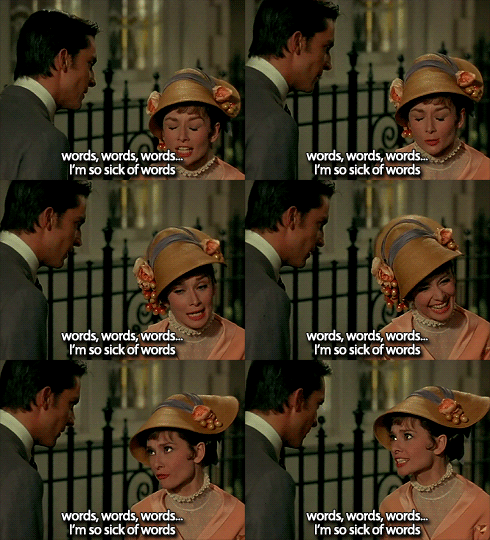
gif image of Eliza Doolittle fiercely singing "words, words, words, I'm so sick of words"

I'm familiar with all three in some way or other, but despite their seeming simplicity they'll each make for an interesting challenge in terms of range, pacing, tone, emotion, and style. not to mention forcing me to sing the notes and timing as written and not just as I remember from musicals or popular culture or whatnot.

for these summer classes, there isn't a formal recital or presentation at the end of eight weeks, but it sounds like I'll at least get to perform for the other voice students at some point. that should be scary-exhilarating and cool also.


side note! in my googling for that .gif file from "Show Me," I discovered suddenly that Mr. Freddy Eynsford Hill is played, in the 1964 film adaptation of My Fair Lady, by none other than Jeremy Brett.

Jeremy Brett? whose name I mostly only know because of my longstanding, if lazy, adoration of all things Sherlock Holmes? 

yes indeed, that Jeremy Brett. I may have to move this whole playlist of his Sherlock Holmes performances up nearer to the top of my summer watching list.

Monday, January 31

accomplishment

today, after having planned to do so for some weeks, I printed out all 24 of my scholarly publications, starting from the oldest book reviews from graduate school (one in this international tech comm journal and one over here), all the way up to my most recent conference proceeding. there are almost ten years spanning all this work. it all fits neatly in a manila folder.

there is more to come. a book chapter on Twitch.tv and user experience research. a short piece on blogging as a ritual of self care. more conference proceedings, possibly.

scholarship is not all I spend time and effort on though. especially lately. speaking of self care... part of my self-improvement journey this past several months has involved finding value in more than mere productivity and work ethic and professional accomplishment. it's difficult to even see how those attitudes have made up (and still make up) so much of how I've been conditioned to see myself. moving beyond that mode is not easy.

but I am trying. not everything needs to be conventionally "useful," after all.

even though I take on the role of a tool within the mechanisms of capitalism in exchange for a paycheck and health insurance and such, I can put that role aside and instead, for a moment, become nothing more than a tool for inhaling and exhaling and pondering the universe.

or I can be a tool for reading and interpreting knitting patterns. or for absorbing and reenacting step-by-step yarn-spinning tutorials. (I'm learning to use a drop spindle, see? it's fabulously difficult and not, all at the same time.)

my ravelry project logs tell me I began this shawl sometime in July of last year. six months later, at the beginning of winter break, I finished it, after restarting the whole thing twice, after ripping back to the stockinette section at least twice, and after doing way too much math to customize the number of lace repeats. 

when I'd finally gotten through the first lace section and moved on to the final border... I noticed a couple of wonky twisted stitches that messed up the pattern pretty obviously. instead of purling the stitch then the yarn-over, I'd done them backwards and mucked up the eyelets. (it was only a million hours later that I figured this out exactly. proofreading lacework is a skill I'm not an expert in).

I had wanted to finish this shawl for October. for Thanksgiving at least. for early winter. but now it was almost Christmas and I had a terrible choice to make. could I live with this mistake? or could I not? would anyone else ever notice these backwards stitches? would I even notice them most of the time, as long as the shawl was keeping my shoulders warm? or would the mangled lace haunt me forever if I didn't fix it now?

I'd already torn out so much work so many times. did I really have to undo more? was there any way to avoid another frustrating round of backwards progress? 

this, by the way, is why you're supposed to check your knitting more thoroughly as you go. you're supposed to catch this kind of thing way before more than a whole new row of stitches separates you from your mistakes, let alone half a dozen.

I decided I couldn't leave it. I wanted the lace to look impeccable. so I experimented on my own, trying to work down to untwist things just in the sections where it needed it-- but this made things irrevocably worse. with no other option but tearing back 8 whole sets of knit-purl lacework, I began a desperate search for any documented knitting wisdom I could possibly trust to guide me out of this disaster. Ravelry comment threads. knitting forums. youtube. I pleaded with them all for an answer.

most of what the internet had to give me were tips on how to knit proper lace in the first place, not anything on fixing lace that you've messed up. but finally... somehow... with mere ounces of hope left that there was any reasonable solution for undoing whatever I had done... I found that Suzanne Bryan had a short video on exactly what I'd been looking for.

this video tutorial was everything. I curled myself around my phone screen almost breathless as I watched it, my mind doing somersaults as I realized this could work. it could work! if I could follow the method just right, and keep track of all the ladder rungs of yarn, and not undo more than just the one section...! this would solve all my lace problems. it was brilliant.

so I scrambled to fetch my spare circular needles and cords, carefully and excitedly knit backwards to the problem section, re-watched the relevant video clips twice more, and then started pulling stitches off.

it was a mess.

it was highly stressful, my fears and hopes in the utmost tension as I worked.

I had to keep going back to the pattern's lace charts (even though I generally stay far far away from the snaking codes of any knitting chart if I can ever help it) to pinpoint exactly which bit of the lace I could leave as it was and which bits needed re-making. I had to count and re-count how far down my mistake was and how far over from which edge of the scallop. 

counting is the hardest part of knitting.

but once I had it figured out, I just had to keep swapping the size 6 needle points from this end of their cord to the other so all the re-stitched stitches would be the right size. and it worked. I reconstituted the two tiny sections into perfect lace, paid very close attention to all the mistakes-waiting-to-happen in the remaining few rows, and finished the shawl the evening.

why was this lace-repair adventure so absolutely thrilling? I'm not sure. there was some risk that I'd again just make the mistakes even worse. there was the novel weirdness of loose yarn-spaghetti draped precariously between everything else.

it wasn't easy, but it was exhilarating. Ms. Suzanne Bryan's claims about her lace-fixing techniques are 100% correct. if you manage to complete a fix like this, you feel utterly bulletproof and infallible for the rest of the day. 

-

why does this small saga of knitting woe and triumph deserve documentation in this little blog of mine? I don't know if there's an answer, other than my typical interest in capturing bits of experience and emotion in as vivid and accurate description as I can. I like to write these vignettes of where and when and how, with all the metaphor and adjectives they need to vibrate satisfyingly from my imagination to yours. 

as for the finished shawl-- it's nice and cozy and blue. I've worn it a few times, even. but for me, the process of knitting is the fun part. the satisfaction of transforming material from one state into another state is undeniable.

thankfully, everything is a process from a certain perspective: crafting, learning, scholarly-research-agenda-ing, fire, and people too.

Friday, January 29

I, pedagogue (spring semester, 2021)

back in the day, I thought I'd never want to teach. and then I realized that in some ways, everything everyone does can involve a layer of teaching somehow. even if it's a very subtle one.

even still, for these past seven years of wading deeper and deeper into teaching college writing classes of various kinds, the real practice of teaching (with all the planning and record-keeping and decision-making and performing and grading and authority-wielding it typically requires) has not often been my favorite part of academia. it's fine. but it's hard. and I never feel very good at it, so it simply can't be as naturally rewarding as all the other corners of academia where I feel far more skilled.

for better or for worse, my two full-time assistant professor jobs so far have been quite teachingcentric. twelve credit hours of teaching every semester, plus a few during summer semesters, until this year. dozens and dozens of students show up in August or January or June for whichever iteration of professional writing I'm teaching this time, working and sharing and hopefully learning, and then they disappear again.

this year, I have one course release for being brand new in town. it gives me a chance to get used to things a bit.

they also gave all the new faculty a copy of the book What the Best College Teachers Do, by Ken Bain. a few colleagues and I read through it together last fall semester and talked about ways to apply the findings in our own classrooms.

the book and our little faculty discussion group made me think much more intensely about my teaching than I've cared to thus far. it also gave me some concrete hope that maybe I can become better at this thing I don't feel very expert in at all. 

so. what am I trying to do a little better this spring? what have I begun to internalize from Bain's research?

possibly more things than I can articulate very well in a little blogpost. but here are a few:

> talk about your own learning journey with students. model or reenact the kinds of transformation you hope that they will undergo as a result of your class.

> trust students and treat them like whole humans with a million shifting priorities, just like you. this is something I already knew and practice decently, I think. but I took particular comfort in it this past year. my course is a small droplet in the ocean of everything these students are trying to learn and become. if my teaching isn't perfect, they probably won't notice or remember for too long.

> ask students big, meaningful, authentic questions--the kinds of questions that professionals in your field will ask and try to answer. (this is particularly tricky in writing because writing, for most people, in most important contexts, isn't very often about itself. its actual subject is the everything else that we write and communicate about.)

I think I do pretty well being authentic and open and compassionate as a teacher. but I have been guilty in the past of assuming students could never be all that interested in the big questions that I study. we don't have time for that, do we? especially at a fancy aeronautical university where nobody is an English major and everyone mainly wants to design or build or test or fly airplanes and other such contraptions-- how could any of those students care about a communications course?

but if Bain is to be believed, the enthusiasm of a teacher combined with the sparks of a big, meaningful question can draw students in, motivate them a little, even if they didn't think they'd care very much about a communications course. 

and I can be good at questions, surely. 

especially big ones! like: how do you know what anyone means? how do you know what anyone else thinks you mean? how people really ever understand each other enough to make good things happen in the world? and what does it mean to read? to write? or to do those things effectively?

the trick now becomes figuring out how much time to spend getting philosophical about definitions inbetween all the more "practical" work of practicing reading and writing and revising and all that. I still think students learn most from doing things, more than they can from reading about things or discussing them or whatnot.

but anyway, I added this little linguistics video to my list of assigned readings. I opened the first day of class reading from Celeste Headlee's book We Need to Talk, which recounts the tragedy of an ineffective conversation in an airplane cockpit. in technical writing we spent the first day exploring informal crowdsourced technical descriptions on Reddit.

and when I listened to this recent episode of So Many Damn Books with George Saunders I felt more affinity for Saunders's love of teaching writing than perhaps I might once have felt. his advice is to remember that you're never just teaching 20-somethings who barely know what to do with their adulthood when you meet them-- you're also teaching the 40-something-year-olds that they'll become. I like that. (not all college students are 20-somethings, but the concept holds. we are all humans-in-progress.)

maybe I'll go back and give the Pedagogue podcast another chance, too, now that I feel more hopeful and less grumbly about this whole teaching business.

Monday, September 28

minds bodies words and shared responsibilities

this draft has been waiting some time for this day. I'd been thinking for a while to rework it into a post, but something always got in the way of my actually doing it. and then when I realized there was a date on the thing-- today's date-- I put it off yet again just so I could ultimately post it on its anniversary. 

this end-of-September Monday marks five years since I wrote the following five paragraphs for Dr. Thomas Rickert's posthumanism class. it is in a genre of grad school essay called the "paper day paper." (if you're curious for more examples, it just so happens that fellow Purdue student Ryan has impressively assembled all of his paper day papers here. not all of mine would be so easily digitized, though I have repurposed snippets from them before, but maybe it would be cool to follow Ryan's example someday eventually.)

-

Mind and Body are Just Words
28 Sept. 2015

I stole the title there from a recent podcast episode of Krista Tippett’s On Being, where she interviews Dr. Ellen Langer. Dr. Langer’s experiments on wellbeing and mindfulness hinge around an idea that “mind and body are just words,” separation between them is artificial, and there is real power in our expectations and perspectives. I am skeptical about the word just. It carries such belittling dismissiveness. Yes, mind and body are words, but words and meanings surely play into Dr. Langer’s whole point that perceptions can make a physiological difference. We can’t ignore words in all that. As Francesca Ferrando puts it, “futures do not appear out of nowhere: they are based on the presents, the pasts, and the ways they are being envisioned” (1). How we talk about things is part of how things thing for us, after all. How we talk about the future will be part of how the future futures.

One thoughtful listener’s reflection on the podcast’s webpage, from a semi-anonymous Sarah, adds, “Our whole body thinks, it's not a function confined to (that admittedly amazing organ) the brain; and the body, with it's [sic] internal and external senses, is dependant [sic] on it's [sic] environment as part of that thinking process.” Perhaps Sarah has been reading Andy Clark. He and this Sarah person at least seem to share some enthusiasm for the possibilities of describing our selves as inseparably enmeshed with environments and tools. Clark writes, beautifully, that “Minds like ours emerge from this colorful flux as surprisingly seamless wholes: adaptively potent mashups extruded from a dizzying motley of heterogeneous elements and processes” (219). Without all that mess, minds like ours (…if we can call them ours…) may not be possible. But for all we owe to the motley universe, Clark does allow us to own our minds and our agency. He describes these “surprisingly plastic minds” as belonging to “profoundly embodied agents: agents whose boundaries and components are forever negotiable and for whom body, sensing, thinking, and reasoning are all woven flexibly and repeatedly from the accommodating weave of situated, intentional action” (43). According to this model we are individuals, yet also systems and parts-of-systems, with flexible boundaries and all kinds of negotiable bits and pieces.

I wonder who/what has the upper hand in these negotiations. Where exactly does agency live in these woven, mashedup contraptions? Anywhere? I imagine it must be distributed, shared among world and self and materials, just as enmeshed as anything else. And if so, the question of control and responsibility—of agency—begins to feel worryingly and impossibly mystifying. This On Being episode that I have stuck in my head suggests, in its earnest, pop-sciencey way, that if one can just change one’s attitude, one can change one’s whole life (for the better, presumably). What power. What responsibility. Several comments in response to this theme argue with great concern about the ethics of asking, say, a lower-class/minority laborer to adjust their attitudes to their work, as if that should be empowering and liberating enough for any profoundly embodied agent. Is it really? Could it ever be?

Along these lines, Katherine Hayles points out early on in How We Became Posthuman the need to consider “how certain characteristics associated with the liberal subject, especially agency and choice, can be articulated within a posthuman context” (5). It doesn’t seem very easy. She later returns to the concern of subjectivity, recognizing that “As the liberal humanist subject is dismantled, many parties are contesting to determine what will count as (post)human in its wake. For most of the researchers discussed in this chapter [Narratives of Artificial Life, ch 9], becoming a posthuman means much more than having prosthetic devices grafted onto one’s body. It means envisioning humans as information-processing machines” (246). And this, of course, is only one sense of human-ness. We can—and at times already do—conceptualize ourselves as information. Hayles quotes William Gibson on the posthuman body as “data made flesh” (5). But might we reverse this? Will distinctions between information and identity blur as much as those between mind and body and world are blurring? Activist and tech designer Aral Balkan would argue and has argued in numerous talks that they have. In a manifesto-esque blogpost called “Indie Data,” (and elsewhere) Balkan writes about the tools and information and processes that are our digital selves—informational yous and mes—digital selves caught up in a market where human rights don’t necessarily apply, where corporations ask us to trade all our digital fingerprints for free access to technology. Balkan begs his audience to pay attention to the ways we participate in that conversion of self into data, and he hopes “to create, support, and popularise products that empower you to own your digital self; your data, tools, and derived intelligence.” Such ownership is not given. It too must be negotiated. Clamored for and defended and somehow brought into sustainable possibility.

Our texts so far in this class have been prodding us to draw fewer dividing lines and to start recognizing the ways in which every thing is part of a lot of other things. Whether it’s Heidegger’s Being and presencing, or Hayle’s enacted/embodied/empatterned systems and information-processings, or Clark’s EXTENDED models of mind, all these words urge more careful thinking, more open awareness, more inclusive considerations of a good future for humans and non-humans and everywhere they overlap. I’m not sure exactly how much control we have over using our present presencing to carve out space or language where the future will best future for the most people, places, and things, but I hope we have a little bit. Whether we do or don’t, we should keep talking about it and writing about it with words that are just words and words that are more than just words. Whether we do or don’t, we should try not to mess it up, if we can.

Scholarly References
Clark, Supersizing the Brain: Embodiment, Action, and Cognitive Extension
Ferrando, "Is the post-human a post-woman?"
Hayles, How we Became Posthuman: Virtual Bodies in Cybernetics, Literature, and Informatics


Postscript:
I have a new academic idol of sorts. Patricia Roberts-Miller blogs about key principles of argument and rhetoric and how those intersect with politics and demagoguery and it's all gloriously insightful stuff. I might blog more about her work later on, someday