Showing posts with label films. Show all posts

Tuesday, September 30

the good fight

what does an average middleclass person in the developed world have to really fight for? stand up for? do capital-S Something about?

plenty of stuff, surely. but then again... fighting seems dangerous. difficult. as long as we have access to some safe-enough shelter, plentiful-enough groceries, functional-enough plumbing, a little companionship, what else could we need to really worry about? with those basic necessities secured, most of us will be content with the state of things, whatever mild to moderate chaos or metaphorical storm clouds may swirl around on the outskirts of our little routines. 

do I mean "be content with," or "get complacent about"?

photo of an art piece in downtown Indianapolis, with a neon crosswalk sign flashing "DON'T CARE" in blue all caps

both, I guess. the main difference between the terms is in the level of awareness each implies. complacency means ignorance. we can frame our implacable cockroach-like ignorance as blissful and cozy, or as a challenging opportunity to learn more stuff. or maybe as protective wall, willful and resolute. which way we see it (or if we see it at all, I suppose) is a decision to make. a mindset we get to set. more likely, multiple shifting mindsets that we trade in and out as days come and go. 

my list above of all the basics that would be worth fighting for if we had to didn't include any education, but really it should. what kind of teacher would I be if I couldn't say learning and knowledge are worth fighting for, standing up to demand, or working as hard as possible for, after all? we need good food and good information to really survive on this planet. we can't leave our brains out of the game. useful stories are what civilization is made of.

we've watched the newest Superman movie more than a few times this summer. is it a useful story? (perhaps I should ask "useful for what?" or "useful to whom?" here. stories can be made to do many kinds of work in the world. not every storyteller has the same kind of use in mind. not everyone understands their needs for safety, shelter, food, and information in the same terms as other people's.)

despite the comicbook/superhero genre not being my usual cup of tea, I did like the messages this one braided together for us. 

  • your biological family and their cultural values aren't the be-all-end-all of who you are or can be. 
  • seeking peace and justice is not easy; people will probably complain no matter what you try. 
  • success of any kind at almost any level takes a ton of collaboration: there's work for the superheros, for journalists, and maybe for the unruly canines too. 

not all fighting is physical or violent (thank goodness). inasmuch as my daily work might be considered a figurative battle-- to wrangle my modest expertise in technical writing into a series of effective lessons for a bunch of college students every semester-- to apply decently rigorous empirical methods to relevantly articulated research questions in the field of media studies-- and all the other paperwork and collaboration and sitting through meetings that attend my little academic career-- then we can say I've fought to defend my few square feet of shelter and my $600/month grocery budget. perhaps I also fight here and there for recognition, for friendships, for leisure time, for a little peace and quiet. what advocacy my life entails beyond these selfish pursuits is very small. smaller than a pebble thrown into a puddle, it seems.

professionally, I advocate for all the podcasts to have transcripts. for inclusive and non-punitive learning-centered pedagogy where students get to make a lot of decisions for themselves instead of merely following arbitrary instructions. for a rejection of the workaholic mindset that still pervades academic culture. for everyone to do their best to read more and communicate clearly and vote in all the elections.

does all of that make a difference? I'll at least say that it doesn't not make a difference, so that's something. I won't always be able to measure the difference it might be making. there is plenty of hope involved.

could I make more of a difference if I were a scrappy investigative journalist? 

more or less is not the right question here though. it'd be a different kind of difference, on a different stage, but another form of education in any case. keeping people empowered with accurate and relevant information about the present universe. meaningful work, indeed. 

but also... maybe scathing exposés about the far-reaching misdeeds of tech billionaires only bring about lasting consequences in comicbook movies with happy endings. 

what does an average middleclass person in the developed world know, really, about all the bigger things out there to fight for? all the things we could/should/might/ought to/would do capital-S Something about before it's too late? nobody can be rationally informed about everything everywhere all at once. it's too much. even if we are informed enough about reality, learning/knowing/deciding what to do about it is another set of mental battles in itself.

my currently second-most-favorite podcast Never Post published a roundtable episode on this idea, back in May. the host (Mike Rugnetta--the one and only. I know, I know, will I ever shut up about Mike Rugnetta?) notes the tension between how we use the internet and how we might wish we could use the internet. it is a global medium--that's why it was made. one of the coolest things we do with the internet is "to socialize and connect globally, which, you know, that's powerful and that's important," Rugnetta says, "but we can't act globally. [...] it's even hard to act locally given the state of especially American politics.
"And, you know, I feel like even my ability to even know how to act locally has perhaps atrophied a bit because of my focus on the importance of familiarizing myself with national and global events."

are there information diet plans out there, something akin to the handy food pyramid, but for sources of news instead of calories? probably. 

do they teach such things in grade school so everyone grows up knowing that your brain will not thrive on a diet of nonsense and trash? maybe somewhere somehow. bless everyone who dares teach grade school.

there is so much information in the world to be had. maybe I shouldn't say "too much," because that depends. too much for what? for whom? 

sometimes it does seem necessary to just stop for a little while though. to push back on all the information (the firehose, the overload, the deluge, the six-lane highway traffic jam) with a little carefully cultivated ignorance: "I haven't looked into that myself," "that's not my lane," "I trust someone else to be smart about and work on that particular problem" and so on. (this brings to mind some of Hank Green's recent vlogbrothers video in which he touches on the difficult value of trusting our fellow humans.) we can all find our own good fight to fight-- there isn't just one. 

hopefully we aren't all fighting alone and/or at cross purposes though. hopefully we have some kind of justice gang/league/squad to back us up at least some of the time. smart and good people don't only exist in the comicbooks and movies. the Green brothers are on my list of people I admire for trying to make the world better. academic acquaintances are on the list. non-profit organizations managed by people whose names I may never know are on the list. 

its been a week or so since I read this detailed breakdown of "The Dark Internet Forest" as a concept for understanding the possibilities and risks of all our globally mediated connectedness and was thus suddenly enchanted with its author, Erin Kissane. she comes back to the centrality of place-- real or physical or digital or conceptual, place is important to remember. positionality. relationality. places matter. where are you? what other places are within reach right now? who else is there? how can you join forces and do Something?

I especially loved that Kissane cites this beautiful pushback against the classic "tragedy of the commons" idea. Elinor Ostrom's book helped me write my dissertation. I should read it again sometime. 

doing capital-S something is not always (probably not often) gonna be easy even when you have a team of active, collaborative superheros to work with. it's still messy. pebbles in ponds sometimes and big splashing ordeals other times. 

flip a switch somewhere and set your mind to care at least a little. doesn't have to be about everything. just don't get totally complacent.

photo of an art piece in downtown Indianapolis, with a neon crosswalk sign flashing "DON'T CARE" in blue all caps and "CARE" beneath it in white

Friday, August 4

masked and unmasked

opening match #6:
Exalted 2e
vs Vampire: the Masquerade 5e

here we have two games where the nuances of managing one's appearance and identity might matter more than anything else. what becomes of a soul exalted by the glory of an actual sun-god above all other mortals? what becomes of a soul damned to avoid every shred of sunlight for the rest of its unholy existence?

thus far I have not fussed very much over why my tournament has featured which edition of which RPG book-- it's all been dictated by what we had in our collection and nothing else mattered. we happen to own the second edition of Exalted, so that's what I'm working with. 

in the case of Vampire, things are a tad more complicated. this time, as we come to the last of the World of Darkness-adjacent gameworlds I will cover, I must note that I did have a choice. the others I've written about so far-- Werewolf: the Foresaken, Mage: the Awakening, and Changeling: the Lost-- all come from a certain line of White Wolf RPG offerings, and while we do own the fourth piece of this little quartet-- the version that would more properly complete the whole series, Vampire: the Requiem (pictured below)-- that is not the edition I'm writing about here.

photo of the red cover of Vampire: the Requiem-- title in spiky letters, glossy rose petals strewn across over the image of a limp hand
{ our very red and shiny, 2004 copy of Vampire: the Requiem that we own. its tagline is: "a modern gothic storytelling game." }

I will briefly mention the older version in my account of prior vampire characters, because I have played a short mini-campaign of Vampire: the Requiem with dear friends in Indiana. however, my main focus will be on the more recent 5th edition of Vampire: the Masquerade-- the latest in a line of game systems that actually predates the early-2000s versions featured in my prior opening matches. since almost the very moment this 2018 edition of Vampire came out, I've played many more and longer campaigns in its very similar setting but fairly different game system. so despite the incongruity it adds to my set of review matches overall, we're gonna roll with it.

photo of two RPG books: Exalted (a grey and red cover with five heros posed in front) and Vampire: the Masquerade (a grey marbled cover with the title embossed in bold red).

I've switched up the usual outline a little bit here, diving into aesthetics and mechanics first, then overall approachability, before finally summarizing past and present characters and their stories. the preliminary verdicts for this one are perhaps the most unfair of all the opening rounds so far.


SYSTEM     Exalted (2e) Vampire: the Masquerade (5e)           
tagline = "This is the story of the Exalted."
"Death is not the end."
publisher =
White Wolf
White Wolf
pub. date =
2006 2018
original cost =
$39.99 $55.00
length =
8 chapters / 400 pages
12 chapters / 400 pages
my exp. level =
none prior
lots


aesthetics

Exalted reminds me of nothing so much as the Mortal Kombat franchise. its colorful comic-book style overlaps with that of Scion a fair bit. and all three feature high-powered, more-than-human characters, with tons of lore and a sense of history inexorably iterating and perhaps repeating itself; but for style and presentation alone, Exalted exceeds Scion on almost every level. the colors and contrasts are richer, the paper is semi-glossy, the page numbers backdropped with stars, and the margins printed to look a little bit like marble. across every spread is a narrow little montage of epic fight scenes to serve as a letterhead above the rest of the contents. between every chapter we get to read mini comics following the exploits of various sample characters and villains. I almost can't overstate how shiny and dynamic it all feels.

perhaps because the world and setting of this system draw on everything that is not Tolkien, everything not already over-represented among typical classical western mythology and heroics, the book cannot simply rely on readers' general familiarity with existing mythology and mythic tropes. instead, it builds everything from scratch, new and intentional and intricately detailed. all of that gives Exalted a richness and diversity I haven't seen in any other RPG thus far. I was struck, for example, by just how many women are featured as main NPCs. that shouldn't be so remarkable, perhaps, but I think it's cool. 

aspects of this game seem quite anime/manga-ish, and other aspects remind me very much of the dark fairytale destinies of The Witcher, the cut-throat vibes from Game of Thrones, and even the razor-sharp whimsy of Discworld (mostly because the setting consists of a huge flat plane of earth, but also because the gods are referenced as playing endless little "games of divinity" with the world). it all seems very robust and crunchy, like shards of lava and obsidian rocks glinting dangerously in the sun. for all the outlandish, colorful extremes, the world needs to be taken seriously. 

-

you'd expect a game called Vampire: the Masquerade to be sexy, eh? and this one certainly channels as much sexiness as it possibly can into the pages of its rulebook. glossy pages, tons of full-bleed photo-realistic art, classy serifed type in black and white and red. glints of temptation at the edges of your vision. all the angular imagery of cities. skyscrapers. crowds. bodies in motion. techno. neon. teeth against a bottom lip. stalkers or soulmates? overstimulation. stars drowning in light pollution. the scent of old money. roses. silk. touch. adrenaline. diamonds. fangs. alleyways. the taste of unknown spices in the air. leather boots. mind-control. catacombs. castles. mystery.

for me, this is a game of intense moments layered together like leaves of fine vellum, each calligraphied with dreadful secrets, risks, bonds, and sacrifices. let's take everything I said about World of Darkness in opening round #1, but add a few gallons of flawlessly immortal elegance and deep red, viscous blood. the word masquerade itself conjures so much decadence and intrigue, artifice and uncertainty; all RPGs are games of pretending, but this one leans in as close as it can and gets really meta with what that can mean. 

you cannot play this game as a good guy. it's too late for that. you'll see. once you've been Embraced (that's the polite term for what happens when your greedy vampiric Sire takes all your mortal blood and replaces it with some of theirs), you might struggle however much you want against the Beast of your inhuman blood-- but that part of you won't be silenced and it won't be controlled. your soul is Damned. what will you do with that inescapable truth?


mechanics

bring out the d10s once again. you'll need plenty for Exalted, and you'll need two distinct colors, at least five of each, to properly play Vampire.

Exalted's mechanics match up with those of Scion to a large degree-- similar stats, similar types of rolls, similar Willpower and Health tracking systems, similar bonuses for describing your actions as epic stunts-- but of course there are key differences that make Exalted its own thing. instead of Legend, the exalted are powered by Essence. and instead of skills in the basic categories of physical, mental, social, skills are divided up into sets of 5, each set favored most by a particular Solar caste.

creating an Exalted character is decently involved, but once you've done it a time or two it isn't so intimidating. first you'll choose a concept and a caste. there are five castes to choose from: Dawn, Zenith, Twilight, Night, and Eclipse. the Dawn caste exalted ones are fearless warriors, Zenith caste shining, charismatic leaders, and Twilight caste the bringers of wisdom and champions of scholarship. Night caste are the clever, stealthy bodyguard types, and Eclipse caste are the most political, interested in diplomacy and balance.

once you've chosen your caste, you get a certain amount of points for skills, advantages, and Charms, plus a few bonus points to spend on upgrading any of these things a little bit further. choosing Charms is the trickiest part. these are your magnificent heroic powers, setting you apart from any other semi-divine creature that might think it can tangle with you and walk away unscathed. you start with ten Charms, half of which must be from your favored skill domains. ten sounds like a lot, but every Charm comes with strict prerequisites for Essence level and skill level. your character will start with the basics and level up from there, just like in any good kung-fu training montage. (not all Charms are combat-related, but still.)

to use Charms, you'll spend points of Essence from either your peripheral essence pool or personal essence pool. these regenerate pretty quickly in game, so there is no excuse not to use them. the only side effect worth considering is the possibility for your character's Solar anima to manifest in more and more obvious forms. if you spend more than a certain amount of your Essence pool before it can regenerate (especially the harder-to-control peripheral Essence), the glorious light of the sun will start to leak through your skin and betray your exalted identity to anyone who might be watching. 

-

the gameplay mechanics of Vampire work very much like the other World of Darkness systems, with relatively small differences. the nine core Attributes are the same, but this time we get 9 skills per category (physical, social, and mental) and a more flexible approach to allocating points to those skills at character creation. however, the available advantages and merits are more limited here. a few are general (like linguistics or resources) but many are specific to vampires only (like a folkloric bane that makes one sensitive to garlic, or pickiness about sources of blood). 

crucially, vampires in this game are not lone hunters, slaking their hunger as they may and enduring a deathless eternity. unless they don't care too much about preserving their un-life, a vampire will be subject to the ancient bureaucratic traditions and structures of a Kindred society. the Camarilla is the ancient hierarchy of most remaining Kindred clans. in recent times, rebel Anarchs have tried to pull down what they see as the oppressive and unnecessary aspects of the Camarilla. which side of this conflict you find your vampire character on will likely depend on the game your storyteller wants to run. in either case, the political frictions within Kindred society can greatly add to the basic horror of waking up as an undead monster.

first step for character creation is to choose a Clan into which your character will be (or will have been, depending on you storyteller's timeline) initiated. there are seven playable clans, each with a particular vibe, in this core book:

  • the Brujah, rebellious but down-to-earth scholars, poets, punks, and rabble-rousers 
  • the Gangrel, most animalistic, wild and fierce as nature
  • the Malkavians, touched by madness, derangement, and absurdity
  • the Nosferatu, classically stealthy and strange, deformed by the curse
  • the Toreador, those obsessed with beauty and hedonism,
  • the Tremere, blood alchemists who stretch past the edges of magic and science in their search for power
  • and the Ventrue, aristocratic and manipulative, thoroughly convinced that they deserve to rule the world.

there is a "clanless" option too. the Caitiff wander among Kindred society without the protection of a clan; perhaps there are pros and cons to that sort of undead lifestyle, but I have always found it kind of boring.

separate from your clan is your coterie-- the group of other player characters in the game, usually vampires of similar age, thrown together for some convenient but also compelling in-game purpose. and along with the bloodline of your clan, you'll gain access to a few Disciplines-- superhuman abilities granted by the vampiric blood in your veins. these are what let you effortlessly crush an enemy's throat, leap from balcony to gutter without a sound. this is how you read others' thoughts or intensify your charm to the point that mortals find your seductive glances impossible to resist. 

rolling anything higher than a 6 on your d10 equals success this time: nice and simple 50/50 odds in most cases. but 1s and 10s have the possibility to shake things up in very exciting ways. mostly you'll be rolling the typical Attribute + Skill combination (sometimes adding dice for Disciplines), but with some of those normal dice replaced with Hunger dice. those are the handful of whatever different color (red, the book cooly suggests). Hunger is a stat tracked during gameplay along with health and Willpower and XP. the higher your character's Hunger levels, the greater the risk for totally uncontrolled frenzy. at Hunger 4, any perceived threat or scent of blood will trigger a dice roll which if failed, may result in the storyteller taking control of your character and leading her to act out whatever monstrous impulses fit the scene. even for regular skill checks, the more Hunger dice in your pool, the more risk there is of either bestial failure (when you roll a 1 on any Hunger dice) or a messy critical success (rolling 10s on Hunger dice). in either case something unexpectedly bloody, cruel, or tragic is about to happen. 

unlike the other World of Darkness games, this one does not use Virtues and Vices-- what virtue could a blood-sucking demon find within themselves, after all? we use Ambitions and Desires as storytelling structures for each player character, instead. an Ambition is something to guide the overarching story of your game-- an ultimate goal to work towards. maybe your vampire wants to enact revenge on the one who created them, or to get permission from the Prince to Embrace a mortal loved one. smaller than Ambitions, Desires are like the stepping stones that may help you get closer to that larger goal. ingratiating yourself with the older, more powerful vampires by doing favors for them, or tracking down resources to better secure your coterie's haven, for example.

Willpower functions almost the same, but instead of adding dice to a roll, you spend Willpower to re-roll up to three from your pool. instead of Morality, Vampire works with a Humanity mechanic. a brand new vampire may start with decently high Humanity (6 or 7 out of 10), but it's likely they won't keep it unstained for long.

approachability

Exalted and Vampire both do a nice job of presenting their systems to readers in an organized and accessible way. they both have quite a lot going on, but it's all divided up into pieces and labeled pretty clearly for us. applaudable book design all around, I say.

despite being just as old as Mage and Changeling, Exalted doesn't suffer from the "let's cram our rulebook full of stylish-but-less-readable typography choices" issue. they save the stylishness for the interstitial comics and art bits, it seems. however, it is quite a dense book, with so much interesting lore poured into practically every section, you might get lost in it. I found it tricky to navigate at first, and very tricky to remember where exactly I first read about that one important NPC or that one city's specific political conundrum. because the lore is somewhat spread out among all the other information in the book, it can feel a little mushy. 

on the other hand, I appreciate how much that lore contributes to a full and logical sense of the world. it seemed a little strange that much of the introduction delves into the lives and culture of the Dragon-blooded, or Terrestrial exalted, when players can only create Solar exalted characters. but in any case, there is a great amount of detail and nuance to build on and to hook your character concepts and plot ideas into. your Exaltation isn't random or without cause-- your Soul, chosen and empowered by the Unconquered Sun in a long-ago age, is now escaping its prison and returning to a new body, transform that body with power and glory and intense purpose. it's fun to think about how your character's original form as a Solar exalted in the First Age might inform their new incarnation.

-

the lore of Vampire is a little less overwhelming. the game has the luxury of decades-worth of tropes and vibes from existing vampire media to lean on (sidenote: Only Lovers Left Alive is the best vampire movie, if we must pick one). the book lets any potential wordiness in its exposition breathe among generous amounts of negative space and provocative art. I was intrigued by and quite pleased with its three-column layout. the shorter lines thus created by such formatting makes the text content itself nice and quick to skim, so finding things throughout the book is way easier.

perhaps most notably, for a World of Darkness property, this particular Vampire rulebook can function entirely on its own. there are mentions of the World of Darkness as a setting, and this Vampire is as compatible as its older cousins with the wider gameworld (I know our prior Vampire games have featured Mages as antagonists, at least).

I should say that the gritty gothic horror and unavoidably bloody content of Vampire might not be for everyone, either. the sexiness may not be inherent to the game, but violence in some form or another is. even so, any good storyteller should be able to balance story details against what everyone is comfortable with. every game and every gamer is different. find some that you like and let everyone else do the same. 


previous characters + stories

other than a vague and nameless concept I once outlined for a fame-hungry Zenith caste character, I have no prior character for Exalted-- only my two new tournament characters whom you'll meet in the next section.

there are a good handful for Vampire though. ready?

very first was Eve Richards, who technically existed in Vampire: the Requiem. not the same system, but still a vampire. we played that game for just a few awesome sessions in Indiana as I was finishing gradschool. Eve was a Gangrel, with a found-family of biker chicks. I remember her drinking pigeon blood and ultimately adopting a good and loyal (and yes, okay, blood-addicted at this point) bulldog named Winston. so cool. 

in Louisiana, a Vampire game was one of the RPGs we were able to stick with for quite a while. friends Frank and Daniel and Oona and Andy and sometimes Emily would join us every two weeks to play as Seattle-based vampires figuring out their afterlives amidst overlapping alliances of older, more powerful Kindred all trying to use them as pawns. I played Sierra Adler, a Malkavian artist/photographer with a deep strain of sibling rivalry. so many things happened in that game-- too much to even try to summarize well. near the end, Sierra confronted a shapeshifting hippie-chick Mage named Thistle and mostly failed to do anything very useful against her blatant threats. our final session came somewhat suddenly and in hindsight feels comfortably ambiguous. there was a gathering. chaos. combat. flames. death. regardless of what really happened, in my gentle rewrite of Sierra's ending, she and her sire (the deeply morose Orla Grace) both met their Final Death together, each flailing to save the other from Mage-hurled fireballs.

next we have one of my most favorite characters out of all the characters I've ever played: Ms. Victoria Abigail Evanston Bell. for this game, set in 1920s Chicago, we played a few prologue sessions as mortals before falling into our fates as vampires. I styled Vic as a high society heiress trying half-heartedly to hide her tomboyish, absinthe-drinking flapper side from the newspapers. she was so much fun. our small coterie (a Gangrel Celia and Malkavian Doyle, later joined by a techie Nosferatu Ethel) helped her recognize and fight back against Vic's awfully controlling Toreador sire and survive the Valentine's Day massacre all in the same weekend. she obviously had to give up her high society life, but as consolation she opened a little back-alley cinema and dabbled in producing films herself. at one point, Vic's hunger got the better of her (see my notes on frenzy, above) and she tore apart an entire speakeasy of gangsters almost single-handedly. many nights later, as the coterie was just about to uncover more clues to the whole deadly underworld conspiracy of it all, a pack of rogue Gangrel in coyote form ambushed them in a city park. none of her friends could save Vic from being torn apart herself. so tragic.

for the same campaign story, now time-jumped into the '60s, I drew up the character Maeve Wells, an eager young Tremere whose curiosity outweighed her sense of ethics even before she was bitten. she was interested in the effects of psychotropic drugs in combination with vampire blood. the clan leaders had all kinds of ideas for experiments she could run, and Maeve was quite prepared to impress them as much as possible. unfortunately the campaign dissolved a little while after that, so we'll never know just how depraved she may have let herself become.

and finally, in addition to those three, I've got Margo Wallace. she starts out as just a teenager cocooned in a tight-knit group of wannabe-enlightened friends, bemoaning the death of the local mall and dreaming off and on about fashion design school or something. she was also destined for clan Tremere, but this campaign barely got off the ground either. maybe we'll pick it back up one of these days... 

lastly for this section-- I also dabbled in running a Vampire story for Jeremiah once upon a time. I still have pages and pages of notes and maps, tracking my ideas for the Kindred who might sneak around drinking blood and manipulating the world of Salt Lake City after dark. there were going to be secret backroom hideouts downtown and ancient cultish libraries and child trafficking rings and the ruthless redirection of refugees into very particular households... but we only played three or four sessions before I just got too intimidated by the prospect of engineering that much darkness.


new characters

I created Zaya Greane, Eclipse caste, to play in a simple one-shot session. she's a mash up of Varys from Game of Thrones, Gus from Breaking Bad, and Madeline Stillwell from The Boys, with some sprinkles of Lorelei Gilmore from the seasons where they're running the charming little Dragonfly Inn. prior to our short one-on-one session of Exalted, we spent a good amount of time developing a setting and context for Zaya. she was ambitious and very skilled with business, negotiations, and managing people even before her Exaltation. after, she would be unstoppable.

and she was. almost. in a world where Solar exalted are seen as dangerously overpowered and in urgent need of annihilation, she faced her fair share of threats. playing her had me tapping into the most determined, fearless, un-intimidatable version of myself. I unlocked secrets, forged alliances, generally struck fear into all the underlings in my service, and succeeded in humiliating Zaya's ex-lover in battle. it was great fun.

for a second Exalted character, I made a Dawn caste gladiator named Canessa. after her Exaltation she is suddenly burdened with far grander ambitions than to win every fight, battle, or war. instead, how about we take down the Empire by infiltrating the mystical center of its powers? why not? Canessa is sure she's powerful enough to find and topple the Imperial Manse. perhaps she'll find the Red Empress there and be the one to finally supplant her. that would be suitably epic, I think. 

as promised, I've taken little Briella Jameson, rock-climbing activist, and complicated her life by throwing mystical alternate realities at it. she will not have a good time as a vampire, I imagine. but anyway-- clan Brujah immediately seemed most fitting for this idealistic activist and advocate for the unhoused that I created. I did toy for a moment with making her either a Nosferatu or a Ventrue. her willingness to work in proximity to the dirt and ugliness of the street might put her in the path of a sewer rat Nosferatu, and such a transformation would be quite interesting storywise. conversely, her political connections would make her attractive to the aristocratic pullers-of-strings that are the Ventrue. but the Brujah vibes were just too perfect, so I went with it. Briella will fit right in with them, eventually. but at the moment she is too squeamish to drink from humans, too confounded to know exactly how she'll survive. perhaps she and her raccoon companion (what should I name it? hmm) will run into Eve and Winston hunting pigeons and stray cats and such, one of these evenings.


preliminary verdicts

someone asked me, as I was explaining this tournament project back at the very beginning, which game might win if I had to pick a champion right that moment, without any of this everso rigorous process. it didn't take much time at all for me to think and answer: Vampire: the Masquerade. it can't quite compete with D&D on number of characters or total hours played, but there is something about the setting and the tension and the way dear husband Jeremiah runs this game... maybe it's the mostly modern setting, giving my brain a more relatable, more seamless set of connections for my roleplaying and storytelling muscles? somehow I find gameplay in this system the most intensely invigorating. all the sensuous and visceral details, the quiet scenes of inner struggle and the obscene moments of bestial ferocity, and everything in between. this game and its stories come alive in the best way for me, somehow. I guess measuring all the deepest, most horrible selfishness of an actual vampire against beautiful little shreds of hope and humanity is really cathartic, or something.

it's definitely not fair to judge one three-hour session of Exalted against all that, but I will say that it had an intensity and sensuousness of its own, and that fed my enjoyment of it quite well. in this case, some of the same reasons I don't mesh with Scion (huge, bombastic stunt descriptions are tricky) are also at work. but at least I felt very well-situated in the game's central conflict. that helped me bring Zaya to life pretty well, and it was very fun to watch her (us?) in action.

when I revisit my preliminary judgements at the end of the opening round, we'll see how everything shakes out for real.


next match-up review: 7th Sea vs. Cyberpunk RED

next (and final!) new mini-campaign: A Song of Ice and Fire

Monday, June 20

seven score and seventeen years ago...

today is Juneteenth. well, not really. it was yesterday. but today is the "observed" day of it. so it counts. ish.

I first learned about this holiday from the most Texas-loving Texan I have ever known, whose name is Sarah. I have lost track of this old friend, nearly ten years since moving away from Texas, but I'll never forget her.

now that Juneteenth is an official federal holiday, I shall never forget it either. 1865. Galveston, Texas. the real, actual, official ending of slavery in the US. 

celebrating the day in any concrete manner is different, I suppose. we'll work our way up to that.

about a week ago, I watched Amistad. (it was the fourth McConaughey movie on my list.)

it was a touching and tragic film, nevermind that the ending is technically in the happy category. 

and its cinematic depictions of tragedy, I'm sure, can only in the most thin and whitewashed way compare to the reality of a transatlantic slave ship.

yesterday and today, photos of this underwater sculpture have been circulating as a memorial of Juneteenth. the artist has apparently said he didn't mean his underwater museums to evoke the middle passage and the unthinkable numbers of humans who either chose the sea or were forced into it, but he is open to the fact that it does so anyway.

seeing the photographs brought back the most harrowing scenes from Amistad: scenes of a woman and baby ultimately choosing to drown, rather than wait out the next horror as captured chattel. scenes of chained, naked women being shoved overboard, presumably because the ship's crew miscalculated their rations and could not feed themselves and those women.

Juneteenth means remembering this history, the pain of it (so thin and light and stupidly cinematic compared to the pain of those who lived it, who still live in its repercussions), and the slow, slow progress toward equity and justice.

remember. there is still work to do

Tuesday, June 14

buried treasure

the fifth of my Matthew McConaughey movies was The Newton Boys, which I watched this afternoon. I'd never heard of it before, but it seemed like my kind of movie. I love heist movies and I get plenty nostalgic for period pieces.

this one chronicles the adventures of some real life bank robbers from the 1920s. very Red Dead Redemption 2 meets O Brother Where Art Thou vibes. I did enjoy the film, though it is a little dull for a heist movie. or "thoughtful," or "meandering" as a few older reviews I looked at put it. the heists themselves are not the point-- it's all about the journey, they impulse, the risks and the consequences.

the opening scene comes with a subtitle indicating that we're on a ranch somewhere out in Uvalde, Texas. 

on seeing this, I immediately wondered whether McConaughey knew any of the original Newton boys. it seems plausible-- the youngest of the gang lived until 1988. I couldn't find any evidence to support such a theory, but I didn't try all that hard either.

like all good based-on-a-true-story films, this one ends with annotations about where the characters all ended up. the coolest tidbit there was: 

a hundred thousand dollar share of their last train heist, buried by Jess Newton somewhere around San Antonio almost exactly 98 years ago this week, has never been found.

after almost a hundred years, it probably never will be, I guess.

you can read more about the gang's legendary exploits here if you like. the video they include at the end is part of what we see in the film credits, which was really the best part of the whole thing. I bet my dad would love this movie at least a little bit.


for the record, here is the full list of McConaughey movies still ahead of me:

EdTV
Reign of Fire
How to Lose a Guy in 10 Days
The Paper Boy
Two for the Money
Failure to Launch
Fools Gold
Ghosts of Girlfriends Past
The Lincoln Lawyer
Mud
Magic Mike
Dallas Buyers Club
Interstellar
True Detective (excerpts)
Sea of Trees
Free State of Jones
The Dark Tower
The Gentlemen
Serenity
and
The Beach Bum

Dazed and Confused, A Time to Kill, Contact, and Amistad are officially checked off. both Frailty and Wolf of Wall Street we've already seen somewhat recently, so they're not included. neither is a film I think I'll ever watch again, anyway.

should I set up a ranking? hmm. I don't typically believe in such things, but it could be interesting to judge these twenty-five pieces of art against each other. we'll see. 

Tuesday, January 31

with eyes unclouded by hate

hello January's end. here we are. and a few weeks back I decided, determinedly, that even though my once weekly blogging habit has been set aside on and off for quite some time now, I cannot let this blog die. so the new blogging goal is two posts per month. one of them shall take a somewhat serious form, and the other shall be about anything at all that might come to mind.

I don't know which this one counts as, this time.

earlier this month Jeremiah and I went to see the 20-year-old classic anime Princess Mononoke, which I thought I might have seen before at some point in those two decades, but could not actually remember. in the theatre, the opening art did stir a few memories, but other than that I had no recollection of the film.

I just went to search friend Melanie's blog to see if she's reviewed Princess Mononoke. so far it is featured here for its beautifulness, and mentioned in a handful of other posts, but there is no full review for me to defer to (yet).

we saw the dubbed English version, with script by that one British author you may have heard of, Neil Gaiman. Princess Mononoke is definitely beautiful, and a complex, funny, and fairly moving film. not many films succeed at moving this amelia person, but this one did, in a subtle, lasting sort of way. I have found the story worth pondering even weeks later. our questing protagonist is full of honor and self-sacrifice and talent, but he is not perfect and does not ultimately save the day (not entirely, anyway, and certainly not by himself). our title heroine is stealthy-fierce, all mysterious and vengeful. there are no simple characterizations, no straight tropes. the film bends this way and that way and it surprises you.

I liked what Leah Schnelbach says in this piece (it is spoiler-y, fair warning) about the multi-facetedness of the characters and the realness and meaning of the story. it's good stuff:  people and their worlds are complex, actions have consequences, plurality and balance are ideals, and hate from any side--no matter how 'righteous'--will poison everything.

the soundtrack behind this film is also exceedingly lovely. the themes and story have depth that makes my brain smile. so yeah. Princess Mononoke is on a very short list of movies that I'd much enjoy watching again every so often.

Tuesday, November 29

from machine, toward what?

most people who know me know I get incredibly picky about movies. it is an awful snobbishness, an unshakeable sensitivity to predictable tropes and shallow sappy mush. in my silly opinion, most films are tolerable, a few are worth having seen but not much else, and a few are utter wastes of time. and a very, very few are masterful, provocative constructions that I'd definitely watch multiple times in order to get the most out of them that can possibly be gotten.

my list of movies I find significant fault with is pretty long. much of the time it's endings-- they're too neat, or too pathetic, or too conventional. I'm incredibly picky about endings of things.

my list of movies I hate is short, and my list of movies I love is somewhere in the middle. former favourites or near-favourites have included The Princess Bride, the BBC's Pride and Prejudice, A Beautiful MindFight Club, Seven Pounds. maybe Inception.

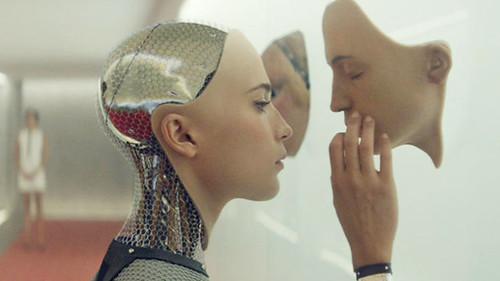
I went to see Ex Machina pretty much on a whim. because I'm so dreadfully picky about films, I don't often bother with seeing things in theatres. but friend Eric had mentioned he was going; I idly looked up the trailer and decided to tag along. I'd done the same with various other films friend Eric and/or friend Sam planned to see. Guardians of the Galaxy was alright. Mr. Holmes was alright.

Ex Machina was astonishingly good. magnificently astonishing.

ex-machina-movie
{ borrowed from this kind soul on Flickr }

it had all the thought-provoking subtlety that I demand of a good film, along with great art and believable/relatable characters, and nothing at all slow or boring or in-the-way of the story. the settings and sequences carry such spotlessness and shine

the ending spun to a stop with a thrilling momentum, yet at the same time with all the delicate, delicious unpredictability I could ever want.

writing about it now, I'm reminded a little of the way Seven Pounds winds back on itself with its puzzling pieces of morbid evidence. but Ex Machina only barely leaves room for us to recognize our own disbelief or suspense--by the time its beautiful twists were unfolding I just had to let them wash over me and my expectations like an avalanche of something wide-open different, ambiguous and unsettling.

I immediately wanted to see it again. in the dark of that theater, gaping, speechless, I just wanted to start all over and keep thinking about the story and the future and the brilliant composition of words-pictures-acting I'd just seen.

if you haven't seen it yet, I'll watch it with you. just name the weekend.


here are a few miscellaneous and relatively unimportant footnotes, for anyone interested in reading more about Amelia's new very favourite film:
summary and info from the production studio
other films from the same studio, some of which I should find and watch to see if I enjoy them as much as I did this one.
some words on the fancy, remote, Scandinavian locations

Saturday, November 26

things I liked about Stranger Things

everyone was talking about this Netflix series Stranger Things a few months ago. I'm not sure if it was the things that were being said or the people who were saying them that made me slightly less skeptical than usual of all the hype. actually, now that I think about it it was the gifs and screenshots that may have made the difference. especially Barb. she simply intrigued me.

anyway, over fall break Patti and I watched it while we knitted. I was prepared for creepy-ness and nostalgia. there was a good amount of both, but thankfully not so much of either that it felt over-saturated. the suspense and monsters were not too gory, heavy-handed, or in-anyone's-face. all the 80s-movies references were subtle enough to not feel stupid.

it lived up to some of the hype, but not all of it. there were plot holes and unexplained bits, and I was quite disappointed by the way things ended for our mysterious heroine. others have written more attentive, more detailed things about the show's treatment of its female characters and on the show's manic-pixie-dream-girl-itis.

those things I didn't like are pretty major. but the rest of my review here is gonna be a list of things I did like. here we go:

- there are only 8 episodes. short is good.

- all the characters we got to follow added variety--the kids had a plot, the teenagers had a plot, the grown-ups had a plot. and all the plots came together eventually, balanced nicely.

- it's set in rural Indiana, and I had fun recognizing the symbol from the Indiana flag on the police officers' sleeves.

- the overall vibe was well done, all chill, shadowy, autumnal, balancing haunted and homey. at times it felt more like a fairytale than an 80s-themed sci-fi suspense thing.

it was worth watching, and I have no regrets. thanks for watching it with me, friend Patti. 

other friends who may not have seen it yet: you'll probably like it too. 

Monday, May 27

we

there are no closed systems. everything influences everything else. all of us play roles in all the others' lives. the cast and the script and the plot and the setting are all so complex we can hardly fit the hugeness of it in our brains. so intricate our explanations, synopses, always feel thin and stretched.

we try anyway. we want to tell stories with our lives. we want there to be a beginning, a middle, and an end.

but when that doesn't work out, at least we can tell stories about our lives. we can carve our memories into neat narratives. I am one of the guiltiest. or am I? sometimes I look for the story before a moment has time to become a memory. sometimes I start hunting for the perfect description of this or that event before it is even over. before I have even crossed through it. I start bending my experience through some kind of lens as soon as I can think to, as if pinning the glory of now into some evokative, poetic phrase will make it keepable somehow. as if boxing each tiny split second into place as part of a meaningful chain of events will make it easier to leave the past behind.
I don't think it's bad to turn our lives into stories. I'm not sure what our reasons are, exactly (a way to hold on to slippery moments? a method of honoring the ever-changing present?), but we seem to like stories a lot. true stories, fantasy stories, short stories, epic stories. something in them can be incredibly engaging. addicting, even. storytelling is a very human, very beautiful pastime.

last weekend, I watched The Fall. friend Melanie had painted it so invitingly and gorgeously, as she tends to do with films, and I looked forward to seeing it. Melanie has excellent, well-justified taste, in my opinion, at least. The Fall was just as lovely as she made it seem.

the trailer:

all of it was great. for me, the most intense, tear-jerking point arrives when the little girl, with bandaged head and a face full of frustration, asks, "Why are you making everybody die?" (the clip at 1:45 shows the line, if you're curious.)

in response, Roy says to her, "It's my story!"

she responds, "Mine too!"

and then you know it isn't only the story they're talking about. it isn't only the silly imaginative story these two have shared, but life. it's not only the plot of his fiction Roy has partially surrendered to this young girl, it's the plot of his own existence. she has a stake in him, now. he can't pretend his actions won't affect her. friend Melanie linked to this analysis in her review, which picks at this idea a bit more. stories. lives. neither of these things can ever be single-author creations, no matter how pervasive the myth of independent, solitary genius. nobody can be the sole creator of anything, can they?

whether we are storytellers or story-consumers, to be in a place of so much power--with so much freedom to see and re-see the world and yet to still be obliged to make affordances for others and their visions--takes a massive, almost paradoxical sort of balancing act. our own imaginations are capricious enough, I think. who knows what someone else is going to re-imagine our stories? we can't predict exactly--but we know it's going to happen. that's part of the magic and the risk.

everything influences everything else. is it butterfly effect, or just particle physics, or what? and is this always true, even in stories? maybe not. but to quote friend Melanie about The Fall: "The genius of the story is when Alexandria pushes her way into it and we wonder how much influence she can exert, paralleling her influence over Roy, himself. The story is both a symbol and a product of the relationship between these two people." nobody owns the story. nobody can force anyone to read it the same way. it kind of reminds me of this old post talking about books as meeting places (or battle grounds). if stories are ways of drawing lines around the chaotic things that happen, ways of making sense of life itself, then the conventional ways of building stories and interpreting stories matter a lot. luckily none of it is completely set in stone.

and if we can say there is magic and risk in sharing a story--in putting it out there to be imagined and re-imagined beyond our control-- then how much more magical and risky is living a life? one life, co-authored in concert with a million other lives?

Friday, May 24

plucked, rearranged, reviewed

this has been a significant chunk of my summer so far. books and sunshine and chocolatey beverages.

so, somewhat in the style of Nick Hornby's The Complete Polysyllabic Spree (which I have semi-emulated once before), here are my ambitious reading plans for the snippets of summer that won't be crammed full of cooking, traveling, crafting, writing, kite-flying, and spontaneous outings with friends.

books brought home from libraries:
The Pleasure of Finding Things Out by Richard Feynman
The Future of Ideas by Lawrence Lessig
The Meaning of the Body by Mark Johnson
Digital Barbarism by Mark Helprin
Gone Girl by Gillian Flynn
The Orphan Master's Son by Adam Johnson
Looking for Alaska by John Green
Pattern Recognition by William Gibson

books borrowed or received from people who are not libraries:
Cloud Atlas by David Mitchell
Do Androids Dream of Electric Sheep? by Philip K. Dick
Invention, Copyright, and Digital Writing by Martine Courant Rife
The Complete Sherlock Holmes volumes 1 and 2 by Arthur Conan Doyle.

books read:
Cloud Atlas
Gone Girl
Do Androids Dream of Electric Sheep?

more of my eclectic reading-history-in-progress can be spied on here. I haven't finished much from the disjointed lists above--but there is still time. there is always time. friend Jacob and I are planning to get through The Orphan Master's Son in some simultaneous fashion, if he ever finds a copy. of course I've read the Conan Doyle before (this lovely new copy was a recent birthday gift). and for all those copyright- and curiosity-related leftovers, friend Kimberly may be able to buy me a few extra weeks with them from Tech's library, if I'm lucky. we'll see.

among the three I have finished--Gone Girl, Cloud Atlas, and Do Androids Dream of Electric Sheep?--I noticed themes of imbalanced power, precarious identities, and a bit of a preoccupation with what is real and what is not quite the same as real but sometimes fools everyone into thinking it's real. who are we? what are we doing here and how are we justifying it? who does it hurt or help and in what measures? why? these are huge questions (my favourite kind, you know. I do like my fiction thought-provoking, please and thank you).

three judges over at this year's Tournament of Books had the chance to read and write about Flynn's Gone Girl. Kate Bolick's quarterfinals judgement includes a few great excerpts, ending with the note that "Gone Girl, most unexpectedly, delivers a critique of our unquestioned ideas about love in a way that’s so inventive you don’t even know it’s happened until you reach the end." rounds later, during the championship, Lev Grossman cites the book's "clinical anatomization of all the various ways in which our personalities are fabrications, and all the various reasons, good and bad and really bad, why we fabricate them." I finished Gone Girl in two and a half days, and I can't stop thinking about those unquestioned definitions of love and happiness and personhood, and how the creepiness of this book highlights them so. who I think I am and who anyone else thinks I am probably never match up. who I want to be and who anyone else wants me to be is even more complicated.

friend Melanie has reviewed Cloud Atlas the novel and the film already, and she has some great thoughts on how far-reaching this book tries to be in sketching the ultimate connectedness of every single little thing. borrowing her borrowed copy, I let the book delight me with its variety, its structure and scope. the subtle and less-subtle connectednesses in these stories are reminiscent of clouds. sometimes we take all that ethereal shifting for granted. "Our lives are not our own. We are bound to others, past and present, and by each crime and every kindness, we birth our future," Sonmi-451, a fabricant diner server, announces. connectedness and unity have such flawless, positive connotations--but there are costs that come with all forms of consensus, aren't there?
so many different kinds of influence.

after I noticed it on her office bookshelf and exclaimed (on the last day of classes) that I'd always wanted to read it, friend Amanda kindly lent me her copy of the very short and very classic Philip K. Dick. this book surprised me in its careful simplicity. I have no idea anymore what I'd been expecting from it, but its calm tone and such a familiar-but-not otherworldliness... a desolate, half-abandoned half-suburban west coast... people who aren't really people and androids who aren't really people either... hmm. in 1968 he wrote this?

my favourite line from Do Androids Dream of Electric Sheep? comes near the beginning, where Dick lays out the means and function of Mercerism: "ultimately, the empathic gift blurred the boundaries between hunter and victim, between the successful and the defeated. As long as some creature experienced joy, then the condition for all other creatures included a fragment of joy. However, if any living being suffered, then for all the rest the shadow could not be entirely cast off." being bound to each other like this can be scary. your pain and my weakness, your strength and my peace, all of it part of some grand universal equation? this reminds me of a conversation friend Adam and I had the other day. as we debated the powerlessness that seems to pervade so much of my experience, he made the incredibly zen comment to me that, "you are part of the universe, so you share blame with all that happens within it as do we all."

the same ideas bled through all these books, and I'm not sure if it's just because I read them all together or what. not many would look at this trio and think, hm, those three books have a ton in common. two of them are relatively contemporary (I just noticed this: Cloud Atlas won the very first Tournament of Books, way back in 2005). one is very realistic and--though a little psychotic at times--thoroughly set in a normal world. there are futuristic elements in Cloud Atlas to match the classic sci-fi vibe of Do Androids Dream of Electric Sheep? and there are tests and lies and mysteries in Do Androids Dream of Electric Sheep? to match the suspense thriller vibe of Gone Girl. then again, maybe I'm seeing things. maybe it is just because I read three non-academic books in a row and wanted to find all these threads. so what?

Friday, July 13

hand in hand and hopeless

friend Melanie (look--she has a great blog), a few months back, put together a list of her favourite romantic films. and in that post, she made the observation that "in most tv shows a romantic expectation is established in the first episode and then delayed time and time again by contrived obstacles. Sometimes they mirror real life, but in reality people tend to just get over it and choose another co-protagonist for their life."

I just loved that. the very thought of a co-protagonist. maybe even if the plot of my life is less than clear, I can wrangle a few awesome characters to join the action. at the bottom of her post Mel asks her readers about their favourite love stories. these days I don't generally cherish memories of romance from the media I ingest, but in response to Melanie's post I immediately thought of Tom Sawyer. dear young Tom's relationship with Becky Thatcher is the very first love story that thrilled me, however young I must have been when I read it. here, courtesy of Mark Twain having been dead for so long, is an excerpt from chapter XXXI, in which Tom and Becky become lost during a picnic outing through the caves:
At last Becky's frail limbs refused to carry her farther. She sat down. Tom rested with her, and they talked of home, and the friends there, and the comfortable beds and, above all, the light! Becky cried, and Tom tried to think of some way of comforting her, but all his encouragements were grown threadbare with use, and sounded like sarcasms. Fatigue bore so heavily upon Becky that she drowsed off to sleep. Tom was grateful. He sat looking into her drawn face and saw it grow smooth and natural under the influence of pleasant dreams; and by-and-by a smile dawned and rested there. The peaceful face reflected somewhat of peace and healing into his own spirit, and his thoughts wandered away to bygone times and dreamy memories. While he was deep in his musings, Becky woke up with a breezy little laugh -- but it was stricken dead upon her lips, and a groan followed it.
"Oh, how could I sleep! I wish I never, never had waked! No! No, I don't, Tom! Don't look so! I won't say it again."
"I'm glad you've slept, Becky; you'll feel rested, now, and we'll find the way out."
"We can try, Tom; but I've seen such a beautiful country in my dream. I reckon we are going there."
"Maybe not, maybe not. Cheer up, Becky, and let's go on trying."
They rose up and wandered along, hand in hand and hopeless.
{ illustration by Norman Rockwell, borrowed from this lovely art blog }

the rest of chapter XXXI is just as sweet. of course the whole story ends long before anything very serious or grown-up can happen between Tom and Becky (to my amusement, Twain even writes in the conclusion: "When one writes a novel about grown people, he knows exactly where to stop -- that is, with a marriage; but when he writes of juveniles, he must stop where he best can."), and in this plot Becky is not a true co-protagonist--nothing compared to Huckleberry Finn, anyway. but the intermittent bits of love story were thrilling to me nevertheless. I'm a girl. so it goes. who wouldn't be flattered to have the fearless Tom Sawyer trying to impress them, holding their hand in a dark, dreadful place?

a while ago I was working on proofreading the first pages of a cute little young-adult novel in which our plucky red-headed 16-year-old protagonist meets a wandering Mexican fellow who will become for a few autumn months her co-protagonist. every time I went through their story--the comical meeting, the realization of a few compatible or at least overlapping goals, and the slow unraveling and interweaving of two personalities-- it tickled me the very same way Tom and Becky's story does. what is it about this youthful, not-quite-full-blown-romance-yet love story? girl and boy brought together as the plot dictates, struggling as co-protagonists for a while, and then... we never really know how things go. we must stop where the author leaves us, often still on the brink of a million possible adventures. I think it is the possibility that is so enchanting. instead of slathering us with rushed-into relationship drama and all the craziness and pressure that generally shows up in more adult romances, these more naive and subtle beginnings leave us with more gently sketched possibilities. the growing up, the awakening, the choices, the imperceptible transformations. co-protagonists... each with a hand in shaping the other's life, if only just a tiny bit. and you never know what might happen. nobody ever does.

Tuesday, March 6

lead me


LetterPress - Printing Kahlil Gibran from Callil Capuozzo on Vimeo.

last week, on a tuesday just as lovely as any tuesday in February ever was, this is what I was doing.

only it was here in Texas, not in Rhode Island (if any two states could be more opposite, I do not know how--not that I've ever been to Rhode Island. is it nice there?). and we were not exactly printing poetry. but aside from those technical differences, it was just about the same process. getting all the itty bitty letters to line up. filling in all the gaps (every single weirdly-shaped one. all of them) with leads and spacers and appropriate widths of furniture. tightening the quoin, everso carefully. slathering a sheet of glass with sticky black ink. rolling and rolling and rolling the ink, to get it just exactly right for inking the type... and then the most exciting bit: setting that perfect blank paper down, rolling it under the platen, and letting that press do its simple, heavy work. rolling it back out and peeling that freshly inked page away from the type-block is pretty lovely too. there's a crisp, rippling sound in it. and then you lay that page down gently and scrutinize it for errors.

we found lots of errors. proofing letterpress prints takes ages. getting the balance of the old Washington Press just right takes ages.

but the archaic novelty of it... oh, it's great. one of these days I'll take pictures of our actual letterpress lab on campus. for now, enjoy these semi-random videos that sort of evoke the experience of working in such a place. (the first far more than this last, I confess. but I do love this movie.... love love love.)


this week in 5340, our class is going to be in the lab looking at type and talking about printing presses. such an awesome little class, this has been. I still need to blog about my hand-bound book, sometime. put that on the list. (it's a long list. getting longer. I need to blog more often.)

Wednesday, November 16

xv xvii xxii xi i xxii xiv xxxi

one month from today, there will be theaters showing this film.

after all this, we needn't to go into how much of a Sherlock geek this silly girl has always been. I can't explain it. I just adore him, even when he's forced by ridiculous screenwriters to face shallow, ridiculous villains peeled straight out of a Dan Brown novel, as he was in the last film.

anyhow: with any luck at all, I will find myself comfortably seated in one of these above mentioned theaters, thoroughly giddy with anticipation.

any of my dear friends back home care to join me? I promise not to squeal one bit.

Thursday, March 17

postage

today is St. Patrick's Day, and fittingly, I have spent most of it with Flogging Molly in my head. it's their song "If I Ever Leave This World Alive," which I remember hearing in the movie P.S. I Love You when I watched it with my roommate last week. cute film, it was. sad and sweet and random. she gets all these letters from her extremely thoughtful dead Irish husband. how beautiful is that?
I love writing letters. I have always loved writing letters, and I will always love writing letters.

anyone who knew me in high school can testify that I was a note-writing fiend. we'll call it a symptom of my finding school too easy, never needing to take notes, and getting all my homework done before class was even half over. I'd find a blank page in a notebook, write someone's name at the top of it, and start writing them a letter. there has always been something so comfortable about communicating on paper--seeing your thoughts spelled out in ink and ready for someone else to take in--even if there isn't much to be said. sometimes I stuck in little puzzles or drawings to keep the recipient entertained during those horrible Western Civilization lectures.

many, many inside jokes, crazy inspirations, and intense debates grew out of these little letters I tossed around between friends and acquaintances back then. I even got a prom date out of one such exchange of notes. the beginnings of short stories and plays and novels took shape in some of those notes. friend Vera (look, she has a blog, too. and by the way, yes, I do really want her to make me a corset like the one in her most recent post.) and I used to exchange entire blank notebooks, each taking a turn to inscribe long rambling, doodley messages for each other. I still have all those notebooks in a box somewhere.

once upon a time I attempted to write and post one letter each week, every week. Sundays were (and are still) good days for thinking about far-away loved ones and composing some news and a few thoughts to send. the goal lasted a month or so, and then for whatever reason I let myself stop. did I run out of people to write? no, not really. did I run out of stamps? they don't cost so much. it's pretty easy to get more. did I run out of time? well, that's possible. life is full of distractions and stuff. I think maybe I only ran out of people I felt like writing, or people who I thought would appreciate a random letter from me.

yes, letters are slow. they cost at least 44 cents to send these days. and they can seem overwrought and extra-complicated, especially now that we have phone calls and email and text messages and facebook and endless other far more immediate means of communication. but I still love letters, even if I'm writing to a person who lives next door, or a person I talked to on the phone thismorning. and it's not that an email can't be just as thoughtful or just as meaningful. it can, and I'm glad. but a letter in an envelope with a stamp on it is wrapped up in an extra layer of time. there is a sense of leisure to writing a letter, despite the extra effort it takes. someday soon I will get back in the habit. yes, that means I will need to buy more stamps.

and if any of you want a letter--first you'll have to promise you'll write back.

Wednesday, February 3

unpredictable

"Every book worth reading is a meeting place."
I love having friends who read books. I especially love talking about books, the ones I've read and the ones I haven't read, the ones I really like and the ones I'm not so sure about. every once in a while I find someone who has loved the same book I have loved, and that is exciting. and every once in a while someone gives me the title of a book they love, or an author they love, and it spreads.

right now I am nearly finished with The Eyre Affair, by Jasper Fforde, in which written manuscripts literally become meeting places, via an ingenious contraption known as the Prose Portal. it's powered by bookworms, who are fed leftover prepositions from the newspapers. in the story there are also a few extraordinary instances of characters from books slipping from their pages into the real world (and vice versa) without the aid of bookworm-technology. that is how the heroine (her name is Thursday. how cool.) meets Mr Rochester.

I don't know what's going to happen next. Jane Eyre just got kidnapped from her own book, and who knows what the horrible villain (his name is Acheron Hades. how ominous.) is going to do to her. the whole country is massively worried, having temporarily lost this literary treasure.

me, I didn't like Jane Eyre that much, so I might not mind if she got kidnapped. the ending bugged me. first-person narratives are always iffy.

but for some people, a first-person gothic romance is exactly what they like. that's good. someone needs to love those Brontë sisters.
for some reason (perhaps having to do with Chris's only recently made-up-fof lack of blogging in the last five months) I was reading through old blogposts and found a few all about the worth of literature. it inspires thought, stirs emotion, and... so what? what is it that gets us so attached to certain stories? what makes them resonate?

and what makes it so tricky to explain the connection?

I don't know. but this brings us to the rest of my opening quote:
"... a meeting place. Some would call it a battleground: are the writer's ideas or the reader's preconceptions to survive?"
friend Sarah handed me this quote, and I wish I knew who to attribute it to, but neither Sarah nor google could tell me the author. it's interesting though. these words and phrases and characters come up against us, offer a challenge, and leave us different people--though it's very hard to pinpoint exactly how.  as voracious readers we return to these battlegrounds as often as we can. even if we don't end up in love with a book, we'll at least meet some interesting ideas.

{ the borrowed image of Rochester and Jane is probably copyright the folks at Masterpiece Theatre. they remade Jane Eyre in 2007. my roommate Bekah is obsessed with it. I like it too. its ending was much better than the book's. } 

Tuesday, April 7

soundtrack sidedishes

Will Smith is getting old.

I noticed this last night, stretched out on somebody else's carpeted floor, watching his performance in the most perplexing and morbid jigsaw puzzle of a film I've ever seen. I spent the first half of Seven Pounds in rather amazed confusion, the second in an almost paralyzing disbelief.

in the middle of this jigsaw awesomely putting itself together, we are invited into Emily's garage. in this shadowy refuge, she works printing letterpress greeting cards and invitations on a couple of old, beat up presses. behind these rare monsters we get glimpses of printing paraphernalia--paper, inks, and pinned up scraps. the idea of this was so lovely to me. I can't envy Emily her heart condition, and I wouldn't want to be looking after an ugly great dane, but I wouldn't mind access to a garage so equipped as hers. it is a relatively minor part of the film, but our hero in the shape of Will Smith spends all night repairing this woman's broken Heidleberg while Muse's cover of Feeling Good rushes around in the background. as I remember that moment now, it seems a little island of calm and normal purpose before the driving perplexity takes over again.

coincidentally, the internet has offered me this not completely irrelevant bit of trivia concerning the woman who plays Emily. Rosario Dawson once appeared in The Chemical Brothers' video for the song Out of Control, which Chris and I included in the first chapter of Starcustard, as the third optional music track--just as the slavekids are attacking the giant slug. how interesting.

Sunday, December 31

wax and string

lovely christmas. how about yourself?

I've been job hunting. which gives me place to mention this rarely updated but rather insightful collection of job hunting related material: overqualified

I've been reading. typography, like i said. and delicious amounts of fiction. devouring films with my siblings. improving my ability to distinguish the many flavours of jelly beans.

geeky brother has dismantled his homemade server (he's headed to Romania in a few short days), and so my lovely web portfolio is dead. sunk into the fluttery and over-populated history of short-lived websites. perhaps not for long... but life is so unpredictable.

and starcustard. a weekend of throwing myself off a cliff into a deep deep gorge full of starcustard. "indulgence is imperative." yes, I'm listening.

but there are a lot of things we won't be telling anyone with chapter eight. every cliff needs to be hung with loose ends, right?

rest assured they will be taken up again. they will make new knots. patience, patience.