the many instantiations of various spinning and weaving arts and crafts consume me. there remains no time for blogging.
Monday, November 25
miscellaneous tapestry
Friday, December 15
two more very unfair comparisons: the semifinals
the semifinals:
The One Ring vs Vampire: the Masquerade (5e)
and
Star Wars: Force and Destiny vs Dungeons & Dragons (5e)
initially, I imagined this could be a short post, even with the two matches put together. I'll do my best to be concise. it may not be easy.
for most of the prior match-ups, I had decently strong feelings about the winners. all that changes now. these are the four best RPGs I've ever played. to decide between them is going to be an arbitrary, subjective, and pointless endeavor. that is what it means to model a summer-autumn-almost-winter writing project on the Tournament of Books. (sidenote: the 20th annual ToB itself is very nearly underway! the shortlist of 16 was just recently posted.)
as I pondered this next step in the tournament (inbetween grading final projects and exams and such earlier this week), I thought back on my approach during the opening round, to my not-really-a-rubric, and I tied my brain into knots figuring how to quantify my sense of these games' mechanics, aesthetics, and user-friendliness. while I'd sketched out the rubric categories, I never gave them a metric. am I measuring out of 5 stars? percentage points? some other nice round number of cute somethings?
I re-read my past reviews, hoping to distill the elements I most value in an RPG and build some useful yardstick out of it. obviously, design is important to me, both aesthetically and in terms of user-friendliness. overall style and world-vibes are important, too-- I clearly go more for fantasy than for sci-fi, more for glowing heroism than for grim dystopias. (Vampire seems a glaring exception on this though. hmm...)
additionally, I value vividness, simplicity, and consistency (not just in games but in most art, now that I think about it). I have the most fun in games that gives me nicely-defined frameworks, clear rules, and then practically infinite freedom to invent within that space. is there a more apt way to describe that? not just the logistics of it all, but the feeling? a feeling of sinking all your imagination into a marvelous, immersive vision but also having the power to make it new and yours? I hope that makes sense to at least somebody.
RPGs are especially tricky to judge because they are more than the sum of their published material. they are not static boxes; so much depends on the storyteller, the game master, not to mention the other players. if I were to judge these four in terms of how much I loved my past gameplay in each system, that might be somewhat easier. but that's not exactly what I'm trying to do here.
nor am I comparing them merely on which story or world I might like best. it is interesting that three of these four are games live solidly within circumscribed gameworlds based on pre-existing lore. D&D is the exception, and even it has more than half its roots in the fantasy of Tolkien, so. that these four have come so far mean that such specific worldbuilding feeds into the sense of vividness and definition I value so much.
alright, alright-- I'll quit stalling. here we go.
The One Ring vs Vampire: the Masquerade 5e
for months I have worried that Vampire would end up against The One Ring in the final round; both were strong contenders all along, but now here they are, one fated to force the other out of the running.
Vampire has years ago earned my steadfast affection, for whatever reasons (see its prior match-up reviews for more on that), and contrarily The One Ring
is a newcomer in my life.
they
are so different, aesthetically and mechanically. for approachability
I'll rank them as equals. both have plenty of depth and complexity, all
made passably navigable with lovely book design. isn't it interesting their covers match so well? black and white and red, with barely-there serifs on those elegantly bold all-caps titles. not many RPG books come with fancy bookmark ribbons, but these both do.
The One Ring sells itself as "rules-light," which is a point in its favor given my preference for simplicity. skimming the book the other day, I did question this label a bit though. there are plenty of rules and guidelines for an epic, detailed, highly-managed roleplaying campaign, even if those rules are designed to sit in the background and let narrative take the stage.
the striking style of Vampire feels incomparable to me, which is a point or two in its favor. but you all heard me gush about The One Ring's
design. that's what makes this so difficult a match. which artfully
drawn style is the best one, for me, today? the glossy, bloody, immortal
danger of the urban fantasy plot? or the warm, antiqued, semi-rustic
valor of the high fantasy adventure?
I still can't decide.
-
now I've written the rest of this post and proofread it twice, still struggling to make up my mind. The One Ring is gorgeous, and simple, and it ticks so many boxes for the kinds of stories and worlds I love to consume. I really hope I get to play it again in the near future, to explore it more as a full game.
and Vampire is so evocative and unique. as I've explained before,
how often do we get a framework to fight against ourselves, to struggle
for a lost humanity? it's so interesting and novel to me, despite (and because of?) the potential discomfort and challenge of its dark, gritty, violent settings.
in a truly infuriating Tournament-of-Books-esque manner, I think I'm going to give up on reaching a judgement via all these relevant, fundamental aspects of the two, and grasp desperately at something-- anything-- for which I can easily pinpoint an obvious preference. if I had to choose just based on the two books' covers, for example, Vampire would win. that faux marble look and the shiny embossed title-- it's perfect.
but doesn't that seem so cheap and superficial? I don't hate The One Ring's cover, even if its use of red strikes me as garish. almost to make up for that stark and somewhat depressing first impression, The One Ring has buckets of marvelously good art in the rest of its pages-- all those chapter spreads, the little ink-scraped edging around the call-out boxes, the sepia sketches here and there. it's so neat and fitting and cohesive.
so.
I think that's it-- the deciding factor. after helplessly trying to compare blood-red apples to elf-grown oranges all day long, I'll choose The One Ring for its artistic and stylistic consistency. that, and the timeless allure of high fantasy.
Star Wars: Force and Destiny vs Dungeons & Dragons (5e)
where to begin? I love both of these games. I've played the one more than the other in terms of hours at the table, but I'm tempted to say my Star Wars roleplaying took on a quality that could easily outpace the more casual kind I have often tended toward in my quantity of D&D gameplay.
how much does that matter?
it matters as much as I decide that it does, I suppose.
in terms of aesthetics, neither of these games knocks my socks off entirely. the on-paper designs of each feel equally solid, good but nothing exquisite.
D&D has the simpler mechanics, I think: simpler character creation, fewer charts to reference, and more straightforward dice. altogether it's not more than a few fractions of a point simpler, but it's something.
on the other hand, Star Wars has the more defined world. playing as a Star Wars character has been some of the most vivid, immersive roleplaying I've ever done. perhaps the existence of all the films helps with that, providing my brain with so much visuality to remix. perhaps it's "limits are possibilities" at work once again. Star Wars is a certain kind of story with preset rules and rhymes. that framework and direction help my style of creativity a heck of a lot.
so how do we weigh the merits of a whole multiverse of magical realms and adventure against those of a vast galaxy full of pseudo-magical, destiny-rich alien interactions? which one, for me, today, should win?
relative simplicity and fantasy win again, it seems. if I must-- and in this case I must-- I pick dragons and
treasure and potions and spells over any number of futuristic laser swords and spaceships. it isn't fair, but it is my verdict.
next up, the final finals:
The One Ring vs Dungeons & Dragons
Monday, November 13
long ago and far, far away
quarterfinals match 2:
7th Sea 2e vs Star Wars: Force and Destiny
if these two were movies or television shows, I would for sure pick 7th Sea. why? because oceans, rapier duels, and period costumes are just miles more to my taste than blasters, laser swords, and hyperspace.
but these are not movies. they’re games: two fascinating RPGs that have beaten out their prior competitors by relatively slim margins. allow me to once again honorably mention Changeling and Cyberpunk RED as I marvel at the chances that have paired two strikingly different alternate/imaginary/far-far-away histories up against each other here.
when I wrote about these two in the opening round, I noted that both have a pretty straightforward aesthetic of heroism and villainy, light side and dark side, goodness triumphing through even the thickest tangles of temptation. those aren't the only kinds of stories you'd be limited to telling in each system, but the game design lends itself to happy endings, mostly. both worlds ask for brave and impetuous, good-at-heart characters. both types of stories might be highly action oriented, or highly political, or most likely some of both.
it's easier than anything to see a poetic resonance between the vibe of sailing ships into pirate-infested waters and that of piloting spacecraft through dangerous asteroid fields. and we absolutely must admit that the dashing, caped Lando Calrissian would fit gorgeously in either setting-- just swap those blasters for a pair of revolvers and we'd be set.
since my earlier review of Star Wars: Force and Destiny we've acquired a brand new copy of Star Wars: Age of Rebellion and are waiting on Edge of the Empire to show up in the mail. then we'll have the whole trilogy of game books, ready for our in-person gaming group to use in the new year for a new collaborative story. so that’s something awesome to look forward to. I think I'll create and play as a human rebel this time... a refugee of Alderaan running headfirst into the difficult question of how far we should go in the fight against the empire...
in plain old down-to-earth reality, Star Wars is actually also a movie (okay, many movies, and shows, and, and, yes, yes, etc.)— but that and its relatively unique and pervasive cultural footprints are not why it's more likely to win this match. I wouldn't call myself a Star Wars fangirl by any means, though I do enjoy plenty of Star Wars media and find much of it quite touching in its way. recently, one of my new favorite podcasts released a really interesting in-depth materialist critique of the whole Star Wars franchise and (to a lesser extent) its fandoms. it's a great episode-- check it out if you have an hour to spare, or at least skim the transcript if you are at all curious and tolerant of such scholarly exuberance. the "behind the episode" bonus content is pretty neat too. there is a Star-Wars-y chart for us at the bottom, even.
(materialist cultural critique is the coolest. and okay fine, I'll admit to being a hopeless Hannah McGregor fangirl if nothing else.)
| SYSTEM | 7th Sea 2e |
Star Wars: Force and Destiny |
| back cover tagline = | "The roleplaying game of swashbuckling and intrigue." | "A long time ago in a galaxy far, far away..." |
| publisher = |
John Wick Presents / Chaosium Inc. | Fantasy Flight Games |
| pub. date = |
2016 |
2015 |
| original cost = |
$59.99 | $59.95 |
| length = |
9 chapters / 304 pages | 13 chapters / 444 pages |
| my exp. level = | some | a bit more than some |
Star Wars as an RPG has been a formative sort of game for me— it was one of the first
really long and epic stories I got to be a part of with other really
dedicated engaged roleplayers (big shoutouts here go to Kay and Shaun and Rhett; y'all were great players for Vampire and Star Wars and bits and pieces of other stuff too). playing as Yahla, being part of her whole story arc and seeing how she faced a dozen dark challenges that I can barely imagine facing in real life, was so cool. it was a chance to play and experience and really lean into what roleplaying games are all about. so it has to win.
7th Sea does deserve plenty of honorable mentions, so let that be known (shout outs to friend Chris and Alyssa for their parts in that campaign, too). Zetallia could've perhaps been something like what Yahla was, if she'd had more time to unfold. hmm... maybe an epilogue to this tournament could be a showdown among all the most formative player characters I've been a part of. that could be interesting.
but for now, may The Force be with us all. the penultimate quarterfinal match is going to be really, really difficult.
next match-up review: World of Darkness vs Vampire: the Masquerade 5e
Monday, November 6
gateway dungeons
quarterfinal match 1:
Dungeons & Dragons 5e vs Pathfinder 2e
does the result of this one seem obvious?
it feels more and more obvious to me the more I think about it. honestly, as much as I keep saying to myself, 'okay let's revisit this properly-- fairly-- as evenhandedly as anyone possibly can...' it just seems to tip the scales further to one side.
after all, there’s a whole chorus of 7 years of games and beloved roleplaying characters on one side, with just a single, simple, half-finished duet on the other. what else are we to expect?
I will say, however, that there is plenty I do like about Pathfinder. its flexibility and openness, plus the more-pleasing-to-me organization of the book’s sections all come together to give it a bit of an edge in this fight. if I'd met this version of Pathfinder sooner, before pandemic times, and had the chance to play even half a dozen more sessions of it, this match would be much less unfair overall. I can see myself liking the system a lot.
unfortunately, all these alternate universes of what-if maybe possibilities are not the one I'm sitting in right now.
right now, in this universe, I miss the reliable, accessible fun of D&D. I'm intrigued by all the Baldur's Gate 3 chit chat flying around (including the chit chat from these colleagues of mine who have a podcast all about video games). I have epilogues of three or four past games percolating in the dusty creative sections of my brain. I'm seriously pondering the idea of wrangling friends and family in various batches to run or help run a short one-shot adventure during upcoming holiday breaks.
so it just has to be D&D that wins. it's not so popular for no reason, even if its general popularity does seem like a fairly self-perpetuating engine at this point. if we need a particular RPG system to serve as a gateway into the hobby as a whole, this one serves fairly well.
which of the other 6 quarterfinalists will D&D have to face next? we shall see.
| SYSTEM | Dungeons & Dragons(5e) | Pathfinder (2e) |
| cover tagline = | "Arm yourself for adventure." |
"Advance your game." |
| publisher = |
Wizards of the Coast |
Paizo |
| pub. date = |
2014 | 2019 |
| original cost = |
$49.95 | $59.99 |
| length = |
11 chapters / 320 pages |
11 chapters / 638 pages |
| my exp. level = | very much lots | some |
any predictions? I have plenty, but the rules say I have to keep them to myself for now.
as an end note here, I speculate that Nyva the half-orc paladin and Damlyn the snow goblin bard would make a very interesting pair. and their systems of origin are similar enough that we could have them adventure together easily enough, couldn't we? perhaps I'll write a little vignette about them one of these days-- a short story evoking some Good Omens meets Daredevil meets The Witcher vibes, where the pure-hearted tough one and the more cynical artsy one are mostly able to follow a shared vision, but not without plenty of amusing conflict along the way.
next match-up review: 7th Sea vs Star Wars: Force and Destiny
Monday, June 19
so much potential
opening match 3: Pathfinder 2e vs Mage: the Awakening
these two are systems I've played only a little bit. as a result they seem pretty evenly matched overall-- at least markedly more even than either of the prior pairs. my brain has had about the same amount of exposure to each of them. that's all we need for less bias, right?
both systems seem pretty complex and crunchy, with pretty hefty rulebooks (600+ pages and almost 400 pages, respectively). and both have grown out of/alongside other core systems. Pathfinder more or less began as a splintered-off version of older Dungeons & Dragons editions; it's got plenty of unique flavor and mechanics all its own, but the two share plenty of DNA.
Mage, of course, is designed to work with World of Darkness and its other various add-on systems. Jeremiah has thrilling tales of extended roleplaying campaigns (the live-action kind) in which vampires, mages, and werewolves all interact within the same in-game territories. in our past Vampire chronicles, NPC mages have shown up as rather major threats, bending reality and wielding fireballs in quite a horrifying manner.
the commonality I see in Mage and Pathfinder is in the double-sided freedom and responsibility they present to their players. these massively detailed systems encourage customization in many senses of the word. player imagination and choices are important in all RPGs, but with these games, even moreso. they both seem to ask for an extra step or two of proactive engagement.
| SYSTEM | Pathfinder (2e) | Mage: the Awakening |
| back cover tagline = | "Advance your game." |
"A storytelling game of modern sorcery." |
| publisher = |
Paizo |
White Wolf |
| pub. date = |
2019 | 2005 |
| original cost = |
$59.99 | $39.99 |
| length = |
11 chapters / 638 pages |
9 major sections / 398 pages |
| my exp. level = | some | some |
previous characters + games
husband and I, during the pandemic, turned to Pathfinder as a relatively new-to-us-both game that we could learn together and, as we learned, run for each other in an informal, two-person campaign. we planned to trade off roles as dungeon master and share in the work of creating and exploring the in-game world. Jeremiah made a halfling named Tibeth, and I made a whisper elf monk named Kasahna Dohrn. we played for a month or so, traversing forests and rivers and towns. but it fell to the wayside after a while. I do want to go back to it, someday. I have notes and sketches for a pseudo prince-and-the-pauper side quest stashed away for if we ever do.
my Mage experience does add up to very slightly more than my Pathfinder experience. two characters, two different short games--one solo and one with friends. there is the aforementioned Hannah McLaughlin, shadow name Rosemary, who started out as a normal enough teenager and bumbled her way a few yards into this dark world of magical threats...
and there is Poppy. that's her shadow name, which is the name your Mage character sheet leaves space for at the top (real names in this world being too precious and dangerous to share with just anyone). Poppy does have a real name, but I do not recall what it must have been. I created her as a savvy local businesswoman running a bakery, Awakened to the Path of Doom to wield Moros magic (the kind that some call necromancy, focused on transitions, transformations, borders). for a group one-shot some months back she joined up with two others first to mentor a brand new member of Awakened society, and then to find out how and why some mysterious evil enemies attacked him and drained away his life force. it was a short game, concluding on the most ominous of cliffhangers. I think at least one of us got yanked into another dimension, never to be heard from again.
new characters
once again I have used my base World of Darkness character, Briella Jameson, as a template. in her Mage form, she's been Awakened to the Thyrsus path of magic, which attunes her more deeply to plants and animals and primal forces, granting her access to Life magic. I gave her a hummingbird familiar, too, partially in honor of the little plain-capped starthroat that has built a nest in the strands of twinkly lights around our patio in real life.my new Pathfinder character was not much more difficult to throw together. I had never played a bard before, and I thought I'd explore some of the ancestries unique to Pathfinder, even if those concepts likely wouldn't be my first choice in an actual game. playing a goblin just seems odd, doesn't it? goblins are grimy little antagonist minions-- they can't be heroes, can they?
stereotypical attitudes aside, I created Damlyn the snow goblin bard, with the barrister background. she started out as a fancy lawyer, got bored of it, and started adventuring as a way of showing off how smart and talented she is. her chosen instrument is the harmonica. very cool.
because I've played at least a little bit of both games, there are no summer one-shots scheduled for these, and thus my new characters haven't seen any gameplay. most likely they won't for a good while. but it was fun to make them and think about what stories I might want to enact using them as lenses.
aesthetics
as I look over Pathfinder's core rulebook, the word that comes to mind is 'sumptuous.' it conjures warmth and sturdiness, embossed leather and shiny buckles, hand-carved lintels and ornate knife handles, slightly wrinkled parchment and candlewax. the gameworlds of Pathfinder follow along somewhat with the Tolkein-ish high fantasy of D&D, that same very Lord-of-the-Rings style but somewhat more evolved. I find its vibe less black-and-white with regard to moral and racial structures. in fact, Pathfinder doesn't use "race" as a category at all, opting for "ancestry" as a more acceptable term for pretty much the same in-game concept.
the ornate style of the Mage rulebook shines glossy and green, its cover iridescent and reflective, half the type on its pages colored in gold. the contrasts of gilded headings and rather spare line art here give a sense of some slightly rustic, slightly refined Arthurian glamour mixed with just a tablespoon of modern grunge. it feels less sumptuous and more delicate, at least on the surface. Mage takes handfuls of urban grit from the World of Darkness core and frames each little particle of it with a lot of silvery-gold occult filigree. maybe we could call it Arthurian noir, or something like that.
{ interior of Mage: the Awakening. that font for the minor headings is straight up Zapfino-- quite classy, but not always easy to read. }
Mage narrows in on that arcane magical potential in a more grounded and gritty way-- darker and more tragic, which we should expect given its core World of Darkness basis, of course.
Pathfinder paints with broader strokes. I could repeat 89% of my aesthetic assessment for D&D here and I think all of it would still apply. in general I imagine that people play a game like Pathfinder to be straightforwardly heroic, and people play Mage for tricksy, arcane politics and keeping secrets.
approachability
have I mentioned how fat these books are? I think Pathfinder is the fattest RPG book in our collection, though I haven't actually compared them all properly. Shadowrun might be its nearest rival.
but anyway, regardless of its massive page count, Pathfinder is very nicely designed. it's got all the lovely paratextual bits one loves to see in a lengthy instructional document-- concise table of contents, headers, page numbers, navigation tabs, good cross references, etc. the order of things makes tons of sense overall, and the combo glossary/index is usefully detailed. without all of that, the sheer amount of information and options and details in this book would be horribly overwhelming. as it is, it's still a little bit overwhelming, but nothing a determined roleplayer wouldn't be able to overcome as they get used to the system.
I find Mage a difficult book for a few reasons. as far as intimidating levels of information and detail go, the chapter on magic alone is almost 200 pages of spell descriptions and mechanics. some of the same wayfinding design elements are here, too, but they seem less effective to me, mostly down to the relative lack of contrast. the type and line spacing feel small, the columns a bit on the crowded side, and the gold headings aren't the easiest to discern. all the real useful wayfinding is in the index. which is alright, but could be better.
both games come with added risk of decision fatigue: Mage moreso in its basic character creation process and Pathfinder moreso in its later advancement options. some people (even me on the right afternoon, perhaps) might find all those decisions delightful.
mechanics
like D&D, Pathfinder uses the same set of 7 polyhedral dice, with the d20 as a centerpiece. and like its base game, Mage uses d10s.
so what's different? gameplay-wise, Pathfinder follows in D&D's footsteps fairly closely. explore, encounter stuff, fight, and get creative with downtime, in whatever ratios you like. the main differences I see are in its character advancement systems and its action economy-- both more granular and therefore a little more flexible. each class comes with an outline to follow for character advancement: new feats and skill boosts, etc. but players often have lots of choice for which feats they want to take from each specified list of options. and instead of the basic actions, bonus actions, and reactions of D&D, Pathfinder breaks things down further into free actions, single actions, reactions, and 'activities' (either two-action or three-action versions). it seems like a lot to keep track of, but you do get used to it.
the Pathfinder character sheet does invite the player to keep track of what seems like million things, from the progression of attributes and skills, to specific feats, spell components, and nuances of proficiency. the attributes and skills themselves are simple enough-- almost but not quite the same as D&D's,
but as we've established Pathfinder likes so much to be, it's more granular. each skill, every weapon, and any piece of armor you might use in this game comes with four possible levels of proficiency-- your character can be untrained, trained, expert, masterful, or legendary. and this level of granularity means you get to choose specifically where you want to focus as your character advances and gains skills. but with great options for flexibility comes a great deal of math.
one more thing that I liked a lot about Pathfinder is the process of character creation has you choose ancestry and background before choosing your class-- it makes so much sense to think through it that way, and it helps make your character feel more like a real personality, not just a mechanical construct.
what does Mage add to the mechanics of regular World of Darkness? similarly to Werewolf, we get to choose which of 5 unique arcane paths our character will Awaken to and which of 5 unique political orders of mages we'll align ourselves with. (the 5 x 5 matrix of options is a staple of these early World of Darkness games, it seems).
and then of course you choose (to some degree) your magical powers. the Path you choose dictates which Arcana you'll have access to, but from there you are free to balance those Arcana in a few different directions and to choose the merits and advantages you might tie to your magic.
the system of Arcana is highly interesting to me. there are ten, arranged into gross/subtle pairs along the points and lines of the pentagram: Death, Fate, Forces, Life, Matter, Mind, Prime, Spirit, Space, and Time. whichever pair your character learns, you can choose which is primary by assigning more or fewer dots to that line on your character sheet. beyond those two Arcana, you also get to choose a third to round out your abilities.
one of the most tedious decision-making pieces of creating a Mage character, for me, is choosing rotes: the "ready-made" spells that a mage can cast most easily from the Arcana she knows. even if your character only has access to less than one-third of the 200-pages-worth of possible rotes, that is still plenty to go over and decide about. and those 200 pages of rotes isn't even all the possible magic your mage can cast during any given game session. improvised spells can be almost anything! you're really only limited by your imaginative and descriptive capabilities (and the prerogatives of your lead storyteller, of course).
Mage swaps out the essence and primal urge of Werewolf with gnosis and mana-- resources spent to enhance your magics in various ways. instead of Morality or Harmony, we have Wisdom. using magic wisely and carefully will prevent Paradox and prevent mages and humans alike from its dangers. the same Virtue and Vice system is also at play.
decision fatigue aside, gameplay for both these systems may involve a few more nooks and nuances than the prior games I've reviewed.
preliminary verdicts
of course all my broad strokes descriptions and assessments above are going to break down if your DM or storyteller wants to run things very differently. I have no way of accounting for those endless possibilities, do I? it's been tricky enough to boil down the expanse of possibilities that the game systems themselves are offering here.
in my admittedly limited and
very-influenced-by-my-life-partner's-views perspective, Pathfinder has a
reputation for being crunchy and numbers-y and mechanically on-purpose quite min-max-able. I have a sense that it is designed to be even more combat-focused than D&D and even more exacting, perhaps more 'realistic.' I didn't think I'd enjoy it very much, but for the few months we played it was quite fun. we made it our own. and I found myself getting used to the crunchiness.
I really love the idea of Mage. waking up to a world that is exponentially deeper and more mysterious than you ever dreamed just sounds cool. tapping into an intellectual, spiritual reality and making exciting things happen in the name of saving the world... yeah why not? some of the introductory paragraphs of Mage put it like this:
"The modern scientific worldview tends to treat ideas as secondary realities, less real than matter. The magical worldview knows that ideas are more real than matter" (p. 34)
and I love that. ideas with real physical influence? heck yes. thinking and willing some awesome result just hard enough, leaning at just the right angle on the right mystical buttons, and watching your power bend reality into what you want it to be? sign me up.
my experience with Mage hasn't (yet) measured up to just how cool it sounds on paper. this is in part because in practice, I'm quite intimidated by the wide open possibility this game throws at me. being prepared to grapple with all that, while balancing the strictures of the mechanics fairly, and somehow also roleplay effectively has been too difficult.
and so despite how evenly matched these two appeared in the beginning, my review is clearly leaning towards one over the other.
next match-up review: Changeling: the Lost vs. Star Wars: Force & Destiny
Monday, July 11
more knitting mishaps
a month or two ago I came across this almost-finished fingerless mitt in one of my craft piles. the rest of the thumb is all that needs knitting (still, I confess, even now at the time of this writing).
but it did need a partner. I have two hands, and if one hand is cold the other probably is too. you know how it is.
but because finishing the thumb of this fingerless mitt did not sound like the most entertaining knitting task at the time, I instead fished up the leftover grey yarn from another craft pile and started on the cuff of the second mitt. I figured I would get them both to the same point of thumblessness and then do both thumbs in succession. easy. a perfect plan.
so that's what I did. or rather, started to do. and then...
mishap the first:
I absently knitted right past the point where I should've started increasing for the thumb gusset section... so I had to tear several rows back and then go find the actual pattern to reference properly, rework it, and then...
mishap the second:
somehow I lost one of my double-pointed bamboo needles. little Hamilton is most likely to blame... but did he chew up a whole knitting needle? or did he just hide it insufferably impossibly well somewhere?
I may never know.
but what I do know, after the discovery that we'll just have to count as...
mishap the third:
... is that all this recent mitt knitting was completely pointless!
for lo and behold-- after searching at three different craft stores in three different states while I was traveling in May, and after finally purchasing new double-pointed needles of the apparently rare size of 2.5 (or 3mm)-- lo and behold what did I find when I tidied and sorted out my horde of craft things the other week?
I found one full and complete version of this same fingerless mitt, just waiting for its thumbless partner to match.
here they all are together, an almost trio. I don't think there is yarn enough for two full pairs. I'll have to think of something else for this grey yarn. something simpler. without pesky thumb sections.
(none of this was at all as thrilling as my wintertime knitting mishap of eight months ago, by the way.)
in the meantime, the poor, unnecessary third cuff shall be ripped back one final time.
and eventually, someday, I'll have to get on with knitting that unfinished thumb after all.
Monday, June 6
abundance
it didn't stay in its original sticky-tacked-to-the-wall position for very long, so now it is pinned to leaning corkboard instead-- a big white paper on which I've scribbled All The Things I want to spend time on this summer break.
there's not any order or timeline to it. some words and phrases have little orbiting sub-items around them. and by now, a few have little blobs of oil pastel crayon next to them. I decided that's how I'll keep track of it all. not just checkmarks or crossing-things-out when I've done them-- that's too basic and also presumes some sort of linear pathway to an ending. some inevitable finality.
my giant scribbly page of summer activities is not really based around accomplishments. these aren't really goals to be working toward but rather ways of being and doing that I want to make space for. it will be okay if I don't finish most of the things. most of them aren't the finishable kind (though some, like the Matthew McConaughey movie marathon* I have planned, are).

{ not my pastels and not my photo. thank you creative commons licenses. }
there are only ten pastel crayons in my little handmedown box, and I've rotated through them a little bit so far, splashing my to-do page with colors. some items have collected two or three colored dots already, representing multiple segments of time I've spent reading or playing or making this or that.
as of today, the things that don't yet have any dots of color include...
camping
clothesline design + installation
bike rides
reupholster bench + ottoman
sunrises
homemade Italian food
third-year review prep
poolside reading
I will get to those things. I have more than 80 whole days of summer left. plenty of time for All The Things and probably a bunch not even on the list.
*for the record, I'm three movies in to this so far, with 15 more to go (...depending on if or how you count True Detective, which is a series and not a movie). will I blog mini-reviews of all the films? maybe. last night was Contact, which did leave me with plenty to think about.
Friday, December 10
almost winter break
the stars in the winter seem brighter, or shinier, or at least more, possibly because there is more night for them to shine in.
yesterday, it rained and rained and rained all afternoon and evening. it began around noon as the barest mist of precipitation in the grey, chill air. at some point while I was teaching my last three technical writing classes of the semester, it intensified until all the sidewalks were slicked and slippery.
today was the first fully cold-cold day of the season.
a dusting of snow on top of Granite Mountain made it look a little like a delightfully craggy, if lopsided, bundt cake.
(did you know that "bundt" is technically a trademarked brand name? I was somewhat astonished to learn this when I doublechecked my spelling just now. I guess it's like kleenex and google and velcro and all the other trademarks that have crept into the zone of regular old vocabulary for what was once the latest amazing innovation but is now just everyday stuff. the company still enforces its trademark over Bundt cake pans-- but you can call the cake itself a bundt cake without issue. thank goodness.)
way up to the north, the mountains around Flagstaff have much more than a dusting of snow-- they look like they've been repainted altogether in a major revision to the horizon. the distant trio of sharp peaks seem to be layered with at least seven perfectly fine, perfectly white veils of silk.
when will it snow here in the valley? my guess is not until next month. but it's hard to say. the nights are officially freezing. the skies have been grey all week. the chill wind and the bright sun are battling over the temperature of the air.
now that classes are over, we'll see if I can sleep in past the late sunrises and hibernate a bit more, as nature's signals have been directing us all to do for at least a month.
what else? my other winter break plans include...
- visiting my family and homeland to the north
- getting a neat haircut, and maybe some highlights or color or something to go with it
- reading at least ten books for fun
- watching all the longest versions of all the Lord of the Rings films
- baking several pies + some other sort of holiday sweets for the neighbors
I did want to join a Christmas choir this month, but I'm still a bit too worried about a certain viral pandemic situation. and singing in a facemask doesn't seem like it would be feasible or effective. hopefully next year...?
in less fun (but still pretty fun) arenas, I also have research to work on (more podcast transcript tracking, among other things) and LibriVox projects to edit and finish (just 4 more sections of this to get done). and that is plenty. in fact, I should take some of my expectations about all that down a few notches. two pies will probably be plenty.
we'll see how industrious I actually want to be during the nineteen or so days of de facto freedom I have before spring semester drags me back to the office. if I can plan all my Business Communication syllabi next week, I won't have to think about that at all until probably... January 10 or so.
Monday, December 21
deep solstice
it has been almost three years since I last joined a public yoga practice. that's kind of a long time. but also not that long.
I have gotten emails from that downtown yoga studio, Sunshine Yoga, in the meantime. pointless emails, but at least they were not overwhelmingly spam-esque.
there was a yoga studio called Spark in Natchitoches for a moment, but it closed its doors before I could participate. I was sad and a tiny bit angry when that happened. how unfair. what stupid timing.
there are at least fourteen yoga studios here in Prescott, but there is also a pandemic going on.
and so the time since I practiced any good yoga with anyone but my own household stretches longer and longer.
I do still have Yoga with Adriene, thankfully.
and now I also have a weekly yoga church thing, which I joined on strong recommendation from friend Patti.
I met Summer Cushman, the beautiful soul who hosts this event, just once I think-- during a dinner at Black Sparrow at some point during this visit to Indiana. her partner Jeremy Cushman orchestrated my introduction to the graduate program + environs at Purdue that March.
so for the last three Sunday mornings, I have set aside 90 minutes for a little yoga, a lot of journaling, and a much-needed dose of connection and fellowship. it's over Zoom, which will never quite be the very same thing as an everyone-in-the-same-room-breathing-and-moving-together yoga class, but it is very lovely in its own way.
{ one of my favorite hand-drawn cards from Christmas 2018 }
yesterday, we turned our journaling and our meditating to the depths of this season. midwinter. cold. darkness. accepting the rhythms of putting down what is ready to die and making room for the new things that might grow when the spring sun comes back.
we were encouraged the day before to collect and arrange a simple little solstice altar for the occasion.
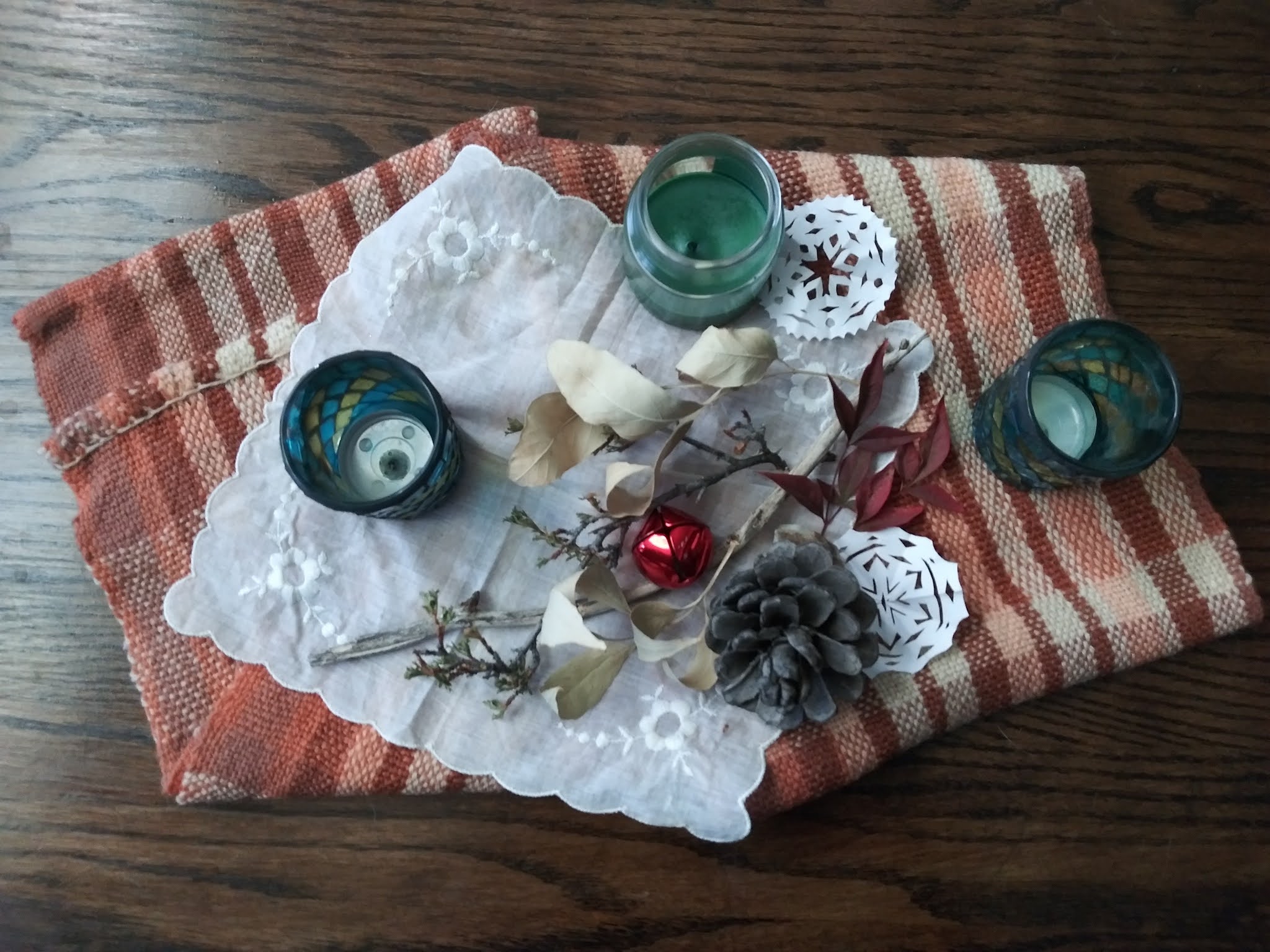
mine is still on the coffee table in our cozy front room. I laid out a hand-woven scarf from my mentor Kelli Cargile Cook, a small wrinkly white handkerchief, three candles (one Christmas-scented), two little paper snowflakes, one red jingle bell, a pine cone and various other plant-bits from the walking trails near our apartment.
while I gathered all these things, I kept thinking about silver and gold. I untangled the bell from a long golden ribbon it had been tied to. the twig I picked up is pale, easily imagined like slightly-tarnished silver. the curled leaves look much more obviously golden in real life. and the brilliant embroidery thread of the handkerchief shines a little bit like precious metal.

I don't remember the rest of the lyrics to the song, other than the basic title: Silver and Gold.
but I like the idea of using whatever we can to brighten some of the darkness this time of year. candles. sparkles. carols.
during yoga church we came back a few times to a quote from Glennie Kindred. I don't want to merely regurgitate everything from yesterday into a blogpost here, so I'm posting just two snippets:
"...it is important to realize that this festival is not the beginning, in a linear way of looking at things, but a rebirth within a cycle in which the starting point chosen here is part of a vibrant whole. Therefore it is necessary to make a connection to what has gone before."
"Something old must die in order for something new to be reborn. This period of rest and darkness is a vital link in the cycle of life."
linearity vs. non-linearity is a (fittingly) constant source of pondering for me. it seems that the connotation of linear = straight, one-dimensional, confining, constricting. but I know that lines can be curvy and wild, too. a circle is also made of points on a line, sort of.
it is easy to forget that, though. to make our stories about ourselves into stair-steps that only go one direction.
yesterday, taking time to remember the bending arcs of things, the out and in, the back and forth-- that was very nice. our starting points and our ending points can be chosen. there can be palpable connections-- whether we make them ourselves or find them waiting for us-- to an infinite, cyclical, beautiful whole in each seemingly-insignificant little moment.
Saturday, October 17
nothing momentous
can these miscellaneous photos become something else if I throw them together in a blogpost today? can they tell a real story or scaffold the lines of a poem?
for me there are wispy old memories inside each one. the past curls up, loose and wriggling, in little mental pockets marked with "autumn 2015" or "July 2016" or "that one conference in Rochester, NY."
but what are they for you?
evidence?
or art? or both? it probably depends on who you are.
plants in a garden. plants on a windowsill.
all in the middle of growing, dying.
or both.
all of it part of some cycle. up. down.
rainfall, rainbows,
showered on or sheltered from.
or both.
writing or drawing, or both. seeing or listening, or both
being or breathing.
but not or-- and.
always trying for and.
or failing.
or both.
along with the wispy memories, there are deep and unpredictable tides of emotion, too. a longing for the pieces of these pasts that have faded too far. a fear of losing all the people and connections that once felt so close and certain. amusement and nostalgia drizzling from clouds of wonder about why everything feels so impossible.
Monday, August 10
blend in
the last several days seem to have slowed down. August is only ten days old but those ten days have stretched themselves out so far, so languorous.
one week ago, we jaunted up to see this famously vast hole in the ground.
it was a nice little trip. not too far. definitely worth it.
what else?
some sewing (sloppy and frustrating), some reading (poetry and textbooks), plenty of games and naps and long walks with the puppy.
around Willow Lake the other day, we almost stepped on this little snake. it was so still and so camouflaged.
little snake (probably a glossy snake or maybe a gophersnake, according to my bits of googling), what can I learn from your sun-basking stillness?
hopefully when the semester starts I will continue making time to be outside in the sun. hopefully some of that time will be given to a little bit of sweet stillness, too.
Monday, June 29
both, and, oscilatio
oscilatio means the skill of shifting positions. recognizing the difference. having it both ways depending on what you're after.
Monday, February 11
professor-ing, spring 2019
I didn't notice when they left and I don't know where they've gone now. to someone else's backyard? some other patch of damp ground?
I'm working from home today, with the window in the den half-open and a dish of homemade granola (too crumbly to be bars, but I tried) on the table next to me.
there are revisions to focus on, but mainly I've been writing emails to send and posting comments on the blog for my graduate course.
did I write last semester about all the courses I was teaching? it looks like I did not-- not specifically anyway. not the way I've done for all my many semesters as a student. I'll make up for it now.
English 3230: Technical Composition
I taught two sections of this last fall as well, and I'll be teaching 3 sections this semester. Two are face-to-face, Tuesdays and Thursdays, and we've almost reached the end of our first major project. Our next project will be a service-learning/community-engagement project built around a partnership with our university library. who knows if it will spark for my students the kind of gushy enthusiasm I felt about my first service-learning project way back in 2005/2006... but I'm excited about it anyway.
English 6560: Digital Cultures - Theory & Practice
this is my online graduate course, in which four delightful graduate students are enrolled. we are discussing various aspects of and scholarship and theorizings about digital culture over at https://engl6560.hcommons.org/ and meeting for video conferences every other week to discuss further. I'm enjoying it quite a lot and can't wait to see what kinds of projects these students come up with for the rest of the semester.
I have more new and exciting courses (undergraduate and graduate) lined up ahead of me for the next few terms. most of them are technical-writing-related, though I also get to adapt the digital cultures course for undergraduates next fall. I'll get to teach an advanced tech writing and editing sometime in 2020... lots to look forward to.
being a teacher and not simultaneously a student is pretty much a million times better than doing both at once. teaching is still difficult, but I think I'm somehow slightly more sure of myself now that I have a different focus. my own scholarship has not been set aside, of course (in fact, I should be working on article revisions instead of blogging, probably), but rather than having all the pressure of three reading lists for grad classes + seminar papers to draft + my own scholarship to advance + teaching, it all feels more manageable and spacious and steady.
Saturday, August 18
muscle memory
I, somehow, remember it pretty well now that I keep hearing it.
even on first re-hearing it a few weeks ago, it astonished me how deeply and fully I recognize and remember this song. this song from 2003 that I don't have particular memories connected to or anything. as far as I remember, it was just popular back then. on the radio all the time.
and now it seems to be on all the time again. or the grocery store has limited music on rotation. who knows.
does anyone still listen to music on the radio?
lately I have been biking around town and to campus a little bit. around the neighborhood for exercise. across the river for lunch.
the feeling of being on a bike in a small college town takes me back to the early 2000s in a way similar to the lyrics of "So Yesterday," but it is much less surprising that this happens. muscle memory is supposed to be deep. riding a bike is supposed to be unforgettable.
as a Purdue student, I think I biked to campus a total of six times the whole five years I was there. West Lafayette had too many steep hills in it.
Logan, Utah also had some steep hills (like the one this building sat on), but I was younger back then and it wasn't so hot and humid all the time either.
as an undergraduate, too, I had particularly limited choices about transportation. unless the car-owning people in my life were willing to offer rides, I had to bike or bus or walk myself everywhere. and thankfully there were wide roads and sidewalks and plenty of space for all those things. and free buses, too. (I miss a good handful of things about Indiana now that it's almost 2 months since we left it, and the relatively sleek public transport is among that handful of things.)
the feeling of being on a bike is a somewhat precarious feeling. balancing. weaving. it's familiar, but my muscles and my breathing are still readjusting.
a new fall semester always requires readjusting. remembering, but also putting away the past to face new things. it probably feels more precarious than it really is.
Friday, May 4
questions about invisibility and value
"...the platform replaces labor that was previously invisible. We have a hard time figuring out what Facebook actually is because we have a hard time admitting that at least part of what it supplanted is emotional labor—hard and valuable work that no one wants to admit was work to begin with."
it's from an article by journalist Sarah Jeong about why it's such an ordeal to extricate ourselves from facebook once we start letting it connect us to people and groups and events and things.
this particular passage above is not the only thing that has pushed me toward thinking about invisible labor, lately (there was this call for papers last fall, for one thing, and various feminist chatterings on twitter, also). but this has me also asking why we don't want to admit that social/emotional labor is labor at all.
what makes it so difficult for society at large to "count" these things—Jeong lists things like keeping address books up to date, knocking on doors to make invitations to neighbors, and putting together cards to mail out for holidays—as work? do we feel obligated to count them as fun, instead? as leisure or play? is it because the social value resulting from all that work has always been enough to compensate for it, such that the work itself seemed like its own reward in a way? or maybe we feel like categorizing holiday cards and such as work would open up too many wheedling excuses for us not to do all these social-connection-making things anymore?
is it because social-connection-making activities are coded as domestic and therefore feminine and therefore "less important" than work you might go into an office somewhere to do?
even if the answer to that rather loaded question is yes, I am still going to ask why.
invisibility serves a purpose sometimes. it can be an awesome superpower, enabling accomplishments that might not get accomplished otherwise. or so the stories say.
or invisibility can be oppressive and dehumanizing. isolating. life-ruining.
how do you tell the difference? are there times when it's both at the same time?
has anyone written a superhero story about a lonely, invisible-turning vigilante who is both empowered and crippled by his abilities? probably. I haven't read any H. G. Wells in a long time.
{ green treetops blocking the sun }
when is it valuable and affirming to be noticed, acknowledged, seen, and appreciated? and when is it valuable, even more empowering, not to be seen or noticed at all?
and does someone have to see you doing a thing to value the effort you put into it? is seeing/valuing the results at all the same as seeing/valuing the effort?
this reminds me suddenly of black boxes + related thoughts from Glasgow four years ago. (maybe it's terribly self-involved to enjoy rereading my own writing so much but I really enjoy re-reading that post.) black boxes hide things. sometimes that's useful. sometimes it's frustrating. or, as in this Invisible Bread comic, it's just really weird.
part of my brain is telling the other part to stop asking questions and think of more concrete examples of this to talk about. I think I will, eventually. but tonight... I just want to wonder about the best ways to crack open black boxes like Facebook or Google, and whether the cracks will break them forever or not. when is the impenetrable blackness of any given magical black-box tool actually essential to the functioning of the tool, and when is it not? is the opacity of a black box correlated in any way with the amounts of labor it might be erasing or replacing? if what functions as a black box to one person is actually pretty transparent to another person, what does that mean? and do we ever black box ourselves and keep our emotional labor hidden on purpose, on accident, or out of some social pressure to keep pretending that it isn't really actually "work" work?
Monday, April 2
actually mushrooms seem pretty charismatic to me
a high (very high) percentage of Dr. Salvo's slides were photographs of puffins. and that is why this ornithologist's photograph instantly reminded me of the talk.
the whole idea of designing sunglasses for a puffin so you can study it without damaging its pudgy little puffin body also fits with some of the talk's themes of conservation and properly caring about the non-human. worrying about a puffin's eyesight is a nice thing to do. considerate. ethical.To study the ultraviolet properties of the puffins bill, we have had to design something to protect their eyes from the light.— Jamie (@JamieDunning) March 29, 2018
These are our prototype auk 'sunglasses', designed at @designdotgold. #ornithology pic.twitter.com/LMCvdl3sv3
and practical, too. you don't want the puffins you are studying to get damaged or die. that would mess up your studying, I imagine.
but some might say that a few blinded, damaged puffins sacrificed in the name of science is probably worth it for what we could learn that might change the world. who knows. but as long as it isn't so much work to design sunglasses for your puffin research participants, it seems more worth it to do that.
related:
George Lakoff's FrameLab podcast makes an argument for calling them human survival issues, rather than environmental issues.
I want to read this book about mushrooms. mushrooms are beautiful.
Friday, July 7
word quartets
you can't see it very well in this photo, but their stylized metal thighs have word-shaped cut-outs on them. I will list them for you here and ask you to pay attention to how the list makes you feel.
Trust
Kindness
Love
Believe
if I could format them all vertically, I would. you'll just have to imagine how they look going up and down these metal thighs in all capital letters.
we could put them in this order instead:
Love
Believe
Trust
Kindness
do you have any preference? did you or didn't you cringe a little bit at the lack of parallelism? does it feel different to treat "believe" as the misfit verb in a list of nouns, or "kindness" as the misfit noun in a list of verbs?
now that I've done a smidge of googling research, I have learned that the artist behind this piece is named Robert L. Barnum. the words were chosen by children involved with the Hanna Community Center and they are also the ones who named it "We Rise Above," which is how it is listed here on this list of other local public art.
as much as the inconsistency niggles and pokes at my hyper-educated writerly brain, I of course can't fault children for choosing this particular quartet of words without thinking about which parts of speech they all function within. most people do not automatically think about such things. even if part of my hyper-educated writerly brain thinks they probably should.
but the more I think about this sculpture and is misfit verb and its misfit noun, the more strangely grateful I get about how mismatched the words are. had they all four been straight-up non-ambiguous verbs or nouns, with no funky Venn-diagram of just noun, noun-or-verb, just verb going on, then I wouldn't have stopped to pay that much attention. if you just gave me a list of sappy-sounding nouns like
Trust
Love
Kindness
Belief
then that's all it would be and my allergies to sappiness would have kicked in and dismissed the whole thing.
instead, the funky Venn-diagram that these words presented got me pondering. how interesting it is that love and trust, simple little words, are both noun words and verb words. commandments and descriptors, both. but the other two, they aren't. they have to be one or the other. and it's simple enough to flip the verb believe into a similar one-word noun. not so simple with the noun kindness, though. why is that? probably there are linguistical, etymological word history reasons for which overlapping functions and orthographic representations match up or don't. I haven't looked into that yet.
I walk past this tall, shiny sculpture fairly often. someday it may lose its thought-provokingness for me. but until then the hodgepodge of words stir up lots of lovely questions. is this art speaking imperatively, or narratively? is it reflecting something the artist and his consultants see in the world, or is it praying for something they would like to see? are these virtues the sculpture asks us to admire in the world? to nurture in ourselves? are they efforts and actions we are supposed to take up, or are they knick-knacks and baubles we should collect where we can? or both?
of course it's both, probably. if they'd all been cut out in noun form, that wouldn't mean love and trust would lose their imperative vibes altogether. if they'd all been in verb form, with kindness split into its English infinitive, be kind, that wouldn't stop us from noticing the moments where those verbs swirl and collect around us into warm fuzzies to hold on to. and maybe our parts of speech are only one limited and insufficient way of chopping up language for storage. these four cut-out words have no context, after all. there is no frame for the list that they seem to make up. there is no sentence for them to live in. nothing outside this sculpture of words dictates how one is supposed to read the thing. that makes the hybrid noun-verbiness of half of them even more exciting, almost. you can interpret these words in multiple ways! and the unwritten noun and verb forms of the other half can perhaps haunt this tall, shiny art, hovering in the gaps for anyone who wants to notice them.