Showing posts with label open source. Show all posts

Friday, July 31

completely, partially

my latest LibriVox contribution-- The City of Din, by Dan McKenzie-- surprisingly made its final journey through the prooflistening stage rather quickly this week, and I am pleased to announce that it's been officially catalogued here for all the world to enjoy if they so desire.

the most unique part of this audiobook is that our pug Wesley has a role in it. in the middle of section 2, Mr. McKenzie is discussing whether to categorize dogs as noisy or not, and he re-enacts the inner monologue of a man trying to sleep while a dog barks somewhere out in the neighborhood. rather than boringly intoning the word "bark" myself, I conveniently captured some of Wesley's insistent barks and used those instead. it took a lot of editing work, but I think it was worth it.

LibriVox relies on the Internet Archive for the bulk of its hosting needs. everything on that LibriVox.org page I linked to above is really pulled in from Internet Archive, where it's all displayed a little differently.

the Internet Archive is undeniably awesome. you probably agree, right? I hope so.

unfortunately the organization is dealing with a pretty awful lawsuit at the moment, one that has some terrible implications. this thread from author Cory Doctorow goes over the issues concisely and forcefully. there's been quite a lot of talk about the lawsuit all over twitter, lately. I very much hope that these greedy print publishers don't succeed in wrecking the Internet Archive's plans for facilitating free circulation of digital books. what an awful world it would be if we had to pay greedy corporations for even the most temporary access to any of media at all.

in all my researching and theorizing about the Internet Archive and similar projects, I've more regularly thought of it as what it has named itself-- an archive. a collection. a carefully stored pile of carefully gathered and curated and digitally infrastructured content. 

libraries are that, too. what's the real difference between a library and an archive? well, some archives are a little more closed-off to the public, but other than that, nothing. they are both, like so much else we humans are about, places to keep things.

sometimes I also think about these digital archives as communities, too. they are collections of things--artifacts, manuscripts, whatever... but those collections of things don't just happen without people. that's what my dissertation was all about: people working together to build archives by building tools that help them build and maintain and expand the archives. LibriVox is a really cool example of that.

smudgy pastels and ballpoint on cerealbox cardboard. "see yourself" "do the work"

I have gotten to know some of the other people who work with LibriVox, a tiny bit. some of them I feel like I know from studying the history of the site and listening to all of the old podcast episodes. some I have interacted with more closely on various projects. it would be fun to meet some of them someday, as I've done with other internet friends. who knows if that will happen or not.

two years ago I read the closing sections of this L. Frank Baum story, Phoebe Daring. the project had been initially started on LibriVox in 2015 as a solo, by a reader who worked on dozens and dozens of LibriVox projects but died before she could finish this one. when the community learned what had happened, they opened her project up and ten of us completed the recording and prooflistening work for it.

thinking about that makes me wonder what I'll leave unfinished. who will finish it. ideally I'll have several decades to keep thinking about that question.


this week, as I approached the end of this month of blogging, I kept coming back to the concept of ...well, I guess of incompleteness. but that word feels overly negative. what I was really thinking of were partly-complete things. partly-done, partly-finished. parts. partialities. my mind has been more or less fascinated lately by the idea of everything always being partial.

in some sense, that can be a negative thing. the partial nature of so much can leave me so unsatisfied. so paradoxically full of what isn't there or what I haven't collected.

in another sense it's comforting. there's still more. it isn't over yet. we have some space to add and grow and keep going. that's the side my wondering wants to be on the most.

July, however, will be complete after today. utterly in the past, over, done, gone, irretrievable. and my month of blogging will be, too. that, at least, is something finished. how I'll look back on everything I've posted in another year, or five years, who knows? but from here, it's done. perfect enough because that's what we (the royal we) decide to call it from this precious, precarious vantage point of now.

Were you thinking that those were the words, those upright lines?
those curves, angles, dots?
No, those are not the words, the substantial words are in the
ground and sea,
They are in the air, they are in you.

Friday, February 20

rolling credits

fall 2011, my very first semester of grad school adventuring. I took a Bibliography class and a Publications Management class at Tech, where both instructors assigned Foucault's “What is an Author?”

amusingly, they each sent out very different PDF versions of this Foucault. this semester, spring 2015, in Postmodernism class, I have collected yet another version.

this Michel Foucault guy. he is undeniably prolific, and not just of his own accord either. these are three different English translations. the essay has been collected and recollected in lots of places.

he shows up in snippet-form in a million other people's work. quotations and paraphrases and summaries and re-purposings galore.


look at all that proliferation, uncontrollable and unending. [sidenote: prolific/proliferate. hmmm. those are cool words.]

speaking of unending proliferation... when we read this Foucault (in company with "The Death of the Author" by Roland Barthes) for Postmodernism this week, I saw these theorists from the seventies prophesying the messiness of internet culture.

Barthes gets prophetic with the assertion that
“In a multiple writing, indeed, everything is to be distinguished, but nothing deciphered; structure can be followed, 'threaded' (like a stocking that has run) in all its recurrences and all its stages, but there is no underlying ground; the space of the writing is to be traversed, not penetrated: writing ceaselessly posits meaning but always in order to evaporate it.” (5)
this reminded me a bit of our class discussion the other week about memes (in particular, this one, which requires advanced Superbowl XLIX background knowledge to even attempt to make sense of--I still don't know if it's parseable, really) and their funny, short-lived, nonsensical nods at “meaning.” and I thought of Tony’s paper day presentation on Wikipedia. what is Wikipedia if not a floating, threaded, tagged, metadata-ed parade of version upon version upon version of writing, editing, responding, and so on? (this whole Barthes piece also reminded me of Doctor Who, for some reason. I think it was the talk of dimensions and eternally present texts and utterances that are always “here and now.” weird connection, I know. I'm not even any brand of a Whovian.)

Foucault's foreshadowing peeks out here, where he tells us that
“as our society changes, at the very moment when it is in the process of changing, the author function will disappear, and in such a manner that fiction and its polysemous texts will once again function according to another mode, but still with a system of constraint--one that will no longer be the author but will have to be determined or, perhaps, experienced” (222). 
he doesn't know or say what exactly would replace the standard model of authorship, and neither can we... yet. we are in this very moment. (maybe the 1970s were in it too. I don't know.) one version of my online self, a few weeks back, made a copy of a statement by some unknown writer on Tumblr about this whole idea: "we live in a post-copyright society," the guy says. Tumblr itself seems to be exactly the world Foucault is describing. on Tumblr it doesn't matter who is speaking.

I now interject with a complicatedly relevant and timely example from an (overly popular?) author/vlogger/whoever:


(for the record, I saw only seventeen--actual seventeen, not seventeen hundred--likes when I checked on goodreads the other day. there are eighteen now, and it's been reattributed. that was quick.)

later on in his essay, Foucault admits that he has “unjustifiably” limited his definition of authorship and discourse (216). what about so many other forms of creative work, he asks? what if we're talking about painting or music? what if? what if we're talking about pixels and code?

the (really awesome, I think) postmodern tendency to keep widening and broadening everything, always chopping down boundaries, tearing up labels, smashing traditions, etc. makes me want to ask so many questions. if everything counts as discourse, what then? leading up to this, Foucault also explains that “all discourses endowed with the author function possess this plurality of self” (215)... as if the self is a text, also. not only is everything discourse, everything is plural. me included. from there, it’s tempting to imagine a "death of the self" along the same lines as this famous "death of the author." someday we may only have self-functions. hmmm.

in our class forums, colleague Beth made a very cool point about the roles and threats and newnesses of technology in this whole shifting authorship/compositionship situation, citing a fellow named Friedrich Kittler on the topic of typewriters. and then friend John posted a link to this awesomeness, which I found delightfully mindboggling. I have a machine that in theory could do such cool things. perhaps I should learn.

back to technology though. technology + humans = cyborgs. and that reminds me of Neil Harbisson. and it reminds me of David Eagleman's Sum (a pretty blue paperback that I actually own). of death-switches. functions without selves. hmm.

Thursday, March 27

the middle eight, after the chorus

the bulk of my music collection, I confessed to my passengers as we embarked toward the capitol of Indiana for various conference adventures last week, was obtained primarily from boys I knew in college. my tastes have evolved some since then (more Iron & Wine, less All American Rejects please), but my actual music collection has definitely not. the twenty-eight hundred music tracks I had back then are roughly the same twenty-eight hundred tracks I at some point between 2002 and 2006 swapped or ripped from all the boys in all the dorm rooms across the hall, upstairs, around the corner, or down the street. only 1582 of those songs, however, are worthy of being carried around in my pocket. only 1582 of them were with us that morning, on the little ipod I'd hooked up to my car's barely-functional tape deck. Songs, Shuffle = a potentially bottomless basket of nostalgic surprises.

as we drove, friend Patti and I tried brainstorming ideas for a vocal duet to perform at the English department fundraising show. should we choose something funny? something awe-inspiring? I tossed dozens of silly suggestions up and down in my head as we drove, sometimes riffing off the selections my little ipod dished up, sometimes spinning ideas out of nothing. this? or this? maybe this one? or something ambitiously a propos of nothing, like this?

none of those are exactly duets, though. could we make them duets, and would it be difficult, and would it be worth doing? and even then, how would we track down instrumental versions to use for accompaniment?

to Soundcloud for answers I went. I figured they'd have plenty of instrumental versions we might borrow, and they did. I also came across a ton of other stuff.

Soundcloud is a neat place for audio-exploring. remixes of a million shapes and colors abound. and while I think the concept of remix has very intriguing implications, its very musical provenance and history isn't something I have hitherto appreciated. neither sixties dance halls nor eighties recording studios have been places I turn for good music, though I don't quite know why not. those venues were not conveniently across the hall or around the corner, I guess. and furthermore, most dance music isn't really meant to be sung, and therefore it isn't generally my kind of music.

swimming in and around and among all the techno synth lyricless-ness I found whole channels, like this one, devoted to curating mixes and mashups.

I've embedded a couple that I found disorientingly recognizable. I've got both Weezer and Simon and Garfunkel songs in my own collection, but hearing them on top of each other is... odd. it's a surprise of a puzzling and delightful kind. it felt a little like when in your dreams, all the settings are utterly familiar, while also looking nothing like the places your waking self knows they should look like.

I wonder if that disorientation only hits if you've heard the original versions of the remixed/mashed-up songs before. after all, if you don't know how they are 'supposed to' go, the remix might sound normal. if you've only heard the cover, it could become the default, the truth, even if some other iteration came first.

colleague Tony is writing interesting-sounding things about music and rhetoric and creativity. the whole metaphor of remix is becoming so pervasive now, so repurposed (itself remixed?) it hardly makes sense to link the term so closely with only audio tapes and instrumental transitions. the idea is almost everywhere now.
the conference adventures (ATTW, CCCCs) pelted me with other people's ideas. the rest of my semester--or perhaps even life--might involve my brain finding ways to make mashups and crossovers with all that information and then some. 

in the meantime, Patti and I are going to don a pair of goggles and a pair of fingerless gloves, respectively, and remix bits of this.

Thursday, November 14

twenty-fifth vs second floors

I think it was good for me last weekend to step outside the hallways of higher learning and look at the world through a slightly more corporate lens for a day.
for one thing, this was the view from floor twenty-five of the fancy downtown-Chicago office building we had the privilege of occupying. a pretty thrilling vista if there ever was one. no ivory tower I've seen so far has anything quite like it (though the Business building at USU might come a tiny bit close).
for another thing, the whole experience reminded me that school is not the only framework wherein curiosity and experimentation and learning are valued. my very academic road is not the only or the best to travel. in fact, sometimes I start wondering why it seems I can only travel one road at a time. what happened to the webdesign business I talked about working on with that genius brother of mine? what if formal institutions of education fall apart in the next decade or so, and tenure ends up too far beyond my reach? I should write up a few backup plans.

my excuse for visiting this fancy Chicago office building sprouted from friend Christine in my Digital Studio class mentioning that she signed up for a free Ruby on Rails workshop called RailsGirls--an event series all about exposing girls and women to programming and technology. their main website says it started in Finland. that's cool.
Christine and I did not get to see Finland. we did learn a good bit of Ruby programming though. I met some great new people and, most awesomely, basked in the unique feeling of being completely surrounded by techie girls. that doesn't really happen every day, or even very often. even though it didn't hit me until halfway through the day, that feeling left an impression. a whole office crammed with female programmers, developers, software experts, and computer geniuses? hello role models. hello inspiration.
this is the not-quite-finished-yet-but-sort-of-usable list-making application I built. the internet is welcome to add random new items to the list, if it would like. I want to keep working on it. it'll be tricker without that roomful of inspiration, but I'll do my best to struggle on.
maybe I'll go again next year and keep learning.
in the meantime, I've come back again to the hallways of academia, where it is almost always autumn. the view from our office windows isn't quite so thrilling, but it has its own loveliness.
soon all those brilliant leaves will be blown away and we'll have snow everywhere. soon my first semester here will be all over. the thought that in three weeks finals will be upon us is pretty thrilling, even if this humble scenery isn't.

Friday, September 27

in/appropriate appropriation

soon enough friends come to know how crummy I am at keeping other people's secrets and gossip separate from all the regular small-talk conversation fodder. most of the time all of it ends up in the same box. mixed, shuffled, ready to be retold or cut-and-pasted however my random brain decides it might need to be thrown back into circulation.

there are times when this is more or less appropriate, of course, but as far as I know there aren't many laws against gossip. unless my friends start getting me to sign non-disclosure agreements, I'm probably okay. sometimes a tactless jerkface, perhaps, but not a dangerous criminal. after all--like Jefferson said, information tends to do that thing where "the moment it is divulged, it forces itself into the possession of everyone."

a million social rules and conventions and expectations govern the paths information takes through our heads and pencils and mouths. nobody can really own them, but ideas do seem to become attached to certain people. specific iterations can seem to belong more rightly to one person or situation than another. how does this work? when I retell a rather funny story that was originally told to me by someone else months and months ago, I hardly need to ask permission, do I? if I'm quoting a film or the catchphrase of some advertisement, nobody's going to sue me, I hope.

I recently read (on the suggestion of friend Brandon) an article in Wired claiming that this giant half-empty digital notebook called the internet collects trillions of words every single day. "We compose some 3.6 trillion words every day on email and social media"--something like "36 million books," according to Clive Thompson. most of that content is probably personal, voluntarily composed, shared without compensation--thrown out there wild and open for not much reason other than why not? or just because we can.

and all this sharing is good for so many things, in so many ways. Thompson goes into this with a few examples. and it is neat to see ideas from this and that part of the globe bumping up against each other--getting mixed and shuffled, retold and re-pasted. we have new ways of making this work. hyperlinks and interactivity and creative commons. so much of this changing ideoscape is changing the ways we understand ownership and authorship. property and freedom. the ease of copying makes a lot of great things possible. maybe we should simply say it makes a lot of things possible, some of which are great and some of which might be sketchy.

friend Chris pointed out the other day just how much hype this new little plot of internet ground called Medium has been getting lately. it looks pretty neat. when Chris brought it up I knew not what he was talking about, but when I went to look, I realized I'd been there before. I'd noticed their sleek design and oddly time-stamped posts, each marked as "4 min read" or "6 min read," in recognition of just how crazy busy everyone's lives are and how important it is to map out and prepare precisely for just how much time you're gonna spend reading stuff off this screen in your lap (or on your desk or in your hand). weird, right? maybe somewhat helpful, but still weird.

so Medium is a semi-new realm of digital creativity or something, it looks like. why does it matter? what's it going to do? Medium itself has some answers, but are those good enough? I like the idea of experimenting with alternative ways of producing and arranging written content. but what about the answers to these questions about cake-having, cake-eating, credit, blame, and definitions? or responses to these questions about the iffiness of ownership, representation, and exclusion? these seem very important questions, I think. Marco Arment, in a footnote to that last piece, asks "what kind of magazine is Medium? What’s it about? Who’s it for? And if they narrow the focus enough to make that easier to answer, who gets left out?" that is a fascinating question. somebody always gets left out, you know. that is part of having standards and being unique. nobody can be everything. the internet tries, but even 36 trillion words is still not everything.

we might want to say it doesn't matter what ideas belong to who. once you put the words and thoughts and connections out there, they force themselves into the possession of all the people they bump up against. we almost can't help it, can we?

it's not so easy. the universe doesn't come out and tell us what's most important or how exactly we ought to value, share, guard, borrow, honor, credit, pay for, or otherwise handle the information we get from our fellow human beings. I don't know what the answers are. I can't even always figure out which kinds of confidences really really must be kept that way. and if I can't figure that out among my few hundreds of words of daily conversation, how can I expect the internet to figure it out for so, so many more times that number?

Tuesday, April 2

mind/body remix

to this question I have no answers. now is too fleeting to ask questions about, isn't it? and as for what now?s cousin what next?... we just have to wait and see. there are always a million possibilities. too many to think about.

last year I happend to have some amazon credit come into my hands just before Austin Kleon's Steal Like an Artist came out, so I ordered it.

and it arrived in the mail and I skimmed happily through at least 6/8 of it before tucking it into neatly the clutter of my nightstand, where it gathered dust for about year.

yesterday I unpacked it, along with the rest of the books I'm not sure why I own.

oh ownership.

what does that even mean?

I came across this Wired article on all the crazy implications of a world so infused with the digital today (via a new friend and future-Purdue-colleague Cody, who--look--has a blog where he talks about games and things). owning intangible digital stuff gets pretty tricky, and in a lot of places, the tangible and the intangible co-exist. I'm tempted to liken this not-really-a-dichotomy to Descartes' persistent philosophy of mind/body dualism, which is probably more to do with the fact that I've been reading about Cartesian models and participatory design than with any real relationship Cartesian philosophy has with digital copyright debates... but you know...

anyway:

Mr. Wiens, in the article, tells us that "the line between hardware and software, physical and digital has blurred." what use is a telephone without an operating system anymore? what's the point of all this plastic without some magic connectivity behind its screen? what use are all those ones and zeros without some buttons to push them around? what good are the pixels and code even, without people to  read and respond? the concrete and the abstract so often seem inextricably connected...

... hm... I wasn't trying to take this post in this direction, but surprisingly the Cartesian connection here is realer than I thought at first. there are plenty of posthumanists who would love to point out that the line between mind and body is getting blurrier and blurrier too. minds don't usually exist without bodies, do they? I need to read more posthumanist things. (and speaking of bodies and minds, I'm reminded all of a sudden about another grad school colleague, Brandon, who also has a blog.) I also just need to read more things. I could get ridiculously carried away talking about the awesome and variable materiality of ideas and the perhaps many and natural inadequacies of all immaterial ideas... but I might also not really know what I'm talking about.

anyway:
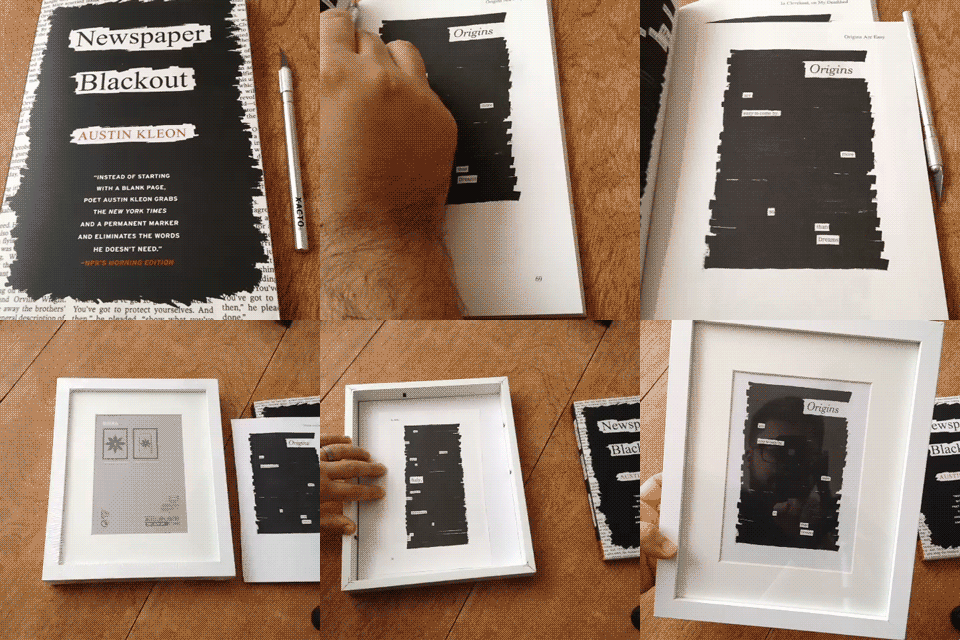
before all this Cartesian nonsense popped up, what I was really thinking about this week was the fun of remixing, oldschool. like this kind of cut-sift-paste-paint collage art I used to spend time reveling in, long ago. repurposing one thing, deconstructing and recontextualizing it, into something just a bit different. Mr. Kleon suggests such cheap cleverness in the gif above, which I borrowed (or perhaps I should say 'stole,' like an artist) from this post.

I thought it was a cool idea.
so when Kleon's Steal Like an Artist resurfaced from the box it was packed in, I set it aside and made a note to attack it with scissors at some point.

the attacking happened this evening. all the best pages from Kleon's little autobiographical advicebook are now hanging willy nilly on my cork boards, among several other repurposed odds and ends.
I like them. especially the one that says
You will need:
_ curiosity
_ kindness
_ stamina
_ a willingness to look stupid
yeah. maybe I will find a little frame for that one.

Tuesday, October 16

gathering gravity and dust

curation seems to be a big new thing in the world, what with this internet magic making it so easy. but the idea of taking existing junk and reframing it somewhere else is not really that new. in my fat green copy of The Rhetorical Tradition there is an old Latin manual of rhetoric called "Rhetorica ad Herennium." the anonymous author goes into detail about many things, firstly the value and ethics of appropriating examples from other sources. here is the beginning of the conversation he has with his imagined opponent who requests acknowledgement for merely arranging others' written works:
"But," they say, "this very choice from among many is difficult." What do you mean it is difficult? That it requires labor? Or that it requires art? The laborious is not necessarily the excellent. There are many things requiring labor which you would not necessarily boast of having done--unless, to be sure, you thought it a glorious feat to have transcribed by your own hand whole dramas or speeches!"
that thought reminds me of Kenneth Goldsmith's Uncreative Writing, which I reviewed recently and found quite fascinating, if sloppily typeset. the author retyped the New York Times once just for fun, as an experiment in uncreativity. that was twelve years ago, in 2000. "Rhetorica ad Herennium" is one of the the oldest surviving books on rhetoric, published just a few decades before Christ was born. even back then, we had people questioning the value of assembling things from other sources. that curation takes work and skill doesn't necessarily mean it's worth doing. or worth celebrating.

but people do it. why? the roots of the word go back to the Latin curatus, pp. of curare "to take care of," and it was priests who did this sort of thing. spiritual care. gathering. watching. shepherding. guarding stuff that seemed important or valuable.

and now we gather and shepherd the details of the hyperlinked universe. we snip things and paste things and copy things. make scrapbooks, make archives, make galleries. some if it is ours, and some of it we just find. these people propose the act of discovery to be a creative labor. okay. sure. sometimes you do have to be looking for stuff in order to find it... but is even that--mere looking--a significant labor, particularly in this era of recycled, reposted, reblogged, reshared, remixed everything? when there are so many people doing this, and so much detail out there to be stumbled upon, do we really want to say your average person deserves credit for that?

perhaps we'll conduct a small, cursory case study, shall we? Chris and I were discussing the increasingly incestuous merry-go-round that is a certain conglomerate of blog/tumblr/twitter/facebook "curation." these sites are bastioned by the personality and preferences of Maria Popova. here in an interview from 2.5 years ago, she calls her site "a destination for indiscriminate curiosity." indiscriminate, eh? and yet... the posts she stitches together fit within recognizable boundaries. there are themes. not very subtle themes either. heavy-handed, undeniable themes. and they crop up over and over again: writing advice. quirky, artsy, hipstery takes on science or history. inspirational lists and doodles and one-liners. the taste of it all gets incredibly predictable. and yes, alright, even my own indiscriminate curiosity tends to move in certain somewhat-defined circles, too. everything will inevitably have a frame. but the difference is this little blog is a singular place. these posts are not being recycled in shorthand as cool-awesome-insightful-soundbite fodder on tumblr.

the same interview broaches the problem of "rehashed content," which Popova rebuts with a comment about remixing. what she cites as important is the way "these pieces fit together, what story they tell by being placed next to each other, and what statement the context they create makes about culture and the world at large." remix is cool. it is valuable. I'm all for pulling interesting stuff together and putting it next to other interesting stuff. but reposting and relinking the same stuff again and again, even if you did originally twist some remix into it, seems nauseatingly lazy.

ironically, Popova has recognized this laziness in other curation feeds. referencing coudal.com and their stream of guest-curated interestingness, she says:
"I read their FreshSignals feed religiously and respect them a great deal, but lately I’ve seen an increasing number of unintentional reposts, things that they’ve already featured as little as two days earlier, or regurgitation – content that has already made the mainstream rounds across the BoingBoings of the world. Which only illustrates the importance of having a singular vision and narrative, rather than a flavor-of-the-month approach to the curatorial yardstick."
singular vision she may have, but I daresay Popova isn't immune from regurgitation. only in her case it doesn't seem to be unintentional.

tons of things are possible now that weren't possible before the magic of the internet. what used to be the domain of priests and museum directors is now something anyone with a Pinterest account likely spends hours doing every Saturday morning. content curation. last month NPR talked about the abuse of the word and whether or not it's worth squirming over. the story cites George Shackelford of the Kimball Art Museum (I've been there once. 'twas lovely), who insists "real curating entails truly taking care of, and taking stock of, something original or valuable...tak[ing] responsibility."

originality may be its own shade of undefinable, but we'll save that bag of questions for another time. when it's click-simple to copy, paste, and re-share a thing, must we really feel obliged to treat that as a unique and worthwhile creative endeavor? I don't know. maybe the curation bandwagon is too crowded at the moment. too full of too much. or maybe we need a new word for some of these less-responsible acts of gathering. if we keep calling it "curation," are we degrading the work real-life curators do? or should we all just relax and let the future happen?
{ image borrowed from this kind soul on flickr. }

(postscript.) while we're here talking about things that are annoying and questionable, I'll toss this not-related-at-all rant in here at the bottom:

I am and have been for a long time now utterly sick of link shorteners. I hate them. I mean, okay, if you really have a reason to save space and squash your URL down into unrecognizable chopped liver, fine. appease all the 140-characters-only twitterfolks, whatever. but if not, just stop. it's inaccessible, it's annoying. it's just dumb. case study number 2 for today--all of the links to our the Full-text Databases of Literary Texts on our library's website are linked using shortened URLs and I think it's idiotic. the end.

Wednesday, February 22

assembly lines

months ago, I was talking to friend Justin about various projects: a video chat program he developed for his research, and much later in the conversation, music--arrangements he'd done. songs (you might say) that he had written (you might say). he didn't say, though. what he did say--in both cases--was that he had "put it together."

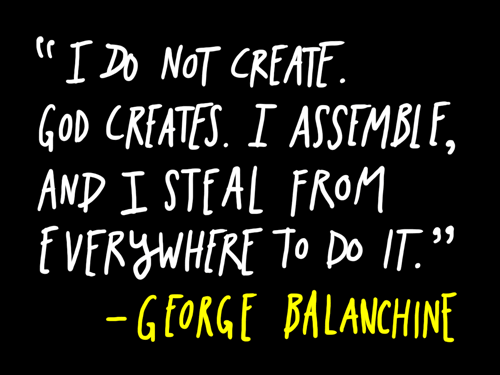
this quote, presented by that one Austin Kleon fellow, reminded me of that idea. ex nihilo creation just does not happen. there are laws of thermodynamics and stuff like that, you know?
even God, I think, does his fair share of assembling bits and pieces of stuff that has always existed.

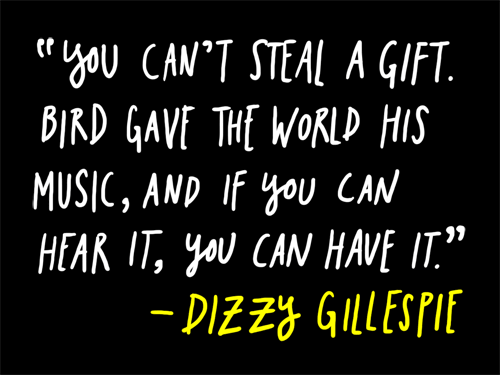
here is another lovely quote, and there are a bunch more on Mr. Kleon's blog proper.
have I mentioned how much I love the word 'if'? I circle all ifs, remembering that every if is a sort of promise. the if in this quote is a little bit tricky. if you can hear the music, you can have it, he says. if you're listening, it's yours. that sounds so simple. but it's hard to listen, sometimes. and what exactly counts as owning that music? I don't think hearing it on a superficial level is enough. letting the melody flit through your ears as you walk down the street, or even sitting down on the curb and listening to it once isn't ownership. there are different ears. different listening. some higher level of attention and absorption that does not come casually. that song--that gift--it's not going to fall into your lap, is it?

maybe putting things together first involves looking really hard at what you've got in front of you and taking it apart. then the pieces can be swallowed, regurgitated, and made into something completely new. only not completely new--just almost completely new.

I just read this fantastic rendering of a speech given by the author David Foster Wallace. I was (am) supposed to be reading articles about coterie publication and marginalia analysis, but this speech--so many bits of it grabbed at me. a collection of those bits will be appearing in the everything notebook over the next few days, just wait. and one of them will appear here, right now, because its thought about attention sort of fits. he says:
The really important kind of freedom involves attention, and awareness, and discipline, and effort...
what else is creativity than a freedom? a power to move beyond the place you are into a place that has never existed before? isn't that amazing? we have this gift of taking all this stuff that for us has always been there, just existing, just waiting...and remixing it into something more. and then whatever we've made becomes part of the always-been-there stuff for someone else. go read the whole Wallace article. it's really great. and then if you've got time, watch these.

watch. absorb. start assembling.

Tuesday, October 11

you shall not need to butter your plates

for 5340 (yes, all I'm ever going to blog about for the rest of the year is grad school, just in case you were curious), I've chosen to research a seventeenth-century cookbook called The Queen-like Closet, by a woman many scholars cite as the first to have made a living writing books. neat, eh?

I was telling friend Chris the other day that this means my food-blogger-wannabe status is about to be intensified. I bet if they'd had blogs in 1670, Hannah Woolley (or Wolley, if you like that spelling better) would have been great at blogging. can you just envision the titles to her posts? the full title of the cookbook I'm studying is: The Queen-like Closet or Rich Cabinet Stored With All Manner Of Rare Receipts For Preserving, Candying And Cookery. Very Pleasant And Beneficial To All Ingenious Persons Of The Female Sex. woah.

here is her recipe for sugar cakes, as copied from the second edition of The Queen-like Closet, as transcribed by the people of Project Gutenberg. if you have a pound of sugar that needs something done with, I dare you to try it.

To make Sugar Cakes.

Take a pound of fine Sugar beaten and searced, with four Ounces of the finest Flower, put to it one pound of Butter well washed with Rose-water, and work them well together, then take the Yolks of four Eggs, and beat them with four Spoonfuls of Rosewater, in which hath been steeped two or three days before Nutmeg and Cinamon, then put thereto so much Cream as will make it knead to a stiff Paste, rowl it into thin Cakes, and prick them, and lay them on Plates, and bake them; you shall not need to butter your Plates, for they will slip off of themselves, when they are cold.


see? doesn't that read just like a recipe some enterprising young food blogger would post--including the wacky spellings? [searced--in case you are too lazy to put up with google thinking you mean "searched" when all you need is a seventeen-century definition of a word you've never heard of--means sifted.] it's so interesting to think about the evolution of recipe formats, and how there are so many different ways to write them. some people like the story-like instructions. some people like step-by-step details. and you are always free to write them however you want, as long as they make enough sense to be followed. hm.

alright. in an effort to make time for blogging this month, I'm going to include a short list of blogposts to come. any requests for which ought to come very next?

-things I've learned from working at the University Press.
-more photos of tech campus and environs
-additional food-blogger-wannabe nonsense (this time featuring bologna)
-the debut of writing group: texas edition

Friday, February 26

start with graphite

Adobe pretty much has a monopoly on the good graphic design software, right?

yes.

but until I get to the point where I can afford and justify giving in to their dominion, I've got Inkscape. I never did figure out Illustrator all that well during my brief full-time design work. Photoshop was always easier for me. but today, in my opensource version of Illustrator, I turned this grimy little sketch...
into this little collection of bezier curves:

with which I shall now be able to do awesome things. like... designing business cards that won't end up looking like a scruffy pencil sketch when you print them. and stuff.
someday, the whole world will be open source. I hope somebody out there is working on something like InDesign. I miss it most of all.

you can get inkscape for yourself here.

Tuesday, February 9

j is for...

I know not many of my readers here are in the business of web development, but it's a pot I keep finding myself in. and this is cool. believe me.

as much as I try I cannot get over how glorious and wonderful this
jquery stuff is. I can't really remember what I used it for last time, but this time it's proving even more essential. our current web project has been completely different from any of my previous attempts. I'm glad I've got genius brother around to do the insanely tricky parts.

it's been pretty fun, polishing up my tarnished design skills and wedging them into a totally new setup. I get to feed CSS to a monster named Django, and so far... I still have all my fingers and toes. the design is actually working. the interface is going to be flawless. you can't imagine how exciting that is.

last week I discovered a little site that I now don't think I could ever live without, as a webdesigner: jquery tools. such slick and simple little plugins. they make me so happy. it all makes this long, precarious and messy road seem much, much brighter.

Monday, March 2

computer geeks aren't human?

so far, whenever I return home from a foreign country I find my computer in a state of inaccessibility. this time it just up and fried, and though my parents succeeded in reconstituting the machine and its hardware, I came home to found it running back and forth from the login screen to a message about registering windows. nobody could tell me where this copy of XP came from or how I was supposed to get my hands on the right product key. useless.

in such cases I call my genius brother and he fixes everything. this weekend he helped me install ubuntu 8.10--a version of linux for human beings. (really, that's what it says on the little disks that they send you.)
I tried a linux system once before--something fedora, when I got back from England. but I think ubuntu will be a bit more friendly.
that, and open source has come a long way in five years.
so have I, really.

it's a pretty cool feeling, have a brand new start. right now my whole hard drive is cleared out, just waiting for me to populate it with whatever I feel like. and I have a lot to learn. lots of lovely documentation to read, if I feel so inclined. new image-editing software, new instant messaging software... new everything. it's exciting.

the first thing I did, once the installation was complete and the machine freshly rebooted, was pull up the robots game. I've missed this game ever since I gave up on that old fedora system so long ago. last night I changed the theme to one with a little alien and evil UFOs, played til midnight, accrued a high score of 2160, and went to bed quite content.

Friday, February 16

naturally open source

i don't know a whole lot about open source stuff, really. but the concept fascinates me. i will build this thing, and i will share it with the world along with all of its inner workings, all of the things that make it what it is. so you can make your own. or make it better.

like music. someone writes a song. sings a song. anyone hearing that song can reproduce the sound of it. singing along, picking out the notes on the piano. music is naturally open source. the more the merrier, right?

like food. i like to cook. so does my aunt minerva.* our cupboard shelf is stacked with books compiled of family recipes, neighborhood recipes, sunday school class recipes. recipes are naturally open source. you bake cookies. you tie the recipe for them to the little paper plate, and you hand them around. you can't have too many cookies.

like the alphabet. i love to read. my brain absorbs all those letters and words and phrases. you can spell quick brown foxes and packed liquor jugs or whatever you want with those letters. they are full of power.

or like potatoes. all you have to do when you want to grow new potatoes is cut up a potato you have and throw a piece of it in a hole in the ground. bury it. water it. shazam. more potatoes.

so anyone can sing. anyone can throw an egg in a frying pan. anyone can spell cat. anyone can build their own linux from scratch. beautiful, isn't it? so democratic and transparent and well, open.

but it isn't easy. it isn't as easy as the word 'transparent' implies. you have to learn to read first. you have to learn how to think in tablespoons and ounces. you have to practice the notes, make sure you're not tone deaf. you need to take care of that potato plant while it grows up. there's always a price to be paid.
"the future is open source everything." ~Linus Torvalds
i got that quote from wikipedia. they cite more examples: soda, coffee, medicine. encyclopedias. freedom. access. openness. it means something a little bit different in each context. sounds like a good thing. but then again, it might stir up a lot of chaos among people who want to keep things secret.

open source everything. i wonder what that'll be like?


* i don't really have an aunt minerva, that i know of. i do have some very nice aunts, but none of them are named minerva.