Showing posts with label work. Show all posts

Monday, June 15

sheep shearing

I spent a little more than 48 hours in Flagstaff the other weekend. gorgeous weather. wonderful wool and fiber festival (even if my very favorite vendor couldn't be there this year). also, as always, the most excellent traveling companions. so grateful to those lovely humans. 

on Sunday, the last day of the festival, I spent 3 hours teaching a little lacemaking workshop and it was wonderful! just 6 enthusiastic students, plenty of time, plus friend Shannon helping out as unofficial assistant, and it all went so well. I'm so glad everyone came ready to learn and practice and struggle with the weirdness that is tatting and tatted lace. I hope they all keep going with it. and maybe some of them will join The Lace Coven too.

the days since then have felt like a dragging two-dimensional swamp, somehow. I think I need more rest.

since summer 2024 I've been prioritizing the whole weekend of Flag Wool, every June, for a getaway with fiber friends. (this year the festival dates conflicted with my favorite academic conference and I confess it was not quite a difficult choice even though I do miss Computers & Writing and all its fun community a good bit.) a different house rental each time. some shuffling of who attends. so much gratitude that I get to be included in the fun. 

at some point along the way I was handed a copy of this book, The Lost Flock, by Jane Cooper. a meandering autobiographical style, very well researched, and fascinating to read. will I ever find myself tending sheep on a remote Scottish island? highly unlikely. more than happy to read about it though. storms and mud and diseases and all, it sounds pretty romantic.

the book cover itself (not to mention the setting and the sheep and the land and all that too) reminded me of Pratchett's The Wee Free Men.

sheep and shepherds. cheese and fleece. community and stories. the books are not that similar at all but you can see the echoes across the two covers I'm sure. blue sky or sea. green hills. close-up on a fleecy sheep with beady ovine eyes. more fleecy sheep wandering the hills in the background.  

I don't reread books that often, but maybe I'll revisit these two again sometime soon. the whole Tiffany Aching series is splendid and poignant and worthy of deep attention. maybe I should acquire a boxed set of them. hmmm.

has anyone in the world of the wee free men considered teaching them how to perfectly shear a sheep? I can't remember.

sheep shearing in progress

sheep shearing is a dying art, they say. a strange little niche profession, so delicate and demanding. too bad we don't have any magical little dudes to help out with it. sometimes I wonder if I would or could ever learn. such a prospect feels almost as far-fetched though, most days. 

sheep need shearing. I'm glad that at least a few other humans out there still know how to shear them. the shearer who typically demonstrates at Flag Wool is Mick Hofmann. my guild friends who have fleecy animals hire him every spring to come shear for them too. 

shorn sheep fleece, ready for processing 

there weren't many nice fleeces for sale at this year's festival. even if there had been though, I remain uninterested in acquiring any raw fleece to process myself. carding 6 batts of Finn two summers back was tedious enough, I promise. 

if the apocalypse arrives and all the industrial fiber mills become defunct and I need to process wool by hand, I'll get over the tedium and hopefully also make friends with someone who can teach me shepherding and shearing too.

Saturday, July 27

wheels and spindles

apparently I haven't blogged about the Tour de Fleece here yet. (you can read a bit more about this July spinning challenge event thing if you like). I've partly kinda-sorta spun along with the bicyclists in past years, but I never focused on it very well or had much of note to show for it at the end.

but this year I had the whole month as free as any summer month could be, and plenty of spinning experience and equipment and goals to work with, so I made some plans. 

seven drop spindles in various states of the spinning process 

starting with Jillian Eve's official Tour de Fleece 2024 bingo card, I narrowed her suggested challenges down to 20 that looked doable/interesting, and determined to let 1d20 pick one for me each day of the tour. here's the full list, with those the dice picked in bold and those I accomplished (whether or not their number got rolled) marked with checks + annotations. I've got a few photos of some of it, too.

1 Spin the oldest fiber in your stash (caliente red Kraemer roving)
2 Spin the newest fiber in your stash (cherry red Kraemer roving)

two colors of red wool drafted and spun together on the bobbin of my antique spinning wheel 

3 Spin outside (my back patio; the parking lot of a busy cafe one morning)
✓ 4 Spin in public (aforementioned parking lot, Fiber Creek, Sharlot Hall, various waiting rooms)
5 Spin a fiber you've never spun before (gorgeous CVM/merino blend from Cactus Hill Farm; BFL from Greenwood Fiberworks)

BFL wool dyed pink-red-green, spun and wound onto a little cross-arm spindle

6 Use a new technique (drafting two rovings together)

red wool spun to fill up the bobbin on my antique spinning wheel

7 Spin more than 1 hour in a day
8 Teach someone else to spin (hurrah for enthusiastic newbies!)
9 Spin a chunky yarn (well, as chunky as I could manage)
✓ 10 Spin a lace-weight yarn (usually my default so pretty easy for me)
11 Spin a plant fiber (glad this one didn't come up actually. I am scared of cotton)
12 Fractal spin (started this one late and haven't quite finished it yet... so it only sort of counts)
13 Spin a textured yarn (the pre-carded Finn was almost too textured, I say)
14 Spin fiber you processed by hand (just a sample of re-carded Albuquerque Finn-- but I tediously and lovingly carded all the rest of it for later)

natural brown wool batts and a small sample of handspun Finn

little drum carder with Finn-carding-in-progress

✓ 15 Spin local wool (llama and alpaca from 2 different local ranches)

drop spindle with a bit of blue-green-purple llama wound onto it

16 Ply with thread (someday I'll try this but I'm not in a hurry to)
17 Create yarn that tells a story (I am still not sure what I want this to mean. we'll see.)
✓ 18 Hold your fiber in the opposite hand (easier with the little e-spinner for some reason)

e-spinner on a messy table, bobbin half-full of brown mystery wool

19 Spin while watching a movie (La La Land. it was alright)
20 Spin while listening to an audiobook (mostly Demon Copperhead. loved it)

in case you're as persistently curious about abbreviations as I am, CVM stands for California Variegated Mutant, a highly regarded and unique breed of American sheep. slightly less interestingly, BFL stands for Blue-faced Leicester, another highly regarded breed of sheep, from the UK. 

it took me a bit longer than the official tour to get anything finished, but that wasn't necessarily part of my game. I'm happy to have tried some new things and stretched my spinning skills in a few different directions. and I have every intention of continuing. who needs the excuse of a cycling tournament going on?

next goals:
finish the 4-ply alpaca (just needs washing and measuring)
wind off the CVM spindle soon-ish
finish the fractal BFL sample
ply the second half of a commissioned spin for Rose
spin more blended red (get 3 bobbinsful at least)


P.S. I also spent a decent chunk of the month working on this fun addition to my spinning arsenal. if I can figure out how old she is I'll see about naming her after another suitable ancestor of mine.

Tuesday, February 20

and spring semester 2024

eleven years ago, back at the very beginning of my academic career, I trekked 6 hours west from Lubbock, Texas, in my very old leper of a car (the paint was all but totally peeled way from its poor hood), to attend my first ever academic conference in Albuquerque.

this week I'm gonna trek 6 hours east and attend the same conference, this time in a rental car, with way more academic experience, an institutional credit card for travel-related purchases, and a significantly different research agenda. I'll be presenting this Saturday all about how I designed and get to teach a fun little class on podcasts. 

slide title with these words over stylized soundwaves: Themes in Humanities, The Art and History of Podcasts: Teaching podcasts as pop culture in a 100-level general education course

 {the title slide, so far anway}


and I'll get to see some of my old professors from USU. very excited for that bit. 

it'll be fun, hopefully. I hope I'll meet some other cool new interesting fellow scholars along the way, too. we shall see, given how sunny and warm it looks to be in Albuquerque this weekend, how much of the conference I actually sit through.

photo of a couple old issues of The Black Box, black and white covers, circa 1990-something

in the more normal weeks of this semester, I'm teaching a couple sections of technical writing. the same old basic tech writing course, only slightly different every time by virtue of new students and a new me and a new world.

besides teaching, I'm also working on a book chapter about podcast transcripts and leading various faculty from various other programs through a series of mushy but important assessment adventures. friend Caroline and I are still working on soliciting content for a new issue of the campus literary arts magazine (the second since we took charge of it last year). maybe we'll have an official reading event at the library with the creative writing class-- fingers crossed. 

it's all nearly haflway over, this set of 16 work weeks called spring semester. at the moment the halfway point feels encouraging. time ticks onward. work gets accomplished. knowledge is made and shared and reinforced. skills are modeled, practiced, learned, forgotten, re-learned.

in other news, I'm also finally getting to see some work from the past year come out in official publication! perhaps the coolest online academic journal of all, Kairos, made space for my multimedia oral history-ish interview piece all about two colleagues who recently retired.

and then colleagues and I have a co-authored piece in the most recent issue of Programmatic Perspectives (the differently cool but still very awesome journal from the Council for Programs in Technical and Scientific Communication). some awesome Purdue colleagues have an article in the same issue, which is quite cool to see. 

time ticks onward. I've been here 4 years. 2 more until hopefully they give me tenure. 

in the meantime, age and experience accumulate. some days I feel older and other days not at all. 

next January, in the auspicious year of 2025, it'll be 20 years since I started this blog for a class. how will we celebrate that, I wonder?

Tuesday, January 31

spring semester, 2023 + attendant miscellany

there's not been much of anything new in my courses for several semesters now... but at long last, this spring, I am teaching a very brand new course-- brand new both to me and to everyone:

HU 145: Themes in Humanities (the art and history of podcasts) 

HU 145 is a sort of catch-all lower-level Humanities credit, required of all students so we can make sure our pilots and engineers have some well-roundedness about them. I have specifically themed my version of this course around "the art and history of podcasts," because why the heck not. it has been so, so fun to plan for this little 100-level intro course. nothing like it has ever been taught on this campus. and maybe nothing like it has been taught anywhere, since I have been making it all up as I go.  

the welcome note / course description I wrote for students / the course catelog goes more or less like this:

This semester, we will explore podcasts and other audio productions from a critical perspective. We will practice our listening skills while examining the conventions of radio and audio production, analyzing the styles and genres of specific productions, and thinking carefully about the cultural contexts in which audio media circulate ideas and contribute to public (or not so public) discourse. Tracing similarities and differences across the history of recorded sound, we will discuss how audio media has been used to record historical events and stories, to foster fandoms and communities, and to shape or re-shape human cultures.
alongside two sections of that awesomeness, I've got one good old standard section of COM 221: Technical Report Writing. 

my students all seem pretty cool so far. it's early in the semester-- we're all still getting to know each other. I trust that learning is happening, little by little, in all of our spongey curious brains.

--

relatively unrelatedly, I'm gonna toss some recent photo bits in this post. do enjoy the randomness.

foggy winter morning, not long ago

weaving, upside down

red toenails, contemplative pug puppy

the sun and the sky and the mountains somewhere down near Tuscon

blooming orchid. light-starved succulents.


my first Tunisian crochet project: a shawlette of ruffles. (this is the yarn-- isn't it lovely?)

Wednesday, June 15

artful mending

I don't know when, if ever, I last used any of the four embroidery hoops I have lying around.

until today. I have put the second-smallest of them to work, and this is what I have done so far:


not the best photos, I know.

I worked in greens and pink using some darning/weaving, very inconsistent seed stitches, wobbly french knots, a tiny bit of chain stitch, and a little bit of reinforcing the eyelets. this is my first visible mending experiment. I hope it doesn't ruin this beloved skirt-- I've had it for 15 years or so. there are at least four more holes that need attention, one right at the base of the zipper, so that'll be tricky.

but here's the next one:


and then there are various pairs of pants and half-sewn skirts. and someday, if I am ambitious enough maybe I'll make a scrap quilt. that'd be cool.

Wednesday, June 8

east carolina and back

last month I got to attend the 2022 Computers & Writing conference, hosted on the charming East Carolina University campus. this year, it was a hybrid virtual/in-person event, which means that on top of the eight in-person sessions I inhaled one after the other while I was there, I also still have at least 12 tabs open from the online program, just waiting for me to spend proper time with some of the virtual presentations. one of them is this one about academic twitter and such, which features none other than friend Patti!

friend Patti is, as I write, gallivanting gloriously around in Portugal or somewhere similarly awesome thereabouts. from her instagram missives, it all looks terribly fun.

traveling for this conference was fun, but stressful. I used to love airports and the shock of new places. maybe I'm getting old and tired, or maybe the pandemic times have just cast shadows over it all. or maybe some of both. all the airports-- Phoenix, Charlotte, Raleigh/Durham, Detroit-- they were all crowded, hectic arenas. were they just as crowded, before? I can't remember.

here are some photos of the little creek I walked by on my way to-and-from the conference events that week.

view of the paved/guardrailed walkway over a pebbly creek

view from the walkway over the creek to where it flows out from under the roadway

and one of the lovely pathway itself, through the tall green trees.

curving paved pathway between some lush green trees

while I was in North Carolina for conference reasons, I took some time to explore downtown Raleigh before I had to come home. it was pretty cool. 

I don't know what this tall reflectively blue building is, but it surprised me as I wandered. I felt ambushed by it in somewhat the same way I did by the Eiffel tower. only this was bright daylight. 

through the gaps between trees and buildings there, you can see the white tents of an arts festival. I had just enough time that afternoon to browse four or five booths, let the live music wash disjointedly over my ears, and wish for more time to souvenir-shop.

I did manage to acquire a nice belt from these recyclers-of-bicycle-tubes, for Jeremiah, before hurrying to return a rental car and resubmit to the circus of the airport. little did I know just how much of a merry-go-round the Raleigh/Durham airport would become for me that fateful Sunday. 

but that's a whole other story, and perhaps too complainingly for here, anyway.

Monday, January 31

accomplishment

today, after having planned to do so for some weeks, I printed out all 24 of my scholarly publications, starting from the oldest book reviews from graduate school (one in this international tech comm journal and one over here), all the way up to my most recent conference proceeding. there are almost ten years spanning all this work. it all fits neatly in a manila folder.

there is more to come. a book chapter on Twitch.tv and user experience research. a short piece on blogging as a ritual of self care. more conference proceedings, possibly.

scholarship is not all I spend time and effort on though. especially lately. speaking of self care... part of my self-improvement journey this past several months has involved finding value in more than mere productivity and work ethic and professional accomplishment. it's difficult to even see how those attitudes have made up (and still make up) so much of how I've been conditioned to see myself. moving beyond that mode is not easy.

but I am trying. not everything needs to be conventionally "useful," after all.

even though I take on the role of a tool within the mechanisms of capitalism in exchange for a paycheck and health insurance and such, I can put that role aside and instead, for a moment, become nothing more than a tool for inhaling and exhaling and pondering the universe.

or I can be a tool for reading and interpreting knitting patterns. or for absorbing and reenacting step-by-step yarn-spinning tutorials. (I'm learning to use a drop spindle, see? it's fabulously difficult and not, all at the same time.)

my ravelry project logs tell me I began this shawl sometime in July of last year. six months later, at the beginning of winter break, I finished it, after restarting the whole thing twice, after ripping back to the stockinette section at least twice, and after doing way too much math to customize the number of lace repeats. 

when I'd finally gotten through the first lace section and moved on to the final border... I noticed a couple of wonky twisted stitches that messed up the pattern pretty obviously. instead of purling the stitch then the yarn-over, I'd done them backwards and mucked up the eyelets. (it was only a million hours later that I figured this out exactly. proofreading lacework is a skill I'm not an expert in).

I had wanted to finish this shawl for October. for Thanksgiving at least. for early winter. but now it was almost Christmas and I had a terrible choice to make. could I live with this mistake? or could I not? would anyone else ever notice these backwards stitches? would I even notice them most of the time, as long as the shawl was keeping my shoulders warm? or would the mangled lace haunt me forever if I didn't fix it now?

I'd already torn out so much work so many times. did I really have to undo more? was there any way to avoid another frustrating round of backwards progress? 

this, by the way, is why you're supposed to check your knitting more thoroughly as you go. you're supposed to catch this kind of thing way before more than a whole new row of stitches separates you from your mistakes, let alone half a dozen.

I decided I couldn't leave it. I wanted the lace to look impeccable. so I experimented on my own, trying to work down to untwist things just in the sections where it needed it-- but this made things irrevocably worse. with no other option but tearing back 8 whole sets of knit-purl lacework, I began a desperate search for any documented knitting wisdom I could possibly trust to guide me out of this disaster. Ravelry comment threads. knitting forums. youtube. I pleaded with them all for an answer.

most of what the internet had to give me were tips on how to knit proper lace in the first place, not anything on fixing lace that you've messed up. but finally... somehow... with mere ounces of hope left that there was any reasonable solution for undoing whatever I had done... I found that Suzanne Bryan had a short video on exactly what I'd been looking for.

this video tutorial was everything. I curled myself around my phone screen almost breathless as I watched it, my mind doing somersaults as I realized this could work. it could work! if I could follow the method just right, and keep track of all the ladder rungs of yarn, and not undo more than just the one section...! this would solve all my lace problems. it was brilliant.

so I scrambled to fetch my spare circular needles and cords, carefully and excitedly knit backwards to the problem section, re-watched the relevant video clips twice more, and then started pulling stitches off.

it was a mess.

it was highly stressful, my fears and hopes in the utmost tension as I worked.

I had to keep going back to the pattern's lace charts (even though I generally stay far far away from the snaking codes of any knitting chart if I can ever help it) to pinpoint exactly which bit of the lace I could leave as it was and which bits needed re-making. I had to count and re-count how far down my mistake was and how far over from which edge of the scallop. 

counting is the hardest part of knitting.

but once I had it figured out, I just had to keep swapping the size 6 needle points from this end of their cord to the other so all the re-stitched stitches would be the right size. and it worked. I reconstituted the two tiny sections into perfect lace, paid very close attention to all the mistakes-waiting-to-happen in the remaining few rows, and finished the shawl the evening.

why was this lace-repair adventure so absolutely thrilling? I'm not sure. there was some risk that I'd again just make the mistakes even worse. there was the novel weirdness of loose yarn-spaghetti draped precariously between everything else.

it wasn't easy, but it was exhilarating. Ms. Suzanne Bryan's claims about her lace-fixing techniques are 100% correct. if you manage to complete a fix like this, you feel utterly bulletproof and infallible for the rest of the day. 

-

why does this small saga of knitting woe and triumph deserve documentation in this little blog of mine? I don't know if there's an answer, other than my typical interest in capturing bits of experience and emotion in as vivid and accurate description as I can. I like to write these vignettes of where and when and how, with all the metaphor and adjectives they need to vibrate satisfyingly from my imagination to yours. 

as for the finished shawl-- it's nice and cozy and blue. I've worn it a few times, even. but for me, the process of knitting is the fun part. the satisfaction of transforming material from one state into another state is undeniable.

thankfully, everything is a process from a certain perspective: crafting, learning, scholarly-research-agenda-ing, fire, and people too.

Friday, December 10

almost winter break

blue ballpoint sketch of two jingle-bells tied with a bow

the stars in the winter seem brighter, or shinier, or at least more, possibly because there is more night for them to shine in.

yesterday, it rained and rained and rained all afternoon and evening. it began around noon as the barest mist of precipitation in the grey, chill air. at some point while I was teaching my last three technical writing classes of the semester, it intensified until all the sidewalks were slicked and slippery. 

today was the first fully cold-cold day of the season. 

a dusting of snow on top of Granite Mountain made it look a little like a delightfully craggy, if lopsided, bundt cake. 

(did you know that "bundt" is technically a trademarked brand name? I was somewhat astonished to learn this when I doublechecked my spelling just now. I guess it's like kleenex and google and velcro and all the other trademarks that have crept into the zone of regular old vocabulary for what was once the latest amazing innovation but is now just everyday stuff. the company still enforces its trademark over Bundt cake pans-- but you can call the cake itself a bundt cake without issue. thank goodness.) 

way up to the north, the mountains around Flagstaff have much more than a dusting of snow-- they look like they've been repainted altogether in a major revision to the horizon. the distant trio of sharp peaks seem to be layered with at least seven perfectly fine, perfectly white veils of silk. 

when will it snow here in the valley? my guess is not until next month. but it's hard to say. the nights are officially freezing. the skies have been grey all week. the chill wind and the bright sun are battling over the temperature of the air.

now that classes are over, we'll see if I can sleep in past the late sunrises and hibernate a bit more, as nature's signals have been directing us all to do for at least a month. 

what else? my other winter break plans include... 

- visiting my family and homeland to the north
- getting a neat haircut, and maybe some highlights or color or something to go with it
- reading at least ten books for fun
- watching all the longest versions of all the Lord of the Rings films
- baking several pies + some other sort of holiday sweets for the neighbors 

I did want to join a Christmas choir this month, but I'm still a bit too worried about a certain viral pandemic situation. and singing in a facemask doesn't seem like it would be feasible or effective. hopefully next year...?

in less fun (but still pretty fun) arenas, I also have research to work on (more podcast transcript tracking, among other things) and LibriVox projects to edit and finish (just 4 more sections of this to get done). and that is plenty. in fact, I should take some of my expectations about all that down a few notches. two pies will probably be plenty. 

we'll see how industrious I actually want to be during the nineteen or so days of de facto freedom I have before spring semester drags me back to the office. if I can plan all my Business Communication syllabi next week, I won't have to think about that at all until probably... January 10 or so. 

{ these two images are very old scans of very old Christmas card sketches }

Friday, January 29

I, pedagogue (spring semester, 2021)

back in the day, I thought I'd never want to teach. and then I realized that in some ways, everything everyone does can involve a layer of teaching somehow. even if it's a very subtle one.

even still, for these past seven years of wading deeper and deeper into teaching college writing classes of various kinds, the real practice of teaching (with all the planning and record-keeping and decision-making and performing and grading and authority-wielding it typically requires) has not often been my favorite part of academia. it's fine. but it's hard. and I never feel very good at it, so it simply can't be as naturally rewarding as all the other corners of academia where I feel far more skilled.

for better or for worse, my two full-time assistant professor jobs so far have been quite teachingcentric. twelve credit hours of teaching every semester, plus a few during summer semesters, until this year. dozens and dozens of students show up in August or January or June for whichever iteration of professional writing I'm teaching this time, working and sharing and hopefully learning, and then they disappear again.

this year, I have one course release for being brand new in town. it gives me a chance to get used to things a bit.

they also gave all the new faculty a copy of the book What the Best College Teachers Do, by Ken Bain. a few colleagues and I read through it together last fall semester and talked about ways to apply the findings in our own classrooms.

the book and our little faculty discussion group made me think much more intensely about my teaching than I've cared to thus far. it also gave me some concrete hope that maybe I can become better at this thing I don't feel very expert in at all. 

so. what am I trying to do a little better this spring? what have I begun to internalize from Bain's research?

possibly more things than I can articulate very well in a little blogpost. but here are a few:

> talk about your own learning journey with students. model or reenact the kinds of transformation you hope that they will undergo as a result of your class.

> trust students and treat them like whole humans with a million shifting priorities, just like you. this is something I already knew and practice decently, I think. but I took particular comfort in it this past year. my course is a small droplet in the ocean of everything these students are trying to learn and become. if my teaching isn't perfect, they probably won't notice or remember for too long.

> ask students big, meaningful, authentic questions--the kinds of questions that professionals in your field will ask and try to answer. (this is particularly tricky in writing because writing, for most people, in most important contexts, isn't very often about itself. its actual subject is the everything else that we write and communicate about.)

I think I do pretty well being authentic and open and compassionate as a teacher. but I have been guilty in the past of assuming students could never be all that interested in the big questions that I study. we don't have time for that, do we? especially at a fancy aeronautical university where nobody is an English major and everyone mainly wants to design or build or test or fly airplanes and other such contraptions-- how could any of those students care about a communications course?

but if Bain is to be believed, the enthusiasm of a teacher combined with the sparks of a big, meaningful question can draw students in, motivate them a little, even if they didn't think they'd care very much about a communications course. 

and I can be good at questions, surely. 

especially big ones! like: how do you know what anyone means? how do you know what anyone else thinks you mean? how people really ever understand each other enough to make good things happen in the world? and what does it mean to read? to write? or to do those things effectively?

the trick now becomes figuring out how much time to spend getting philosophical about definitions inbetween all the more "practical" work of practicing reading and writing and revising and all that. I still think students learn most from doing things, more than they can from reading about things or discussing them or whatnot.

but anyway, I added this little linguistics video to my list of assigned readings. I opened the first day of class reading from Celeste Headlee's book We Need to Talk, which recounts the tragedy of an ineffective conversation in an airplane cockpit. in technical writing we spent the first day exploring informal crowdsourced technical descriptions on Reddit.

and when I listened to this recent episode of So Many Damn Books with George Saunders I felt more affinity for Saunders's love of teaching writing than perhaps I might once have felt. his advice is to remember that you're never just teaching 20-somethings who barely know what to do with their adulthood when you meet them-- you're also teaching the 40-something-year-olds that they'll become. I like that. (not all college students are 20-somethings, but the concept holds. we are all humans-in-progress.)

maybe I'll go back and give the Pedagogue podcast another chance, too, now that I feel more hopeful and less grumbly about this whole teaching business.

Monday, November 23

sleep and soup and stories

the general if mild exhaustion of this month feels pretty normal by now. but it is Thanksgiving week at last. there shall be time for sleeping more and making art and baking a dozen pies.

okay, maybe only three pies. or a smattering of mini-pies. we shall see.

there are bigger ideas than pie that I want to blog about. will blog about someday. maybe even soon.

on reading and teaching and knowing and goals that involve other people and therefore feel both somewhat easier and a million times more difficult than any other goals might feel. 

on airplanes and writing. believing. or not.

but today the priority is simpler: blogging for its own sake. I know my brain is too tired for blogging about all or any of those big ideas. so for now, this post is about smaller things. or at least about smaller-to-write-about things.

like the sunlight and shadowy air that lap around the hills and ridges about this town. the depth of horizon we get here is an endless source of loveliness.

or like how I've run out of time for making my handdrawn Christmas cards. but maybe I'll rehash one or two into digital ones. or reprints. or something.

what else?

today, apparently, is a new-ish holiday of its own (invented by a 7-year-old New Zealander a few years back). so, happy howly Wolfenoot to all. perhaps I'll give the gift of a bath to our two little pugs, for the occasion.

I'm also thinking about cookie dough. I'll probably make spaghetti and asparagus for dinner in a moment. there is laundry to fold and knitting to knit and a new roleplaying character to draw several increasingly-less-terrible sketches of. (she is a halfling monk with a wild amount of red hair. I named her Juniper Thornbrook, or June to her friends.)

and there are plenty of little bug-monsters to fight, in this rather adorable new to us platformer game.

and reading and writing, too. three library books. a journal/diary five-eighths or more full. two or three teaching notebooks (one for plans, one for grading), a research notebook, a professional service notebook, and various folderfuls of notes (inside my brain and outside of it) on a half-dozen half-told stories.

one month from now I'll be another year closer to being "old," whatever that really means. it'll also be the depths of actual winter. what will the solstice-time hold for us then? hunger and cold, to be counteracted with stories and soup. (speaking of soup, this is my new most favourite soup ever, though we make it with vegetarian meatballs.)

so inbetween baking pies and roasting poultry this week, let us collect some more good soup recipes, stock our brains with good stories + good story ingredients, and make plans for hibernating in as much comfort as we could possibly ever deserve.

Thursday, July 30

August aspirations

goals, of a sort, for the last two weeks of summer break:

sewing. last weekend I cut out pieces for two sundresses and picked apart a long skirt to transform into a third sundress. I also have some trousers to mend and probably a few other random small projects too.

reading. I'm still working my way through the Audre Lorde collection from the library. I also have five tabs open right now that need the attention of my reading brain. (there are usually much more than five, but I'm trying to be realistic and abandon any that have been open for more than a week; I know deep down I won't get around to them anytime soon after all.) one of those tabs is this article, which I've read already but want to plan on rereading every semester for the rest of time, as a reminder that however lazy or unmotivated students may seem, it's more complicated than that. if there's time, I'll also fit in some more short stories from Tor.com, one of the most useful online venues for new and intriguing short fiction that I've come across.

seeing the Grand Canyon. I haven't visited this landmark since I was fourteen, I think. we're just going to make a day of it. drive two hours north. bring snacks. take photographs. indulge in a moment or two of reverence for nature and its grandeur.

writing. even after this month of blogging-every-day is over, I have chapter revisions to work on for an edited collection on user experience research. I have letters of recommendation to write. there are also a few more editing projects to tidy up in the coming weeks, not to mention syllabi and lesson plans. will there be time for fun writing, too? I hope so.

gaming. I completed my second playthrough of Horizon Zero Dawn not long ago. only one irritatingly difficult hunting task was left incomplete. I'm now working on Detriot: Become Human-- a unique sort of game where almost all the choices you make change how the rest of the game goes. yeah, it's got problematic elements, but it's also thought-provoking and intense, which is interesting to me.


of course at some point I also should probably figure out how I want to arrange my new office-- not that I'll be there that often, since in-person office hours are prohibited this semester-- and make sure I'm as ready as possible for teaching three hybrid face-to-face technical/professional writing courses. it's a lot.

but two weeks is also a lot. fourteen days or so. more than three hundred hours. not counting the hundred-ish I'll spend sleeping, that's an abundance of time. hopefully I end up happy with how I use it all. even if I don't officially accomplish all the things I'm presently imagining I might.

Monday, July 27

editing work and so-called "educational technologies"

it's not the most important volunteer gig in the world, but I am on the official Board of Copy Editors for a scholarly journal in the field of social work.

see? (I still need to have them update my institutional affiliation, I know. soon.)

the article I'm editing now is about perceptions of social work and advocacy organizations in Ireland. it's pretty interesting. part of the fun of this position is getting to dip my brain into current scholarship from another field, from lots of other perspectives. one of the pieces I previously edited was all about volunteerism-- something not unrelated to my own scholarship.

today I've been combing through this forthcoming article's reference list, checking for completeness and formatting. like most social science journals, this one uses APA style, which I'm thankfully pretty familiar with.

my editing process can be a little haphazard for a project like this. but generally it follows these broad strokes:

1. read through the piece once and make notes about persistent issues or anything else that stands out, tidying up a few of the easy things (commas, spelling, other punctuation) along the way
2. check that everything listed in the references is actually cited in the text, and vice versa (this is something I learned from Dr. Hawkins as part of her teaching in Bibliography & Research Methods many years ago)
3. attend to citation formatting (all the periods in the right spots, capitalization as APA dictates, and so on)
4. make sure all the headings and subheadings are styled properly (and I'd usually check tables and figures here too, but this particular article doesn't have any)
5. draft a makeshift style sheet for any judgement calls I get to make about hyphenation or capitalization of terms (these are always really informal sticky-note things, if that)
6. go through again, adding queries for the author where needed, making decisions and changes for the major issues previously noted, watching for consistency and fluency at the word- and sentence-level.
7. spot check one last time for the things on the style sheet, review the queries and comments to make sure they make sense, and then send the whole thing off after appending my initials to the filename.

if it's work for hire, I'll prep an invoice and send that along with my edits. I've done a huge amount of editing for hire this summer, it seems like. dissertation proposals, articles about orthodontics, computer graphics, and GPS, and even several book chapters about analytic software programs. but for this particular job I'm only getting paid in collegial respect and academic clout. it makes a nice line on my CV and boosts my ethos as a person with practical, ongoing experience editing. plus, I enjoy it.

there's about a day or two more of work left on the piece. the references and headings are sorted, so all that's left, roughly, are steps 5 through 7. from this point on, I shouldn't need to keep opening and closing the section on APA style at the Purdue OWL. it's down to the less tedious part of the job now. I could, I know, be a lot more meticulous about how I approach the work and how I track the time I spend on it. for now, this is what works for me.

the tedium of citation-tidying, I'll add, is pretty pleasant tedium. actually one of my favourite things about editing scholarly work like this is replacing all the default hyphens with en-dashes in all the page ranges of the references that have them. APA doesn't strictly care about that detail, but the beautiful differences between hyphens and dashes were irrevocably drilled into me back when I worked with the more comprehensive Chicago style at Texas Tech University Press.

style guides like Chicago and APA and resources like the OWL that grow up around them all count as educational technology, don't they? sure, the term is burdened with connotations of electronics, computers, digital connectivity, and such, but books are technologies too. I'd count these guides' paper-based versions as technologies just as much as I'd count their websites at https://www.chicagomanualofstyle.org/home.html and https://apastyle.apa.org/.

the Purdue OWL has always been a website, though its offline home, the regular Purdue Writing Lab, predates it by almost twenty years.

educational technologies. any technology that serves a process of education, right? well, one would hope.

about a year and a half ago, the dear Purdue OWL entered into a partnership with a purveyor of so-called educational technologies called Chegg. shortly thereafter, citation generator banners appeared all over every page of the OWL, offering quick and easy auto-citations in MLA or APA style. I reacted with great disappointment and irritation at the time. and so did plenty of other people.

since then, the powers-that-be over at the OWL have toned it down a bit. the citation generation tools are still there, but not on every single page. still, it feels odd. one tool, the OWL, gives students valuable reference information and examples and helps them learn to apply that knowledge in their writing. the other just black-boxes it all away and says, more or less, "trust us, we'll handle it, you don't have to think too hard. or at all."

I guess there are probably times when not having to think too hard about some process or technology is perfectly okay, but in academia? it seems thoroughly wrong. this kind of thing doesn't really serve education. does it?

such over-reliance on technology goes beyond students, too. a related "educational technology" here is plagiarism-detection software like Turnitin and other such tools. these companies give lip service to academic integrity and education, but their true goal is profit. they're invested in manufacturing some kind of vague ethical crisis so they can sell software subscriptions.

using software to catch students "cheating" is not education. it's barely relevant to education by any stretch of the imagination. and if you have to rely on such tools to figure out if your students are cheating on their writing assignments or not, then you haven't given your students or their writing enough of your attention, and you haven't designed very good writing assignments.

what has bugged me most about Turnitin and the like is the fact that it copies piles and piles of student work for its own databases and uses those copies as a core part of its function. and I suppose they think that because their terms of service say this is all perfectly fine to do, it is.

I say not. if students had any real choice in the matter, then maybe. but given the power dynamics of your typical college classroom, they don't. if their professor says upload your work via this tool, then students are more or less forced to do so, whether or not they care about the implications.

copyright is a whole mess in itself, but any logical understanding of intellectual property should acknowledge that students own their creative work, even within the relatively convoluted confines of formal education. for a third-party technology company to copy that work and profit from its application is pretty clearly unfair. unjust. messed up. all because some teachers are so worried about cheating they're willing to outsource part of their job to a for-profit company rather than design more robust assignments and trust their students half an inch.


for further reading:


Monday, July 20

more listening

what and who do you find easy to listen to vs. difficult to listen to? I've had reason to ponder this lately, mainly with regard to diversity and tolerance and such. but of course, as I tend to do, I'm getting broad and philosophical about it.

my favourite things to listen to include:
- rainfall
- string instruments
- well-structured podcasts while I'm working with my hands
- chill, lyric-less music while I'm working with my brain
- husband Jeremiah playing the guitar
- vegetables sauteing or sauce simmering on the stove
- soft, gentle pug snoring

there are probably many more that I can't think of right now, too.

sometimes there are voices I get really sick of hearing, or that I'm impatient about listening to. I tell myself that it's not because of the voice itself, but some quality in it or some context around it that makes it insufferable. the ponderous, over-thoughtful droning of too many academic podcasts. the hyper-critical griping of various YouTube reviewer guys. or the two-dudes-talking podcasts that for whatever reason can't seem to edit out even a shred of their blathering (ahem).

I have limited time in my life. I can't be expected to truly listen to everyone. being picky is not a bad thing.

but lately I'm thinking listening as activism. I'm thinking about who we listen to as a crucial moral and political choice. (it isn't always that, I hope, but it can often be that. the personal is political, they say.)

part of what sparked this thinking of late was my slowpokey journey through the Me and White Supremacy workbook. I've been going through each chapter, journaling as earnestly as I can about each prompt (me and tone policing, me and white superiority, me and white silence, and so on). along with a few of the prompts there are a videos from the workbook's author, uploaded back when the book was still just a daily instagram challenge. and the videos are long. some of them are over an hour long.

listening to a stranger talk to me for that long (and about a subject so potentially touchy, at that) takes some discipline. focus. commitment.

in the first section of her book, Layla Saad has said as much. love, truth, and commitment: we won't get through this workbook and its work without those things. and I feel like I need to re-read that section of the book every other day, to help me keep going and stay committed as the discomfort of unpacking all the ways I'm steeped in white supremacy soup intensifies.

listening to a voice that's so different and so passionate isn't easy. the videos that go with the book aren't totally unscripted, but they're conversational. they're personal. it is so easy to say I don't have time for all that.

for me, putting off this set of intense, fine-grained confrontations is convenient. I have every excuse to put it off for next summer or the summer after that, and very little pressure from the outside world to stick with it.

but... as Ms. Saad writes, in address to white people like me and almost everyone else I have ever closely interacted with,
"Whether or not you have known it, [white supremacy] is system that has granted you unearned privileges, protection, and power. It is also a system that has been designed to keep you asleep and 'unaware' of what you having that privilege, protection and power has meant for people who do not hold white privilege. What you receive for your whiteness comes at a steep cost for those who are not white. This may sicken you and cause you to feel guilt, anger and frustration. But you cannot change your white skin colour to stop receiving these privileges, just like I cannot change my black skin colour to stop receiving racism. But what you can do is wake up to what is really going on, challenge your complicity in this system and work to dismantle it within yourself and the world."
there are things I can't change and things I can change.

maybe I can't change my basic inclinations to choose Margaret Atwood's The Testaments off the digital library shelf instead of buying the more 'experimental' Girl, Woman, Other by Bernardine Evaristo's from an airport bookstore. but I for sure can reconsider those basic inclinations and push myself and my brain to include more non-white voices more often. even if (perhaps especially if) those voices seem strange to me.

in this vein of feeding myself more Black voices, I requested some Audre Lorde from the local library the other day. I mostly wanted to read the oft-recommended Sister Outsider, but the copy I found of that collection also included two other works of hers: Zami (semi-autobiographical loveliness) and Undersong (poetry and such). the blurb on the back cover about Zami, the first of the trio, didn't sell it in a way that grabbed me. but as everyone should do with any book they happen to find in their hands, I read the first few lines of it anyway. and it is loveliness. lyrical, thoughtful, evocative, full of allusion and depth and feeling.

previously, the only Audre Lorde I'd ever read was in an Argument Theory class during my first round of grad school: "The Master's Tools Will Never Dismantle the Master's House." (it might actually have only been a section of it; mainly I remember that we discussed-- fitfully-- whether or not one could discuss an argument's structure and effectiveness without discussing the argument's content). I'm looking forward to reading more of her.

I will keep reading and listening to Layla Saad, too. I've also added the more-conversational-than-I-usually-want-to-tolerate Pod Save the People and the deeply educational and impressive 1619 Project to my podcast queue. is it enough? who knows. it feels like barely, barely enough to be beyond tokenism. it's not likely to be enough to thoroughly crack through all the ways I've been conditioned to prefer and validate white voices over any others.

Wednesday, April 29

generosity and gratitude

basically we have one week left in this quaint little Louisiana town.

no, we haven't managed to sit ourselves down to watch Steel Magnolias yet. should we still try? (part of me does want to.)

one week!

and there is so much to do. food to use up from the fridge. piles of things-we-don't-need-anymore to organize and donate somehow. fragile dishes and art and knickknacks to wrap and stuff into boxes.

if times were even a tiny bit more normal than they are now, we'd have a goodbye party. we'd schedule in plenty of time to visit one last time all the friends we've made here. we'd go out to that Mexican place one last time. have another end-of-semester karaoke thing. 

but times are not very normal. so instead of all that... what will we do?

I'll distantly and carefully turn in my office keys next Monday morning, distantly contrive to drop off  a few spare houseplants and some spare yarn at a few dear colleague's doorsteps, and perhaps write short goodbye notes to leave in everyone's mailboxes on campus. I'll assume, for now, that campus will return to something like normal eventually.

right now, there are thirteen days until grades are due for Spring 2020. not long after that, my contract with NSULA will officially end. the summer will start to uncurl and stretch its scaly paws, and I'll have three months to play and write and daydream before my next job starts in August. will those three months go by as slowly and weirdly as the last eight weeks have gone by?

right now, I am lucky. my contract with the new institution was signed a few weeks before all of this happened. we've been able to find a new apartment and afford all the headachey moving expenses, so far. I can do my job remotely, for as long as I have to, without too much trouble.

we are lucky, so far. 

my students? most of them are hanging in there, keeping up with things despite everything. this semester has been the opposite of ideal in about a thousand ways. it's been seven weeks since normal classes in normal classrooms. some learning opportunities have worked out okay and many others have not worked out very okay at all. but by now we've adjusted our earlier definitions of "okay."

through all this uncertain weirdness, I've tried to be as generous and patient and responsive with all the students as possible, even moreso than usual. I don't know yet how that generosity is going to finally and concretely translate into course grades next week. I hope to still see evidence that learning about professional writing has been attempted by all the students, whatever else is happening. I hope to read some thoughtful and thorough reflection from everyone before the end. learning is more important than grades.

despite all the important considerations reflected in this recent post and this less-recent post, I'm not sure if all my students will pass or not. I'm not sure how far my responsibility to be generous right now extends in relationship to students' responsibilities both pre- and post-pandemic. maybe all of these things need their definitions adjusted, too.

I haven't read Kathleen Fitzpatrick's (who keeps a very nice blog) new book Generous Thinking yet, but I want to. the whole idea-- generosity, open collaborations, re-imagining our institutions so that they serve more people more equitably-- feels so lovely.

despite the loveliness, I can't help but ask questions. who can afford to be generous and in what ways? what are the little hidden costs of personal generosity? it seems so cynical to ask such things.

in terms of my students, I can definitely afford to be outrageously generous about their grades. I hope the students and their brains can afford it too.

in terms of everything else, I can probably afford more than I think I can.

right now, there's just enough time to ponder everything I'll be leaving behind next week. there's time to feel a few puddles of regret and a whole mountain range of gratitude. we haven't been here long, but friends and colleagues and students and neighbors have been very generous to us. lucky. grateful. and hopefully, in my own ways, just as generous.

Friday, December 20

commence contentment

it feels like I used to have so much to say. I was just ambitious enough to be confident enough to recognize all my self-doubt and still ignore it.

is ambition something you grow out of? it does seem easier to have when you're young--when you haven't yet heard so much of what other people have said or thought or done, the world feels so much more ripe and open for everything your little human brain could possibly imagine into it.

and then you grow up, and get tired, and everyone around you and before you is doing so much already. how can you keep up?

I know it's a bit silly to worry about keeping up. I'm in my own lane and it isn't a race anyway. 


today I attended fall commencement at NSU. gymnasium full of chairs, lots of bright purple, congratulatory speeches, cheering, decorated mortarboards, lines and lines of accomplished humans, etc. the music was gorgeous, too--a string quartet and a vocal quartet performed excellently during the processional, the anthem, and the alma mater. I came away from it all thinking about the value of letting yourself appreciate things as fully as possible. that might become my mantra for 2020: appreciation.

I never attended my own college or grad school commencements. I probably didn't miss much, really. it just now so happens to be part of my job to go and sit with the other faculty and applaud on cue. it's nice to feel like a part of something and to pay attention to all these students' achievement.

the speaker this year was Denise Lewis Patrick--prolific writer, Natchitoches local, and 1977 alumna (she has a blog too, such as it is). I appreciated her talk for its down-to-earth encouragement and its brevity. she spoke about all the post-college things she'd learned--about people, organizations, and changing technologies. she promised today's graduates that they would similarly need to learn many new things, no matter how prepared they might feel for their futures.

feeling prepared might be a little overrated, anyway. how much ambition does a person really need in their life, after all? I might be just fine with a little contentment now and then and a decent supply of curiosity.

Wednesday, August 28

fall semester, 2019

ten days into fall semester. it's been a bit of a rough transition from lovely summer travels to four new sets of students and curricula and work routines and everything.

for the official blog record, here's everything I get to teach this fall--

English 1020: Composition & Rhetoric II
an entirely new course for me, more or less. last time I taught anything like this was spring 2013 at Texas Tech University. I'm a much different instructor at a much different institution this time. but I think this class will be fun-- one of our projects involves writing about some of the opinions/controversies on the Change My View subreddit. each student is also choosing a theme to research and write about over the semester. should keep things exciting for us all.

English 3230: Technical Composition
this is my seventh section of this course. oddly, I've only got the one Monday-Wednesday-Friday section for this semester. 15 students, 15 weeks left. I've switched up a lot of things for this time around (including our textbook), so it's been more work to prep for this time around. ah well. we're doing our team project first, then instructions, then resumes, etc. hopefully plenty of useful learning happens.

English 3610: Intro to Digital Cultures
this is the undergraduate version of my graduate course, Engl 6560, last spring. different readings, a lot more hands-on things in our face-to-face classroom. yesterday I had students compare/contrast working in Google Docs vs. Word Online vs. Graphite. in future weeks I want to have us play around with wikis, twine, glitch, twitter threads, terms of service, interface design, maps, social media, and maybe some of these activities too. 
 
English 5220: Technical Writing
this year, I'm teaching this graduate course to 9 students instead of just 2. it's my one online class this semester, and it should be great. we're using Solving Problems in Technical Communication as our main textbook, and we also get to read (or listen to) all this great stuff:
most of these are the same readings as last year, but I added that final one after discovering it this summer, and several of the podcasts are new additions also.

ten days done, most of four whole months left to go... 

Friday, April 19

playing opposite

thinking today about the word "work," particularly all the times it gets linked up as a prefix or suffix to other words.

so I made a list (it's not as comprehensive as this list, but oh well). it would surely look better as a wordle or other word-art-blob, and maybe I'll eventually use this list to make such a thing. for now, it is merely a list.

coursework, coworker, co-working
framework, meshwork, metalwork, network
paperwork, post-work, workaround, workbench
workday, worker, workflow
workforce
workout, workplace, works cited, workshop
workspace, workstation

(I know "works cited" isn't a single word, but the idea is a single idea, and its particular sense of the noun is intriguing today.)

someday I'll go look up the etymologies of all these words, too. what history do they share? what do they not share? and why?

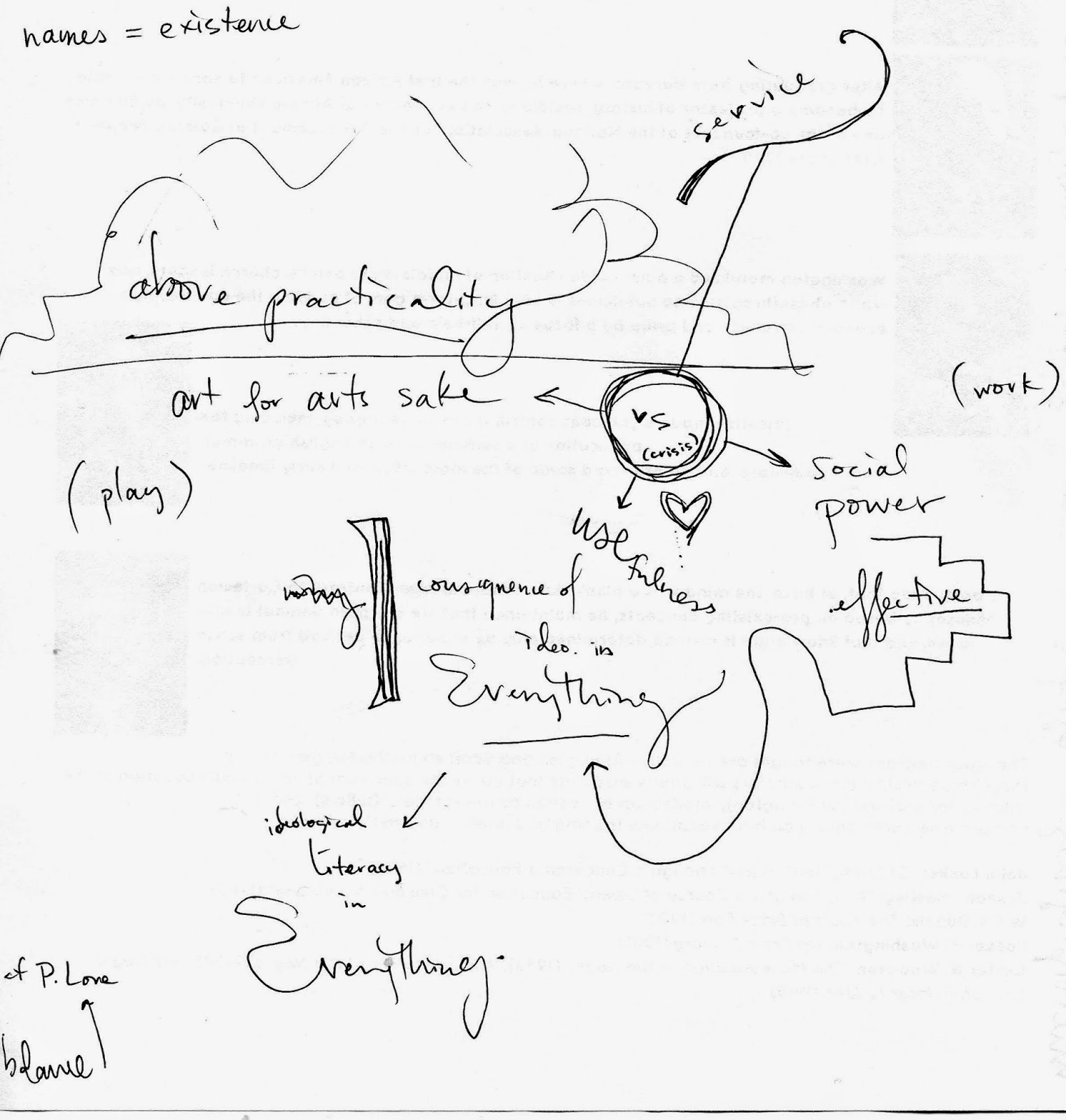
scribbly doodle with phrases like "above practicality" "art for art's sake" "ideological literacy in everything" "service"

something else I'm thinking about is all the stuff that isn't work, or the stuff that at least gets talked about as the opposite of whatever it is we mean when we talk about work.

work vs. play
working vs. unemployed
going to work vs. going to school
hard at work vs. taking a break

and then there are all the synonyms for work. labor. effort. striving. functioning. succeeding. trying.

the word (or suffix or prefix) "work" shows up in my (newly resurrected) file of daily writing 1183 times. I sense that the word, its synonyms, and whatever we mean by it are all going to show up a lot in my future scholarship. my scholarly brain is quite obsessed with the concept lately. partly because
of dissertation residue and many of the ideas I reference in this piece, and partly because in the past month or so I've been consumed with Asao Inoue's book Labor-Based Grading Contracts: Building Equity and Inclusion in the Compassionate Writing Classroom.

I have so many thoughts and so many tenuous hopes that the thoughts might connect into something bigger. if there are meaningful lines to draw around and among the ideas of working to learn, working to live, working to play, workplaces, networks, and the ways we share the world with a million forms of black-boxy technology, then I'm going to find them. write them.