Showing posts with label education. Show all posts

Tuesday, September 30

the good fight

what does an average middleclass person in the developed world have to really fight for? stand up for? do capital-S Something about?

plenty of stuff, surely. but then again... fighting seems dangerous. difficult. as long as we have access to some safe-enough shelter, plentiful-enough groceries, functional-enough plumbing, a little companionship, what else could we need to really worry about? with those basic necessities secured, most of us will be content with the state of things, whatever mild to moderate chaos or metaphorical storm clouds may swirl around on the outskirts of our little routines. 

do I mean "be content with," or "get complacent about"?

photo of an art piece in downtown Indianapolis, with a neon crosswalk sign flashing "DON'T CARE" in blue all caps

both, I guess. the main difference between the terms is in the level of awareness each implies. complacency means ignorance. we can frame our implacable cockroach-like ignorance as blissful and cozy, or as a challenging opportunity to learn more stuff. or maybe as protective wall, willful and resolute. which way we see it (or if we see it at all, I suppose) is a decision to make. a mindset we get to set. more likely, multiple shifting mindsets that we trade in and out as days come and go. 

my list above of all the basics that would be worth fighting for if we had to didn't include any education, but really it should. what kind of teacher would I be if I couldn't say learning and knowledge are worth fighting for, standing up to demand, or working as hard as possible for, after all? we need good food and good information to really survive on this planet. we can't leave our brains out of the game. useful stories are what civilization is made of.

we've watched the newest Superman movie more than a few times this summer. is it a useful story? (perhaps I should ask "useful for what?" or "useful to whom?" here. stories can be made to do many kinds of work in the world. not every storyteller has the same kind of use in mind. not everyone understands their needs for safety, shelter, food, and information in the same terms as other people's.)

despite the comicbook/superhero genre not being my usual cup of tea, I did like the messages this one braided together for us. 

  • your biological family and their cultural values aren't the be-all-end-all of who you are or can be. 
  • seeking peace and justice is not easy; people will probably complain no matter what you try. 
  • success of any kind at almost any level takes a ton of collaboration: there's work for the superheros, for journalists, and maybe for the unruly canines too. 

not all fighting is physical or violent (thank goodness). inasmuch as my daily work might be considered a figurative battle-- to wrangle my modest expertise in technical writing into a series of effective lessons for a bunch of college students every semester-- to apply decently rigorous empirical methods to relevantly articulated research questions in the field of media studies-- and all the other paperwork and collaboration and sitting through meetings that attend my little academic career-- then we can say I've fought to defend my few square feet of shelter and my $600/month grocery budget. perhaps I also fight here and there for recognition, for friendships, for leisure time, for a little peace and quiet. what advocacy my life entails beyond these selfish pursuits is very small. smaller than a pebble thrown into a puddle, it seems.

professionally, I advocate for all the podcasts to have transcripts. for inclusive and non-punitive learning-centered pedagogy where students get to make a lot of decisions for themselves instead of merely following arbitrary instructions. for a rejection of the workaholic mindset that still pervades academic culture. for everyone to do their best to read more and communicate clearly and vote in all the elections.

does all of that make a difference? I'll at least say that it doesn't not make a difference, so that's something. I won't always be able to measure the difference it might be making. there is plenty of hope involved.

could I make more of a difference if I were a scrappy investigative journalist? 

more or less is not the right question here though. it'd be a different kind of difference, on a different stage, but another form of education in any case. keeping people empowered with accurate and relevant information about the present universe. meaningful work, indeed. 

but also... maybe scathing exposés about the far-reaching misdeeds of tech billionaires only bring about lasting consequences in comicbook movies with happy endings. 

what does an average middleclass person in the developed world know, really, about all the bigger things out there to fight for? all the things we could/should/might/ought to/would do capital-S Something about before it's too late? nobody can be rationally informed about everything everywhere all at once. it's too much. even if we are informed enough about reality, learning/knowing/deciding what to do about it is another set of mental battles in itself.

my currently second-most-favorite podcast Never Post published a roundtable episode on this idea, back in May. the host (Mike Rugnetta--the one and only. I know, I know, will I ever shut up about Mike Rugnetta?) notes the tension between how we use the internet and how we might wish we could use the internet. it is a global medium--that's why it was made. one of the coolest things we do with the internet is "to socialize and connect globally, which, you know, that's powerful and that's important," Rugnetta says, "but we can't act globally. [...] it's even hard to act locally given the state of especially American politics.
"And, you know, I feel like even my ability to even know how to act locally has perhaps atrophied a bit because of my focus on the importance of familiarizing myself with national and global events."

are there information diet plans out there, something akin to the handy food pyramid, but for sources of news instead of calories? probably. 

do they teach such things in grade school so everyone grows up knowing that your brain will not thrive on a diet of nonsense and trash? maybe somewhere somehow. bless everyone who dares teach grade school.

there is so much information in the world to be had. maybe I shouldn't say "too much," because that depends. too much for what? for whom? 

sometimes it does seem necessary to just stop for a little while though. to push back on all the information (the firehose, the overload, the deluge, the six-lane highway traffic jam) with a little carefully cultivated ignorance: "I haven't looked into that myself," "that's not my lane," "I trust someone else to be smart about and work on that particular problem" and so on. (this brings to mind some of Hank Green's recent vlogbrothers video in which he touches on the difficult value of trusting our fellow humans.) we can all find our own good fight to fight-- there isn't just one. 

hopefully we aren't all fighting alone and/or at cross purposes though. hopefully we have some kind of justice gang/league/squad to back us up at least some of the time. smart and good people don't only exist in the comicbooks and movies. the Green brothers are on my list of people I admire for trying to make the world better. academic acquaintances are on the list. non-profit organizations managed by people whose names I may never know are on the list. 

its been a week or so since I read this detailed breakdown of "The Dark Internet Forest" as a concept for understanding the possibilities and risks of all our globally mediated connectedness and was thus suddenly enchanted with its author, Erin Kissane. she comes back to the centrality of place-- real or physical or digital or conceptual, place is important to remember. positionality. relationality. places matter. where are you? what other places are within reach right now? who else is there? how can you join forces and do Something?

I especially loved that Kissane cites this beautiful pushback against the classic "tragedy of the commons" idea. Elinor Ostrom's book helped me write my dissertation. I should read it again sometime. 

doing capital-S something is not always (probably not often) gonna be easy even when you have a team of active, collaborative superheros to work with. it's still messy. pebbles in ponds sometimes and big splashing ordeals other times. 

flip a switch somewhere and set your mind to care at least a little. doesn't have to be about everything. just don't get totally complacent.

photo of an art piece in downtown Indianapolis, with a neon crosswalk sign flashing "DON'T CARE" in blue all caps and "CARE" beneath it in white

Friday, October 18

bunny vs. fence

the other day, this lengthy stretch of fencing (branded nicely enough with so much black, white, and red to represent the construction company Sundt, whose slogan seems to be three standalone words, "Skill. Grit. Purpose.") went up all along the drive that goes between my academic office building and various parking lots between here and places off-campus.

I'm told that they'll be building a new dormitory somewhere on top of the rocky, scrub-filled gully on the other side. it'll have more student housing and more classroom space. so cool. so necessary. 

some of us in my academic office building are mildly worried that this new construction will block our most excellent west-facing views of Granite Mountain. we shall see, I guess. I remain hopeful that the slope of this gully will mean the top of the new dorm will be low enough for us to look over from our third floor offices.

as I walked back out from my office to my car last Tuesday, I noticed a little grey-brown bunny frantically searching for a way through the fence, up and down the hill in short bursts, back and forth over the blaring red curb, every so often sprinting for its life all the way across the road back to the unfenced rocks and bushes to the east.

I watched it for a solid few minutes. it hopped away in panic from my slowed footsteps, then dashed in further panic across the path of someone's big white SUV driving up past us both. 

I didn't see the bunny come back that evening. so I studied the fencing as I walked. surely one little bunny would eventually find a gap to squeeze under, I thought. (the creatures seem to squeeze through pretty tiny gaps in our back garden gate, after all.)

if the chainlink were bare of this black branded tarp, then could a little bunny more easily get through? or if the corners of each fence panel were less square and more rounded, that would surely help.

I wonder if any of the planners and facilities and maintenance people worried about the impact of this construction project would have on the non-human critters in the area. hopefully at least a little bit. probably not as much as they worried about other aspects though-- the costs of labor and fencing and other materials; the design and the blueprints and the building's whole physical footprint; and the timing and logistics and how soon they can start selling spots in the new dorm.

at the bottom of the hill, the fence merely ends,. for now. the sidewalks remain open and the parking lots in regular use. for now. if the bunnies are persistent enough, they will find their way back into their hideaways in the scrub-filled gully. 

and hopefully they will all find new hideaways once the gully is dug out and filled with a bunch of concrete and whatever else dormitories are made of.

and if not?

they're just bunnies. some of their cousins, whichever side of whichever fence they've ended up on, will replace them soon enough.

Thursday, September 12

fall semester, 2024

the word semester shows up in at least 130 of my past blogposts, which is a little more than 10% of all the posts I've thus far posted. considering that this little blog has always been roughly half focused on various academic and intellectual pursuits, this makes plenty of sense. semesters are like seasons.

the word itself is not even 200 years old, the etymology dictionary tells me: "...semenstris 'of six months, lasting six months, half-yearly, semi-annual,' from assimilated form of sex 'six' (see six) + mensis "month" (see moon (n.)). The word, and the idea, were picked up in the U.S., where the German higher education system served as a model."

apparently the Latin-y adjective forms semestral and semestrial are a few centuries older. interesting. 

anyway, I'm glad our semesters are not a full six months long these days. four months is plenty. 

and for these upcoming four months, I'm teaching three batches of students, including a few repeats from past semesters. the longer I hang out at this institution, the more that will keep happening I suppose.

COM 221: Technical Report Writing
counting the two sections I have this semester, I've taught practically a million versions of this course (okay, 15 total sections. that is still a lot). it's becoming a bit of a struggle to not get completely burnt out and bored of it, but I'm doing my best to keep it interesting for me. we're only in week 3, so I'm still getting to know the vibe of the students. we'll have some fun together I hope though.

HU 356: Audio Production & Podcasting
this one is going to be interesting no matter what-- it's a brand new class, only recently outlined and designed and proposed by me for our catch-all Humanities & Communication department. I am pretty excited to see how this goes. so far I'm having students practice various little audio recording tasks, then we'll level up to remixing all those clips into some fun story-arc, before finally moving on to pitching and workshoping individual podcast projects. the students all have great ideas so far. (wish me luck persuading the one who simply wants to copy Mr. Rogan's insufferably long-winded (at least it is to me) format into doing something at least slightly more inventive.)


what else? I signed up for a weaving class next month. some family is visiting next week. we have some more camping planned for during fall break. we're having a brand new screen door installed sometime soon. and our Monday evening D&D group is on the brink of moving up to level 8. in November, our crazy puppy will turn 1 year old.

at some point we should work on the mish-mash garden projects and other household tasks that need doing. and eventually figure out our holiday plans. 

or maybe we let go of shoulds for a while and enjoy the almost-autum while it's here.

Saturday, June 29

favorite conference

last week, my time was taken up by another academic conference.

I presented on semi-academic podcasts and how awesomely they seem to cultivate discussions about scholarly things for the consumption (and perhaps participation) of non-scholarly audiences. such a thing seems pretty rare, but maybe it's less rare than I'm making it out to be. after all, 

“Podcasting’s bridging of knowledge barriers in an intimate manner is one of its key, and most readily apparent, properties. Thanks to the medium’s wide accessibility— given its general affordability and portability— knowledge in diverse domains can be shared by individuals and groups around the world. Thanks, as well, to their intimate, personal and often-conversational natures, podcast episodes can help individuals of different educational levels cross disciplinary boundaries easily. Audience members need not be enrolled in an educational system in order reap their benefits” (Swiatek, 2018, p. 177-178).​

how's that for a minimalist literature review, eh? Swiatek's chapter is in the collection I used as a textbook for my introductory podcast course last year. good stuff.

bridging knowledge barriers can happen across all kinds of lines, not just those of formal higher education, of course. academia is only one of many domains of learning. 

but for my presentation, I concocted a fairly narrow set of criteria for the four examples I showcased. to fit in properly with what I wanted to talk about, the podcast needed to be...

- officially made by/with credentialed, institutionally-affiliated academics ​
- making use of the ethos and/or expertise of their degrees at least a little
- purposefully talking to and/or translating for non-academic audiences ​to some extent

I also limited my examples to humanities/communication-y topics, because that's my discipline, and a 15-minute conference talk cannot be much more comprehensive than that anyway. I am curious to look at other podcasts in this vein though. eventually. Huberman Labs would count. and probably plenty of others I haven't heard of yet.

my observation, as a fairly high level podcast fangirl, has been that most scholarly podcasts don't bother talking beyond their own discipline, much less beyond the academy in general. in a sense, that might be what "scholarly" means-- by, for, and of scholars. but I also knew of a few counter-examples. a few podcasts that managed to feel more openly, accessibly, publicly academic.

for this little starting-place of a conference talk, I looked at these four: Material Girls; Lingthusiasm; Think Fast, Talk Smart; and Professors Play

according to my proposal for the event, I wanted "to highlight these as particularly valuable examples of public scholars demonstrating from the ivory tower how playfulness, connection, and personality are key ingredients for learning, teaching, and thriving as 21st-century humans."

want to see my little digital handout with transcribed bits from each show? there's a link to my slides from there too, which in turn have a few painstakingly chosen, hopefully entertaining-ish, audio clips. 

it is perhaps silly to turn my little presentation from last week into a blog post here, but (now that I'm halfway through doing it anyway) it does seem to match the spirit of my whole point— academia doesn't need to keep all of its cool conversations to itself.

on top of making that point, my other goal with the talk was to have fun introducing whoever showed up at my 11:00am panel to a few very engaging podcasts. I called it "Public Scholarship as Playful Pedagogy," but the title easily could've been shuffled into “Playful Scholarship as Public Pedagogy”— I'm still not sure which sounds better. the lines between all these things are fairly slippery at the best of times.

the lofty version of my whole argument is something like this: podcasts are conversations, usually quite public ones that can shape the cultures and communities of the world we live in. sometimes they even create new communities, which in turn have their own world-shaping power. so it matters who gets to be part of the conversation. it matters how the conversations are designed. 


Computers & Writing is one of the best conferences. next year it'll be in Athens, Georgia. will I get to be there and keep talking about podcasts as scholarship or pedagogy or public pedagogical artifacts or anything like that? we shall see.

Tuesday, February 20

and spring semester 2024

eleven years ago, back at the very beginning of my academic career, I trekked 6 hours west from Lubbock, Texas, in my very old leper of a car (the paint was all but totally peeled way from its poor hood), to attend my first ever academic conference in Albuquerque.

this week I'm gonna trek 6 hours east and attend the same conference, this time in a rental car, with way more academic experience, an institutional credit card for travel-related purchases, and a significantly different research agenda. I'll be presenting this Saturday all about how I designed and get to teach a fun little class on podcasts. 

slide title with these words over stylized soundwaves: Themes in Humanities, The Art and History of Podcasts: Teaching podcasts as pop culture in a 100-level general education course

 {the title slide, so far anway}


and I'll get to see some of my old professors from USU. very excited for that bit. 

it'll be fun, hopefully. I hope I'll meet some other cool new interesting fellow scholars along the way, too. we shall see, given how sunny and warm it looks to be in Albuquerque this weekend, how much of the conference I actually sit through.

photo of a couple old issues of The Black Box, black and white covers, circa 1990-something

in the more normal weeks of this semester, I'm teaching a couple sections of technical writing. the same old basic tech writing course, only slightly different every time by virtue of new students and a new me and a new world.

besides teaching, I'm also working on a book chapter about podcast transcripts and leading various faculty from various other programs through a series of mushy but important assessment adventures. friend Caroline and I are still working on soliciting content for a new issue of the campus literary arts magazine (the second since we took charge of it last year). maybe we'll have an official reading event at the library with the creative writing class-- fingers crossed. 

it's all nearly haflway over, this set of 16 work weeks called spring semester. at the moment the halfway point feels encouraging. time ticks onward. work gets accomplished. knowledge is made and shared and reinforced. skills are modeled, practiced, learned, forgotten, re-learned.

in other news, I'm also finally getting to see some work from the past year come out in official publication! perhaps the coolest online academic journal of all, Kairos, made space for my multimedia oral history-ish interview piece all about two colleagues who recently retired.

and then colleagues and I have a co-authored piece in the most recent issue of Programmatic Perspectives (the differently cool but still very awesome journal from the Council for Programs in Technical and Scientific Communication). some awesome Purdue colleagues have an article in the same issue, which is quite cool to see. 

time ticks onward. I've been here 4 years. 2 more until hopefully they give me tenure. 

in the meantime, age and experience accumulate. some days I feel older and other days not at all. 

next January, in the auspicious year of 2025, it'll be 20 years since I started this blog for a class. how will we celebrate that, I wonder?

Friday, June 24

virtual academic-ing


as part of this virtual conference going on here at the end of the month, I was able to attend a workshop hosted by the very professor who once upon a time, almost 20 years ago now, assigned his professional writing students to create blogs and write every Wednesday about our webdesign readings. he's still teaching at dear old Utah State University. I should try to go visit again someday. 

for now: thank you, dear rylish, for nudging me into this writing space. 

Tuesday, June 7

sing, sing, sing

so I signed up for eight weeks of voice lessons this summer. it was kind of fun and random to enroll at the local community college and get a new email address and go actually check out their pretty Prescott campus.

it's nice. lots of cool sculpture gardens here and there. I was especially struck by this lovely little bench:


it hasn't been that long since I was a real student (and secretly/not-so-secretly, professorship is pretty much endless-studentship anyway), but it does feel like a long time. 4 years now I guess? 

but now, for this season at least, I am a part-time, non-degree-seeking Yavapai Rough Rider.

drawing of the Yavapai College mascot-- a cowboy-looking dude with a moustache
{ image borrowed from a local news piece about the YC softball team }

I had my first lesson this afternoon: 50 very enjoyable minutes with Dr. Audis, who earned her doctorate at none other than Texas Tech University. (interestingly, but not really coincidentally given all the myths and legends of our shared western/southwestern contexts out here, Texas Tech has a really similar mascot... only theirs is red-flavored instead of green...)

anyway, the first lesson was a great time. I tried not to be too nervous; I hummed warm-up scales through buzzing lips and emulated an ambulance siren with my voice as fully as I could. that last exercise was scary-exhilarating and hopefully that small thrill will help spur me to practice it even if it will likely frighten the pugs a little. 

then we sang through a few folk songs and a few show tunes, ultimately settling on these three as my summer repertoire: 

- the classic Irish folk song, "Danny Boy"

- one of the more heart-wrenching songs from Fiddler on the Roof, "Far From the Home I Love"

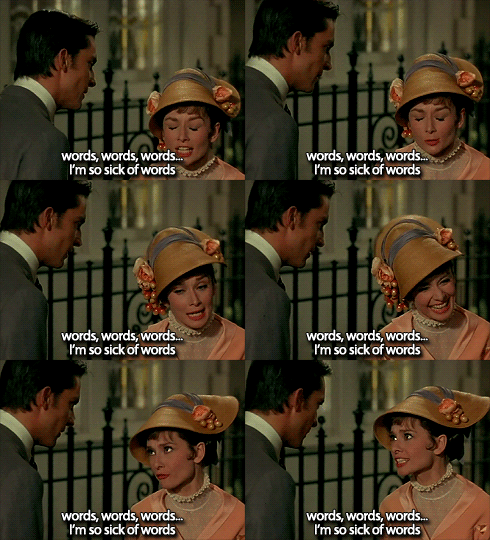
- and "Show Me," from My Fair Lady

gif image of Eliza Doolittle fiercely singing "words, words, words, I'm so sick of words"

I'm familiar with all three in some way or other, but despite their seeming simplicity they'll each make for an interesting challenge in terms of range, pacing, tone, emotion, and style. not to mention forcing me to sing the notes and timing as written and not just as I remember from musicals or popular culture or whatnot.

for these summer classes, there isn't a formal recital or presentation at the end of eight weeks, but it sounds like I'll at least get to perform for the other voice students at some point. that should be scary-exhilarating and cool also.


side note! in my googling for that .gif file from "Show Me," I discovered suddenly that Mr. Freddy Eynsford Hill is played, in the 1964 film adaptation of My Fair Lady, by none other than Jeremy Brett.

Jeremy Brett? whose name I mostly only know because of my longstanding, if lazy, adoration of all things Sherlock Holmes? 

yes indeed, that Jeremy Brett. I may have to move this whole playlist of his Sherlock Holmes performances up nearer to the top of my summer watching list.

Friday, January 29

I, pedagogue (spring semester, 2021)

back in the day, I thought I'd never want to teach. and then I realized that in some ways, everything everyone does can involve a layer of teaching somehow. even if it's a very subtle one.

even still, for these past seven years of wading deeper and deeper into teaching college writing classes of various kinds, the real practice of teaching (with all the planning and record-keeping and decision-making and performing and grading and authority-wielding it typically requires) has not often been my favorite part of academia. it's fine. but it's hard. and I never feel very good at it, so it simply can't be as naturally rewarding as all the other corners of academia where I feel far more skilled.

for better or for worse, my two full-time assistant professor jobs so far have been quite teachingcentric. twelve credit hours of teaching every semester, plus a few during summer semesters, until this year. dozens and dozens of students show up in August or January or June for whichever iteration of professional writing I'm teaching this time, working and sharing and hopefully learning, and then they disappear again.

this year, I have one course release for being brand new in town. it gives me a chance to get used to things a bit.

they also gave all the new faculty a copy of the book What the Best College Teachers Do, by Ken Bain. a few colleagues and I read through it together last fall semester and talked about ways to apply the findings in our own classrooms.

the book and our little faculty discussion group made me think much more intensely about my teaching than I've cared to thus far. it also gave me some concrete hope that maybe I can become better at this thing I don't feel very expert in at all. 

so. what am I trying to do a little better this spring? what have I begun to internalize from Bain's research?

possibly more things than I can articulate very well in a little blogpost. but here are a few:

> talk about your own learning journey with students. model or reenact the kinds of transformation you hope that they will undergo as a result of your class.

> trust students and treat them like whole humans with a million shifting priorities, just like you. this is something I already knew and practice decently, I think. but I took particular comfort in it this past year. my course is a small droplet in the ocean of everything these students are trying to learn and become. if my teaching isn't perfect, they probably won't notice or remember for too long.

> ask students big, meaningful, authentic questions--the kinds of questions that professionals in your field will ask and try to answer. (this is particularly tricky in writing because writing, for most people, in most important contexts, isn't very often about itself. its actual subject is the everything else that we write and communicate about.)

I think I do pretty well being authentic and open and compassionate as a teacher. but I have been guilty in the past of assuming students could never be all that interested in the big questions that I study. we don't have time for that, do we? especially at a fancy aeronautical university where nobody is an English major and everyone mainly wants to design or build or test or fly airplanes and other such contraptions-- how could any of those students care about a communications course?

but if Bain is to be believed, the enthusiasm of a teacher combined with the sparks of a big, meaningful question can draw students in, motivate them a little, even if they didn't think they'd care very much about a communications course. 

and I can be good at questions, surely. 

especially big ones! like: how do you know what anyone means? how do you know what anyone else thinks you mean? how people really ever understand each other enough to make good things happen in the world? and what does it mean to read? to write? or to do those things effectively?

the trick now becomes figuring out how much time to spend getting philosophical about definitions inbetween all the more "practical" work of practicing reading and writing and revising and all that. I still think students learn most from doing things, more than they can from reading about things or discussing them or whatnot.

but anyway, I added this little linguistics video to my list of assigned readings. I opened the first day of class reading from Celeste Headlee's book We Need to Talk, which recounts the tragedy of an ineffective conversation in an airplane cockpit. in technical writing we spent the first day exploring informal crowdsourced technical descriptions on Reddit.

and when I listened to this recent episode of So Many Damn Books with George Saunders I felt more affinity for Saunders's love of teaching writing than perhaps I might once have felt. his advice is to remember that you're never just teaching 20-somethings who barely know what to do with their adulthood when you meet them-- you're also teaching the 40-something-year-olds that they'll become. I like that. (not all college students are 20-somethings, but the concept holds. we are all humans-in-progress.)

maybe I'll go back and give the Pedagogue podcast another chance, too, now that I feel more hopeful and less grumbly about this whole teaching business.

Monday, September 7

separately solemn: fall semester 2020

today begins week three of my first semester teaching at Embry-Riddle Aeronautical University. I am the newest Assistant Professor of Professional Writing in a department without a degree program. students here can get a minor in Humanities & Communication, but nothing more. since they all want to be pilots or engineers, that's how it is.

I'm teaching two courses, three sections, this semester. one of technical writing and two of business writing. there are 62 students enrolled altogether, which might be the most students I've taught at one time ever.

COM 221: Technical Report Writing
this one is quite reminiscent of the English 421 I taught once at Purdue. for the most part, I've kept this course very similar to the technical writing and technical composition courses I've taught for the last two years. but for our final project, I'm finally going to teach some podcasting stuff. finally. 

COM 222: Business Communications
if Com 221 is the English 421 of ERAU, then Com 222 is the English 420. though the distinctions between professional/business communication and technical communication aren't so very huge, they do exist. it feels like ages since I've focused on the former. so I'm resurrecting some of the projects I taught back in 2016 and 2017, updated a little, with a new textbook to go with them this year. cause-related marketing proposals. very exciting. 

overall, Embry-Riddle feels like a mini-Purdue in many ways: engineering-heavy. mostly white and privileged students. the differences, however-- that it's a much smaller private university, perched on top of a desert-- are significant.

how many college campuses have I spent how many autumns, now? this will be the sixth campus (USU, U of Plymouth, TTU, Purdue, NSULA, and here). I don't feel like counting the autumns themselves just now. someday maybe I'll make a chart.

cottonwood_trail_20191110_119

{ photograph borrowed from this kind user of Flickr }

true autumn weather is a month or so away, still. but regardless of weather, classes have started. and that comes with a particular and lovely feeling.

only... it's different this year. and I don't think it's different just because I'm getting old. 

something like the same old scintillating energy of a college campus in September is here, jolting through brain and body every now and then. but it's so muted. six feet of space (give or take) has diluted it. closed office doors and silent office hallways are smothering it. I didn't know the trademark thrill of any given academic autumn would be so vulnerable to the side effects of separation.

after a summer of moving and reading and blogging and not teaching anything, my teaching muscles need re-building. it might take me longer to find a workable rhythm this semester. 

talking for 4+ hours (thank goodness not completely consecutive hours) in a cloth mask is exhausting

keeping track of two separate classroom cohorts for each section I'm teaching is a little hectic. 

finding my place in a new institution is tricky enough, without such strange circumstances. what with all the reasonable but seemingly unending surveillance and daily temperature checks and stern, scolding emails from administrators and wobbly hopes tossed about on fathoms of uncertainty-- it's so easy to be so panicky. and almost as easy to sweep the panic into a corner and pretend like it's not there at all.

it makes me wonder, again and again, what really matters anyway? 

I'm thankful, for now, for patient and smart students. it's a weird time for all of us. hopefully we still learn a few things that will still matter beyond this semester and next.

Monday, July 27

editing work and so-called "educational technologies"

it's not the most important volunteer gig in the world, but I am on the official Board of Copy Editors for a scholarly journal in the field of social work.

see? (I still need to have them update my institutional affiliation, I know. soon.)

the article I'm editing now is about perceptions of social work and advocacy organizations in Ireland. it's pretty interesting. part of the fun of this position is getting to dip my brain into current scholarship from another field, from lots of other perspectives. one of the pieces I previously edited was all about volunteerism-- something not unrelated to my own scholarship.

today I've been combing through this forthcoming article's reference list, checking for completeness and formatting. like most social science journals, this one uses APA style, which I'm thankfully pretty familiar with.

my editing process can be a little haphazard for a project like this. but generally it follows these broad strokes:

1. read through the piece once and make notes about persistent issues or anything else that stands out, tidying up a few of the easy things (commas, spelling, other punctuation) along the way
2. check that everything listed in the references is actually cited in the text, and vice versa (this is something I learned from Dr. Hawkins as part of her teaching in Bibliography & Research Methods many years ago)
3. attend to citation formatting (all the periods in the right spots, capitalization as APA dictates, and so on)
4. make sure all the headings and subheadings are styled properly (and I'd usually check tables and figures here too, but this particular article doesn't have any)
5. draft a makeshift style sheet for any judgement calls I get to make about hyphenation or capitalization of terms (these are always really informal sticky-note things, if that)
6. go through again, adding queries for the author where needed, making decisions and changes for the major issues previously noted, watching for consistency and fluency at the word- and sentence-level.
7. spot check one last time for the things on the style sheet, review the queries and comments to make sure they make sense, and then send the whole thing off after appending my initials to the filename.

if it's work for hire, I'll prep an invoice and send that along with my edits. I've done a huge amount of editing for hire this summer, it seems like. dissertation proposals, articles about orthodontics, computer graphics, and GPS, and even several book chapters about analytic software programs. but for this particular job I'm only getting paid in collegial respect and academic clout. it makes a nice line on my CV and boosts my ethos as a person with practical, ongoing experience editing. plus, I enjoy it.

there's about a day or two more of work left on the piece. the references and headings are sorted, so all that's left, roughly, are steps 5 through 7. from this point on, I shouldn't need to keep opening and closing the section on APA style at the Purdue OWL. it's down to the less tedious part of the job now. I could, I know, be a lot more meticulous about how I approach the work and how I track the time I spend on it. for now, this is what works for me.

the tedium of citation-tidying, I'll add, is pretty pleasant tedium. actually one of my favourite things about editing scholarly work like this is replacing all the default hyphens with en-dashes in all the page ranges of the references that have them. APA doesn't strictly care about that detail, but the beautiful differences between hyphens and dashes were irrevocably drilled into me back when I worked with the more comprehensive Chicago style at Texas Tech University Press.

style guides like Chicago and APA and resources like the OWL that grow up around them all count as educational technology, don't they? sure, the term is burdened with connotations of electronics, computers, digital connectivity, and such, but books are technologies too. I'd count these guides' paper-based versions as technologies just as much as I'd count their websites at https://www.chicagomanualofstyle.org/home.html and https://apastyle.apa.org/.

the Purdue OWL has always been a website, though its offline home, the regular Purdue Writing Lab, predates it by almost twenty years.

educational technologies. any technology that serves a process of education, right? well, one would hope.

about a year and a half ago, the dear Purdue OWL entered into a partnership with a purveyor of so-called educational technologies called Chegg. shortly thereafter, citation generator banners appeared all over every page of the OWL, offering quick and easy auto-citations in MLA or APA style. I reacted with great disappointment and irritation at the time. and so did plenty of other people.

since then, the powers-that-be over at the OWL have toned it down a bit. the citation generation tools are still there, but not on every single page. still, it feels odd. one tool, the OWL, gives students valuable reference information and examples and helps them learn to apply that knowledge in their writing. the other just black-boxes it all away and says, more or less, "trust us, we'll handle it, you don't have to think too hard. or at all."

I guess there are probably times when not having to think too hard about some process or technology is perfectly okay, but in academia? it seems thoroughly wrong. this kind of thing doesn't really serve education. does it?

such over-reliance on technology goes beyond students, too. a related "educational technology" here is plagiarism-detection software like Turnitin and other such tools. these companies give lip service to academic integrity and education, but their true goal is profit. they're invested in manufacturing some kind of vague ethical crisis so they can sell software subscriptions.

using software to catch students "cheating" is not education. it's barely relevant to education by any stretch of the imagination. and if you have to rely on such tools to figure out if your students are cheating on their writing assignments or not, then you haven't given your students or their writing enough of your attention, and you haven't designed very good writing assignments.

what has bugged me most about Turnitin and the like is the fact that it copies piles and piles of student work for its own databases and uses those copies as a core part of its function. and I suppose they think that because their terms of service say this is all perfectly fine to do, it is.

I say not. if students had any real choice in the matter, then maybe. but given the power dynamics of your typical college classroom, they don't. if their professor says upload your work via this tool, then students are more or less forced to do so, whether or not they care about the implications.

copyright is a whole mess in itself, but any logical understanding of intellectual property should acknowledge that students own their creative work, even within the relatively convoluted confines of formal education. for a third-party technology company to copy that work and profit from its application is pretty clearly unfair. unjust. messed up. all because some teachers are so worried about cheating they're willing to outsource part of their job to a for-profit company rather than design more robust assignments and trust their students half an inch.


for further reading:


Wednesday, August 28

fall semester, 2019

ten days into fall semester. it's been a bit of a rough transition from lovely summer travels to four new sets of students and curricula and work routines and everything.

for the official blog record, here's everything I get to teach this fall--

English 1020: Composition & Rhetoric II
an entirely new course for me, more or less. last time I taught anything like this was spring 2013 at Texas Tech University. I'm a much different instructor at a much different institution this time. but I think this class will be fun-- one of our projects involves writing about some of the opinions/controversies on the Change My View subreddit. each student is also choosing a theme to research and write about over the semester. should keep things exciting for us all.

English 3230: Technical Composition
this is my seventh section of this course. oddly, I've only got the one Monday-Wednesday-Friday section for this semester. 15 students, 15 weeks left. I've switched up a lot of things for this time around (including our textbook), so it's been more work to prep for this time around. ah well. we're doing our team project first, then instructions, then resumes, etc. hopefully plenty of useful learning happens.

English 3610: Intro to Digital Cultures
this is the undergraduate version of my graduate course, Engl 6560, last spring. different readings, a lot more hands-on things in our face-to-face classroom. yesterday I had students compare/contrast working in Google Docs vs. Word Online vs. Graphite. in future weeks I want to have us play around with wikis, twine, glitch, twitter threads, terms of service, interface design, maps, social media, and maybe some of these activities too. 
 
English 5220: Technical Writing
this year, I'm teaching this graduate course to 9 students instead of just 2. it's my one online class this semester, and it should be great. we're using Solving Problems in Technical Communication as our main textbook, and we also get to read (or listen to) all this great stuff:
most of these are the same readings as last year, but I added that final one after discovering it this summer, and several of the podcasts are new additions also.

ten days done, most of four whole months left to go... 

Monday, February 11

professor-ing, spring 2019

there were at least a dozen robins out in our backyard a minute ago, chirping away and pecking things out of the damp dirt.

I didn't notice when they left and I don't know where they've gone now. to someone else's backyard? some other patch of damp ground?

I'm working from home today, with the window in the den half-open and a dish of homemade granola (too crumbly to be bars, but I tried) on the table next to me.
 
there are revisions to focus on, but mainly I've been writing emails to send and posting comments on the blog for my graduate course.

did I write last semester about all the courses I was teaching? it looks like I did not-- not specifically anyway. not the way I've done for all my many semesters as a student. I'll make up for it now.

English 3230: Technical Composition
I taught two sections of this last fall as well, and I'll be teaching 3 sections this semester. Two are face-to-face, Tuesdays and Thursdays, and we've almost reached the end of our first major project. Our next project will be a service-learning/community-engagement project built around a partnership with our university library. who knows if it will spark for my students the kind of gushy enthusiasm I felt about my first service-learning project way back in 2005/2006... but I'm excited about it anyway.

English 6560: Digital Cultures - Theory & Practice
this is my online graduate course, in which four delightful graduate students are enrolled. we are discussing various aspects of and scholarship and theorizings about digital culture over at https://engl6560.hcommons.org/ and meeting for video conferences every other week to discuss further. I'm enjoying it quite a lot and can't wait to see what kinds of projects these students come up with for the rest of the semester.

I have more new and exciting courses (undergraduate and graduate) lined up ahead of me for the next few terms. most of them are technical-writing-related, though I also get to adapt the digital cultures course for undergraduates next fall. I'll get to teach an advanced tech writing and editing sometime in 2020...  lots to look forward to.

being a teacher and not simultaneously a student is pretty much a million times better than doing both at once. teaching is still difficult, but I think I'm somehow slightly more sure of myself now that I have a different focus. my own scholarship has not been set aside, of course (in fact, I should be working on article revisions instead of blogging, probably), but rather than having all the pressure of three reading lists for grad classes + seminar papers to draft + my own scholarship to advance + teaching, it all feels more manageable and spacious and steady.

Thursday, August 2

reflect, revise, reset

I am preparing to teach an online technical communication course for a handful of graduate students.

it is an exciting and slightly daunting prospect, and I'm really grateful for the opportunity. teaching online is fun. teaching graduate students will be new. hopefully I will love it. hopefully the students will love it too, at least a little bit.

as I've started putting together assignment sheets and syllabus sections, I've gone back to the files I have from my first semesters as a graduate student, way back seven years ago. my experiences from then are inspiring my preparations now in a messy but helpful sort of way.

the class I will be teaching is not going to be exactly like the first technical communication course I took in 2011. there are no PhD students at my new Louisiana institution, and there isn't quite a full tech comm graduate program, either. we offer a certificate in Writing for Business, Industry, and Technology and a related MA degree in Writing and Linguistics. my work here will fit into the little tech-comm-shaped niches around and among those programs and the offerings for our undergraduate emphasis in professional writing.

it's been interesting to look back at the work I did as a brand new graduate course and revisit the thoughts I was thinking about everything I was learning. one of the essays I turned in to Dr. Kelli Cargile Cook at Texas Tech in 2011 starts out, after one boring sentence that sets the stage, with a million semi-rhetorical questions:
"Who is qualified to create or enforce a definition of technical writing? In the face of rapidly changing technologies, will a static definition be at all important or useful? What is the clearest, most accurate way to make sense of our place as people who write and communicate among extremely diverse communities? What commonalities among those communities are worth emphasizing? Are any of the basic truths about technical communication universal enough build a profession upon? Will it be possible to include all the essentials without being completely vague? These questions and many more continue to shape the process of figuring out who we are, what we do, and why it matters."
that's six questions, all crammed into one opening paragraph. another professor of mine, Dr. Richard Johnson-Sheehan, always gave me pointed critiques when I included too many rhetorical questions in essays for his courses at Purdue: "your reader is going to lose patience with these," he would say, implying his own quickly waning interest.

I think I've learned to agree with him, by now. I do still love questions, but I understand now that they can be a tiresomely slow way to introduce one's main point.

one day soon I may remediate that whole long, rambly essay into a less-long, less-rambly blogpost. that could be fun. for me anyway. possibly useful for anyone out there who might wonder what I really think I'm doing with my academic life, too.

definitions of technical communication (and of rhetoric, or writing, or art) are still, forever, being debated. my own place in this disciplinary debate is still debatable too. malleable. amorphous. emerging.


I know a lot more now than I did in 2011. and I know much, much more now than I did seven years before that when I returned from studying abroad, declared myself an English major at Utah State University, and eventually started this blog. a whole decade and a half of experience has ways of teaching one things. sometimes without you even noticing.

it's August, 2018. new things are happening. the world and me look so different than they used to. it feels like a beginning--expansive, wild, wide, and uncharted. a chance for new rules. better habits. but it's hard to know what the best new habits might be. so much of this new life is going to be unfamiliar for a while. disorienting.

teaching experience and academic credentials have piled up on top of me over the years. those things have given me some grounding amid all the chaos of finishing one thing and beginning another. the transition has felt long. May 18 was almost a dozen weeks ago, and my new semester at Northwestern State is still weeks away. as much as this feels like a beginning, it's just as much middle, and partially an ending, too. as soon as August 4 gets here and Purdue's commencement ceremonies are over, I'll officially officially be Dr. Amelia Chesley, with a real PhD and a diploma in the mail, with an exciting tenure-track job as an Assistant Professor. soon enough I'll have this office in Keyser Hall arranged just how I want it. I'll have a phone in that office, and faculty meetings to go to and everything. 


I still have a million things to learn, at least.

Saturday, December 23

stories and truths of many sizes

I was just barely thinking about Jean ­Francois Lyotard, and then about Clay Shirky, and then about blogging, and when I opened up all my draft blogposts I found this one. what an odd little coincidence, it seemed.

this post began as notes copied from a reading response I must have written and turned in for my Postmodernism course several semesters ago. I'm going to revisit it and see what happens.

that semester, I wrote rather candidly that I'd thought I would tiredly skim Lyotard's The Postmodern Condition. it is a short treatise, but nonetheless skimming is fairly expected in graduate school. however, apparently I almost couldn’t put Lyotard down that week. something about his little exploration of The Postmodern Condition sparked against my jumbly thoughts and I just had to finish it. and I wanted more.

my reading response post for the class eventually congealed around two main topics: technology and money. I'm going to reverse the order for this post, and put money first. mostly this is because I'm smiling at the memory of the Megan I met on a train, and I want that very small story to exist here on my blog.

the other reason is that the technology thoughts seem to loop back nicely into the current and future trajectories of my scholarship, and ending with them will perhaps as more light and insight to that trajectory as it continues unfolding for me and my brain.

money
in his section 11, "Research and Its Legitimation through Performativity," Lyotard leads us, his readers, around to a (by now fairly obvious) perspective on power and truth:
“A new problem appears: devices that optimize the performance of the human body for the purpose of producing proof require additional expenditures. No money, no proof—and that means no verification of statements and no truth. The games of scientific language become the games of the rich, in which whoever is wealthiest has the best chance of being right. An equation between wealth, efficiency, and truth is thus established.” (44-45)
I found this obvious then because I'd read various other bits and pieces about the construction of proofs and the materialities of epistemology. I would go on to read more, too. Barad's Meeting the Universe Halfway gets at many of the same conundrums. what it means to know something, to make known something, to verify and prove to others that you have verified it-- these are huge questions. Lyotard says that money makes it easier. money is very persuasive stuff. material. rhetorical. powerful.

and Lyotard puts this thought to us in such a clear, direct way. resigned, almost, but thoughtfully so. I was reminded by this section of a conversation I had with a medical student named Megan on a train from Dundee to Oxford this summer. she sat across the table from me and offered to share her gummy sweets, and eventually we both looked up from our studying and fell into a gloriously fluid conversation about who knows how many interesting thoughts.

one of our many topics was medical research, and Megan explained how unfortunate she found it that most useful, successful medical research is driven by capitalist, consumerist ideals. developing nations don’t have the resources to carry out their own research, nor the resources to pay for research on any of the diseases or treatments that make the most difference to them. the citizens of developing nations won't have the resources to pay for such treatments, so why should medical researchers invest their time there? no money, no science. no truth. and on the other hand, in developed countries, we have plenty of time and money with which to worry about cancers and heart diseases and such, and those are the things that get studied.

I’d never really thought about that manifestation of privilege. and it is just one example of what Lyotard points out about how power and proof and rationality and funding and research are all tied very tightly together. I have been lucky to have funding and support from handfuls of institutions, and having that has allowed all the thinking and making that I've been doing as an adult. so far I think I can count on that support remaining, in some form or another, as long as I can make myself useful in some way to the institutions providing it.

anyway-- I think the “no money, no truth” slogan, paraphrased from Lyotard, should go on an ironic t-shirt or something. somebody make one.

technology
in an earlier section of the book, Lyotard makes a bewilderingly simple (to me) claim about technology-- that it only has two principal purposes. the line appears in section 1 in the context of the sciences/technologies of language and communication, where he says this: “Its two principal functions— research and the transmission of acquired learning—are already feeling the effect, or will in the future” (4). I had to stop there, puzzled and frozen and what? The vague pronoun and the bold claim both held me up for several minutes.

in the margin, I added this note: what?

I wondered and puzzled over this claim. technology is principally for gaining knowledge and sharing knowledge? who says? since when? in what arena?

I wasn't sure, that semester, why I was so skeptical here. (husband dearest would say it's because such a stance is my habit, and I can't help myself. maybe he is right.) mainly it seemed to be because I hadn't thought about the idea before. it was new. while I reveled in the puzzlingness of it, I questioned myself too. if Lyotard means communicative technologies, not all of them, does his claim make more sense then? but then again, which technologies aren’t at least a tiny bit communicative? really? as a rhetorician I take a position that everything sends some kind of message. are those messages always based in "acquired learning" somehow? perhaps they are. everything around us is teaching us, even if we aren't paying attention. perhaps especially then.


as a rhetorician, it is my habit and my training to notice what the everything is teaching us, and then to try analyzing how it does so. right now with my dissertation work I'm pondering what the crowdsourcing work of LibriVoxers may have to teach us, and trying to connect that to professional/technical writing scholarship and practice generally. the ideals and methods of LibriVox are inspiring, I think. every voice is welcome. every tiny contribution valued alongside the tiny (and not so tiny) contributions of thousands of others.


one of Lyotard's more memorable contributions (at least as far as my brain is concerned) is the idea of the petit récit or 'small story' in contrast to the grand narratives of epic myths and stereotypes that sometimes dominate our ways of thinking about ourselves as humans. that idea--many small stories bubbling around, opening up many new perspectives, adding difference and color to places that looked old and flat before--seems important. right now, in this early 21st-century digitally networked time, we have space for millions of small stories. millions of different voices. it can seem an overwhelming abundance sometimes. what do we do with it? how do we handle the abundance? is this a chorus of voices or a chaos of noise? these questions seem worth asking. one person's chaos may be another's chorus, I imagine.

I may need to go reread Lyotard, and this time I might skim.

{ photos taken by Dr. Michael Salvo, over a year ago, in room 306 of Heavilon Hall, where I defended my dissertation prospectus using my voice and some words and chalk } 

Tuesday, October 24

autumn timewarp collage

this week has brought the first cold rains of the season. half of October stayed quite warm and muggy, but autumn is properly settling in now. the time of hats and sweaters has arrived.


yesterday it seemed to rain and rain all day long. I spent the morning grading, the afternoon putting together job applications and writing bits of dissertation chapters. the pug spent most of his day snoozing, as usual, but we also went for a glorious long walk in the pre-evening. having a dog is such a great excuse for going on walks every day. I never thought I was a dog person, but walking a little pug around the neighborhood has become an unfading pleasure for me. I like being outside. it's amusing to watch him sniff at everything.


it's also amusing to watch him in general, whether he is curled up in a puddle of wrinkly fur or whether he is stretching up to look out the windows and grumble at bicyclists. 


my time this semester has an interesting grounded uncertainty about it. I'm teaching an online course, so my teaching efforts fit into whatever slots and nooks they need to. and so does everything else. morning walks, housework, reading and writing and research, cooking, spending time with dear husband, writing and reading and research, notebooks, evening walks, and making lists of more job applications that need filling out. 


the mountain photo there is from two weeks ago when my youngest brother was about to get married. the Chagall above is from a trip to the Art Institute of Chicago several years ago now--I'm not exactly sure when. maybe it was during an October.

last October had art in it, too. Washington DC art. and also Hamilton.


there are ten Octobers chronicled in this blog. ten sets of intermittent records of my thoughts during the tenth month of ten different years. much has changed since the October of my senior year of undergraduate work, when I was neck-deep in building websites and waxing exuberant about the first USB drive I ever owned. so much has changed.

and many things have not changed. autumns are still the best. academia is still a great cozy, challenging cocoon of crazy curiosity. I am still writing.  


Thursday, September 21

must be seen as

I have been wanting to write something about this newsworthy mess that unfolded in Virginia ever since it happened over a month ago. but what to write? and why? and why now?

my thoughts have needed time to percolate. I still don't know if they are done percolating. is there an ideal thought-percolation time? is there a point at which you have thought enough about something? I kind of don't think so. but probably it depends on what your thinking-goals actually happen to be. are we thinking to do something, or solve something, or...? usually I am thinking for the sake of it, and in that case there is never enough. but I usually have to stop at some point, because only so many things can fit into the whole percolation.

more and more thinking about Charlottesville would also need more and more data about Charlottesville. and while I've been able to get some, there is no way to get it all. I wasn't there. what I have to think with are observations and thoughts that other people have written down on twitter and facebook and other internet spots. such places become the avenues by which I find my news and my sense of newsworthiness. there is so much room in the world for so much news these days. so many stories and voice. this twitter-essay is less directly related to the Charlottesville mess, but it's a story and a message I keep thinking about.

to supply my brain with more informed view, I could, I suppose, listen to more newsy podcasts. or watch some more newsy videos. the podcasts I tend to put on while I wash the dishes are more ponderous, less newsiness. although, in the way of timeliness, 99% Invisible did recently re-run this Memory Palace episode about a statue of Nathan Bedford Forrest.

I don't know if there are any confederate monuments in Indiana anywhere. there is this place, though, just up the road a bit. though it fits the theme of memorials to dead white guys who participated in the general ruination of many, many non-white guys, I don't think anyone is likely to get all enraged about it. I'm not sure though.

it's difficult to think about the complexities of causality and blame. I wonder quite often, what good does blame do? what use is it to spend so much time investigating the precise sources of evils and ills and wrongs and badness, even if we are able to figure it out? does investigating it all make us think we will have any control over the wrong?

maybe just knowing is control enough, in some way. however complex and impossible, we have to try to make things less bad, if we can, right?

sometimes it's hard to see how. sometimes it's easier. sometimes listening is enough. and sometimes listening isn't even that easy.

I've been listening to a few new podcasts lately. Malcolm Gladwell's pet research-and-thinking-aloud project Revisionist History has been a mix of interesting and meh. this very first of the episodes struck me--it's about art and snobbery, patriarchy and sexism, and the concept of "moral licensing." go listen. learning about moral licensing was worth it despite Gladwell's rambling self-important tone.

moral licensing. a justification for keeping all our old and toxic ways of thinking because we spent a little time poking a hole or two in their edges.

so much to think about. I've also been reading a little from a book called Intersectionality. the chapter on how educational institutions play various roles in perpetuating injustice has been thought-provoking for me, now, as I consider my future as a small piece within larger systems of educational institutions. my favourite part of Intersectionality was a quote from Audre Lorde.
"Difference must be not merely tolerated, but seen as a fund of necessary polarities between which our creativity can spark like a dialectic. Only then does the necessity for interdependence become unthreatening." (qtd in Collins & Bilge, p. 169)
necessary polarities. necessary and productive difference. no consensus, no flattened-out unity. difference. to see difference differently changes it. is that what Lorde means? that what might be threatening to us if we resist will transform into a beautiful, wonderful thing is we'd just learn to see it that way?

or is it actually that the threat was all in our heads to begin with?

I'm not sure who the we is. hypothetical we. everyone we.

or me and you. maybe. partly.

and then there is the whole paradox of tolerance to grapple with. what belongs in this world we are creating, and what doesn't? what things are okay, and what things are so bad we shouldn't even look at them? think about them?

Wednesday, January 25

background signal

what if it were illegal to yell?

part of me almost sort of likes that idea. criminalizing all the obnoxious, excess noise...

101 years ago, a fellow named Dan McKenzie published a book called The City of Din: A Tirade Against Noise. someday I will have time to read it and when that time comes I'll be so excitedly interested I can hardly imagine it. The City of Din is a public domain text (available via the Hathi Trust), so maybe someday I'll read it (calmly and softly and in a lovely, quiet room) for LibriVox.

McKenzie's tirade was made known to me by Russell Davies, who blogged about it in the context of a more recent book: The Age of Noise in Britain. that one also sounds like a fascinating-to-me book. there is always so much and more to read. not enough time.

what I am reading (still), is Benkler's The Wealth of Networks. I'm treading water in this fat, deep treatise, soaking up quarts and quarts of 10-year-old wisdom about humans, technology, ideology, policy, and the economy. this quote stood out to me yesterday, and I transcribed it first into a notebook and then into this blogpost:
“culture operates as a set of background assumptions and common knowledge that structure our understanding of the state of the world and the range of possible actions and outcomes open to us individually and collectively.” (p. 297)
a few pages on he points to a need for us to study how culture works on us, how it influences policies, how it does its structuring and how it draws its lines. he writes, “we must diagnose what makes culture more or less opaque to its inhabitants…” (p. 299). Benkler consistently uses a metaphor of containment and habitation in this discussion. culture is all around us. it's what we swim and breathe and see in.

of course that reminded me of David Foster Wallace's renowned speech (do you remember me blogging about it before, once?)--"This is Water," as it's sometimes called. this video rendition is rather neat. go watch it if you haven't. it isn't that long. not even 9 whole minutes. totally worth it, believe me.

in other related and semi-relevant things-I've-been-reading lately, there is an article (stumbled upon via the smacksy blog) about how powerful it can be to recognize the frames of your own perspective. I'm thinking that the phrase “the story I’m telling myself is…” can easily be adapted into “the culture I’m swimming in says…”. either mental trick can pull us out of our bubbles for a moment or two, help us remember our limits and our contexts, yes, but also our agency and our responsibilities. it's empowering to reflect on the background structure of your whole life. to actively participate and acknowledge your role in either accepting/reinforcing or resisting/revising the culture you swim in--that seems important. that's what it takes to make all of that power and structure more open-book, more readable, more transparent and less like a vice.

today, in my LibriVox researching (I'm almost one year into all ten+ years of these), I wound my way over to this set of slides from a 2007 podcasting conference. I'm curious what the spoken half of the talk must have been like, but the slides do stand alone pretty well. transparency is a theme there, too. openness and empowerment.

I do not think I would really want yelling to be illegal. a quieter culture might be nice, and if I can in some small part bend my world that direction, maybe I should. but then I think about how subjective it will always be. what's horrible noise to me would be awesome entertainment to someone else, and what's perfectly comfortable background music to me could be uselessly inaudible to the next person.

and then there's the whole issue of times when making some serious noise seems useful, meaningful, and lastingly important. it's probably very meaningful and important that yelling is not illegal.