Showing posts with label hearts. Show all posts

Wednesday, January 31

goodbye, January

since the eve of 2024 one month ago, it feels like so much has happened. some of it too fast, too soon, too painfully. 

the grief of losing the first little doggo that I ever really shared my longterm day-to-day life with... I cannot describe it. as much as I'd like to keep trying to, the feeling altogether and gargantuanly transcends words. the whole experience is impossible to talk about in any satisfying, accurate, indubitable way. "losing"? "letting go"? that we "had to" say goodbye? what kind of stupid, broken euphemism circus is this? everything about our language-cloaked expressions of such pain just feels utterly inadequate.

pine trees silhouetted against a morning sky: blue above white above orange glowing above the mountain horizon
{ I suppose we can't have sunrises without some sunsets. }

a happy pug, white fur with darker ears and nose, his mouth open as if smiling for the camera
{ and nothing lasts forever; dog-years are too extra short. }

it is probably irrational to think no one else could ever know what I mean, even if the words and metaphors feel so flimsy. it's not like I'm the only person to ever experience this sort of sadness. nor is this the first unexpected loss in my life. but it has been the closest and the sharpest. so far.

on new year's day I wrote something about how the world (a world so embroiled in hate and genocides and ugly senseless conflict!) is an absolutely crushingly horrific mess, how my heart hurts and hurts and hurts, and how this loss seems to prefigure and to threaten-- or, even more, to promise-- every other inevitable loss I will ever have to face for as long as I live.

it's one thing to philosophically observe, in general, that nothing can last forever. okay. of course. to confront and deeply feel it-- specifically-- as one solitary ending to the life of a inimitably cuddly goofy fuzzy little domesticated animal... that is different.

other aspects of this January were plenty normal, whatever that means. most of my activities seem to come with rather suitable words with which to sketch them into sharable imagery: going to bed early and sleeping in. checking out library books. reading and ignoring and sorting and replying to emails. seeing friends. enduring snow and rain and cold. demonstrating crafts at the museum. putting birdseed in the feeder in the backyard. talking with family on the phone. eating quiche. drinking tea. making soup. needing a haircut but not yet ever managing to go out and get my hair cut. sweeping the floor. running errands. craving hot chocolate. writing lists and syllabi and assignment sheets. spending money. making things. existing. 

{ eclipse shadows from October, 2023. Wesley's last weekend camping trip with us. }

sure, nothing lasts forever. change is nature. this too shall pass: all of these phrasings alternatingly as full of solace as they are of tragedy, representative of a fact more solid than perhaps any other so-called fact. death and endings are, from one point of view, more normal, more mundane, more irrefutable than any of the other relatively comfortable, unassuming, smoothly proceeding lifestuff I might casually document and remember about this particular month of the year. that's what feels so difficult and impossible about it.

the vortex of this heartache felt immeasurable, indescribably vast and infinite, from the inside. 

even so, from a day or two or ten beyond, it begins to shrink and fade. all future moments frame it into something more manageable.

but again the words seem to balk and fail me. "manage"? is that what we are meant to do with these feelings? this grief? is that actually possible? the stringy, endless paradoxes curl up inside of each other, confounding my basic little human brain with ineffability.

{ classic pug-under-the-table photo, new year's eve 2023 }

January, perhaps fittingly, seems so very long. all the transitions it spans-- all the shifting, deepening of the dark season, the post-holiday recoveries, the shiny new beginnings of a calendar year and of an academic semester-- all of that is a lot for 31 average winter days.

I don't know if it really did feel longer for me this year, or if I'm only saying that because it seems like an appropriate thing to sigh into this semi-bleak and impermanent world. 

one month ago, as the cold moon began to wane and the spinning earth began to tilt just barely back towards the sun, our little old dog ate his last breakfast and went on his last stumbling walk and took one final car ride, sitting on my lap. I only knew him for half his life. I wasn't sure if I'd get along with such a beast at first. but we did get along, so well. I loved that pug and I'm glad he was here to share so much of the too-short day-to-day of my life for a while.

Monday, October 15

because poetry.

there's a scene in John Green's latest book, Turtles All The Way Down, where two teenagers sit next to an outdoor in-ground pool and the young man's simple bits of poetry, spoken off-the-cuff under the stars, seem to successfully unseat the young woman's (the protagonist's) spiraling, paralyzing anxiety.

it was a very lovely scene. and it made me think back to a headline I'd seen just a day or so earlier: "How Doctors Use Poetry."

upon first clicking that link to that headline, I read as far down as these few lines:
"...reciting poetry engages the primary reward circuitry in the brain, called the mesolimbic pathway. So does music—but, the researchers found, poetry elicited a unique response. While the mechanism is unclear, it’s been suggested that poetic, musical, and other nonpharmacologic adjuvant therapies can reduce pain..."
and then, a week or so later, I finally came back to read the whole thing. and eventually look up the cognitive neuroscience study the author references. I wanted to blog about this. because poetry.

because the idea of communication beyond the 'restricted' language of 'science' is interesting. because feelings and power and pathos and transformation feel important.

perhaps something about this time of year makes poetry feel especially necessary. seasons changing. colder, darker times pressing in upon us. stresses of the semester intensifying...

I often think I should read and savor more poetry more regularly. but sometimes it doesn't seem accessible or convenient. making space for poems isn't always easy.

our lovely local poets here at NSU have offered me an excuse for savoring plenty of poetry lately though. they're participating in a month-long poetry marathon to support a small indie non-profit literary press. one poem every day, for almost all of October. I like it. maybe there's something about knowing that poems have been written under a time constraint that makes them especially delicious and interesting.

almost all of these poems evoke some kind of emotion. some ask more patience of me than others. I like the ones that make me feel pried open, or guided dot by dot around a gallery of newness, or plunged into a deep ocean.

all the poems of the 30/30 poetry-fest are on one webpage, which makes it difficult to send you to the ones I like the most. you'll have to search a little bit for them. some of my favourites so far:
  • A Study in Time and Space / by Rebecca Macijeski
  • God owns a carwash in Iowa / by Ally Schwam
  • Two Heads / by Karen Greenbaum-Maya
  • Camelot’s Redemption / by Chad W. Lutz
  • If I could make this easy / by Jen Stewart Fueston

and there are still 15 more days of poems to be written! if you're into it, you can donate to the press and incentivize our lovely local poets this month, here and/or here.


more poetries, previously:
also, all of this poetical literary mashup film by Yulin Huang is very cool.

Thursday, September 21

must be seen as

I have been wanting to write something about this newsworthy mess that unfolded in Virginia ever since it happened over a month ago. but what to write? and why? and why now?

my thoughts have needed time to percolate. I still don't know if they are done percolating. is there an ideal thought-percolation time? is there a point at which you have thought enough about something? I kind of don't think so. but probably it depends on what your thinking-goals actually happen to be. are we thinking to do something, or solve something, or...? usually I am thinking for the sake of it, and in that case there is never enough. but I usually have to stop at some point, because only so many things can fit into the whole percolation.

more and more thinking about Charlottesville would also need more and more data about Charlottesville. and while I've been able to get some, there is no way to get it all. I wasn't there. what I have to think with are observations and thoughts that other people have written down on twitter and facebook and other internet spots. such places become the avenues by which I find my news and my sense of newsworthiness. there is so much room in the world for so much news these days. so many stories and voice. this twitter-essay is less directly related to the Charlottesville mess, but it's a story and a message I keep thinking about.

to supply my brain with more informed view, I could, I suppose, listen to more newsy podcasts. or watch some more newsy videos. the podcasts I tend to put on while I wash the dishes are more ponderous, less newsiness. although, in the way of timeliness, 99% Invisible did recently re-run this Memory Palace episode about a statue of Nathan Bedford Forrest.

I don't know if there are any confederate monuments in Indiana anywhere. there is this place, though, just up the road a bit. though it fits the theme of memorials to dead white guys who participated in the general ruination of many, many non-white guys, I don't think anyone is likely to get all enraged about it. I'm not sure though.

it's difficult to think about the complexities of causality and blame. I wonder quite often, what good does blame do? what use is it to spend so much time investigating the precise sources of evils and ills and wrongs and badness, even if we are able to figure it out? does investigating it all make us think we will have any control over the wrong?

maybe just knowing is control enough, in some way. however complex and impossible, we have to try to make things less bad, if we can, right?

sometimes it's hard to see how. sometimes it's easier. sometimes listening is enough. and sometimes listening isn't even that easy.

I've been listening to a few new podcasts lately. Malcolm Gladwell's pet research-and-thinking-aloud project Revisionist History has been a mix of interesting and meh. this very first of the episodes struck me--it's about art and snobbery, patriarchy and sexism, and the concept of "moral licensing." go listen. learning about moral licensing was worth it despite Gladwell's rambling self-important tone.

moral licensing. a justification for keeping all our old and toxic ways of thinking because we spent a little time poking a hole or two in their edges.

so much to think about. I've also been reading a little from a book called Intersectionality. the chapter on how educational institutions play various roles in perpetuating injustice has been thought-provoking for me, now, as I consider my future as a small piece within larger systems of educational institutions. my favourite part of Intersectionality was a quote from Audre Lorde.
"Difference must be not merely tolerated, but seen as a fund of necessary polarities between which our creativity can spark like a dialectic. Only then does the necessity for interdependence become unthreatening." (qtd in Collins & Bilge, p. 169)
necessary polarities. necessary and productive difference. no consensus, no flattened-out unity. difference. to see difference differently changes it. is that what Lorde means? that what might be threatening to us if we resist will transform into a beautiful, wonderful thing is we'd just learn to see it that way?

or is it actually that the threat was all in our heads to begin with?

I'm not sure who the we is. hypothetical we. everyone we.

or me and you. maybe. partly.

and then there is the whole paradox of tolerance to grapple with. what belongs in this world we are creating, and what doesn't? what things are okay, and what things are so bad we shouldn't even look at them? think about them?

Tuesday, May 30

briefly, for now

apparently Rosa Parks wrote recipes on the backs of envelopes too. really, is there anything else as useful to do with the back of an envelope? maybe doodling.

just the other week, right before our roadtrip to Utah and back, I wrote this brownie recipe down on the back of a small, greenish envelope. the brownies were baked, and then proceeded to get lost in our box of roadtrip snacks for almost the whole trip. but we found them again, and I ate several alongside the bananas.

speaking of recipes, I've been very much wanting to make this marvelous pie again, but there has hardly been any time inbetween celebrations and driving and driving and more celebrations and more driving. making pie crust is the hold-up today. if only I had pie crust in the freezer, I would be set.

all I have in my freezer by way of crust-esque stuff is phyllo dough at the moment. so I have been prompted to go searching for a phyllo tomato and corn pie recipe. and I found one. my hastily-thrown-together version of it is in the oven now.

unrelatedly, I am recently fascinated by Virginia Woolf's A Room of One's Own. my sister had a copy of it sitting around when I was at her (very cute, new) house in March, and while she hemmed a huge fat white ballgown for me, I read to her from it. we only got to chapter 3 or something, but ever since I have been thinking about it and wanting to keep reading. not long ago, on my little non-LibriVox LibriVox app, I found a free audiobook copy, read by the lovely Cori Samuels, whom I feel like I sort of know from listening to practically every single episode of the LibriVox Community Podcast.

I have a section and a half still to go, I think. I'll finish it soon and then see where my thinking takes me next. I'm especially intrigued by Woolf's section about women writers in the centuries preceding hers. there are so many she cites that I want to go look up and investigate a bit more: Anne Finch, the Countess of Winchilsea. Aphra Behn. George Eliot.

Mary Carmichael is fictional, it turns out, or I would want to look her up too.

but ah well. I do have enough reading to do anyway, without adding fictional novels to my list.

and oh, guess what-- my first audiobook solo has been catalogued! I may work up a whole post for it one of these days, in which I'll have space to outline the tricky process of translating a text into a series of audio files, and comment on the intertwining layers of authorial and narratorial presences. we'll see.

and oh, one more thing-- it did rain, but not too much. I loved it all.

Monday, September 22

inhale envy

Saturday I was out running errands (legitimize the new car, donate all those excess clothes, pick the last two zucchini from the garden plot) and had a few moments to kill in between places of business that open at 8:30am on weekends and stores that didn't open until 10:00. Barnes and Noble presented itself, conveniently in between these times, and I wandered in to browse.

my favourite shelves in bookstores are the ones with the blank books. there's only so long you can gush over those, though, so I also explored the games aisles and the news aisles and the clearance bins. there were tempting boxes of chocolate in the clearance bins... but I was only there to kill time, not spend any money. I'm still subsisting on the tail end of tiny slash nonexistent summer paychecks, so I'm putting off as much spending as possible until next month.

my other favourite shelves are the ones with new books. Barnes and Noble has one of these too, perpendicular to the coffee-dispensing section of the store.

I picked up and perused the first pages of a little paperback with a yellow-pea-coated girl on the cover. white block letters, out-of-focus trees in the background. it was the title that caught my eye. The Opposite of Loneliness. Marina Keegan. Introduction by Anne Fadiman.

I must admit I didn't remember any of that information over the weekend. I didn't remember what it was called or what it looked like or how it was bound. all I remembered was the twist that jumped out from the middle of that glowing Introduction by Anne Fadiman, and the reason I put the book down.

but in order to write about that, I needed to remember all the other details. an isolated, poignant twist with no detailed context wouldn't quite be a story worth telling, would it?

as anyone else would have in this forgetful situation, I turned to the world's favourite (or least favourite?) external memory aid slash search algorithm.

these are the words I ventured to feed into the search box:

writing student dies dead student publishes collection

and there I've given away the whole sad, slow, sinking, twist, so there may not be much hope of painting for you the sense of holding a lovely book of essays in your hands, of reading along about the quirks and dreams and pleadings of its author, starting to wonder, to envy, and feeling even a bit anxious to skim through this Introduction and taste the insides of this collection--to traipse right into the essays this student of Anne Fadiman's must have had such writerly fun drafting and polishing...

...and then realizing, without knowing why it took you so long, that Anne Fadiman's past tense was is not the regular, innocent past tense was.

I snapped the book shut and half-tossed it back on its shelf, not even bothering to straighten it up with its fellow copies.

her last Yale Daily News column comes up first in the search results.

a Huffington Post eulogy-esque review (or is it more a review-esque eulogy? I'm not sure) is second.

I'm not sure what made me so suddenly give up on that shiny new book. maybe, after hearing so much praise and promise, it seemed unfair. maybe the praise and promise seemed pasted-on and obligatory to me, too thick, once I knew their recipient wasn't around anymore. I felt cheated, disbelieving. maybe I couldn't swallow the implications of envying a talented but tragically dead Yale graduate.

Friday, September 20

everything-ing

I used to hate how everyone started using the word "heart" as a verb. did it start with Milton Glaser? would it be fair to blame him, or has this heart-as-a-verb thing been going on even longer than that? someone should do an in-depth etymological study.

wherever it came from, my old-fashioned opinion is that we already have a perfectly decent verb that means "to express deep affection for," and yeah, okay, it has a vast range of connotations that make context and inference important to consider--but "heart" as a verb? how tacky. of course Stephen Fry has a few marvelously written things to say about that attitude. and I know, I should relax.

but I still kind of squirm at the idea of hearting cities and people and bacon or what have you, though perhaps slightly less now than before. I've been thinking: if objects are nothing but slow events anyway, and we can understand any little spot or speck as part of something else ongoing and expansive and huge, then why not think about everything in a more verb-centric way?

instead of calling the chocolate confection I mixed together and baked last week "brownies," I could call it and the whole encapsulating set of steps the event of me brownie-ing. we play tricks like that with other nouns, sometimes. if you've got a skateboard you can say you went skateboarding. if you use a pencil to mark down some tentative appointment, then you have penciled (you can also metaphorically pencil things, which then makes the noun irrelevant). and I had to come up with a phrase with which to title this post. Fry references chairing meetings and tabling motions, too. so even if it sounds much less normal than all those examples, I don't feel too strange saying I spent a Sunday brownie-ing.

I used friend Anna's most glorious recipe:
1 cup butter, melted
1 cup sugar
2 eggs
1 cup flour
1 teaspoon salt
⅔ cup cocoa powder
2 teaspoons vanilla
1 - 1½ cups chocolate chips

cream together the butter, sugar, and eggs. add the flour and salt. mix well, then add the cocoa.
mix well, then add the vanilla. lastly (so they don't settle to the bottom completely), stir in the chocolate chips. smooth into a greased cake pan and bake for 30 minutes at 375º.
let them cool a bit before you cut them. Anna always dusted hers with a few good heaping spoons of powdered sugar, but I didn't have any.

this idea that nothing stands still, nothing should be considered as a static, closed entity, is increasingly becoming of great academic interest to my whirling brain. a thing is nothing but a slow event. we are all events. in progress. continuing. making and being made.

I have blogged about Frank Chimero before, though possibly not enough or in such a manner as to convince anyone I am obsessed with him. yet. in between all my readings for class, I've been flipping through the pdf version of Chimero's book on design. it's lovely writing. thoughtful, gorgeous, almost artsy writing. I bring it up here because in the intro to The Shape of Design, Liz Danzico points out how verb-centric Chimero can be: "Announce a noun, and Frank helps trace its mutable shape to something more active. A verb! The adjacent process."

I like this. do I like it also because it lets me get out of pinpointing specifics and having to keep them in neat, separate jars? or have I misunderstood our seemingly overbearing human urge to quantify and solidify the world?

pie-ing and pavlova-ing are next on my baking agenda. thinking about them as verbs--delineated as processes and not as products--is a little complicated but pretty cool, I think. a pie doesn't come out of nowhere, after all, even if you do buy it from the freezer section of the grocery store. there is always a bunch of adjacent processes. why are they so easy to forget?

these brownies aren't supposed to just sit here, once they've been stirred together and baked. we slice them up into squares. we take some to class and share. we eat them. and then at the end we have to wash dishes.
for some sense of the reality of my growing preoccupation with this topic: past writings on process.

Friday, August 24

endings and edges

today, this very friday morning, my dear dear Kimberly A. Barnes got married.

yesterday, one year ago, 23 August 2011, I arrived in the state of Texas to begin a meandering career as a graduate student.

three months ago I was spending my evening traipsing around SighiÅŸoara, Romania. karaoke. pudding. a bit of rain. cobblestones and amazement. three months ago? yeah.

and on tuesday I traded my fabulous assistantship at the university press for a hopefully-just-as-fabulous assistantship as a graduate instructor. my last day of work was ... it's cliche beyond cliche to say 'bittersweet,' isn't it? it wasn't quite that. it was... sinking. that preemptive nostalgia, full of whispers from your future self that say 'you're going to miss this.' there's nothing you can do about it, either. in a year from tuesday I might look back on that last day and remember in vivid detail the paper-cuts and dust and boxes. the card (it's there on my desk for me to smile at still) from Joanna and Judith. the hugs and the pouty-sad faces and the promises to visit. or maybe I won't. and in two years? five years?

five years ago this month I was learning all about being a missionary service under the completely great supervision of Sister Lara Taylor (she has a blog and her name is Johnson now). how long ago that was. how much has changed since then.

in four months it will be Christmas eve.

hm. year marks. month marks. birth days. anniversaries. friend Hannah wrote about the whole weirdness of time and its ceaseless passage recently. we are here. have been here. were once there. all this insistent keeping track.

time.

change.

weddings.

all of this stuff just keeps happening.

the two of us in this photograph--Sister Kimberly Ann Barnes and I, in the blue truck we drove around the south side of Lethbridge for 3 months, entertaining ourselves and our cameras as we waited for whomever we were meeting that chilly February morning way back in 2008--did we know what was going to happen next? not a bit.

do we now?

well. she is going to be married. and I am going to go visit her in her new place in Oklahoma City, someday soon.

and what then?

more days, more months, more anniversaries, slicing up our existence and wrapping edges around all the things that end or change or for whatever reason need to be marked. more moments, freezing and melting and re-freezing.

Friday, July 13

hand in hand and hopeless

friend Melanie (look--she has a great blog), a few months back, put together a list of her favourite romantic films. and in that post, she made the observation that "in most tv shows a romantic expectation is established in the first episode and then delayed time and time again by contrived obstacles. Sometimes they mirror real life, but in reality people tend to just get over it and choose another co-protagonist for their life."

I just loved that. the very thought of a co-protagonist. maybe even if the plot of my life is less than clear, I can wrangle a few awesome characters to join the action. at the bottom of her post Mel asks her readers about their favourite love stories. these days I don't generally cherish memories of romance from the media I ingest, but in response to Melanie's post I immediately thought of Tom Sawyer. dear young Tom's relationship with Becky Thatcher is the very first love story that thrilled me, however young I must have been when I read it. here, courtesy of Mark Twain having been dead for so long, is an excerpt from chapter XXXI, in which Tom and Becky become lost during a picnic outing through the caves:
At last Becky's frail limbs refused to carry her farther. She sat down. Tom rested with her, and they talked of home, and the friends there, and the comfortable beds and, above all, the light! Becky cried, and Tom tried to think of some way of comforting her, but all his encouragements were grown threadbare with use, and sounded like sarcasms. Fatigue bore so heavily upon Becky that she drowsed off to sleep. Tom was grateful. He sat looking into her drawn face and saw it grow smooth and natural under the influence of pleasant dreams; and by-and-by a smile dawned and rested there. The peaceful face reflected somewhat of peace and healing into his own spirit, and his thoughts wandered away to bygone times and dreamy memories. While he was deep in his musings, Becky woke up with a breezy little laugh -- but it was stricken dead upon her lips, and a groan followed it.
"Oh, how could I sleep! I wish I never, never had waked! No! No, I don't, Tom! Don't look so! I won't say it again."
"I'm glad you've slept, Becky; you'll feel rested, now, and we'll find the way out."
"We can try, Tom; but I've seen such a beautiful country in my dream. I reckon we are going there."
"Maybe not, maybe not. Cheer up, Becky, and let's go on trying."
They rose up and wandered along, hand in hand and hopeless.
{ illustration by Norman Rockwell, borrowed from this lovely art blog }

the rest of chapter XXXI is just as sweet. of course the whole story ends long before anything very serious or grown-up can happen between Tom and Becky (to my amusement, Twain even writes in the conclusion: "When one writes a novel about grown people, he knows exactly where to stop -- that is, with a marriage; but when he writes of juveniles, he must stop where he best can."), and in this plot Becky is not a true co-protagonist--nothing compared to Huckleberry Finn, anyway. but the intermittent bits of love story were thrilling to me nevertheless. I'm a girl. so it goes. who wouldn't be flattered to have the fearless Tom Sawyer trying to impress them, holding their hand in a dark, dreadful place?

a while ago I was working on proofreading the first pages of a cute little young-adult novel in which our plucky red-headed 16-year-old protagonist meets a wandering Mexican fellow who will become for a few autumn months her co-protagonist. every time I went through their story--the comical meeting, the realization of a few compatible or at least overlapping goals, and the slow unraveling and interweaving of two personalities-- it tickled me the very same way Tom and Becky's story does. what is it about this youthful, not-quite-full-blown-romance-yet love story? girl and boy brought together as the plot dictates, struggling as co-protagonists for a while, and then... we never really know how things go. we must stop where the author leaves us, often still on the brink of a million possible adventures. I think it is the possibility that is so enchanting. instead of slathering us with rushed-into relationship drama and all the craziness and pressure that generally shows up in more adult romances, these more naive and subtle beginnings leave us with more gently sketched possibilities. the growing up, the awakening, the choices, the imperceptible transformations. co-protagonists... each with a hand in shaping the other's life, if only just a tiny bit. and you never know what might happen. nobody ever does.

Tuesday, May 1

to sing, to say, to do, to seem

so I dug up the full text of this lovely poem by E. E. Cummings, for May day. I did this during a longer-than-it-should've-been distraction/break from my visual rhetoric research paper. you might remember me having mentioned this poem last semester. who knows why I have become so fond of this poet and his quirky poetry. but this one especially seems so fitting (or at least I think so), and so fun. here, in case you like it enough to want any more, is the digitized text I borrowed it from. maybe these five little stanzas will be my summer poetry-memorization project. (wish me luck with that.)

SONG

but we've the may
(for you are in love
and i am) to sing,
my darling:while
old worlds and young
(big little and all
worlds)merely have
the must to say

and the when to do
is exactly theirs
(dull worlds or keen;
big little and all)
but lose or win
(come heaven,come hell)
precisely ours
is the now to grow

it's love by whom
(my beautiful friend)
the gift to live
is without until:
but pitiful they've
(big little and all)
no power beyond
the trick to seem

their joys turn woes
and right goes wrong,
(dim worlds or bright;
big little and all)
whereas (my sweet)
our summer in fall
and in winter our spring
is the yes of yes

love was and shall
be this only truth
(a dream of a deed,
born not to die)
but worlds are made of hello and goodbye:
glad sorry or both
(big little and all)

Tuesday, February 14

nothing is known of Saint Valentine


I've just been playing around with this little doodle, originally posted way back in July.
there are no love-related holidays in July, are there?
not that I can think of. there are tuesdays though. I love tuesdays.
love is an irrational thing, you know. I have no reason to love tuesdays, but I do anyway. even though they're not always the greatest. not always the most fun.
at least my irrational love of tuesdays is completely unconditional.
as is my love for ice cream (chocolate ice cream, of course).
and my love for plaid. goats. typography. sunrises.
unconditional, irrational love. today is all about celebrating that.
and, underneath all the sugary pink and candy-coated chocolate-ness, also about the real stuff, which can perhaps be just as irrational, but is nevertheless far more intense and profound and committed and transforming than a love of tuesdays (however genuine) ever could be. loving people is better. let's do more of that, shall we?

Sunday, July 17

where is the map?

Tuesday, May 17

marvels of adventure vs. clarities of home

here is the second round of this blog-all-dogeared-pages thing I've done once before. this time it's a nonfiction book called The Fallen Sky: An Intimate History of Shooting Stars, by a former colleague (he was the editor of Isotope back when I was one of his happy, grateful interns. that counts as colleagues, right?) of mine called Christopher Cokinos(look, he has a website).

reading a book by a person you know (however slightly) is a little bit layered. there are memories of that person waving at you from behind the words, which can be a little distracting. to say the least, it makes the book into a different experience. I loved it, though.

this post's title is adapted from something Chris mentions near the end of his meteorite-memoir: "The marvels of adventure are nothing beside the clarities of home." it is a sentiment that weaves all his homesickness and longing into a solid inequality--home wins. wherever your heart is triumphs. but later he revises his thoughts. the marvels of adventure and the clarities of home both have a place, and they need each other. such balances (and imbalances, also) are what life seems to be all about.

here--and I think I will let all these quotations speak for themselves this time--are all the other notable bits I have taken the liberty of retrieving from The Fallen Sky:
"It's reassuring, though, to be reminded that sometimes the beautiful does lurk." pg 67

"We can view the world scientifically while keeping in mind or heart these enduring metaphors of a sensual sky. Metaphors are like the movies. We go to them suspending our disbelief so we can be swept up in a fiction that enlightens. We've made the sky a kind of body to remind ourselves of function, of necessity, of ardor. Perhaps in doing so we give the sky itself a kind of immortality that we ourselves lack; we invest the sky with timelessness as recompense for our own passages." pg 138

"'Bliss' is a more interesting word than 'success,' I think, but success is an ever-talkative critic that can spur us to do more than we think we can." pg 203

"Walking, I stared into lit apartments the way I would stare at lit living rooms and leafed-out trees glowing like green brains from streetlamps, all those years ago when I went on long walks in my humid college town in Indiana, where I first mistook novelty for passion, stoicism for wisdom." pg 347

"...the south pole is less a pinnacle of exploration and more a weirdly moving testament to the human need to carry itself, its entirety, to every farthest point." pg 383

"...the deepening blue of the sky that colored belief and disbelief, that dared me to say that i was here and that a single life could come up against this like ice flowing into formations, the massive sweep of hese mountains and time and that a single life could follow some hunters of shooting stars and become one by driving across the sky's double..." pg 430

"... to speak one's feelings may be terrifying but it's infinitely preferable to the alienation that blossoms from long-held silence." pg 433

I need to find a copy of Chris's other book, Hope Is the Thing With Feathers. I am sure this Personal Chronicle of Vanished Birds is just as finely written and passionately researched as his Intimate History of Shooting Stars.

hmm. what would I decide to passionately research and write about, I wonder, if I were to write a non-fiction book? by all means, start giving me suggestions.

Thursday, March 31

sure as the most certain sure

earlier this week, as a break between quizzing myself on analogies and quantitative comparisons, I dipped myself into Walt Whitman's Leaves of Grass. yes, yes, I do know that they shelve poetry in the nonfiction section. does that make it boring? no. it doesn't. not all nonfiction is boring. just most of it.

anyway--I started with the famous 'Song of Myself.'
Have you reckon'd a thousand acres much? have you reckon'd the earth much?
Have you practis'd so long to learn to read?
Have you felt so proud to get at the meaning of poems?
Stop this day and night with me and you shall possess the origin of all poems,
You shall possess the good of the earth and sun, (there are millions of suns left,)
You shall no longer take things at second or third hand, nor look through the eyes of the dead, nor feed on the spectres in books,
You shall not look through my eyes either, nor take things from me,
You shall listen to all sides and filter them from your self.
       — Walt Whitman
it's proud stuff. there are a dozen other sections I would love to quote. I took the title of my post today from part 3, line 12. I love the beginning of part 5 and all the poignant images in part 8. you start to get this idea of the poet encompassing all things--somehow on the inside and the outside and underside of every little smidgen of the world, taking time to marvel and wonder and question. and he writes all of it down in this lengthy, sensual free verse, just so the rest of us can put out our fingertips and touch at least one thin layer of what it feels like to be so full.

the whole poem makes me want to go sit outside in a big empty field and spend the afternoon looking at things, digging around in my heart to find a place and a description for them all.
how long would that take me?

I came across this today. it's a guy named Austin Kleon doing what he calls talking to a previous version of himself. Mr. Kleon quotes Goethe:  “We are shaped and fashioned by what we love.” and then he talks about shaping and fashioning our own selves in the creative work we do. "In my experience, it’s in the act of making things that we figure out who we are." that's quite a beautiful, cyclical idea. I am shaped and I am shaping, all at the same time, in discovery of who I am and what I mean. in creating something new I can sort of recreate myself? all the the blank paper I surround myself with, and all the stories I spill onto it, all the scrawling lines and curls in the margins... all of that together becomes a frame for everything that is me?

and all Whitman's proud vision? all his rolling mesh of observation and introspection? that is a frame for who he was. and it still is, even though he died in 1892. I guess whatever we spend time creating will leave behind a shadow of who we have been. that's what we're all doing here, after all. we are creating ourselves.

an impossibly amazing person told me recently that the person I am is easy to see in all my sketches. I've waited my whole life to hear someone say that to me and for it to be really, deeply true.

was it?

Tuesday, March 22

syrupy cynicism

xkcd (you've heard of it, right?) has a tagline. Randall Munroe, the ex-NASA employee who writes the thing, announces it as A webcomic of romance, sarcasm, math, and language. and apart from the math in there, what's not to love?

xkcd also comes with a warning. at the bottom, just so everyone knows what they're getting into when they show up to read it, it says: this comic occasionally contains strong language (which may be unsuitable for children), unusual humor (which may be unsuitable for adults), and advanced mathematics (which may be unsuitable for liberal-arts majors). not counting all the programming geekiness and occasional vulgarity, xkcd is all smart and insightful and amusing, wrapped up in an adorable minimalism. (okay, the programming geekiness might be insightful and amusing too, but I wouldn't know half the time, would I?) it's art. it's social commentary. it's philosophy.

I've been thinking about this one recently. comic number 807, or, as it happens to be titled, Connected:


the title text is the thought-provoking part. Mr. Munroe continues: "Or love in general, for that matter. It just leads to the idea that either your love is pure, perfect, and eternal, and you are storybook-compatible in every way with no problems, or you're LYING when you say 'I love you'."

hmmm. is that the idea we're trying to sell ourselves? that there is no middle ground? that it has to be a piece of cake or nothing at all? I wonder why. maybe it's like Frank Chimero said. "It is okay to romanticize things a little bit every now and then: it gives you hope." you teach yourself idealism because you need hope so badly. you sometimes forget the 'little bit' and the 'every now and then' and you invest your whole future in unrealistic storybook bliss.

more comics from the Romance section of xkcd, with accompanying random thoughts:
aw, can't you just taste the bitter loneliness they're both shivering with there? it's so cute, right? I think it makes a funny contrast to this one:
such funny, fickle beings we can be. we harbor so much longing for the imaginary and unreal, always looking over that fence, analyzing the greenness of that non-existent grass.
even putting all romanticizing aside, you have to admit that finding and loving a person who loves you back is pretty amazing and miraculous. how does that happen? will we ever understand it? or are you doing well enough if you can simply be grateful for it, and create something equally miraculous with the love you've found, once you've found it?

this one could be sad. but... your heart will always give you a choice, won't it? as much as our internal organs manage to control our behavior most of the time, I don't believe you always have to listen to them. you can choose to trust your heart or you can choose to change your mind. you are the only one who can.

these what if questions are the kind you have to fight with sometimes. who knows where they come from and what they have to gain by planting doubts in your life? I think the trick is realizing that you get to decide. the universe trusts you to do the right thing. and even if you don't, it will all work out eventually. there is no template, no magic checklist, no fool-proof map to go by, and if you keep trying to make your experiences match up with what you see in movies or in books, you'll always be a little disappointed and confused. you have to trust yourself just as much or more than the universe does. go on. put down all those other people's stories and write your own.

Saturday, December 25

Tuesday, April 27

on your sleeve

there are a few themes running through my piles of old sketches. this is probably the case with most artists. we each have our crutches and our passions. ideas that occupy our minds in stretched-out phases. for a while I drew anything and everything with little bite-mark indentations. and of course there were dozens and dozens of mermaids, princesses, and fairies. in a hundred old school notebook margins there is a version of this sad little torn up lily:
loves me not.
part of me once thought this composition dreadfully clever. maybe it is. was. maybe.

a few years later (not that I catalog my sketches by date. that would be far too organized a thing to do.) we come across a lot of this scribbled advice:
let go.
I am still not sure what I so much needed to let go of. probably several things. Let go became sort of a mantra for a while--my little wounded insides stretching towards some kind of Buddhist detachment. sometimes I still go back to this thought, wishing for more control. perhaps I haven't truly let go of anything yet.

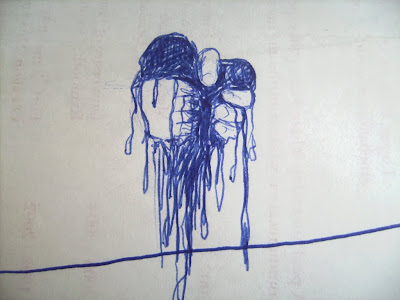
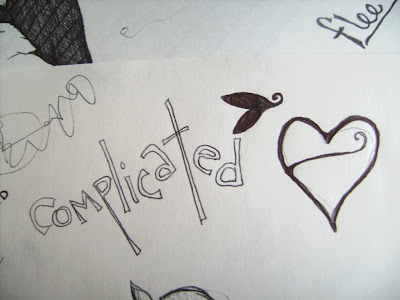
the other thing is hearts. easy. iconic. a little bit evocative... and also really cliché. but I found so many hearts, and so many different ideas connected to them, I decided to make a collection. here's one of the fifty-two:
complicated.
fifty-two hearts, carved out of the pages and pages of no-longer-blank paper that fill a couple of manila folders in a box in my closet, photographed and plastered upon the internet. I wonder what else I could do with them. none of them match. they all seem to come from separate pieces of myself. how strangely ironic.


{ for the record, I catalog my sketches according to the size of paper they are sketched on. the largest ones at the bottom, the tiniest ones paper-clipped in bunches at the top. }

Tuesday, April 18

april snowstorms

it snowed today. made me miss the nearing spring.

there are three weeks left.

and I know things must end. (I think the reasons have to do with patience.)
I wonder why we can't get perfect recall.

anyway: the following are excerpts from my spring break journal entries, one month ago. I wanted to post them to commemorate good times with good friends. they all took photographs, but my memory is ink.

3/16 [after hiking Angels Landing in Zion National Park]
sitting around a fire, wonderfully, thoroughly sore. tense.
knackered. today was hard.

so tired. so cold and tired. but accomplished.
more familiar. more.
3/17 [evening, after hiking Echo Canyon in the late March snow]
the last day. melancholy glory -- good weather.
one last blaze of a bonfire, ashes of the moments we know we can't keep.
hymns. soft.

nothing you can write down. nothing the same as the feeling of now with friends and endings.

the ambivalence is so thick you float on it, hazy and dreaming.
soaking it in.
pulling all the threads of experience and knotting them around your memory so you won't forget it.

but no matter the adverbs -- no matter the photographs -- holes will get in and blur it all.
and you'll only be able to picture bits: the amalgamation of sensations and thoughts and emotions. not the one-thing-at-a-time intensity of the climb.
the climb over
in the snow and sandstone
your hands on rock and chain,
your body supported by gravity and friction.
your wet jeans. your scraped knuckles. your uncertainty and your persistence hovering around your aching shoulders like angels.
And the marvelous:
marvel at the capacity of your self. weakness and ability so mixed.
marvel at the laws of nature that created this place, this hole in the earth, this color in the rock.
and marvel at your fellows. the way they climb ahead. the way they climb beside you.
marvelous.
3/18 [on the way home, after breaking camp.]
slept perfectly. woke up and packed. drove away just as the rain swept through the canyon.
and now I can feel real life pushing its fingers through the thinning boundary of my vacation. assignments. responsibilities.

don't be afraid.
I need to do that all again someday.
and savor the joy.

Thursday, March 23

bring it

last post i mentioned something about interest being one of those weird human things, less of a quality and more of a relationship. because where you have one thing and another thing, there's always some kind of relationship, even if it's distant.

where do those relationships come from?

do the molecules just bump into each other and randomly stick? is it some weird potential keneticism that we can't control, an invisible chemistry? a coincidence that me and you or he and she got from strangers to dearest friends?

hm. but it doesn't just happen. i mean, it can... but real meaning is only a result of effort. meaning must be made. we humans pull it out of our ears if we have to. but it's more fun to pull it out of the stars. out of each other. out of the earth. out of the library. wherever.

and naturally things just don't pull themselves out of the stars. there's got to be someone doing the pulling. the reaching up. reaching out. reaching.

who is it? who are you? what do you want?

more importantly, what do you have?

there are too many holes in you to spend time worrying about. instead, worry about what you do have. and bring whatever that is with you when you leave the house. bring it with you when you reach up. bring it with you when you're pulling things out of your ear. without it, what are you?

nothing. an empty hole in the universe. right?

maybe not. there is a reason words like inherent and intrinsic exist.

but if we take a deconstructionist view today, you and your opinions and your knowledge can all be sliced up and torn apart. you and everything that describes you or defines you can be carefully separated until all your qualities have become autonomous, independent, and instead of thoroughly possessing those qualities you will be only related to them, however closely.

okay, we needn't take that view. but it is interesting.

even stripped of all your you-ness you'd still probably exist. as much as a hole exists, anyway. the whole world is defined by boundaries: skin, dirt, atmosphere, infinity.

and so, you. whatever that means it's an important ingredient. without you, what is there? just all the other stuff. unrelated stuff. uninteresting stuff. (relatively, of course)

okay, what is the point i'm trying to make here?

well, it's something i'm only beginning to understand. it's a cogito, ergo sum sort of idea, a tree falling in a forest sort of idea... only of course the forest is there and of course the tree makes noise... but your being there--that matters. not to the existence of the forest, but to the interest of it.

and this goes back to the hi-resolution experience idea. if you're only distantly related to that tree in the forest, say you only read about it once in your high school geography book, then it isn't that interesting to you.

so interest isn't just up to the bank. you have to bring your money in first.
it isn't just up to the stars. you have to go out and look up and bring your heart with you first.