Showing posts with label technology. Show all posts

Saturday, June 29

favorite conference

last week, my time was taken up by another academic conference.

I presented on semi-academic podcasts and how awesomely they seem to cultivate discussions about scholarly things for the consumption (and perhaps participation) of non-scholarly audiences. such a thing seems pretty rare, but maybe it's less rare than I'm making it out to be. after all, 

“Podcasting’s bridging of knowledge barriers in an intimate manner is one of its key, and most readily apparent, properties. Thanks to the medium’s wide accessibility— given its general affordability and portability— knowledge in diverse domains can be shared by individuals and groups around the world. Thanks, as well, to their intimate, personal and often-conversational natures, podcast episodes can help individuals of different educational levels cross disciplinary boundaries easily. Audience members need not be enrolled in an educational system in order reap their benefits” (Swiatek, 2018, p. 177-178).​

how's that for a minimalist literature review, eh? Swiatek's chapter is in the collection I used as a textbook for my introductory podcast course last year. good stuff.

bridging knowledge barriers can happen across all kinds of lines, not just those of formal higher education, of course. academia is only one of many domains of learning. 

but for my presentation, I concocted a fairly narrow set of criteria for the four examples I showcased. to fit in properly with what I wanted to talk about, the podcast needed to be...

- officially made by/with credentialed, institutionally-affiliated academics ​
- making use of the ethos and/or expertise of their degrees at least a little
- purposefully talking to and/or translating for non-academic audiences ​to some extent

I also limited my examples to humanities/communication-y topics, because that's my discipline, and a 15-minute conference talk cannot be much more comprehensive than that anyway. I am curious to look at other podcasts in this vein though. eventually. Huberman Labs would count. and probably plenty of others I haven't heard of yet.

my observation, as a fairly high level podcast fangirl, has been that most scholarly podcasts don't bother talking beyond their own discipline, much less beyond the academy in general. in a sense, that might be what "scholarly" means-- by, for, and of scholars. but I also knew of a few counter-examples. a few podcasts that managed to feel more openly, accessibly, publicly academic.

for this little starting-place of a conference talk, I looked at these four: Material Girls; Lingthusiasm; Think Fast, Talk Smart; and Professors Play

according to my proposal for the event, I wanted "to highlight these as particularly valuable examples of public scholars demonstrating from the ivory tower how playfulness, connection, and personality are key ingredients for learning, teaching, and thriving as 21st-century humans."

want to see my little digital handout with transcribed bits from each show? there's a link to my slides from there too, which in turn have a few painstakingly chosen, hopefully entertaining-ish, audio clips. 

it is perhaps silly to turn my little presentation from last week into a blog post here, but (now that I'm halfway through doing it anyway) it does seem to match the spirit of my whole point— academia doesn't need to keep all of its cool conversations to itself.

on top of making that point, my other goal with the talk was to have fun introducing whoever showed up at my 11:00am panel to a few very engaging podcasts. I called it "Public Scholarship as Playful Pedagogy," but the title easily could've been shuffled into “Playful Scholarship as Public Pedagogy”— I'm still not sure which sounds better. the lines between all these things are fairly slippery at the best of times.

the lofty version of my whole argument is something like this: podcasts are conversations, usually quite public ones that can shape the cultures and communities of the world we live in. sometimes they even create new communities, which in turn have their own world-shaping power. so it matters who gets to be part of the conversation. it matters how the conversations are designed. 


Computers & Writing is one of the best conferences. next year it'll be in Athens, Georgia. will I get to be there and keep talking about podcasts as scholarship or pedagogy or public pedagogical artifacts or anything like that? we shall see.

Friday, September 8

once and future risks

opening match #7: 7th Sea 2e vs. Cyberpunk RED

this one is quite the contrast, isn't it? I almost can't get over how strikingly different these games are. we have one all about heroism and romantic adventures on the wide open seas, where explorers will risk their lives for honor and glory to stand bravely against the shadowy villains of a preindustrial, magical world. and then the other, a game of cybertech and surveillance and hacking and drugs and shady alleyway deals, set in perhaps the most hectic, grimy, yet also sparkly version of the future, where a bunch of tortured, damaged antiheroes emerge from however much generational trauma you want to imagine, just trying to make it through the night under the echoing buzz of a corp-ruined, crime-ridden, chaos-loving city. 

while I didn't have any prior experience with any Cyberpunk RPG before this, there is plenty of cyberpunk-ish content in the world that I have seen. a handful of Gibson novels, of course. various hacker shows and hacker characters. Mr. Robot, Altered Carbon, (still need to finish watching both of those series, someday.) and even The Matrix films in their way. on top of such general pop culture exposure, I've played a little Shadowrun (more about that in the final opening match, soon-ish), and I watched husband Jeremiah playing Cyberpunk 2077 once upon a time, but none of that counts as playing the RPG of Cyberpunk RED. this one was totally new. 

7th Sea, in contrast, is a game I've got some experience with. not a ton, but some. and while we're diving into relevantly themed pop culture, surely I have ingested even more swashbuckling-esque content than I have cyberpunk, since it is often more "mainstream," we might say. all those charming Johnny Depp movies about pirates. The Mask of Zorro. Casanova. Master and Commander. The Princess Bride, even. practically any good classic adventure movie could fit the bill, from Indiana Jones to The Mummy. I'd even count the tv show Firefly, at a stretch. (and could this reenactment gun show festival thing count too, somehow?)

for this penultimate opening round, I've yet again used a similar outline of sorts: quick table of metadata, summaries of prior characters and experience with each system, new characters, then thoughts on their aesthetics, mechanics, and approachability. as I write and revise this post, I'm still deciding which way my preliminary verdicts will lean.

SYSTEM     7th Sea
Cyberpunk RED           
tagline =          
"The roleplaying game of swashbuckling and intrigue."
"The roleplaying game of the dark future."
publisher =
John Wick Presents / Chaosium Inc.
R. Talsorian Games
pub. date =
2016
2020
original cost =
$59.99 $60.00
length =
9 chapters / 304 pages
14 major sections / 456 pages
my exp. level =              
some 
none prior


previous characters + pop culture and such

our online gaming group began a grand swashbuckling 7th Sea adventure somewhere in the murky months of 2020, in which I played the young totally-not-Scottish scholar Effie McIntyre. we sailed from totally-not-Great-Britain all the way to totally-not-the-Caribbean and started exploring some spooky ruins. our storyteller wasn't loving it though, so we switched back to D&D after a bit. 

Effie and her compatriots were fun while they lasted though-- we all sailed out from the troubled Highland Marches on the Righ Eileen, a merchant brigantine captained by Effie's uncle, crewed by a trio of cousins and other NPCs. Effie's brother (Baltair-- played by dear Jeremiah) served as first mate. I remember encounters at sea and along the coasts of the pirate-ruled Atabean Islands. there was vengeance afoot, and secret societies, precious ancient artifacts and supernatural skullduggery.

some years later, we got another 7th Sea game going, this time set more firmly on the continent of Théah and its various totally-not-European nation states. for this one, friend Chris and I created and roleplayed a pair of noble cousins from Castille (i.e. totally-not-Spain)-- Zetallia Fierro Greca de Tomas de Rioja y Carleon (yes I stole her first name from Catherine Zeta-Jones because of Zorro, so what?!) and Baltasar Cabello de Carlos-Miguel de Monte Ciervo (known to and loved by his close friends as Baz). the third in our trio was a mysterious Vodacce (i.e. totally not Italian) woman called Andolina di Amati, Lina for short, played marvelously by friend Alyssa. 

same friend Alyssa happened upon and recommended to us a neat little 7th Sea podcast about the time we were getting the game started, and I jumped into that wholeheartedly. it's not live-streamed/raw-footage play like the Critical Role folks do, but for me the editing and shorter episodes make it far more digestible and enjoyable. do check it out if you like pirates and fabulous voice acting. 

our adventures with Zeta and Baz and Lina only featured a few teaspoons of pirates, relatively speaking. but what a range of adventures we did have! lavish feasts with drinking and dancing in the old castles of the Glamour Isles, deadly intrigue in the dirty streets of Carleon, voyages alongside selkies, and desperate fighting against monsters, inquisitors, and worse. somewhere inbetween all the adventure, Zetallia was given a holy vision of Theus and chosen as a prophet. I wrote a little bit about her reactions to that, and her feelings about home and family and priorities, over here.


new characters

my new 7th Sea character for this tournament is a duelist from the heart of the totally-not-France country of Montaigne. I named her Irène Valois; she is a tall, toned, somewhat vain woman-- a skilled fighter with frizzy dark hair and deeply olive skin. having been raised with all the privilege her noble family could provide, she has trained hard to become a Musketeer, to protect and serve the capital city of Charouse. she also nurtures two competing dreams: to venture east and hunt monsters in the deadly Lock-Horn Woods, or-- perhaps the safer path?-- to join the highly selective Lightning Guard and keep even the mere shadows of any revolutionary assassins far away from l'Empereur's chambers. when she has a night off duty, she loves to spend much of it looking up at the stars.

for Cyberpunk, I made two new imaginary protagonists: Cortessa the lonely, moody Tech and Jaq the brash, vengeful Netrunner. any romance they come with is surely of a very different texture than the classic swords and sorcery of 7th Sea.

Cortessa also goes by Cortex or Tex in their closer circles. I imagine them like an incredibly androgynous mix of Benedict Cumberbatch and Tilda Swinton-- curly, silvery mohawked hair, pale skin with grease stains up to the elbows. as a Tech, Cortessa tinkers and breaks and fixes and builds stuff with bits and wires, hardware and software and cyberware, scraping by as a freelancer and hoping someday to move out of the dingy streets into an actually nice, actually safe apartment somewhere in a corp arcology. will such dreams ever come true? hard to say. even if they do, they might not be as dreamy as anyone hopes.

Jaq "the jungle queen" Aranda is the Netrunner character I decided to play in our very awesome one-shot two Fridays back. she's from the streets too, but not quite so whiny or desperate about it. she is tough. or at least she looks tough enough that it amounts to the same thing.

a photo of a half-colored sketch, in ballpoint ink, sharpie, and highlighter. she's got spiky blue/purple hair, pink sequined overalls, and a chunky gold leather belt
{ a sloppy sketch of Jaq }

Jaq's only ambition is to get by one day at a time and brutally punish anyone who gets in her way. for the last several months she's been tracking down the rotten Arasaka execs who must have been behind the kidnapping of her family and the death of her 4-year-old daughter. she's going to make the corp let the survivors go or she's going to burn it all down.

our one-shot was quite an enjoyable rollercoaster of violence, hacking, stealth, and playing dress-up. it was great. maybe we will write some spin-off short stories someday.

aesthetics

Cyberpunk RED evokes all the slick and glitchy neon you might expect. crazy punk hairstyles. strobe lights. mirror shades. implants and biotech of all shapes. plus a ton of cutting-edge slang, of course. the single best word to describe Cyberpunk is 'attitude.' and we must acknowledge that attitude can never just be a regular, innocuous noun. there is far too much connotation in it now-- it is a word bursting at its seams with tension, negativity, and conflict. that vibe infuses the whole setting of Cyberpunk, setting the stage for some pretty intense stories.

and 'intense' is another good word for Cyberpunk. it is loud. bold. unabashed. aggressively nonchalant. the book itself blends the look of graffiti and old-school monospace computer console typography. there is heavy use of all-caps and small-caps and drop-caps. the setting and the system also seems to be a bit of a catch-all-- this rebooted cyberworld is to Gibson and sci-fi as D&D's ever-expanding world is to Tolkien and fantasy. from its first pages the book takes up a very "choose your own adventure" kind of layout; all the thumbnailed cross-references in the intro chapter want to be hypertext. they want you to click on them and be whisked to the right page.

every little thing has a place here in this overcrowded futuristic hive. but it feels chaotic anyway. there's too much. it will burst into dark and senseless violence at any moment. I'm seeing Cyberpunk RED as a flashier, more disco, more in-your-face version of World of Darkness. of course, it's more high-tech and futuristic, too. there's not much hope, not much safety or goodness-- just survival.

7th Sea may dabble in chaos and darkness, but it's not the senseless kind. it's a dramatic, sweeping, perfectly orchestrated sort of chaos. like the perfect long-take chase scene across a crowded ballroom. there may be villains and darkness in these stories, but none of it stands a chance against our heroes. I was describing this game to a friend last week as "Zorro + Pirates of the Caribbean + a handful of stereotypical renaissance faires" and I think that conjures plenty of the right vibes: swords. ships. lots of nautical imagery strewn about. maps and compasses. coastlines and courtiers and caped crusaders. many fancy costumes, masques, intriguing magical trinkets, and maybe a few fairy wings if you're lucky.

rich shades of brown and sepia, with touches of copper here and there, all keep the relatively simple book design feeling cohesive and authoritative. chapter headings are in nice big loopy, swishy handwritten type. the art is glowing and neat-- almost-but-not-quite like a bunch of actual portraits from the actual 17th century. it's all more like snapshots than portraits: candid moments of drama and danger, a dash of the mystical here and sprinkles of the mythical there, all laid out to evoke vast possibilities for exploration and adventure.

photo of the chapter 3 art from 7th Sea: two figures dueling against a backdrop of a palace room on fire
{ photo of one of 7th Sea's chapter spreads }
 

mechanics

character creation for 7th Sea is fairly involved, but really fun at the same time. there are no templates or sample quick-builds or other shortcuts. instead, the book invites you to start with a concept: a national origin and a shred of personality, and then build from there using a full 20 questions about their backstory, psychology, and connections in the world. from this deeply creative foundation, only then do you move on to choosing Traits and Skills, Advantages, Quirks, a virtue and a hubris, etc. characters are pretty customizable despite the relatively simple set-up of 5 Traits and 16 Skills. the range of backgrounds and advantages to choose from feels just about right-- not so many that it's overwhelming, and not so few that it's boring.

part of the variety comes from the setting itself. there are 10 nations your character might call home-- from the island nations of Avalon and Inismore to Vestenmennavenjar in the far north and Vodacce off to the south-- each one roughly based on some actual part of 17th-century Europe, but far more mystical and far less racist and misogynist, thank goodness. each nation has a few exclusive backgrounds and a few favored advantages, too.

7th Sea uses all d10s, which is familiar enough to us at this point-- 8 of the 12 systems I've reviewed so far do. but in this system they do not work the way dice work in most other RPGs. rather than simply adding up numbers and comparing them against some kind of difficulty level, a player in 7th Sea will roll their handful of d10s (based on ranks in a given Trait + Skill + any bonus dice) and then tally up how many sets of at least 10 can be made from the results. each set of 10 is called a Raise, and that's the important number. bonus dice can come from all kinds of places-- using one of your advantages, spending your own Hero Points, enacting a virtue or a hubris or a quirk, or in receiving help from other characters.

depending on where your story is at, you'll roll dice for either a free-flowing Dramatic Scene or for a more structured Action Scene. each character in the scene will have so many Raises to use to effect change. narrative control for Dramatic Scenes is shared however it makes sense. for Action Scenes, it starts with whoever has the most Raises, then in descending order. how you spend those Raises depends on how your character views the scene, its risks and consequences, opportunities, etc.your traits and skills will guide your approach to any given situation, but the system rewards narrative prowess more than it rewards having a lot of dice to roll (though of course more dice = more Raises = more potential for showing off your narrative prowess). the idea is to spur creative, narrative storytelling and build a dynamic, collaborative epic of your own. maybe it's also less math? or maybe it's just different math. 

over multiple sessions, character advancement happens in lockstep with the narrative-- each character is writing their own story, outlined in smaller "story steps." accomplishing all the steps in your story will let you level-up a Trait or a Skill related to it. Zeta's first story involved finding a mentor to teach her a bit of dueling. once she did, her Skill in Weaponry went up from 1 to 2. 

mechanically, that's pretty much all there is to playing 7th Sea: roll, count up your Raises, and tell a cool story. all the rest is true roleplaying.

-

Cyberpunk RED is also all about the d10, though some d6s show up here and there. we have three options for building a character in this system: one fully custom/from-scratch process and two shortcuts or character templates, which are quite nice as scaffolding, because holy cow there are a lot of aspects to consider. to start, you choose your character's Role, and most things follow from that first decision. there are 10 Roles altogether, from Rockerboy to Nomad (and who on earth knows why they are in the order they are in-- Rockerboy, Solo, Netrunner, Tech, Medtech, Media, Exec, Lawman, Fixer, Nomad-- it's not alphabetical and I can't quite suss out any other organizing principle. is it pure random chaos? who knows). there are nifty flowcharts and tables to help you build your character concept from basically nothing but vibes: pick a Role > Run your Lifepath > Buy your Stats > and so on. it's a pretty fun process too, but does drag on a bit. some of it reminded me of the Wrath & Glory system, where you can choose and archetype and build from there. 

thankfully all the flowcharts and template options make it a little easier to make decisions about all the rest. on top of the 10 different Roles, there are 10 key Stats and like an impossible number of Skills. 30? 40? I don't even want to go count them all again, it's so many!

gameplay proper is a bit more straightforward overall, though there can be plenty going on if you've picked up lots of gear, fancy cyberware, or lots of hacking abilities. each specific Role comes with a key Role Ability. for my Netrunner, Jaq, it was the Interface ability. she starts at rank 4, which unlocks a certain number of sneaky, hacker-y "Net actions" (in contrast to "Meat actions," which are normal actions anyone can take in meatspace). Jaq has a cyberdeck with 7 programs installed-- some offensive and some defensive. in our too-short 3-hour one-shot, she used them to divert power from her sketchy landlord's defense systems, infiltrate a hospital's records and surveillance cameras, and switch a stolen helicopter into autopilot for a while. super cool. 

hacking aside, the basic mechanics of gameplay involve taking your base rating for each skill (the relevant stat plus your skill level) and then adding the result of a d10 roll. rolling a 10 is a critical success, meaning you can re-roll that d10 and add that result to your total. if you roll a 1, that's a critical failure. same deal, but in reverse-- you'll re-roll the d10 and subtract it from the total result. depending on your character build, and how lucky they are, you'll also get a pool of Luck points that you can spend to add, 1 per point, to your result.

specific stats for weapons and armor and other equipment may add bonuses or change the damage for some actions-- those are the trickier things to keep track of along the way (though no tricker than weapons or spell slots and such in D&D, really).


approachability

I mentioned the "choose your own adventure" layout of Cyberpunk earlier. in some ways, that makes navigating the many many sections and options in the book a fairly flexible process, provided you're paying attention to those cross references and the other wayfinding signals in the margins. I didn't always see or properly parse those things until I'd already flipped through three other sections looking for the information I needed. the order of things is a little confusing at times, so I'm glad the writers put some good thought into breaking it down and signalling where to turn. the book does work hard to make itself accessible in plenty of different ways for players with different levels of familiarity. does it always succeed? I think that depends on how each reader's brain works.

{ photo of the margin thumbnail cross-references in the Cyberpunk RED book}

with so many options for character builds, this can feel like a complex system. but much of the complexity is front-loaded, so once you get yourself set up the game itself can be pretty straightforward. basic dice, basic math, lots of fun. my view of this may be a tad skewed, given that our one-shot barely gave us a chance to get used to how our weapons and damage and health points all worked, but so it goes. 

-

7th Sea has its own intricacies, but you can take your time uncovering them as you play. the 20 questions character creation is the most in-depth part of the set-up. with the core book, you've got everything you need in a relatively simple, readable layout. it's a fairly different system, but I'd hardly call it intimidating. it invites a fairly hardcore style of roleplaying and collaborative storytelling, which may not be for everyone. but still, everyone is invited.

if in comparison to other RPGs, 7th Sea seems more difficult or unwieldy as a system, I'm gonna put that down to a general oversaturation in gaming culture of d20 systems like D&D. the abundance of information out there on those systems doesn't inherently make d20 systems easier or more accessible-- it just facilitates an invitational feedback loop of "hey most people are playing these kinds of games, so maybe I'll join the party," on repeat. based on that, D&D may seem easier for most people, and it may in fact be experienced as easier, but mostly for structural reasons rather than game-design reasons (here I'm gonna attempt to cite this scholar on twitter who has made similar arguments somewhere in her feed but I cannot find the exact specific posts).

I suppose it may or may not be useful to talk about structural access vs. inherent access in my review here. but I wanted to mention it. this game is beautiful and it is well-loved and it can be awesome for players who really gel with the roleplaying style. the game seems especially designed for folks who love the voices and the improv and the in-the-moment seeing what a character will do, taking time for describing actions and faces and lines of conversation, reveling in those dramatic moments. it is different from the more broad-strokes, action-for-action's-sake sorts of RPGs in the world, and that means it might require some significant mindset adjustments for players who aren't used to it or who are expecting more quantitative dice-rolling momentum.
 

preliminary verdicts

it's almost hard to imagine more heightened contrast between any two games. no other match thus far has captured such extremely and intensely different worlds and different vibes. 

my 7th Sea experiences have been complicated a bit by interpersonal ups and downs, while my Cyberpunk adventures seem minuscule and rushed in comparison. how to choose? 

there is a sense in which the roleplaying style of 7th Sea is almost-but-not-quite as intimidating and discomfiting to me as the huge, superpowered contexts of Scion and Exalted. its invitation to creative flair within a simple matrix of approaches and dice hasn't totally gripped me as a roleplayer. and yet its setting is intensely alluring. 7th Sea is all the thrilling legends from all my favorite old stories. I think my heart wants this one to win out, even against the attention-grabbing silver chrome neon styles of Cyberpunk, just for the romance of it.

next match-up review: Shadowrun 5e vs A Song of Ice and Fire

Wednesday, June 29

sound/less bubbles

a not-so-random memory: 

my first boyfriend, the redhead, putting a pair of earphones in my ears and pushing play on a Smashing Pumpkins song while we just lay there. it's the best, he said. having music right in your ears while you just zone out, your brain totally wrapped up in the sounds.

it's weird now to think of what a novelty cheap earphones were in 2004. for me. him. us. what a novelty having a boyfriend was, too, then.

and what a blip mp3-players were, eh? I never actually had one, unless you count an iPod touch as an mp3 player. but those things seem too internet-enabled and multifeatured to count, I think. 
 
recently I put a bunch of actual mp3 files onto my current phone. I like having a little pocketful of Imogen Heap and Jason Mraz and Death Cab for Cutie to carry around.
 
I must confess though, music doesn't effect me the way it seems to effect others. my brain treats it like wallpaper, most of the time. sometimes rather loud, ugly wallpaper and sometimes quite lovely, attractive wallpaper... but more often just there, on the walls, in the background, drawing very little attention to itself unless the lyrics are particularly striking.
 
falling asleep to white noise of some sort is one thing, but having my brain all wrapped up in any given sound... I don't always find that very pleasant. 
 
my sensitivity to sound seems to deepen the more I think about it. even with music piped directly into my ears, I can still hear the hum of the dishwasher and/or the air conditioning and/or the PlayStation 4 (which has gotten particularly vociferous in its old age). when the neighbor's power tools and the traffic going by and dog park noise from across the way is all piling up around me, I hate this sensitivity. 
 
on the other hand, when little Hamilton is chewing on something he shouldn't be under the bed in the other room, it does come in handy to be able to hear the difference between pug teeth on a proper chew toy and pug teeth on a stolen ballpoint pen.
 
too much sound makes me edgy and irritable. so in pursuit of a world without so much irritation, I acquired a new set of fancy earphones today. they are the wireless bluetooth kind, and they come with two noise-canceling modes. I never thought I'd feel like I needed wireless earphones... but after lots of research and review-reading and consideration, these came out as the most effective and comfortable option.

will they trap me further within a bubble of my own endlessly unvoiced thoughts? I hope not entirely.
 
also I still think someone definitely needs to write about how headphones have done for music what widespread literacy and silent reading practices have done for books-- i.e. make them very private, internal experiences instead of communally shared ones. though perhaps someone somewhere already has and their article is just not on my radar yet.

Friday, July 31

completely, partially

my latest LibriVox contribution-- The City of Din, by Dan McKenzie-- surprisingly made its final journey through the prooflistening stage rather quickly this week, and I am pleased to announce that it's been officially catalogued here for all the world to enjoy if they so desire.

the most unique part of this audiobook is that our pug Wesley has a role in it. in the middle of section 2, Mr. McKenzie is discussing whether to categorize dogs as noisy or not, and he re-enacts the inner monologue of a man trying to sleep while a dog barks somewhere out in the neighborhood. rather than boringly intoning the word "bark" myself, I conveniently captured some of Wesley's insistent barks and used those instead. it took a lot of editing work, but I think it was worth it.

LibriVox relies on the Internet Archive for the bulk of its hosting needs. everything on that LibriVox.org page I linked to above is really pulled in from Internet Archive, where it's all displayed a little differently.

the Internet Archive is undeniably awesome. you probably agree, right? I hope so.

unfortunately the organization is dealing with a pretty awful lawsuit at the moment, one that has some terrible implications. this thread from author Cory Doctorow goes over the issues concisely and forcefully. there's been quite a lot of talk about the lawsuit all over twitter, lately. I very much hope that these greedy print publishers don't succeed in wrecking the Internet Archive's plans for facilitating free circulation of digital books. what an awful world it would be if we had to pay greedy corporations for even the most temporary access to any of media at all.

in all my researching and theorizing about the Internet Archive and similar projects, I've more regularly thought of it as what it has named itself-- an archive. a collection. a carefully stored pile of carefully gathered and curated and digitally infrastructured content. 

libraries are that, too. what's the real difference between a library and an archive? well, some archives are a little more closed-off to the public, but other than that, nothing. they are both, like so much else we humans are about, places to keep things.

sometimes I also think about these digital archives as communities, too. they are collections of things--artifacts, manuscripts, whatever... but those collections of things don't just happen without people. that's what my dissertation was all about: people working together to build archives by building tools that help them build and maintain and expand the archives. LibriVox is a really cool example of that.

smudgy pastels and ballpoint on cerealbox cardboard. "see yourself" "do the work"

I have gotten to know some of the other people who work with LibriVox, a tiny bit. some of them I feel like I know from studying the history of the site and listening to all of the old podcast episodes. some I have interacted with more closely on various projects. it would be fun to meet some of them someday, as I've done with other internet friends. who knows if that will happen or not.

two years ago I read the closing sections of this L. Frank Baum story, Phoebe Daring. the project had been initially started on LibriVox in 2015 as a solo, by a reader who worked on dozens and dozens of LibriVox projects but died before she could finish this one. when the community learned what had happened, they opened her project up and ten of us completed the recording and prooflistening work for it.

thinking about that makes me wonder what I'll leave unfinished. who will finish it. ideally I'll have several decades to keep thinking about that question.


this week, as I approached the end of this month of blogging, I kept coming back to the concept of ...well, I guess of incompleteness. but that word feels overly negative. what I was really thinking of were partly-complete things. partly-done, partly-finished. parts. partialities. my mind has been more or less fascinated lately by the idea of everything always being partial.

in some sense, that can be a negative thing. the partial nature of so much can leave me so unsatisfied. so paradoxically full of what isn't there or what I haven't collected.

in another sense it's comforting. there's still more. it isn't over yet. we have some space to add and grow and keep going. that's the side my wondering wants to be on the most.

July, however, will be complete after today. utterly in the past, over, done, gone, irretrievable. and my month of blogging will be, too. that, at least, is something finished. how I'll look back on everything I've posted in another year, or five years, who knows? but from here, it's done. perfect enough because that's what we (the royal we) decide to call it from this precious, precarious vantage point of now.

Were you thinking that those were the words, those upright lines?
those curves, angles, dots?
No, those are not the words, the substantial words are in the
ground and sea,
They are in the air, they are in you.

Monday, July 27

editing work and so-called "educational technologies"

it's not the most important volunteer gig in the world, but I am on the official Board of Copy Editors for a scholarly journal in the field of social work.

see? (I still need to have them update my institutional affiliation, I know. soon.)

the article I'm editing now is about perceptions of social work and advocacy organizations in Ireland. it's pretty interesting. part of the fun of this position is getting to dip my brain into current scholarship from another field, from lots of other perspectives. one of the pieces I previously edited was all about volunteerism-- something not unrelated to my own scholarship.

today I've been combing through this forthcoming article's reference list, checking for completeness and formatting. like most social science journals, this one uses APA style, which I'm thankfully pretty familiar with.

my editing process can be a little haphazard for a project like this. but generally it follows these broad strokes:

1. read through the piece once and make notes about persistent issues or anything else that stands out, tidying up a few of the easy things (commas, spelling, other punctuation) along the way
2. check that everything listed in the references is actually cited in the text, and vice versa (this is something I learned from Dr. Hawkins as part of her teaching in Bibliography & Research Methods many years ago)
3. attend to citation formatting (all the periods in the right spots, capitalization as APA dictates, and so on)
4. make sure all the headings and subheadings are styled properly (and I'd usually check tables and figures here too, but this particular article doesn't have any)
5. draft a makeshift style sheet for any judgement calls I get to make about hyphenation or capitalization of terms (these are always really informal sticky-note things, if that)
6. go through again, adding queries for the author where needed, making decisions and changes for the major issues previously noted, watching for consistency and fluency at the word- and sentence-level.
7. spot check one last time for the things on the style sheet, review the queries and comments to make sure they make sense, and then send the whole thing off after appending my initials to the filename.

if it's work for hire, I'll prep an invoice and send that along with my edits. I've done a huge amount of editing for hire this summer, it seems like. dissertation proposals, articles about orthodontics, computer graphics, and GPS, and even several book chapters about analytic software programs. but for this particular job I'm only getting paid in collegial respect and academic clout. it makes a nice line on my CV and boosts my ethos as a person with practical, ongoing experience editing. plus, I enjoy it.

there's about a day or two more of work left on the piece. the references and headings are sorted, so all that's left, roughly, are steps 5 through 7. from this point on, I shouldn't need to keep opening and closing the section on APA style at the Purdue OWL. it's down to the less tedious part of the job now. I could, I know, be a lot more meticulous about how I approach the work and how I track the time I spend on it. for now, this is what works for me.

the tedium of citation-tidying, I'll add, is pretty pleasant tedium. actually one of my favourite things about editing scholarly work like this is replacing all the default hyphens with en-dashes in all the page ranges of the references that have them. APA doesn't strictly care about that detail, but the beautiful differences between hyphens and dashes were irrevocably drilled into me back when I worked with the more comprehensive Chicago style at Texas Tech University Press.

style guides like Chicago and APA and resources like the OWL that grow up around them all count as educational technology, don't they? sure, the term is burdened with connotations of electronics, computers, digital connectivity, and such, but books are technologies too. I'd count these guides' paper-based versions as technologies just as much as I'd count their websites at https://www.chicagomanualofstyle.org/home.html and https://apastyle.apa.org/.

the Purdue OWL has always been a website, though its offline home, the regular Purdue Writing Lab, predates it by almost twenty years.

educational technologies. any technology that serves a process of education, right? well, one would hope.

about a year and a half ago, the dear Purdue OWL entered into a partnership with a purveyor of so-called educational technologies called Chegg. shortly thereafter, citation generator banners appeared all over every page of the OWL, offering quick and easy auto-citations in MLA or APA style. I reacted with great disappointment and irritation at the time. and so did plenty of other people.

since then, the powers-that-be over at the OWL have toned it down a bit. the citation generation tools are still there, but not on every single page. still, it feels odd. one tool, the OWL, gives students valuable reference information and examples and helps them learn to apply that knowledge in their writing. the other just black-boxes it all away and says, more or less, "trust us, we'll handle it, you don't have to think too hard. or at all."

I guess there are probably times when not having to think too hard about some process or technology is perfectly okay, but in academia? it seems thoroughly wrong. this kind of thing doesn't really serve education. does it?

such over-reliance on technology goes beyond students, too. a related "educational technology" here is plagiarism-detection software like Turnitin and other such tools. these companies give lip service to academic integrity and education, but their true goal is profit. they're invested in manufacturing some kind of vague ethical crisis so they can sell software subscriptions.

using software to catch students "cheating" is not education. it's barely relevant to education by any stretch of the imagination. and if you have to rely on such tools to figure out if your students are cheating on their writing assignments or not, then you haven't given your students or their writing enough of your attention, and you haven't designed very good writing assignments.

what has bugged me most about Turnitin and the like is the fact that it copies piles and piles of student work for its own databases and uses those copies as a core part of its function. and I suppose they think that because their terms of service say this is all perfectly fine to do, it is.

I say not. if students had any real choice in the matter, then maybe. but given the power dynamics of your typical college classroom, they don't. if their professor says upload your work via this tool, then students are more or less forced to do so, whether or not they care about the implications.

copyright is a whole mess in itself, but any logical understanding of intellectual property should acknowledge that students own their creative work, even within the relatively convoluted confines of formal education. for a third-party technology company to copy that work and profit from its application is pretty clearly unfair. unjust. messed up. all because some teachers are so worried about cheating they're willing to outsource part of their job to a for-profit company rather than design more robust assignments and trust their students half an inch.


for further reading:


Tuesday, July 7

thread count (1/1132)

the "twitter thread" as a genre fascinates me. I have so many curious questions about it. when was the first cohesive thread of posts created on twitter? who wrote it and about what?

threaded tweets are a reaction to the restrictions of the platform. it's like adapting the limited microblogging form to serve a longer form of writing. combining a handful of tiny posts into something bigger-- like building a tower out of toy blocks.

twitter added an official thread-making feature to its platform not that long ago. but threads (in the computer/internet sense) have been a thing for way longer than that. although etymonline doesn't mention this newer usage--perhaps it's too new-- in its word history of "thread," Merriam Webster does, interestingly. I guess regular dictionaries have a stronger incentive to keep up with the times than etymological dictionaries do.

I learned the internet meaning of thread on online bulletin boards, where a thread is an asynchronous conversation contained under a heading within a specific discussion forum. multiple people can post to a forum thread. everyone's replies are timestamped, linkable, quotable, reply-to-able, and it's all very organized.

a twitter thread is different. sure, the usual "any string of posts-and-replies" does technically constitute a twitter thread... but that's not really what anyone is talking about when they use "twitter thread" as a specific noun. any old string of posts and replies on twitter is more likely to be referred to as a conversation or an exchange. the connotation of "a thread" (often with an introductiony colon, like "a thread:") on twitter involves a string of posts written by a single author, on some focused topic, typically (but not always) within a short span of time. there can be replies, but they feel separate from the twitter thread itself.

so if we want to delineate the twitter thread genre, what are its requirements and hallmarks? and what are its conventions? every genre has conventions-- sometimes very strong ones. memos and emails should have subject lines, letters can have letterhead, and academic articles have references lists at the end. twitter threads have their own rules, too.

we expect a twitter thread to include at least three tweets linked together by topic, structure, and the platform's formatting. there are usually twice that many, if not more. sometimes there is a narrative feel to the thread, and other times it's more list-like. often the thread is announced and introduced as such in the first post, whether or not the ensuing thread is planned out or more off-the-cuff. at the end, especially if the thread has been shared repeatedly and garnered a lot of attention, the author may add a concluding postscript with a link to somewhere readers can donate or otherwise compensate the author's writing work in some way.

but the really interesting and evolving convention I want to talk about is the numbering. there are different ways to number the individual tweets in your twitter thread. in my experience, the numbers most often come at the end of each post, as in the following variations:
[content of tweet...] 1/12
[content of tweet...] (1/12)
(when the total number of tweets is known at the outset)

[content of tweet...] 1/
[content of tweet...] 1/x
[content of tweet...] (1)
(when the total number of eventual tweets is not known-- this mode seems more common)
I've been collecting twitter thread examples (a whole sixteen of them!) for a while now in anticipation of exploring these numbering conventions a bit more. the end-of-the-tweet positioning is the most common numbering style I've seen, overall. but it's not the only one. on rare occasion, the numbers may come first. plenty of threads don't including numbering at all.

so I have sixteen tabs-worth of twitter threads open next to this blogpost draft right now (I'll link them all at the bottom, pseudo-reference-list-style), and while such a random sample of course can't be truly representative of all the twitter threads that have been created in recent months, they at least give me the beginnings of some general insights into twitter thread numbering conventions.

my main finding? the convention of numbering the tweets in a thread on twitter is dying.

at the very least, it's become a marker of formality, more than a useful signal to readers about the order or length of the composition. numbers seem to be less important to a thread's legibility now that the twitter platform supports and displays threaded tweets so smoothly for most people.

I'm surprised by this, for some reason.

but of these sixteen example threads, only 4 include fully numbered tweets (3 at the end as shown above, and 1 at the beginning). another 10 forego numbering altogether, and 2 include numbering for content within the thread, but not as a marker for each separate tweet.

so there you have it. some really, really informally-gathered data about a quirky little internet genre.

it's interesting, right? it is to me. twitter is a culturally powerful and maddeningly ephemeral discursive space. how conventions emerge and spread and morph a little over time is fascinating in any genre or medium. looking at how it seems to be working on twitter helps me think of twitter as not so special. sure, it's different, but it's mostly made of humans just the same way email chains and academic journals are.

as promised, the twitter threads I referenced in this random exploration of mine, listed here in chronological order. I'll add a note that linking them here like this takes them out of context. they may or may not make as much sense from outside the constant/endless/fast-paced nature of twitter as experienced by those who spend too much time scrolling around within it.


Sunday, January 13

goodbye, facebookland

this week I deactivated my 15-year-old facebook account.

why?

many reasons. mainly, it's a new year, time for trying new things. facebook's role in my recent life has largely been a passive, bad-habit-esque waste of time, and I'm increasingly convinced that its recent roles in spreading terrible ideologies and misleading nonsense makes it problematic for anyone to continue supporting it at all.

so I want to live a year or so truly without it and see what happens. perhaps I'll have more time to write and blog and exercise and knit and make phone calls.

speaking of more time for blogging, over the past months I have been (as is usual) sifting through a dozen different ideas of what I might blog about, with new ideas poking at my brain every few days, too. there are podcasts to blog about, and the upcoming semester to blog about, and gardening plans to blog about. but when? I can't feasibly blog about everything all at once, sadly.

for now, I guess I'm blogging about facebook.

somewhere in the depths of all my old blog drafts, I've had a collection of notes sitting here, from a talk given by a facebook executive or employee of some sort. it was hosted in the student union at Purdue University, where I sat and took notes in the blogger app on my old phone.

here's me, kicking off my mild resolution to blog here more often in 2019, attempting to reconstitute and expand these old notes and snippets into something intelligible and interesting.

facebook's goal/mission/quest/thing has been, for as long as I've heard them talking about having one, is to connect the world.

is this a noble and valiant thing for facebook to be doing? does it seem like a mission that we should trust facebook with?

well, in any case, the speaker opened by stating facebook's mission. and then he spoke excitedly about new developments like live video, virtual reality, and artificial intelligences. oh and about how many new jobs facebook was creating every day. hurray for tech jobs.

he also, unaviodably, had to address issues of privacy and tracking, and he did touch on the ethics of selling users' data to marketers. I'm reminded now, several facebook privacy and ethics scandals later, of this twitter thread about ethics and technology:
Gorcenski writes in her informal critique there that there are no universal codes of ethics. ethics standards are always situated. they're constructed, imperfect, with plenty of ambiguity-- often just enough ambiguity to make companies and other institutions feel halfway okay about carrying out very questionable actions in the world.

from my notes, I see that most of my interest and my strongest reactions to this talk had to do with what the speaker said about facebook-as-governing agent. he shared his experience dealing with the many challenges of managing, filtering, and/or censoring public and semi-public online expression across national borders. he reminded us that facebook has employees and users all over the world. what's legal and appropriate in one country doesn't always match what's legal and appropriate in others. but somehow, facebook's own community standards have to make the whole world happy, to at least some extent.
in negotiating with governments about how to enforce or uphold various local standards, the speaker explained, facebook does as much as they can to push their own values. yes, there are tensions between how a borderless online community wants to function and how more traditional global powers want to run their more traditional, border-bound nations.

facebook, the speaker emphasized, tries to be an agent of empowerment. a platform for making invisible things visible. shining light into dark corners. facilitating new and more transparent conversations. changing the balance of power.

and then the speaker said something about facebook hopefully having a major role in someday establishing some kind of global online government. after that, according to my notes, I typed out this:

"eeeeek."

does the world want and need to be connected by a central online platform, really? is the capitalist interest that facebook has in being the medium by which everyone is connected anything we can trust?

I'll end this post with two more brief thoughts (the second of which is more of a gesture towards some other people's thoughts, really).

1. it is worth admitting explicitly that the phone-typed notes I took on this nameless facebook employee's presentation are at least three years old at this point. I wish I had included the fellow's name and title and the date of the talk and all that, but I did not. it is also worth admitting that I have not included every single thing I made notes on. what I have done is shape the more timeless bits into a satisfying order and fit them carefully into real sentences. in any case, I make no pretense that my reconstituted representation of the talk and its mood is fully accurate.

2. one of the many awesome podcasts I've listened to inbetween semesters has been ZigZag's end-of-season offering, "If Capitalism and Socialism Had a Baby." they interview Rufus Pollock, who wrote a book called Open Revolution (which you can read online in PDF form over here). I love the ZigZag podcast, and their whole second season was a carnival of great interrogations and important questions about technology and humans. go listen to it!

Thursday, August 9

cryptocurrency, female empowerment, + podcasts as technical communication

I am loving this podcast: https://zigzagpod.com/

especially this recent episode of listener stories and general reflection.

and especially Ms. Manoush Zamarodi's response in that episode (around the 19:01 mark) to a listener who wrote in to criticize the hosts' allegedly "acting like silly dumb girls." as she read his letter aloud, I waited, eagerly and impatiently hoping to hear a rebuttal pointing out just how sexist and short-sighted it is to code female laughter as automatically juvenile, thoughtless, idiotic, or stupid, or as some sort of coy, superficial act. Zamarodi is subtler than I think I would have been in her response, but she makes much the same point: there's not one single societally-approved way of sounding or acting intelligent.

she says, "we laugh because we know it's okay not to know everything, that this is a real-time exploration, an investigation into changes that are happening in tech and our culture. And you know what, we don't care if it's not a good look, because it's who we are, and I'm sorry if you find that tiresome. But I really do hope you will keep listening and get used to what strong, intelligent women sometimes sound like. We're being real. And maybe you just haven't heard women in such an up-close and transparent, authentic way before."

thank you for that, Manoush.

the whole podcast so far is wonderful stuff to listen to. people, real experiences, uncertainty, trying new things. plus you get to learn a little bit about blockchain technology and journalism and the future.

I got thinking the other day that this podcast, personal and documentary-ish though it may be, is a great example of technical communication.

podcasts-as-technical-communication is a preoccupation of mine generally, given my scholarly immersion in the later and my personal enjoyment of the former. I want to write more about ZigZag and tech comm someday, but I think that post needs more thinking time.

for now... what other podcasts could be counted (at least in some way) as technical communication? let us explore my subscription list of 30+ podcasts and see what else we find.

most obvious examples:

10-Minute Tech Comm
interviews with scholars and practitioners of technical communication. this makes it more meta, perhaps, but it still counts as sharing information about technical topics. (also--I was in an episode, did I mention that?)

RadioLab 
presenting science-y information and stories in creative narrative forms. definitely a form of public tech comm.

What Trump Can Teach us about Con Law
legal communication is arguably a more narrow sub-discipline than most, but law is very technical. Roman and Elizabeth break it down and make it relevant. that counts.

The Infinite Monkey Cageinformal, comedy-infused, very science-y discussion panels, with episodes based on a theme like space travel or the immune system. the show mixes informative with entertaining very well.


and then a few slightly less-obvious examples:

Lingthusiasm
there's a lot of technical, science-y stuff related to how we use language (mouths and tongues and air and frequencies, not to mention unicode and twitter). and though it's sort of hard to think of it as such, language is a technology in its own right. Gretchen and Lauren make all that technical stuff very fun. (sidenote, I kind of can't wait to read the book Gretchen is working on.)

Ways of Hearing
music and sound and how our bodies and technologies mediate those things. so much about this is inherently technical: see above.

The Sporkful
food and cooking = technologies. most of the time this little show is human-interest stories and entertainment, but Mr. Pashman gets pretty technical about all kinds of food things every so often. they even settle debates from listeners about the practical ethics of grocery store lines and free ice cream samples.

Succulent FAQ podcast
horticulture and plant science, even if discussed mainly in hobby-ist terms, count as technical topics, I say. this one is more how-to than any of my other examples, so that makes it especially similar to traditional tech comm.

others I can think of but don't subscribe to myself-- Planet Money, TED Radio Hour (and most TED talks in general), Song Exploder, StartUp, and Car Talk (even if it is all re-runs now).

I'm sure there are dozens more out there, ranging from specifically how-to-ish all the way up to generally educational in some way. can you help me think of more? feel free to add to the list.

Wednesday, February 28

deadly light

we searched out an audio-short-story with which to pass the time on our way to and from Chicago several weeks ago. it was "The Call of Cthulu," by H. P. Lovecraft, streamed on Spotify. it begins with a few lines that I've since thought about over and over again:
"The most merciful thing in the world, I think, is the inability of the human mind to correlate all its contents. We live on a placid island of ignorance in the midst of black seas of infinity, and it was not meant that we should voyage far. The sciences, each straining in its own direction, have hitherto harmed us little; but some day the piecing together of dissociated knowledge will open up such terrifying vistas of reality, and of our frightful position therein, that we shall either go mad from the revelation or flee from the deadly light into the peace and safety of a new dark age."

I've been writing (in what is shaping up to be chapter 2 of a sure-to-be-marvelous dissertation project) a little bit about what Lovecraft's narrator here describes as a terrible horror--the distant someday when knowledge from every possible corner of the world will finally be pieced together into a comprehensive whole. such a vision is what plenty of people seem to be working toward now. Wikipedia founder Jimmy Wales boasts that the the Wikipedia project will make it happen. The Internet Archive founder Brewster Kahle insists that such a thing is more than possible. in 1926 when "The Call of Cthulu" was written, I expect it didn't seem quite so possible.

despite all the fancy internet-connected technologies that make access to information so incredibly and amazingly simple compared to how past centuries must have done things, I do have rather many doubts about whether access to knowledge could really ever be comprehensive and universal. knowledge isn't quite the same as information, after all. and whether or not it'd be easy to gather up and store some version of all the knowledge any human has ever professed to know, what would that actually look like? and how would one actually interact with it? I have a feeling that human knowledge is so diffuse and multiple and embodied that it can't ever be summed, can't ever be so singular as to be stored in any static form. no matter how interdisciplinary things get, all the kinds of knowledges out there in the world will always be in some way dissociated.

but it is interesting to imagine it differently. to dream for a moment, with Wales and Kahle and Lovecraft, that all the edges might someday match up.

and if they ever did, and if we dared to let ourselves read through the everything, would we really go mad?

or run as fast as we could back into a blissful pool of ignorance?

or both? or neither?

Thursday, March 30

tracing recognitions

I find it amusing to read the uploader's disgruntled comments on this audio file of Blake's "The Tiger," when the nearly-identical track is included in this collection of the same poem (which collection proliferates across mirrors and apps from here to there). creative people have remixed the track into various interesting musicalish and ambient tracks of their own.
see here, here, here, and here.

tracing all those connections is quite fun. who knows if it is useful. but not everything needs to be useful.

I'm reading Clay Shirky's Cognitive Surplus at the moment. it's a quick few chapters of popular non-fiction. and it makes quite a nice sequel to Benkler's The Wealth of Networks--which I finally finished the other day! I have many thoughts on all of Shirky and Benkler's thoughts, and how they combine with many other people's thoughts. the unifying theme is one of how much technology has changed the kinds of opportunities we all have for connecting with each other and sharing stuff. so many new possibilities for useless remixing. isn't it exciting?

it was probably more exciting in 2006. it seems normal now, mostly.

anyway, the thing Shirky brings up that stands out is that the "useless" judgement only really applies if you're looking at things from a certain limited frame. dominant in most of our capitalist society is a frame of monetization and professional production values. amateur readings of poetry and slapped-together cat photos with funny captions are useless in that frame. they are free and mediocre at best. but if you switch frames, and instead of money you value communal experiences of making and sharing, then such things are not so useless after all. in that frame, the commercially produced and marked-up-for-profit books and comedy and content become the useless stuff.

Shirky is not the most academic of sources, but that may matter less than parts of me imagine it might. in combination with everything else I'm reading, he seems pretty useful no matter what the popularity of his chosen genre.

in my library database adventures the other week, I came a cross an unexpectedly familiar name. I'd searched for "librivox" and found, among random and mostly useless-to-me news snippets, this edited collection. It includes a whole chapter about LibriVox, and another chapter written by a philosopher/historian/LibriVox volunteer. Matthew Rubery was the editor, and I recognized his name, incidentally, from a random but not so useless news snippet.


Jeremiah's grandfather had clipped this out for me--a piece of a review of Rubery's new book. Jeremiah's grandfather has taken quite an interest in my dissertation topic. I feel like I may have to work just as hard over the next year to impress him with my work as I will to impress my committee members.

I have The Untold Story of the Talking Book on request with our library. with any luck the Inter-Library Loan people will get me a copy soon, so I can find out what, if anything, Rubery has included about my favourite online audiobook project.

Tuesday, November 29

from machine, toward what?

most people who know me know I get incredibly picky about movies. it is an awful snobbishness, an unshakeable sensitivity to predictable tropes and shallow sappy mush. in my silly opinion, most films are tolerable, a few are worth having seen but not much else, and a few are utter wastes of time. and a very, very few are masterful, provocative constructions that I'd definitely watch multiple times in order to get the most out of them that can possibly be gotten.

my list of movies I find significant fault with is pretty long. much of the time it's endings-- they're too neat, or too pathetic, or too conventional. I'm incredibly picky about endings of things.

my list of movies I hate is short, and my list of movies I love is somewhere in the middle. former favourites or near-favourites have included The Princess Bride, the BBC's Pride and Prejudice, A Beautiful MindFight Club, Seven Pounds. maybe Inception.

I went to see Ex Machina pretty much on a whim. because I'm so dreadfully picky about films, I don't often bother with seeing things in theatres. but friend Eric had mentioned he was going; I idly looked up the trailer and decided to tag along. I'd done the same with various other films friend Eric and/or friend Sam planned to see. Guardians of the Galaxy was alright. Mr. Holmes was alright.

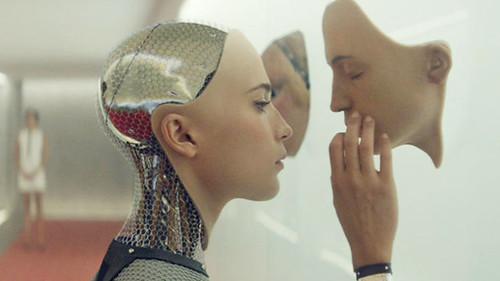
Ex Machina was astonishingly good. magnificently astonishing.

ex-machina-movie
{ borrowed from this kind soul on Flickr }

it had all the thought-provoking subtlety that I demand of a good film, along with great art and believable/relatable characters, and nothing at all slow or boring or in-the-way of the story. the settings and sequences carry such spotlessness and shine

the ending spun to a stop with a thrilling momentum, yet at the same time with all the delicate, delicious unpredictability I could ever want.

writing about it now, I'm reminded a little of the way Seven Pounds winds back on itself with its puzzling pieces of morbid evidence. but Ex Machina only barely leaves room for us to recognize our own disbelief or suspense--by the time its beautiful twists were unfolding I just had to let them wash over me and my expectations like an avalanche of something wide-open different, ambiguous and unsettling.

I immediately wanted to see it again. in the dark of that theater, gaping, speechless, I just wanted to start all over and keep thinking about the story and the future and the brilliant composition of words-pictures-acting I'd just seen.

if you haven't seen it yet, I'll watch it with you. just name the weekend.


here are a few miscellaneous and relatively unimportant footnotes, for anyone interested in reading more about Amelia's new very favourite film:
summary and info from the production studio
other films from the same studio, some of which I should find and watch to see if I enjoy them as much as I did this one.
some words on the fancy, remote, Scandinavian locations

Thursday, November 17

in case

last year, August, I became one of those people who owns a smartphone, and therefore I had to also acquire accessories to surround the smartphone.

one of which was this lovely iPhone case.

I like it. it's simple, not bulky, not boring. it tends to get plenty of compliments.


the scuffs it acquired gave the thing character, mostly.

but then it started seriously splintering at the top left back corner. dad lent me some superglue and that took care of it... until the glue gradually chipped away.


and then this happened to the plastic bits framing the buttons.


and the bottom corner started to chip, too.


and then a whole sliver of the edge split off.


I'm still somewhat attached to this case, and I don't really want to muster up the batch of first-world energy it would take to go shopping for a new one yet, but all these splinters will probably get dangerous at some point. 

the question is, will I want to replace this old bent and breaking accessory with one from the same line, or will I want something totally new? 

Monday, August 8

reflections on teaching online

the online summer class I've been teaching ended last Friday, when all the last final projects got turned in. as of five seconds ago, all the grades are tallied and posted and submitted. hurrah! two weeks til fall classes start...

did any sort of learning happen over those 8 weeks of summer term? on my end, definitely yes. I hadn't taught online before. during the spring and beginning of the summer I attended conference panels galore about online writing instruction. my wonderful mentor Kelli Cargile Cook spoke about the best practices she's developed and studied over her career. friend David Grover from Texas Tech presented on his dissertation research--all about how underprepared graduate students are when they get the chance to teach writing online. at Computers & Writing, I met the brilliant and generous people behind the OWI community website. so many awesome resources and inspirations. it was terrifying, but encouraging.

I was arguably more prepared (on paper, anyhow) for this course than for anything else I've ever taught in my life. most other things I've ever taught involved sticky notes with tentative 6-point outlines and thoughts, all scribbled down mere hours before the lesson. sticky notes don't work for online classes, though. instead, there were dozens of PDFs, a screencast video introduction, a website thing, bits of Blackboard fiddling, many many emails, and many Slack messages.

the slick, fancy Slack messaging app suggested itself as an especially appropriate online teaching tool for professional writing. I'd been hearing about the app on all the podcast advertisements, and I figured my bundle of Business Writing students could benefit from some exposure to it. with help from friend Michael, I poked around and tested things out and got everything set up just how I needed it for the various sections and projects of the class. hosting the whole class within Slack was disorienting for students at first, but most of them caught on quickly and enjoyed the interface. we didn't have quite as much fun as this Zach Whalen fellow seemed to have with his students on Slack, but ah well.

as the course got busier and summer ticked itself relentlessly into the past, I found myself wishing I could be sure my students were reading the announcements I made and the updates I posted. is there such a tracking device? my search just now brought me to this detailed list of Slack shortcuts and tips. there is a way to see who has logged in to Slack-- I'll have to explore that option next semester. it may or may not tell me who has read which channels. this piece might be something to share with students as they set up their Slack accounts for my class--hopefully they'd find it helpful. I need to remember the "reminder" function and the "pin file" function, for important information that students might lose track of too easily. the user-name policy also sounds pretty useful-- one way to maintain a sense of professionalism.

benefits a face-to-face class include students seeing each other and talking to each other a lot more, instead of merely performing for me and my syllabus of requirements. I'm not sure how well my students got to know each other. I did create an "off-topic" channel and let students have it to themselves (I checked now that class is over to find 4 lonely little posts there). our Slack space stayed very to-the-point and business-oriented, a place where work got submitted and readings got "discussed" within minimum wordcounts and with little dialogue. next semester, I'll have to incentivize more student-to-student communication and discussion. this boils down to an odd form of pandering bribery and forced-ness, which my soul squirms and recoils about just a little. I like to think that as an undergraduate student I would have been utterly happy to talk to my fellow students of my own accord (very not true). who needs incentives for that? but that's my vaguely-more-enlightened and far-less-shy gradstudent self talking.

my course was 99% asynchronous, and I so wished that I could have all 17 of my students in one channel at the same time. more focused, immediate discussion could have been way more useful. all the best online courses I've ever taken have included a synchronous Skype or chat-room element. but the way online courses are marketed in this program means students sign up expecting to work at their own paces and not expecting to show up to be counted at any particular time. because of that, I didn't feel like I could design a course with much, if any, synchronous discussion time in it at all. this summer, I asked students to sign up for one-on-one video conferences, so at least there'd be a sliver of synchronous discussion. this worked pretty well. for next semester, I may consider assigning small-group conference meetings, perhaps to discuss peer review work more directly. the institutional constraint here is a challenge to work around. perhaps it deserves to be brought up with my supervisors and program directors. we'll see.

this weekend I talked with a few potential community partners about linking my fall Business Writing assignments to their local, real-world business contexts and needs. it's lovely to know people who run small, local businesses in this lovely college town. wish me luck getting myself organized to incorporate some of those ideas for the next batch of scattered, disembodied online students.

Thursday, May 5

the impossibility of defaultlessness

it seems so easy to be in a marvelously good mood when one is recovered from awful sickness. the work of spring semester is over. I have little margins of space all around in which to read whatever I want. and today is the first day in a week that I haven't felt like a half-rotten zombie full of slime.


so today I attended the second half of a Digital Humanities Symposium. it was exciting--interdisciplinary and spark-full--and there were pastries, too.

I might call myself a newly minted fan-girl of Amanda Visconti, a DH scholar with Purdue's libraries, who talked about her dissertation project, Infinite Ulysses. social reading, they call this. digital text, networked, layered with your reactions and my reactions and anyone else's.

socially-mediated, communal reading experience. Michael Widner from Stanford talked about it too, in the context of his project Lacuna. I have so many questions about this tool that I did not ask during the question-time of the last panel. would it work for a technical writing class? would it work for an online class? can I download it and play around with it on my own for a week or so?

during his presentation, Widner made a small aside about default settings. in building Lacuna, he and his team had millions of decisions to make about how it would function for users. as students add reading notes and annotations to these digital texts, what kind of tags should they be able to chose from in categorizing those notes? should annotations be public by default, or private? in their user testing, it turned out that unless a category tag is selected by default, most users won't select any. if readers' annotations are set by default to public, most of them stay that way. if the default setting is private, most of them stay that way. based on these observations, Widner's comment/advice was: "whatever the default is, that's what most users will do, so your defaults should promote the kind of engagement you want to see."

ah, the weight of those decisions. it's arbitrary, to some extent, which little settings are default or not. privileged, or not.

at this little comment, my brain started whirring and wondering. Widner described various options they'd tried out as the defaults for the Lacuna reading environment. only one arrangement of settings can be default at once though--that's just how it seems to work.

and then I wondered, what if we wanted defaultlessness? no defaults at all--nothing privileged or pre-set for anyone... some purely customizable, blank, open, transparent, full-of-possibility canvas of un-made decisions?

it wouldn't work. it wouldn't ever work. nobody would ever get anything done, if they had to set their own defaults from scratch.

what would 'from scratch' even mean, in a default-less world?

these thoughts reminded me of these thoughts. another word for default mode might be dominant. the default orthography for most sentences includes a capitalized first word and a period at the end. the dominant discourse about education is that official degrees from official institutions are pretty darn valuable. these aren't the only ways of working with sentences or the only ways of learning things.

my dad used to tell us, don't live your life on auto-pilot. don't walk around on default. usually the context was some kind of cleaning frenzy, and the subtext swirling around in my memory, at least, implies that a default life is one that won't stay very neat or tidy, one that might not look very respectable to any important visitors who stop by. I'm sure that's not all he meant, though. a default life is one where you give away all your choices. or one where you don't think enough about making any choices at all, even when you have the chance.

for anyone to live a non-default life, there have to be some default settings to start with, I guess. I wonder how many different defaults there are out there. mine probably weren't the same as everybody's.