Showing posts with label pain. Show all posts

Wednesday, January 31

goodbye, January

since the eve of 2024 one month ago, it feels like so much has happened. some of it too fast, too soon, too painfully. 

the grief of losing the first little doggo that I ever really shared my longterm day-to-day life with... I cannot describe it. as much as I'd like to keep trying to, the feeling altogether and gargantuanly transcends words. the whole experience is impossible to talk about in any satisfying, accurate, indubitable way. "losing"? "letting go"? that we "had to" say goodbye? what kind of stupid, broken euphemism circus is this? everything about our language-cloaked expressions of such pain just feels utterly inadequate.

pine trees silhouetted against a morning sky: blue above white above orange glowing above the mountain horizon
{ I suppose we can't have sunrises without some sunsets. }

a happy pug, white fur with darker ears and nose, his mouth open as if smiling for the camera
{ and nothing lasts forever; dog-years are too extra short. }

it is probably irrational to think no one else could ever know what I mean, even if the words and metaphors feel so flimsy. it's not like I'm the only person to ever experience this sort of sadness. nor is this the first unexpected loss in my life. but it has been the closest and the sharpest. so far.

on new year's day I wrote something about how the world (a world so embroiled in hate and genocides and ugly senseless conflict!) is an absolutely crushingly horrific mess, how my heart hurts and hurts and hurts, and how this loss seems to prefigure and to threaten-- or, even more, to promise-- every other inevitable loss I will ever have to face for as long as I live.

it's one thing to philosophically observe, in general, that nothing can last forever. okay. of course. to confront and deeply feel it-- specifically-- as one solitary ending to the life of a inimitably cuddly goofy fuzzy little domesticated animal... that is different.

other aspects of this January were plenty normal, whatever that means. most of my activities seem to come with rather suitable words with which to sketch them into sharable imagery: going to bed early and sleeping in. checking out library books. reading and ignoring and sorting and replying to emails. seeing friends. enduring snow and rain and cold. demonstrating crafts at the museum. putting birdseed in the feeder in the backyard. talking with family on the phone. eating quiche. drinking tea. making soup. needing a haircut but not yet ever managing to go out and get my hair cut. sweeping the floor. running errands. craving hot chocolate. writing lists and syllabi and assignment sheets. spending money. making things. existing. 

{ eclipse shadows from October, 2023. Wesley's last weekend camping trip with us. }

sure, nothing lasts forever. change is nature. this too shall pass: all of these phrasings alternatingly as full of solace as they are of tragedy, representative of a fact more solid than perhaps any other so-called fact. death and endings are, from one point of view, more normal, more mundane, more irrefutable than any of the other relatively comfortable, unassuming, smoothly proceeding lifestuff I might casually document and remember about this particular month of the year. that's what feels so difficult and impossible about it.

the vortex of this heartache felt immeasurable, indescribably vast and infinite, from the inside. 

even so, from a day or two or ten beyond, it begins to shrink and fade. all future moments frame it into something more manageable.

but again the words seem to balk and fail me. "manage"? is that what we are meant to do with these feelings? this grief? is that actually possible? the stringy, endless paradoxes curl up inside of each other, confounding my basic little human brain with ineffability.

{ classic pug-under-the-table photo, new year's eve 2023 }

January, perhaps fittingly, seems so very long. all the transitions it spans-- all the shifting, deepening of the dark season, the post-holiday recoveries, the shiny new beginnings of a calendar year and of an academic semester-- all of that is a lot for 31 average winter days.

I don't know if it really did feel longer for me this year, or if I'm only saying that because it seems like an appropriate thing to sigh into this semi-bleak and impermanent world. 

one month ago, as the cold moon began to wane and the spinning earth began to tilt just barely back towards the sun, our little old dog ate his last breakfast and went on his last stumbling walk and took one final car ride, sitting on my lap. I only knew him for half his life. I wasn't sure if I'd get along with such a beast at first. but we did get along, so well. I loved that pug and I'm glad he was here to share so much of the too-short day-to-day of my life for a while.

Thursday, July 7

a negative amount of sense

I don't know enough about anything. I don't know enough. this is both true and an excuse to stand back, to distantly question and wonder, to pretend for a while to put myself in other people's shoes and to still fail at understanding why they do this or that, and then to shrug those other perspectives away because I can't know enough about anything.

I don't watch the news. I get news filtered through friends and internet icons. I stay out of it; I have the privilege of class and skin color and education enough to stay out of the news and let my little life sail on. the most affecting mishap I've had to personally deal with lately was watching one of my cute handmade clay bowls slip off the counter and shatter into pieces. I'll make a new one. it'll probably be just the same as the old one.

what are broken dishes when meanwhile, death threats and gun violence and rape and bigotry, brutality, corruption, hatred, and anger seem to fill the world and the internet? there is all this anger and rage and tragedy, all swirling around my privilege and the blissful ignorance it tends to afford.

have you seen this video?


I keep re-watching it, wanting to re-watch it and re-watch it as if my re-watching it might mean that everyone else were watching it, learning something.

I should be grading student drafts, and working on my own drafts, yet I feel like I have to write this instead. and what do I really want to do in a post like this? what can I even hope to halfway-decently attempt, when writers more invested and more practiced and more attended-to than I will probably ever be are already saying more powerful and more meaningful things than I could about this latest ugliness?

I remember marveling--two years ago, November 2014--at this court decision. it made negative amounts of sense. I don't know enough about anything, but I remember that I started looking at uniformed officers differently that year. I told friend Chris, as we watched people on twitter rage and mourn, that I wanted to walk over to our municipal building on 6th and South Street, where all those cop cars are always parked outside, and I wanted to stop at least one officer and ask them questions, and hope they'd sit down and take time for answering. I didn't. I haven't. I still pause when I see uniformed officers, still wonder to the end of the sky what they think about all of this swirling injustice and death. I'm sure there would be miles of red tape, or at least buckets of busy dismissiveness, if not paranoia about whether I'd be likely to spin their comments into some kind of sensational media story.

I am not a journalist. I don't watch the news. I have too many silly podcasts to listen to. today, it happened to be this one from a Sporkful series on Other People's Food. an interview and an audio collage about segregation. about the negative amounts of sense that used to mean strictly separate water fountains, train cars, restrooms, and--more happily--about the activism that eventually changed things.

my instinct is to question. my reactions are questions. why? why? why not talk, and listen, and leave your weapons out of it? why make excuses, why not call this systemic awfulness what it is? why not confront the racism in it? wouldn't it be better to confront and wrestle with, rather than ignore and excuse and backpedal and victim-blame and cover-up? why not trust people? why not put some real faith in the "innocent until proven guilty" principle? why panic? why suspect the worst? why put this woman in handcuffs, why not trust her to keep cooperating? why not trust people? why not treat people like they are, can be, will be good?

I keep thinking about my interactions with uniformed officers. speeding tickets. warnings. nothing bloody, nothing that warrants any screaming. I keep thinking that if I were pulled over for a burned out taillight, I would have been trusted to stand and wait and do as I was told--no handcuffs, no guns. more patience. I would be suspected of nothing beyond failing to maintain a tiny lightbulb within my vehicle. my skin color makes it safer and calmer and pretty much normal, if inconvenient, for me to interact with law enforcement people if I ever have to, and that is puzzlingly unfair beyond unfair.

what am I doing with a post like this? I am reacting. I don't know enough about anything--not about any victim or any officer, not about what the weather is like in Baton Rouge or in Minneapolis this week, not about the political or legal webs within which the cities I've lived in are being maintained, and not at all enough about the biases that insidiously sit in my own head. I do not know who wrote all the news articles or what kind of slant their publishers may have expected. I do not know exactly what kind of methods were used in compiling which kinds of data from what sources. I do not know if the world will ever be different enough from the depressing way it is for certain groups of people in this country.

but ever since this Hank Green fellow made this video about democratic engagement I have been meaning to use up some paper and ink and stamps with more pointed and purposeful reactions to things. now is all there is, so it may as well be now.

Thursday, October 8

still somewhere


{ a corner of the University of Wisconsin campus in Madison, Wisconsin. late summer 2015 }

heart in my throat.

that's a cliche figure of speech, not one I've used in description before. choking on your own life, your own inner core. very cliche, but it feels new to me. and maybe all the idiom dictionaries say it means extreme nervousness or fear. for me though, that part of the cliche doesn't apply. this feeling is not connected to the mild terror I feel about having to decide--actually decide for my very own self in some very focused and purposeful way--what to write a dissertation about and then figure out which faculty members will best be able to help me write it. this heart-in-my-throat-ness is rather a feeling with no meaning. not nerves, not fear, not sympathy, not sadness.

surely it's connected to something, but I cannot tell what.

this, starting this fall, is year three.

it's been a long summer, a long year. a long way since January and home and crafts. I have not stayed in one place like this since... oh goodness-- even this long in one place? in one town? it was early 2002. high school. I was eighteen. three years isn't so long. three years isn't hard to look back across. but since my long-ago high school life it's been snippets of much less time:

one year in Logan, Utah
one year in Exmouth, Devon
two years in Logan, Utah
three quarters of a year in Kidder, Missouri
half a year in Seattle, Washington
eighteen months in Alberta, Canada
half a year in Seattle again
two years in West Jordan, Utah
two years in Lubbock, Texas

and now...

now it's year three of my phd. three years in this cozy Lafayette, Indiana place. three straight years with only small breaks for visiting parents and siblings, for wandering in new cities and new woods, and a bit of going to conferences.

plenty of the things they told us about year three have proven true enough. I am in a daze and not sure where to work, what to focus on. I do feel very daunted. shaky about the future, even the future of three weeks away. I am sick of coursework on a level I did not think would ever be possible. even posthumanism class in some moments seems to slap me across the face with impossible drudgery.

I left the book in my office or I'd take a photo of this, but you'll have to trust me that on its last page, at the end of what Katherine Hayles has to say about How We Became Posthuman, I penciled in an awe-struck "will I ever write a book like this?"

and underneath that: "how?"

our next book for posthumanism class is Karen Barad's Meeting the Universe Halfway: Quantum Physics and the Entanglement of Matter and Meaning.

I have read the preface and am already asking, again, "will I ever write a book like this? could I?"

a phd is supposed to be daunting, I guess. they don't want to hand them out to just anyone. you have to climb a good number of very tall staircases. wondering. climbing. uncertain. climbing. reading. climbing. writing. wondering.
“There are no solutions; there is only the ongoing practice of being open and alive to each meeting, each intra-action, so that we might use our ability to respond, our responsibility, to help awaken, to breathe life into ever new possibilities for living justly.”
   — Karen Barad. Meeting the Universe Halfway (x)

Friday, June 19

paused

disappointment paralysis: when all narrativium sloshes from one side of your life to the other and spills away uncontrollably, leaving you to tremble at the center of it and wonder where the story is going. when things aren't making sense, nothing is fitting into a plot quite yet and there aren't any conflicts to address (they've all walked remorselessly out the door on you) and you can't find any of your props (they've all misplaced themselves in distant, locked rooms) and your character list seems suddenly erased (subject to immediate and serious revision for no reason at all).

it's a feeling I can't quite keep in my head to describe. a robotic feeling. a half-turned-off immobility of a sort. a creaking passionlessness attended by drifts of lethargic, unmotivated thoughts. from that place it seems like the story will never un-empty itself back into any useful channel.

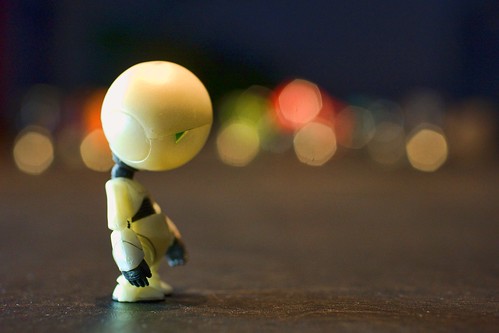
have you ever felt like that? like you could almost relate to this guy here?
Marvin, the paranoid andriod
{ photo by this kind soul on flickr. }

but seeing all these June lilies in all their gorgeous smeary, speckled orange...
even if they aren't my favourite flowers, seeing them everywhere has been sort of awakening.

they didn't show up in any bouquets. they just seem to be in everyone's yards this time of year. nodding and swaying and sprawling because it is June and they are June lilies. and in my noticing of them there is something not exactly, but almost sort of akin to what the flowers at the bottom of this old blogpost had to say.

by itself it isn't much. but it makes the ramshackle haltedness and sticky ground where we are feel more like a pause in the story arc than an utter abandonment of it. flowers and fireflies. still worth smiling about.

Friday, April 24

twentyfour: numbers, calories, feelings

let it be known that I am having a giant, imaginary shouting match with Apple and all their employees right now.

also let it be known that there are one thousand posts sitting around behind the scenes of this blog. see there in that right-hand column? one thousand. eighteen of those are drafts (including this one). a lovely palendromical 303 of them are mere sunday-scribbles posts. 109 are tagged with the label 'random'.
so after this, I will have seventeen more posts (of which six will appear within the next week) to think up some fabulous celebratory thing to write here for the one thousandth actual published post. does my blog audience have any suggestions for me? should I hold some silly contest or scavenger hunt or game? hmm.

while I ponder, and while I mourn the death of this melodramatic semester and this fickle April and--most stressfully and traumatically of all--my dear old nameless macbook, I'm going to talk about food.

yesterday, I made chicken and rice. I think (not counting the recent occasion of Easter) this was the first time I've cooked chicken since Thanksgiving or something.

usually it's canned cream-of-mushroom soup you do this with. I didn't have any, so I made do with almond milk and actual mushrooms and random spices. turned out gorgeously, if I do say so myself.


a few weeks ago, inspired by Ms. MacKenzie Smith of the grilled cheese social blog, I made pear/gruyere grilled cheese.
these are awful photographs, with too much yellow light in them, but nevertheless, they are evidence of grilled-cheese-bliss on a plate.


I also baked my genius brother's famous savage chocolate-chip cookies the other night. I have eaten way too many of them today. so? aren't Fridays meant to be days that you eat hardly anything besides exceptionally awesome chocolate-chip cookies? good. I thought so.

other planned baking adventures for the near future include more fresh bread, cream cheese wontons, and pie crust. comfort food. yeah.

Monday, April 13

thirteen: unlucky

not even the heady scent of fresh-mown grass or the sweep of springtime clouds and breezes--not even a strawberry ice cream cone--none of it, nothing--has succeeded in lifting me up out of this well (deep, deepening, deeper than yesterday) of what if why not when where how not why which who why why not but why. I am choking on feelings. smothering.


there are no stories in this. no sense. the universe is sinking me.

Wednesday, October 8

the world we are creating

if there are things you love on the internet, save copies of them. this is advice that Dr. Sullivan is alway giving us with respect to our wandering research. if you even sort of think you might want to use it someday for an object lesson, class project, seminar paper, conference illustration, or article-fodder, download the thing. as endless and un-erasable as the internet seems most days, the stuff of it doesn't always stay there. you cannot trust the cloud.

(whether you can trust the integrity and/or longevity of your harddrive to any significantly greater extent is a separate though not unrelated question. all is temporary, and the scales of temporariness are complicated.)

if there are people you love on the internet, I don't know what to tell you. so far, there's no way to download people. that's probably a good thing.

early thismorning I saw people linking to a new post by Kathy Sierra. it is a long post, personal, a tad meandering, but it seems everso soul-questioningly, heart-wrenchingly important.

read it. go on. I've linked to it twice now, redundantly, asking you to read this long meandering story even if you have not been a Kathy Sierra fangirl since at least 2005, and even if you have no clue who this Andrew Auernheimer fellow (hm... he blogs on livejournal. how old-fashioned...) might think he is, and even if you, like me, find life much more effective without worrying very much about the hopeless-seeming, headache-inducing state of the universe.

Sierra's post might not be there very long. I have made a copy of it, in case the original disappears. it's also on Wired, for the moment. (if Wired and Dropbox disappear, who knows what we shall do).

two-thirds in, Sierra shifts into saying we. "This is the world we have created."

not only does that make us sound so implicated, so conspiratorially close to culpable... it also makes us sound so finished. so final. we've hit send. we've checked enough boxes. the world has been published. editing is over and this is the product we're stuck with.

not so. please, not so. I'd rather say "this is the world we are creating."

the we is still there. I don't see any ways of getting around that we, though parts of me are tempted to pick we apart and subdivide it into some sort of graph with axes like experience, influence, responsibility, investment, and such.

all the other words could stand to be picked at too. which exact this? creating how?

in one of those neat serendipitous internet moments, the following video was posted today. Mr. Rugnetta says a few things on cultural (re)production that answer that last question. the how is discourse. pens, not swords. writing and media, not sticks or stones or construction equipment. it's actions too, of course, but what we say about how we act, and how we storify things that happen = way incredibly powerful. Sierra's story similarly notes that stories with enough inertia and spin can permanently warp one's perspective. even the most disturbingly inaccurate stories, like the kind you might hear about scaly, murderous llamas, can stick in your head and tint everything you see. all the Pratchett you've ever read will say the same thing--narrativium is not to be trifled with.

I wonder sometimes if the stories we tell about the stories we tell carve ruts as deep or as damaging. those are thoughts for future blogposts, I think.

as long as I'm being redundant today, I'm going to include another video--yes, more of this silly Rugnetta fellow and his ponderings. it's relevant, I promise. and the followup comments/responses over here are also enlightening and chewy. (my brain has been particularly hung up over the 8:40 mark. it's a part of me that's been trained to meekly accept and swallow all things as somehow divinely-permitted-side-effects-of-this-fallen-mortal-experience-which-will-ultimately-all-work-together-for-my-everlasting-good that wants to say, "yeah, shrug off those death threats, everything will be fine." what does that mean? who does that make me? am I supposed to squash this attitude? or unravel it away? maybe all I can do is wait to see how I actual feel when or if death threats are ever made in my direction, and keep my mouth shut about the concept until then.)

anyway. this whole situation--trolls, women, internet, life--is more than a story. we can uses stories and conversations and videos and blogs to reach out for little parts of it, and build what we see into some sensible structure, with sections and headings and terms lined up for convenient deconstruction. but labels make me squirm, generally. what we mean by troll and or victim obviously isn't easy. it's not even always useful. the definitional blurriness between criticism/harassment is another thing that might deserve plenty of more discussion. my own experiences of such things aren't the same as anyone else's. that's why we need to tell the stories, after all. that's why we invented ways of sharing all the crazy insides of our heads.

maybe all this talking and thinking will help. somehow.

Monday, September 22

inhale envy

Saturday I was out running errands (legitimize the new car, donate all those excess clothes, pick the last two zucchini from the garden plot) and had a few moments to kill in between places of business that open at 8:30am on weekends and stores that didn't open until 10:00. Barnes and Noble presented itself, conveniently in between these times, and I wandered in to browse.

my favourite shelves in bookstores are the ones with the blank books. there's only so long you can gush over those, though, so I also explored the games aisles and the news aisles and the clearance bins. there were tempting boxes of chocolate in the clearance bins... but I was only there to kill time, not spend any money. I'm still subsisting on the tail end of tiny slash nonexistent summer paychecks, so I'm putting off as much spending as possible until next month.

my other favourite shelves are the ones with new books. Barnes and Noble has one of these too, perpendicular to the coffee-dispensing section of the store.

I picked up and perused the first pages of a little paperback with a yellow-pea-coated girl on the cover. white block letters, out-of-focus trees in the background. it was the title that caught my eye. The Opposite of Loneliness. Marina Keegan. Introduction by Anne Fadiman.

I must admit I didn't remember any of that information over the weekend. I didn't remember what it was called or what it looked like or how it was bound. all I remembered was the twist that jumped out from the middle of that glowing Introduction by Anne Fadiman, and the reason I put the book down.

but in order to write about that, I needed to remember all the other details. an isolated, poignant twist with no detailed context wouldn't quite be a story worth telling, would it?

as anyone else would have in this forgetful situation, I turned to the world's favourite (or least favourite?) external memory aid slash search algorithm.

these are the words I ventured to feed into the search box:

writing student dies dead student publishes collection

and there I've given away the whole sad, slow, sinking, twist, so there may not be much hope of painting for you the sense of holding a lovely book of essays in your hands, of reading along about the quirks and dreams and pleadings of its author, starting to wonder, to envy, and feeling even a bit anxious to skim through this Introduction and taste the insides of this collection--to traipse right into the essays this student of Anne Fadiman's must have had such writerly fun drafting and polishing...

...and then realizing, without knowing why it took you so long, that Anne Fadiman's past tense was is not the regular, innocent past tense was.

I snapped the book shut and half-tossed it back on its shelf, not even bothering to straighten it up with its fellow copies.

her last Yale Daily News column comes up first in the search results.

a Huffington Post eulogy-esque review (or is it more a review-esque eulogy? I'm not sure) is second.

I'm not sure what made me so suddenly give up on that shiny new book. maybe, after hearing so much praise and promise, it seemed unfair. maybe the praise and promise seemed pasted-on and obligatory to me, too thick, once I knew their recipient wasn't around anymore. I felt cheated, disbelieving. maybe I couldn't swallow the implications of envying a talented but tragically dead Yale graduate.

Wednesday, February 27

or dysfunctional nihilism

this is a bunch of small thoughts I've been collecting for a while. please, forgive the datedness and borrowedness of some of them and the existential generality of the others.
there is no shortage of tragedy in the world. perhaps this is because there is no end to our human ability to read our circumstances as deeply dramatic, emotional, and meaningful narrative. there is no shortage of tragedy at all. sometimes the tiniest things can dissolve away all the good things in your head, until it's hard to focus on anything but how little control you have over the way your life goes.

is it more depressing to think about how little control you have over the way anyone else's life goes?

for months and months I've wanted to blog something about this rather artistic video appeal concerning 'the leading cause of death in the world,' apparently, because... well, I guess because it seems clever. a clever and pathetic appeal to writers and journalists. and this kind of art and rhetoric intrigues me for some reason.

yesterday the grip of my own small tragic mood was loosened when I got out of bed and started cleaning my closet. a small thing. unimportant except in light of the fact that I'll be moving around the corner in a week or so, and need to put things in boxes and suitcases in preparation. anything, any mindless chore to distract us from the howling nothingness, eh?

I am totally up for wearing plaid with stripes. who cares anyway?

but we do. we care. we care about the silly details of what we wear every day and we care about the plight of illiterate children in Africa and lots of things in between. and we aren't exactly helpless puppets in the hands of fate, are we? I don't think so. there are things we can do. but do we? John Green provided me with the phrase 'functional nihilism' in this as-usual-enlightening video. we all wear a nihilist hat from time to time. but it isn't the only hat we can wear. we can get out of bed and do things. make stuff happen. change the world. in fact we can't really help changing the world. there is no running away. your breath, your apathy, your words, your footsteps. it's all here being mixed in with everyone else's.

are there reasons behind all this trite and inescapable no-man-is-an-island stuff? maybe. are they at all effable reasons? maybe not.

and this brings me to Ms. Rachel Botsman and her presentation on the the case for collaborative consumption. I can't remember where or when I came across this, nor am I certain exactly how it ought to connect with the above quote from Einstein or the Solidarités International video. maybe you all can help me out with that part.

a global village. trust mechanics. and this swap-trading stuff is the kind of thing my lovely, clever sister would get into and make awesomeness happen with, if she got half a chance.

maybe I'll read Botsman's book sometime. maybe I'll write one myself sometime...

Tuesday, August 28

why don't the newscasters cry?

emotions can be utterly unruly things.

where do they come from? what can we do about them? what is the point of them? it seems as if none of us really understand these things, but we tell ourselves stories about out emotions--paint small pictures of the things that make us happy or sad or curious or angry. and we attempt to pin down at least a few causes. explain exactly how these crazy things move us. experiment with possible remedies. muddle through the best we can.

haven't they done studies on this? emotions and causality? maybe it's too touchy and amorphous to study. too fickle. too complicated. too infinitely individual. we all feel so uniquely. but there's commonality in there, somewhere, we think. something overarchingly human stretched out between every person.
maybe. who knows?

there's a Jack Johnson song called "The News" and it often comes to mind when I think about the way real tragedy feels so distant, when narrative tragedy pricks so much nearer. the lyrics host a handful of hyperboles, and on paper they lack the crooning gentleness of the singer's voice... but still.
A billion people died on the news tonight
But not so many cried at the terrible sight
Well mama said
It’s just make believe
You can’t believe everything you see
So baby close your eyes to the lullabies
On the news tonight
Who’s the one to decide that it would be alright
To put the music behind the news tonight
Well mama said
You can’t believe everything you hear
The diagetic world is so unclear
So baby close your ears
On the news tonight
On the news tonight
The unobtrusive tones on the news tonight
And mama said
Mmm
Why don’t the newscasters cry when they read about people who die
At least they could be decent enough to put just a tear in their eyes
Mama said
It’s just make believe
You cant believe everything you see
So baby close your eyes to the lullabies
On the news tonight
I had to look up the word 'diagetic' (also 'diegetic')--it's from the Greek word for narrative. a style of narrative where things are told to you through a narrator... not simply shown as they happen. does this make a difference? what did Jack Johnson mean here? the world as it is told to us can't every be truly clear. the films and veils of a hundred varying perspectives get in the way of any pure recount. there is always an angle. there is always a slant. objectivity is a myth.
so I have a theory. if there are too many layered perspectives (he said, she said, they said, this happened) between us and the story, perhaps it will hamper our emotional response and/or provoke a lesser empathetic instinct. the style of the narrative matters.

the opposite of diegesis is mimesis. the imitation of reality, not simply its retelling. are mimetic imitations--stories presented to us without narrators, without filters--are those more likely to bring out tears? are they more real? if everything is make-believe and every version of events a kind of story, then how do we trace or mark or judge the kinds of stories, and which are more important?
these photos here are of the sculpted replicas of shoes worn by murdered Jews. I walked slowly past them our first full day in Hungary, trying to stretch my imagination far enough back and far enough out... far enough to include what it might have been like to stand on the banks of that lovely river, the Duna, and know you were going to die for confusing reasons related to your heritage and your faith.

I couldn't do it. my attempts unearthed a vague poignance, but of course nothing very close to a full understanding.
were there too many layers? Dr. Jones was the one who related the history and the story of the sculpture to us. the sculptors themselves too harp upon a certain story, and even that story must have been told to them by somebody. or a dozen somebodies. where do we get the original story? who does it belong to? is there anyone's voice left for it to be told in?

I proofread the memoir of a Holocaust survivor last month, called Transcending Darkness. reading over the text and noticing the ways it struck and disturbed and tugged at me is what spurred this whole narrative-style-makes-a-difference theory. which styles are best, for which purposes? which stories need telling, and why? and presuming we ever make sense of those questions, then which kinds of emotions are most worthwhile, anyway? maybe we needn't judge. maybe the vague, disconnected feelings that settle in response to cold, diegetic news reports and the wrenching, indescribable ones that bloom out of unfiltered, mimetic storybook experience can both have their place. the deeper, powerful emotions may not mean much without the thin, vague ones behind them.

news and history and story are all different things. we consume them differently and we think about them differently. but why? for some reason each comes with its own set of genre conventions and rules and methods. we respond to these layered modes of narrative differently. but is that the way it should be?

Wednesday, August 8

process victims

I read the following phrase in one of my proofs several weeks ago, concerning a building that had caught fire and burned down:
"a victim of faulty wiring and wooden construction"
since I was only playing proofreader and not comprehensive editor at the time, I kept my puzzlement and questions to myself and saved them for this blogpost. the worrying idea spawned by this (perhaps less-than-accurate) phrase spirals around this question: how can you be a victim of the way you were built and the context you are standing in?

okay, I'm personifying a building. maybe our author was too. the word victim doesn't always imply a human... but.... it does imply some intent, right? and even the fire, since it was an accident, cannot have been intentionally victimizing its setting. these things... these words. they mess with your head if you think about them too much. the etymology of the word victim is tied up with sacrifice and pain.
late 15c., "living creature killed and offered as a sacrifice to a deity or supernatural power," from L. victima "person or animal killed as a sacrifice." Perhaps distantly connected to O.E. wig "idol," Goth. weihs "holy," Ger. weihen "consecrate" (cf. Weihnachten "Christmas") on notion of "a consecrated animal." Sense of "person who is hurt, tortured, or killed by another" is first recorded 1650s; meaning "person oppressed by some power or situation" is from 1718. Weaker sense of "person taken advantage of" is recorded from 1781.
freund Kolby informed me yesterday, interestingly, that the German word for victim is das Opfer. it can also mean offering, sacrifice, or casualty. there's also a long list of other kinds of victims. das Brandopfer, Verbrechensopfer, Unfallopfer, and so on. who controls these kinds of situations? these victim-victimizer relationships? the offerer, the torturer, the fire, the criminal, the forces of nature or gnarled hands of fate. never the victim. unless we find ourselves with a willing victim? or does willingness ruin the whole connotation? would not a willing victim pose an oxymoron?

I could mess with definitions for hours. so what? rambling thoughts. qualities and causes and chance and control. at the top of that list of German victim-words is this one: Opfer der Verhältnisse. a victim of circumstances.

so maybe you can be a victim of the way you were made. the faulty wiring you were fitted with or the wooden construction that is what you are.

but if we start saying that, then we may as well say we are victims of all the awesome things that happen, too. I might be a victim of my fabulous curly hair, or a victim of this brilliant sunny afternoon. and then our connotations will get really, really twisted. which is not necessarily a bad thing... but I'm just saying... maybe let's be careful with our usage. words are powerful things, you know?

a few weeks ago my dad, whose perspective on life I greatly value, gave me a bit of his usual off-the-cuff fatherly advice. something he seemed to have been thinking about in the face of recent days' happenings. he said 'you can't count on life ever functioning efficiently.' logical and efficient are not adjectives that apply to life as a whole. life is a process. and maybe we should realize that the process, however convoluted, is more valuable than the outcome. this thought reminded me, with a very vivid and immediate spark, of rube goldberg machines.

when I was a kid, I had of course not heard of Rube Goldberg at all. but my siblings and I would sometimes scavenge bits of wood from dad's workshop, turn our bikes on their backs, set up tracks for  marbles or tennis balls, and build little machines. they never really accomplished anything (other than entertaining a few kids for a while), so I suppose you couldn't call them rube goldberg machines. and maybe life is similarly pointless. we don't really know...

inspired by my dad's words the other week, I'm going to declare that life is like a rube goldberg machine. perhaps it's a bit like this one:


Melvin the Mini Machine from HEYHEYHEY.

you are one piece of the game at a time. in the middle. maybe someone out there can see all the pieces, how they fit together, but you can't. you just don't get to.

and this crooked little corner of the process of your life is the only forever you get. right now, wherever you are and all the stuff you're made of. the rest of forever will be just the same... one tiny moment in the middle of everything else beyond it, behind it, beneath it, and before it.

enjoy it. I'm going to continue playing etymologist-nerd here and tell you that one meaning of the verb enjoy might be something like 'put joy into' or 'give joy.' that sounds right.

Tuesday, March 28

pain is


this cartoon here was drawn by hugh macleod.
his site of blogging, marketing, web rants is full of cartoons, many of which are quite vulgar, many of which are quite inspiring. his book proposal on how to be creative is brilliant. [2011 edit: it's now a book, Ignore Everybody. cool]

anyway, I've been thinking about pain and being prepared for it. I firmly believe that life is pain. unavoidably, mercilessly, beautifully. and I don't find this attitude pessimistic. nor am I saying that because I'm afraid to be labeled a pessimist. I'll admit that in other ways I am one, but my life is pain motto is not at all a complaint--it's an observation. and a rejoicing in paradox. a poetry of balance. realism. equation. without pain what would life be like? what would be the point? (I know, I know, I often ask what's the point anyway, of anything, but just play along for a minute).

life = pain. pain = life. beautiful, yeah. pain.

hugh macleod says "if you accept the pain it can't hurt you."

okay.

but then is it still really pain?

is my assertion that life is pain the same as acceptance? anticipation? does it make a difference? really?

I still can't change it. I still get hurt. I still make mistakes.

so acceptance must mean something higher... maybe... or nobler. letting go of that pain and seeing bigger pictures. I'm not there yet. I'm not invicible.

or am I?

pain does not equal death.

and most of the pain has left me unscarred, unbroken. that's the beauty of it.

but I find it kind of weird that even knowing that life is pain doesn't give me any more power. I still get thrown out of my groove. that's mortality for you.