Showing posts with label beginnings. Show all posts

Thursday, September 12

fall semester, 2024

the word semester shows up in at least 130 of my past blogposts, which is a little more than 10% of all the posts I've thus far posted. considering that this little blog has always been roughly half focused on various academic and intellectual pursuits, this makes plenty of sense. semesters are like seasons.

the word itself is not even 200 years old, the etymology dictionary tells me: "...semenstris 'of six months, lasting six months, half-yearly, semi-annual,' from assimilated form of sex 'six' (see six) + mensis "month" (see moon (n.)). The word, and the idea, were picked up in the U.S., where the German higher education system served as a model."

apparently the Latin-y adjective forms semestral and semestrial are a few centuries older. interesting. 

anyway, I'm glad our semesters are not a full six months long these days. four months is plenty. 

and for these upcoming four months, I'm teaching three batches of students, including a few repeats from past semesters. the longer I hang out at this institution, the more that will keep happening I suppose.

COM 221: Technical Report Writing
counting the two sections I have this semester, I've taught practically a million versions of this course (okay, 15 total sections. that is still a lot). it's becoming a bit of a struggle to not get completely burnt out and bored of it, but I'm doing my best to keep it interesting for me. we're only in week 3, so I'm still getting to know the vibe of the students. we'll have some fun together I hope though.

HU 356: Audio Production & Podcasting
this one is going to be interesting no matter what-- it's a brand new class, only recently outlined and designed and proposed by me for our catch-all Humanities & Communication department. I am pretty excited to see how this goes. so far I'm having students practice various little audio recording tasks, then we'll level up to remixing all those clips into some fun story-arc, before finally moving on to pitching and workshoping individual podcast projects. the students all have great ideas so far. (wish me luck persuading the one who simply wants to copy Mr. Rogan's insufferably long-winded (at least it is to me) format into doing something at least slightly more inventive.)


what else? I signed up for a weaving class next month. some family is visiting next week. we have some more camping planned for during fall break. we're having a brand new screen door installed sometime soon. and our Monday evening D&D group is on the brink of moving up to level 8. in November, our crazy puppy will turn 1 year old.

at some point we should work on the mish-mash garden projects and other household tasks that need doing. and eventually figure out our holiday plans. 

or maybe we let go of shoulds for a while and enjoy the almost-autum while it's here.

Tuesday, July 5

what is in a name?

as promised, I have written up and organized many, many, many photos for a full stand-alone page chronicling my adventures (so far) with this lovely old spinning wheel, now posted neatly alongside my about page and a draft/test page for an audio workshop I hosted once upon a time.

before: a disassembled saxony spinning wheel, dark with grime
{ before all the learning about and cleaning of }


the spinning wheel, all cleaned up, reassembled, and almost functional
{ after all the cleaning and fiddling and reassembling } 

she needs one more replacement part and much more practice before she produces any yarn at all. so in the meantime, I do wish to solicit your opinions on her name. I'm weighing these three options at the moment...

Lydia, (after my father's maternal great-great grandmother Lydia Ann Taylor, 1852-1888),
Charlotte (after another of my father's maternal great-great grandmothers, Charlotte Amelia Van Orden, 1828-1895),
or Phoebe (after my mother's maternal great-grandmother Phoebe Rebecca Reynolds, 1863-1922)

...but at any point I could decide that Selina (after my mother's paternal great-great-grandmother Selina Tibbs, 1817-1891) or Florence (after my father's paternal great-grandmother Florence Charlesworth, 1879-1931) are worth considering. those two remind me a bit too much of a town in Kansas + the famous British nurse, respectively, but who knows if some quirk of my spinning wheel's personality will nudge them into the running.

Tuesday, June 7

sing, sing, sing

so I signed up for eight weeks of voice lessons this summer. it was kind of fun and random to enroll at the local community college and get a new email address and go actually check out their pretty Prescott campus.

it's nice. lots of cool sculpture gardens here and there. I was especially struck by this lovely little bench:


it hasn't been that long since I was a real student (and secretly/not-so-secretly, professorship is pretty much endless-studentship anyway), but it does feel like a long time. 4 years now I guess? 

but now, for this season at least, I am a part-time, non-degree-seeking Yavapai Rough Rider.

drawing of the Yavapai College mascot-- a cowboy-looking dude with a moustache
{ image borrowed from a local news piece about the YC softball team }

I had my first lesson this afternoon: 50 very enjoyable minutes with Dr. Audis, who earned her doctorate at none other than Texas Tech University. (interestingly, but not really coincidentally given all the myths and legends of our shared western/southwestern contexts out here, Texas Tech has a really similar mascot... only theirs is red-flavored instead of green...)

anyway, the first lesson was a great time. I tried not to be too nervous; I hummed warm-up scales through buzzing lips and emulated an ambulance siren with my voice as fully as I could. that last exercise was scary-exhilarating and hopefully that small thrill will help spur me to practice it even if it will likely frighten the pugs a little. 

then we sang through a few folk songs and a few show tunes, ultimately settling on these three as my summer repertoire: 

- the classic Irish folk song, "Danny Boy"

- one of the more heart-wrenching songs from Fiddler on the Roof, "Far From the Home I Love"

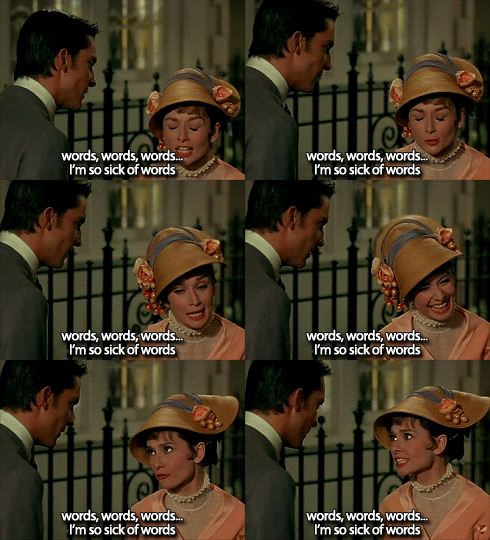
- and "Show Me," from My Fair Lady

gif image of Eliza Doolittle fiercely singing "words, words, words, I'm so sick of words"

I'm familiar with all three in some way or other, but despite their seeming simplicity they'll each make for an interesting challenge in terms of range, pacing, tone, emotion, and style. not to mention forcing me to sing the notes and timing as written and not just as I remember from musicals or popular culture or whatnot.

for these summer classes, there isn't a formal recital or presentation at the end of eight weeks, but it sounds like I'll at least get to perform for the other voice students at some point. that should be scary-exhilarating and cool also.


side note! in my googling for that .gif file from "Show Me," I discovered suddenly that Mr. Freddy Eynsford Hill is played, in the 1964 film adaptation of My Fair Lady, by none other than Jeremy Brett.

Jeremy Brett? whose name I mostly only know because of my longstanding, if lazy, adoration of all things Sherlock Holmes? 

yes indeed, that Jeremy Brett. I may have to move this whole playlist of his Sherlock Holmes performances up nearer to the top of my summer watching list.

Monday, June 6

abundance

it didn't stay in its original sticky-tacked-to-the-wall position for very long, so now it is pinned to leaning corkboard instead-- a big white paper on which I've scribbled All The Things I want to spend time on this summer break.

there's not any order or timeline to it. some words and phrases have little orbiting sub-items around them. and by now, a few have little blobs of oil pastel crayon next to them. I decided that's how I'll keep track of it all. not just checkmarks or crossing-things-out when I've done them-- that's too basic and also presumes some sort of linear pathway to an ending. some inevitable finality. 

my giant scribbly page of summer activities is not really based around accomplishments. these aren't really goals to be working toward but rather ways of being and doing that I want to make space for. it will be okay if I don't finish most of the things. most of them aren't the finishable kind (though some, like the Matthew McConaughey movie marathon* I have planned, are).

oil pastel crayons

{ not my pastels and not my photo. thank you creative commons licenses. }

there are only ten pastel crayons in my little handmedown box, and I've rotated through them a little bit so far, splashing my to-do page with colors. some items have collected two or three colored dots already, representing multiple segments of time I've spent reading or playing or making this or that.

as of today, the things that don't yet have any dots of color include...

camping
clothesline design + installation
bike rides
reupholster bench + ottoman
sunrises
homemade Italian food
third-year review prep
poolside reading

I will get to those things. I have more than 80 whole days of summer left. plenty of time for All The Things and probably a bunch not even on the list.


*for the record, I'm three movies in to this so far, with 15 more to go (...depending on if or how you count True Detective, which is a series and not a movie). will I blog mini-reviews of all the films? maybe. last night was Contact, which did leave me with plenty to think about.

Sunday, October 3

waning crescent

this morning we woke up at first light, well enough rested, and after wrapping myself up in a fuzzy robe, I sat outside while the dogs sniffed around, watching the eastern edges of the sky turn colors.

I love seeing this happen. dawn. morning. sunrises. 

this time of year is especially great for it. the sun takes its time, the horizon for me today was obscured by the wall around our property, the tree on the left, more trees beyond that one.

but the sky is all still there, spread out behind everything, changing from dark to light under a mottled scrape of east-to-west cloud.

the cloud turned colors too-- from a grey smudge to grey-blue, then purple, before pink and flaming. I couldn't see the sun itself but I saw all the colors it was throwing around. 

my bare feet got cold. little Hamilton pawed at me to let him up on my lap. early hikers passed by on the trail behind our house. I noticed a mourning dove huddled on the edge of the back wall. a trio of crows swooped overhead. 

after a while, I stood up and walked a ways out from under our back-porch awning. up, up above the treeline and the blazing pink-gold clouds, the brilliant, bright white moon smiled down at us. it hung there tipped over on its side, a slim crescent against the blue morning. it surprised me, how solid and silvery and high it still was, with the sun right there on its tail.

I had to look this up to remind myself properly of the order of all the lunar phases, but as it happens, we're under a waning crescent moon today. at this point in her rhythm, she's pulling all her shine into her other half, turning and shrinking away, saving it for whoever is out on the other side. maybe it's just her, there with all the sunbeams-made-moonbeams. with no obligations to reflect it for anyone else at all. 

I've been thinking about that aspect of the moon for a while now. about how much value there is in that new moon phase-- how through all the never-ending cycles of waxing and waning and shining and spinning, there's plenty of time when the moon seems to keep her light to herself.

maybe that's a lesson I'm learning this year. this season. 

shining full-blast for everyone else all the time is a recipe for burnout and depression and resentment. and it's gotta be okay-- more than okay-- to use your talents just because you feel like it, even if nobody else will see or care or show up for it. my own reasons can be enough.

nature is pretty awesome, even if some portion of what we see as awesome in it is projected personifications and metaphors. so what? we are nature too. all of us and our stories have a place in the wild and shifting colors of the sky, clouds and moonlight and all.

I'm so grateful for cool, crisp morning sunrises and a tidy backyard to enjoy them in. so grateful for this space and time and everything I can learn from it.

not today's sunrise. just one sunrise of many


Monday, December 21

deep solstice

it has been almost three years since I last joined a public yoga practice. that's kind of a long time. but also not that long.

I have gotten emails from that downtown yoga studio, Sunshine Yoga, in the meantime. pointless emails, but at least they were not overwhelmingly spam-esque.

there was a yoga studio called Spark in Natchitoches for a moment, but it closed its doors before I could participate. I was sad and a tiny bit angry when that happened. how unfair. what stupid timing.

there are at least fourteen yoga studios here in Prescott, but there is also a pandemic going on.

and so the time since I practiced any good yoga with anyone but my own household stretches longer and longer.

I do still have Yoga with Adriene, thankfully.

and now I also have a weekly yoga church thing, which I joined on strong recommendation from friend Patti.

I met Summer Cushman, the beautiful soul who hosts this event, just once I think-- during a dinner at Black Sparrow at some point during this visit to Indiana. her partner Jeremy Cushman orchestrated my introduction to the graduate program + environs at Purdue that March. 

so for the last three Sunday mornings, I have set aside 90 minutes for a little yoga, a lot of journaling, and a much-needed dose of connection and fellowship. it's over Zoom, which will never quite be the very same thing as an everyone-in-the-same-room-breathing-and-moving-together yoga class, but it is very lovely in its own way. 


{ one of my favorite hand-drawn cards from Christmas 2018 }

yesterday, we turned our journaling and our meditating to the depths of this season. midwinter. cold. darkness. accepting the rhythms of putting down what is ready to die and making room for the new things that might grow when the spring sun comes back. 

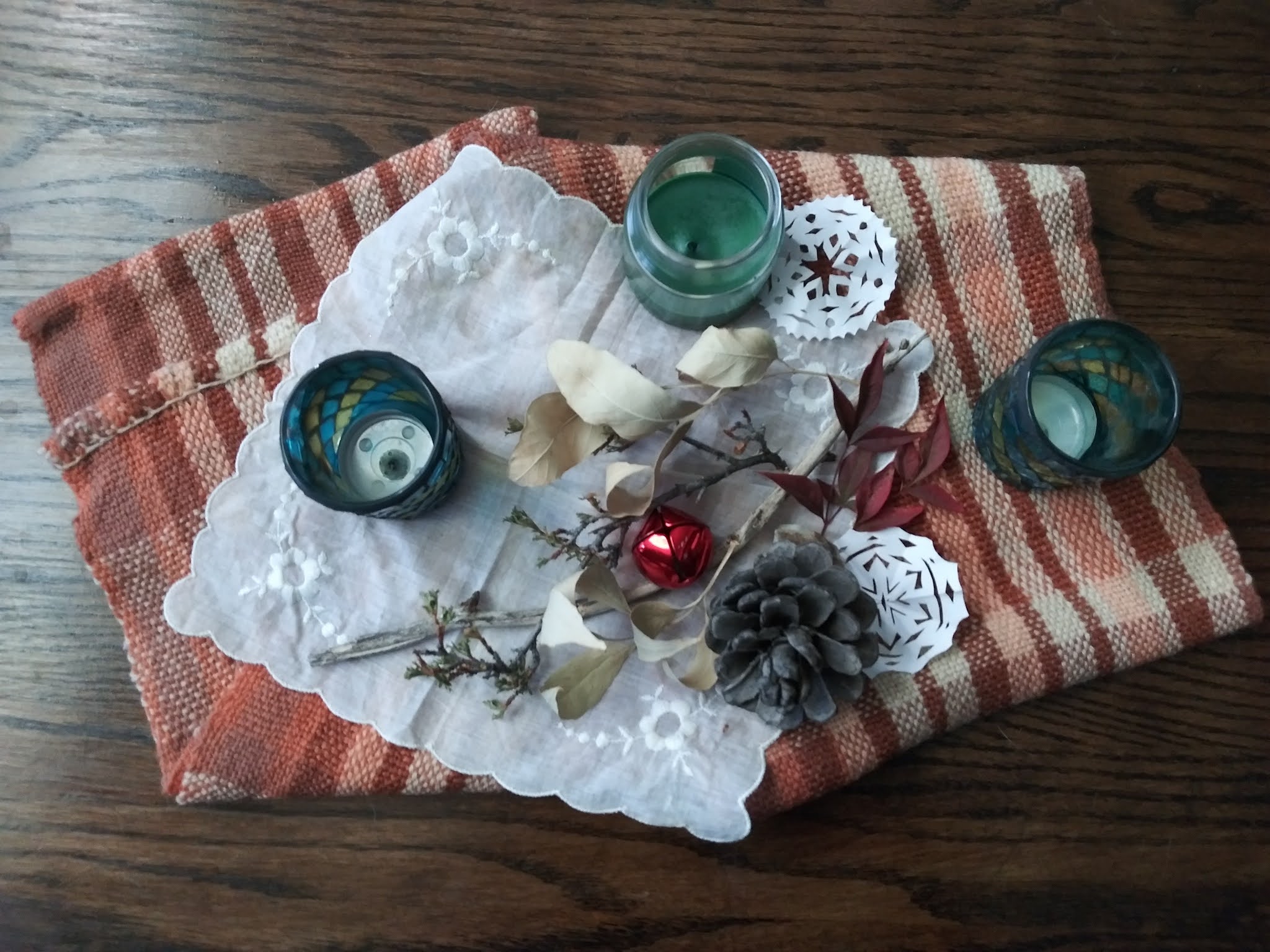
we were encouraged the day before to collect and arrange a simple little solstice altar for the occasion. 

mine is still on the coffee table in our cozy front room. I laid out a hand-woven scarf from my mentor Kelli Cargile Cook, a small wrinkly white handkerchief, three candles (one Christmas-scented), two little paper snowflakes, one red jingle bell, a pine cone and various other plant-bits from the walking trails near our apartment.

while I gathered all these things, I kept thinking about silver and gold. I untangled the bell from a long golden ribbon it had been tied to. the twig I picked up is pale, easily imagined like slightly-tarnished silver. the curled leaves look much more obviously golden in real life. and the brilliant embroidery thread of the handkerchief shines a little bit like precious metal. 


I don't remember the rest of the lyrics to the song, other than the basic title: Silver and Gold.

but I like the idea of using whatever we can to brighten some of the darkness this time of year. candles. sparkles. carols. 

during yoga church we came back a few times to a quote from Glennie Kindred. I don't want to merely regurgitate everything from yesterday into a blogpost here, so I'm posting just two snippets:

"...it is important to realize that this festival is not the beginning, in a linear way of looking at things, but a rebirth within a cycle in which the starting point chosen here is part of a vibrant whole. Therefore it is necessary to make a connection to what has gone before.

"Something old must die in order for something new to be reborn. This period of rest and darkness is a vital link in the cycle of life."

linearity vs. non-linearity is a (fittingly) constant source of pondering for me. it seems that the connotation of linear = straight, one-dimensional, confining, constricting. but I know that lines can be curvy and wild, too. a circle is also made of points on a line, sort of. 

it is easy to forget that, though. to make our stories about ourselves into stair-steps that only go one direction. 

yesterday, taking time to remember the bending arcs of things, the out and in, the back and forth-- that was very nice. our starting points and our ending points can be chosen. there can be palpable connections-- whether we make them ourselves or find them waiting for us-- to an infinite, cyclical, beautiful whole in each seemingly-insignificant little moment.

Monday, August 24

little by little

here is the front of several hours of weekend weaving. five different yarns. green cotton warp thread. the weaving itself is probably about three inches high. not sure how many rows of weft, total-- why would I count?

and here is the back:

I made this frame loom from one of the frames my dad and I made a few Christmases ago, which was itself made from old baseboards out of an old building. 

The Weaving Loom blog has been very helpful for instructions and inspirations. 

I have four or so more kinds of yarn I've pseudo-planned to add in. some cream, more yellow, two shades of red, and a little more variegated. it's hard work, weaving in and out and around. I'm excited to see how the design develops.

I took the photos with the weaving at the top, but in practice I'm weaving from the bottom up. I wonder which way I'll want to display the thing when it's done. whenever that is.


--

as a postscript, here is a photo I'd forgotten I'd taken of another Audre Lorde poem.

When you are hungry
learn to eat
whatever sustains you
until morning
but do not be misled by details
simply because you live them.

Do not let your head deny
your hands
any memory of what passes through them
nor your eyes        nor your heart
everything that can be used
except what is wasteful...

Saturday, August 1

birthday weekend, or an excuse for photographs

today, at least according to his paperwork, is Hamilton's birthday.

there are a bunch of August birthdays in my family. my paternal grandma (the one who first taught me to knit) will turn 81 today, I think. my genius brother's birthday is in another week or so. and my sweet husband's is at the end of the month. so much to celebrate.


this is one of the very first photographs I took of the puppy, when we first brought him home in mid-January. he was skinny and timid.

now he is about ten pounds bigger and only very rarely timid. he is a good companion to Wesley and most of the time to us.

Wesley's birthday is sometime in April and I never have been told the precise day. maybe it should be April 1, for symmetry. next April, he'll be a lucky thirteen years old.


even though birthdays are just regular days and they don't really need all the pressure we put on them to be glittery and special, I ordered new nametags for both the pugs today. we've been meaning to acquire them anyway, for almost seven months now, so a birthday may as well be the prompt that gets it done. and hopefully they come in the mail soon, despite all the semi-horrifying corruption etc. that seems to be going on with the US Postal Service lately.


this last photo is Hamilton as of today, in one of his favourite spots under the chair I sit in to work. sometimes he's a perfect angel under there, quiet and content to chew on his toys. sometimes he is a hooligan who can't sit still and just wants to chew on everything but toys. but I guess we all have our angelic moments and our hooligan moments, sometimes quite close together. Hamilton is a good pug anyway.

Friday, July 24

land acknowledgements are not enough

when I wrote this post about how differently temporary some things are, I wasn't thinking about colonial ruin and the violent displacement of Native peoples.

my relative ignorance about that violent displacement is something to blame on my undeniably privileged upbringing.

when I wrote that 2013 post, I was moreso thinking about the fact that because humans and our vehicles move around at such a (one might say violent) pace, birds and squirrels must get out of our way or risk getting squashed.

this makes a pretty awkward, and in some ways even terrible, metaphor, I know. it's at least something to start thinking with, and hopefully move beyond.

I wrote in that post that "places themselves... they seem to always be there. to always have been there. but even here wasn't quite how it is now, once upon a time. this town and all the other collections of civilized life had to start somewhere. the static only seems static as a backdrop for all the movement and life and craziness. relatively."

this way of phrasing the seemingly "always there" nature of my world-- this way of looking at things-- it erases so much. not intentionally, of course, but it does-- similarly to how the movements of humans and all their stuff so easily overlooks, disregards, and damages the natural world, erasing what it is and might have been-- selfishly reshaping it all into roads and buildings and infrastructure.

there is that troubling metaphor again though, where it's 'humans' who erase and reshape, actively, and always nature' that is erased or reshaped, passively.

that's too simple, too vague, and if I follow that metaphor through, it's offensive in equating Native people with silent, inert, passive nature. so let me say it better. for one thing, Native people aren't gone. despite countless instances of rhetorical erasure and systematic disenfranchisement, they're still here living and working and making. these people have not been completely erased in reality, but we so often erase them from how we think about our country, its land, its history, its future. and that kind of thinking should stop.

for another thing, 'nature' (whatever we really mean by such a monolithic term) isn't truly so inert or passive--not even the rocks or dirt underneath all our feet and roads and infrastructure--and we shouldn't reduce the powerful grandeur of nature to a mere backdrop on top of which we can do whatever we want without consequences. the non-human all around pushes back in unexpected ways. we're all connected.

it would be nice if we all recognized the connections and acted accordingly. unfortunately it's way too easy, especially when wrapped up in a bubble of comfortable privilege, to erase the connections that feel too inconvenient to think about. too easy to assume that we've earned all the comfort we have, and that others deserve whatever discomfort they are facing. but the truth is that we haven't, not totally, and even if we can say we have, would that make it okay for our comfort to come at the expense of so many others? I hope not.

I was prompted via this Michigan League for Public Policy challenge to revisit this map that shows roughly the boundaries of various Native tribes' lands. they have a note on the site about publicly acknowledging whose traditional territories you stand on, as I have heard conference speakers do at the beginnings of their talks many times. I want to read more about this and think about how to follow suit in a meaningful way.

where we live now, in the middle of Arizona, happens to be right next door to a bunch of land that belongs--traditionally and officially--to the Yavapai tribe. fourteen hundred acres or so, reserved for the Yavapai tribe by the US government in multiple stages starting in 1935.

on some of that land, there are department stores and pet stores and a movie theatre and a sushi place, I recently learned. there is also the stereotypical casino resort, high on a hill overlooking this majestic desert valley.

and the name Yavapai is everywhere. the county is named for this tribe, and by extension the local community college and various streets and districts and businesses and services, too. but do all the things named Yavapai really count as acknowledgement of the people whose land this was and is? do those street signs and advertisements with the word Yavapai on them help prevent anyone from erasing actual Yavapai people from how we see the land, its history, or its future?

{image of the Yavapai tribal flag, borrowed from Wikimedia }

I'm definitely not going to solve all the problems and injustices caused by centuries of colonial horribleness in this blogpost. mainly I wanted to write this to reflect on past ignorance and to make a record (for future me and for whoever happens to read my musings here) of how I'm trying to process my own role within a system of colonial, racist horribleness.

there is plenty I still don't understand and possibly never will. for some of my ignorance, I have no excuse. for smaller fractions of my ignorance, there are plenty of flimsy excuses. so much of this precedes me, and I didn't choose to be born and raised in this system of privileging people who look like me at the expense of people who don't. most of the stories I was told as a child had white explorers, mountain men, and pioneers as the heroes. Native people were most of the time mythical villains, if they featured in those stories at all.

none of this excuses me from learning about this now and figuring out what to do about it now. there has already been so much violence done over this land. physical and rhetorical damage. intentional and unintentional damage. I can't necessarily undo it, but I can start learning enough to undo my own ignorance and stop myself from participating in any more of it.

the very least I can do is work on telling different stories. stories that don't erase (or worse, vilify) these fellow humans. I'm not totally sure yet what that looks like, but I think it starts with seeking out those kinds of stories. rich, complex, beautiful, human stories. local stories, hopefully. and seeking out stories is easy enough these days; two seconds of googling has given me half a dozen lists of "awesome/great/best indigenous podcasts" to listen to:


so that's what I'm going to try to do next. more listening, less separating myself from the stories and perspectives of my fellow humans. it might not feel like much and it might not make any kind of huge obvious difference. but those are flimsy excuses for not trying to do something, anyway.

Wednesday, April 29

generosity and gratitude

basically we have one week left in this quaint little Louisiana town.

no, we haven't managed to sit ourselves down to watch Steel Magnolias yet. should we still try? (part of me does want to.)

one week!

and there is so much to do. food to use up from the fridge. piles of things-we-don't-need-anymore to organize and donate somehow. fragile dishes and art and knickknacks to wrap and stuff into boxes.

if times were even a tiny bit more normal than they are now, we'd have a goodbye party. we'd schedule in plenty of time to visit one last time all the friends we've made here. we'd go out to that Mexican place one last time. have another end-of-semester karaoke thing. 

but times are not very normal. so instead of all that... what will we do?

I'll distantly and carefully turn in my office keys next Monday morning, distantly contrive to drop off  a few spare houseplants and some spare yarn at a few dear colleague's doorsteps, and perhaps write short goodbye notes to leave in everyone's mailboxes on campus. I'll assume, for now, that campus will return to something like normal eventually.

right now, there are thirteen days until grades are due for Spring 2020. not long after that, my contract with NSULA will officially end. the summer will start to uncurl and stretch its scaly paws, and I'll have three months to play and write and daydream before my next job starts in August. will those three months go by as slowly and weirdly as the last eight weeks have gone by?

right now, I am lucky. my contract with the new institution was signed a few weeks before all of this happened. we've been able to find a new apartment and afford all the headachey moving expenses, so far. I can do my job remotely, for as long as I have to, without too much trouble.

we are lucky, so far. 

my students? most of them are hanging in there, keeping up with things despite everything. this semester has been the opposite of ideal in about a thousand ways. it's been seven weeks since normal classes in normal classrooms. some learning opportunities have worked out okay and many others have not worked out very okay at all. but by now we've adjusted our earlier definitions of "okay."

through all this uncertain weirdness, I've tried to be as generous and patient and responsive with all the students as possible, even moreso than usual. I don't know yet how that generosity is going to finally and concretely translate into course grades next week. I hope to still see evidence that learning about professional writing has been attempted by all the students, whatever else is happening. I hope to read some thoughtful and thorough reflection from everyone before the end. learning is more important than grades.

despite all the important considerations reflected in this recent post and this less-recent post, I'm not sure if all my students will pass or not. I'm not sure how far my responsibility to be generous right now extends in relationship to students' responsibilities both pre- and post-pandemic. maybe all of these things need their definitions adjusted, too.

I haven't read Kathleen Fitzpatrick's (who keeps a very nice blog) new book Generous Thinking yet, but I want to. the whole idea-- generosity, open collaborations, re-imagining our institutions so that they serve more people more equitably-- feels so lovely.

despite the loveliness, I can't help but ask questions. who can afford to be generous and in what ways? what are the little hidden costs of personal generosity? it seems so cynical to ask such things.

in terms of my students, I can definitely afford to be outrageously generous about their grades. I hope the students and their brains can afford it too.

in terms of everything else, I can probably afford more than I think I can.

right now, there's just enough time to ponder everything I'll be leaving behind next week. there's time to feel a few puddles of regret and a whole mountain range of gratitude. we haven't been here long, but friends and colleagues and students and neighbors have been very generous to us. lucky. grateful. and hopefully, in my own ways, just as generous.

Friday, December 20

commence contentment

it feels like I used to have so much to say. I was just ambitious enough to be confident enough to recognize all my self-doubt and still ignore it.

is ambition something you grow out of? it does seem easier to have when you're young--when you haven't yet heard so much of what other people have said or thought or done, the world feels so much more ripe and open for everything your little human brain could possibly imagine into it.

and then you grow up, and get tired, and everyone around you and before you is doing so much already. how can you keep up?

I know it's a bit silly to worry about keeping up. I'm in my own lane and it isn't a race anyway. 


today I attended fall commencement at NSU. gymnasium full of chairs, lots of bright purple, congratulatory speeches, cheering, decorated mortarboards, lines and lines of accomplished humans, etc. the music was gorgeous, too--a string quartet and a vocal quartet performed excellently during the processional, the anthem, and the alma mater. I came away from it all thinking about the value of letting yourself appreciate things as fully as possible. that might become my mantra for 2020: appreciation.

I never attended my own college or grad school commencements. I probably didn't miss much, really. it just now so happens to be part of my job to go and sit with the other faculty and applaud on cue. it's nice to feel like a part of something and to pay attention to all these students' achievement.

the speaker this year was Denise Lewis Patrick--prolific writer, Natchitoches local, and 1977 alumna (she has a blog too, such as it is). I appreciated her talk for its down-to-earth encouragement and its brevity. she spoke about all the post-college things she'd learned--about people, organizations, and changing technologies. she promised today's graduates that they would similarly need to learn many new things, no matter how prepared they might feel for their futures.

feeling prepared might be a little overrated, anyway. how much ambition does a person really need in their life, after all? I might be just fine with a little contentment now and then and a decent supply of curiosity.

Wednesday, August 28

fall semester, 2019

ten days into fall semester. it's been a bit of a rough transition from lovely summer travels to four new sets of students and curricula and work routines and everything.

for the official blog record, here's everything I get to teach this fall--

English 1020: Composition & Rhetoric II
an entirely new course for me, more or less. last time I taught anything like this was spring 2013 at Texas Tech University. I'm a much different instructor at a much different institution this time. but I think this class will be fun-- one of our projects involves writing about some of the opinions/controversies on the Change My View subreddit. each student is also choosing a theme to research and write about over the semester. should keep things exciting for us all.

English 3230: Technical Composition
this is my seventh section of this course. oddly, I've only got the one Monday-Wednesday-Friday section for this semester. 15 students, 15 weeks left. I've switched up a lot of things for this time around (including our textbook), so it's been more work to prep for this time around. ah well. we're doing our team project first, then instructions, then resumes, etc. hopefully plenty of useful learning happens.

English 3610: Intro to Digital Cultures
this is the undergraduate version of my graduate course, Engl 6560, last spring. different readings, a lot more hands-on things in our face-to-face classroom. yesterday I had students compare/contrast working in Google Docs vs. Word Online vs. Graphite. in future weeks I want to have us play around with wikis, twine, glitch, twitter threads, terms of service, interface design, maps, social media, and maybe some of these activities too. 
 
English 5220: Technical Writing
this year, I'm teaching this graduate course to 9 students instead of just 2. it's my one online class this semester, and it should be great. we're using Solving Problems in Technical Communication as our main textbook, and we also get to read (or listen to) all this great stuff:
most of these are the same readings as last year, but I added that final one after discovering it this summer, and several of the podcasts are new additions also.

ten days done, most of four whole months left to go... 

Thursday, August 2

reflect, revise, reset

I am preparing to teach an online technical communication course for a handful of graduate students.

it is an exciting and slightly daunting prospect, and I'm really grateful for the opportunity. teaching online is fun. teaching graduate students will be new. hopefully I will love it. hopefully the students will love it too, at least a little bit.

as I've started putting together assignment sheets and syllabus sections, I've gone back to the files I have from my first semesters as a graduate student, way back seven years ago. my experiences from then are inspiring my preparations now in a messy but helpful sort of way.

the class I will be teaching is not going to be exactly like the first technical communication course I took in 2011. there are no PhD students at my new Louisiana institution, and there isn't quite a full tech comm graduate program, either. we offer a certificate in Writing for Business, Industry, and Technology and a related MA degree in Writing and Linguistics. my work here will fit into the little tech-comm-shaped niches around and among those programs and the offerings for our undergraduate emphasis in professional writing.

it's been interesting to look back at the work I did as a brand new graduate course and revisit the thoughts I was thinking about everything I was learning. one of the essays I turned in to Dr. Kelli Cargile Cook at Texas Tech in 2011 starts out, after one boring sentence that sets the stage, with a million semi-rhetorical questions:
"Who is qualified to create or enforce a definition of technical writing? In the face of rapidly changing technologies, will a static definition be at all important or useful? What is the clearest, most accurate way to make sense of our place as people who write and communicate among extremely diverse communities? What commonalities among those communities are worth emphasizing? Are any of the basic truths about technical communication universal enough build a profession upon? Will it be possible to include all the essentials without being completely vague? These questions and many more continue to shape the process of figuring out who we are, what we do, and why it matters."
that's six questions, all crammed into one opening paragraph. another professor of mine, Dr. Richard Johnson-Sheehan, always gave me pointed critiques when I included too many rhetorical questions in essays for his courses at Purdue: "your reader is going to lose patience with these," he would say, implying his own quickly waning interest.

I think I've learned to agree with him, by now. I do still love questions, but I understand now that they can be a tiresomely slow way to introduce one's main point.

one day soon I may remediate that whole long, rambly essay into a less-long, less-rambly blogpost. that could be fun. for me anyway. possibly useful for anyone out there who might wonder what I really think I'm doing with my academic life, too.

definitions of technical communication (and of rhetoric, or writing, or art) are still, forever, being debated. my own place in this disciplinary debate is still debatable too. malleable. amorphous. emerging.


I know a lot more now than I did in 2011. and I know much, much more now than I did seven years before that when I returned from studying abroad, declared myself an English major at Utah State University, and eventually started this blog. a whole decade and a half of experience has ways of teaching one things. sometimes without you even noticing.

it's August, 2018. new things are happening. the world and me look so different than they used to. it feels like a beginning--expansive, wild, wide, and uncharted. a chance for new rules. better habits. but it's hard to know what the best new habits might be. so much of this new life is going to be unfamiliar for a while. disorienting.

teaching experience and academic credentials have piled up on top of me over the years. those things have given me some grounding amid all the chaos of finishing one thing and beginning another. the transition has felt long. May 18 was almost a dozen weeks ago, and my new semester at Northwestern State is still weeks away. as much as this feels like a beginning, it's just as much middle, and partially an ending, too. as soon as August 4 gets here and Purdue's commencement ceremonies are over, I'll officially officially be Dr. Amelia Chesley, with a real PhD and a diploma in the mail, with an exciting tenure-track job as an Assistant Professor. soon enough I'll have this office in Keyser Hall arranged just how I want it. I'll have a phone in that office, and faculty meetings to go to and everything. 


I still have a million things to learn, at least.

Monday, August 21

fall semester, 2017

if all goes as it supposedly should, this will technically be my very last fall semester as a student. I am not sure how I feel about that yet.


I think I feel less optimistic than I was feeling last fall. this year is so different, so pressure-filled. so seemingly monumental in all its changes and changing. a final year. slipping away already. counting itself down from 11 months and a half to only 11 months and a quarter, just like every year but also in an extra-bewildering way now. the idea I can't help but swirl around in my head over and over again is: there will never be enough time.

and maybe that idea is right. but also... maybe... I'll deal with my finite amount of time just fine.

I will have to. we'll all have to, and so it goes.

today's writing music: Solar Fields
today's re-reading: Kathleen Fitzpatrick
and today's prooflistening: poetry

Monday, July 31

sharing

as of two weeks and three days ago, this is our new place.


it is a very nice place, freshly painted with all the windows and light my plants and I could ask for. and it is where we are finding places to keep our things. old things and new things. some things that once were mine and some that were once his (and a few that were once other people's, too), most of the things don't really need those separate pronouns anymore.


the dog is ours. the furniture is ours. the dishes in the sink are ours. I have hung clocks on at least one wall in every room, and there are piles of books and notebooks on at least three different tables.


we still don't know where (or if?) to keep our bikes, there are shelves that don't have anything on them yet. but most of our things have settled in with us now. and we get to share this balcony and a bench swing here, for one more year of phd-ing.

Friday, November 4

the $10 founding father without a father

I have two of the loveliest friends to thank for originally exposing me to Hamilton: friend Liz, who teaches high school English around here, and friend Patti, who is a fellow Purdue rhetoric & composition scholar. they are both kindred spirits of sorts-- fellow English major geeks and appreciators of much beautiful and random culture. Liz and I go see Shakespeare whenever we can, and if Patti lived closer we would be religiously watching Elementary every week.

I clearly recall the day last spring-ish when Liz mentioned the fact that someone had made a hip-hop musical about Alexander Hamilton and asked if I wanted to hear some of it. we had crafts in our laps and the soundtrack on her phone, hooked up to bluetooth speakers.

it's intense, this music. relentless, rushing, and deep. and smashed-full of intricate lyrics. if you haven't listened, you must. go listen.

Patti and I binged on Hamilton the whole drive to and from New York last summer. I remember being so excited to see the two-disc album in her sack of CDs. reading the liner notes while she drove gave me such headaches, but it was worth it as the price to pay for familiarizing myself with all the layers and nuance of Lin-Manuel Miranda's wordsmithery.

some months ago, on our trip back from the beaches of northern Michigan, I forced dear Jeremiah to listen to the whole soundtrack. he had been skeptical, and as a human who is often quite skeptical of the celebrated and the hyped, I cannot blame him for that.

luckily, once he heard the masterpiece he was in love with it too.

we decided to get tickets to see the show in Chicago. they were not cheap, but life is short, right?

there was quite the countdown from the moment of that decision to the night of the show. in the meantime I spent too much time reading through annotated lyrics. I discovered this ridiculously amazing tribute of a podcast series all about Hamilton (thanks friend Beth for that tip). and Liz and I got together to watch the Tony awards, to see the cast and crew and producers of Hamilton win lots of prizes.

and then there was also a PBS documentary about the making of the show, and about Hamilton himself, and about America. it was beautiful, and you can watch it online up til November 18th.

last weekend, the day arrived at last. we took the train into the city, dined at the oldest Italian restaurant in Chicago, took selfies in front of the marquee, and climbed a lot of stairs up to the balcony of the theatre. 

there were of course piles of merchandise for sale: totes, hoodies, program books.

what will I put in this tote bag? maybe it will be the tote bag I take to the library, for books and audiobooks and such.


right now all it has in it is the fancy program book and the less-fancy playbill. fancy glossy perfect-bound program book has excellent photo arrangements of the original Broadway cast. it's gorgeous.


the Chicago show was also gorgeous. being so familiar with the soundtrack already made for a very interesting and layered entertainment experience. the Chicago actors are not the Broadway actors, so they all put their own little garnishes on their parts. there was so much motion and energy in the performance--a visual-kinetic counterpart to the rhythms and dynamics of the recorded music by itself. I found myself drinking in all the lighting decisions, the ambiance of the whole stage. at almost any time, no matter where the spotlights fell or who was monologuing, we could see silent actors at the corners of the action, in the background, walking past or sitting patiently. they didn't always have parts to sing or back-up vocals to add, but they were very there, as watchers.

I could probably write a lot about each scene, each song. but I'll spare you too much gushing and touch on my favourite bits from each half. the favourite moment from Act I came in a trios of songs: "Guns and Ships," "History Has its Eyes On You," and "Yorktown." this is how the Revolutionary War was won. this is where we establish the theme of history watching from an unreachably far, high place. that theme haunts the rest of the show, touching each character in very different ways. the whole sequence was simply masterfully orchestrated-- bodies, music, voices, lines, colors, contrast, tension-- and then the Brits surrender and it all dissipates into relief, crystalizes into jubilation.

it's harder to pick favourites in Act II. the whole character of Jefferson is delightful in his unflinching high-mindedness. I loved the stark, tenuous feeling of Hamilton's impending mistakes in "Say No to This." and I trembled and cried a bit at the very end of "It's Quiet Uptown."

I feel very lucky to have been in that theatre, with the beautiful, pathos-infused results of so many fellow-humans' creative work. how lucky we all are, to be alive to see such stories crafted and told so marvelously.

Tuesday, November 1

reviews previews

a few weeks back, friend Patti (who is, for your information, the most talented twitter-ist I have had ever the pleasure to follow on twitter) mentioned to me this alternative to National Novel Writing Month: one review of something for every day of November.

and so in a gush of bloggerly excitement, she and I decided to do it. I enjoyed the challenge of blogging every day for a month back in April 2015, and reviews are a thing I occasionally do here anyway. it shouldn't be too difficult.

so I made a list, to make sure I would have enough things to review. 30 whole things. some were very easy to think of, and some took more pondering. stay tuned-- I shall be reviewing shows (both stage and television), places, books, audiobooks, podcasts, food, recipes, restaurants, activities, and maybe some art. every day will be a little slice of something this Amelia has experienced relatively lately.

if I try, I may reach the heights of reviewing skill to which friend Melanie long ago ascended. Melanie's insightful pieces on film and literature always teach me something and urge me toward new interests and new stories. Melanie, you should join in our November review-a-thon blogging challenge too!

I'm kind of cheating today, writing a preview of the month and not technically reviewing anything specific yet (unless we want to count my mini-review of Melanie's reviews? that might count). but anyway, I've got to start somewhere. so here goes. happy November.

Monday, August 8

reflections on teaching online

the online summer class I've been teaching ended last Friday, when all the last final projects got turned in. as of five seconds ago, all the grades are tallied and posted and submitted. hurrah! two weeks til fall classes start...

did any sort of learning happen over those 8 weeks of summer term? on my end, definitely yes. I hadn't taught online before. during the spring and beginning of the summer I attended conference panels galore about online writing instruction. my wonderful mentor Kelli Cargile Cook spoke about the best practices she's developed and studied over her career. friend David Grover from Texas Tech presented on his dissertation research--all about how underprepared graduate students are when they get the chance to teach writing online. at Computers & Writing, I met the brilliant and generous people behind the OWI community website. so many awesome resources and inspirations. it was terrifying, but encouraging.

I was arguably more prepared (on paper, anyhow) for this course than for anything else I've ever taught in my life. most other things I've ever taught involved sticky notes with tentative 6-point outlines and thoughts, all scribbled down mere hours before the lesson. sticky notes don't work for online classes, though. instead, there were dozens of PDFs, a screencast video introduction, a website thing, bits of Blackboard fiddling, many many emails, and many Slack messages.

the slick, fancy Slack messaging app suggested itself as an especially appropriate online teaching tool for professional writing. I'd been hearing about the app on all the podcast advertisements, and I figured my bundle of Business Writing students could benefit from some exposure to it. with help from friend Michael, I poked around and tested things out and got everything set up just how I needed it for the various sections and projects of the class. hosting the whole class within Slack was disorienting for students at first, but most of them caught on quickly and enjoyed the interface. we didn't have quite as much fun as this Zach Whalen fellow seemed to have with his students on Slack, but ah well.

as the course got busier and summer ticked itself relentlessly into the past, I found myself wishing I could be sure my students were reading the announcements I made and the updates I posted. is there such a tracking device? my search just now brought me to this detailed list of Slack shortcuts and tips. there is a way to see who has logged in to Slack-- I'll have to explore that option next semester. it may or may not tell me who has read which channels. this piece might be something to share with students as they set up their Slack accounts for my class--hopefully they'd find it helpful. I need to remember the "reminder" function and the "pin file" function, for important information that students might lose track of too easily. the user-name policy also sounds pretty useful-- one way to maintain a sense of professionalism.

benefits a face-to-face class include students seeing each other and talking to each other a lot more, instead of merely performing for me and my syllabus of requirements. I'm not sure how well my students got to know each other. I did create an "off-topic" channel and let students have it to themselves (I checked now that class is over to find 4 lonely little posts there). our Slack space stayed very to-the-point and business-oriented, a place where work got submitted and readings got "discussed" within minimum wordcounts and with little dialogue. next semester, I'll have to incentivize more student-to-student communication and discussion. this boils down to an odd form of pandering bribery and forced-ness, which my soul squirms and recoils about just a little. I like to think that as an undergraduate student I would have been utterly happy to talk to my fellow students of my own accord (very not true). who needs incentives for that? but that's my vaguely-more-enlightened and far-less-shy gradstudent self talking.

my course was 99% asynchronous, and I so wished that I could have all 17 of my students in one channel at the same time. more focused, immediate discussion could have been way more useful. all the best online courses I've ever taken have included a synchronous Skype or chat-room element. but the way online courses are marketed in this program means students sign up expecting to work at their own paces and not expecting to show up to be counted at any particular time. because of that, I didn't feel like I could design a course with much, if any, synchronous discussion time in it at all. this summer, I asked students to sign up for one-on-one video conferences, so at least there'd be a sliver of synchronous discussion. this worked pretty well. for next semester, I may consider assigning small-group conference meetings, perhaps to discuss peer review work more directly. the institutional constraint here is a challenge to work around. perhaps it deserves to be brought up with my supervisors and program directors. we'll see.

this weekend I talked with a few potential community partners about linking my fall Business Writing assignments to their local, real-world business contexts and needs. it's lovely to know people who run small, local businesses in this lovely college town. wish me luck getting myself organized to incorporate some of those ideas for the next batch of scattered, disembodied online students.

Wednesday, February 17

shiny emerald wisps of inspiration

sometimes, though not so much lately, I feel like I am fighting inspiration off with a stick--making great efforts to do one thing at a time and actually finish a project before yet another wouldn't-it-be-nice-if-I-also... comes along to take me in some new direction.

inspiration, for me at least, isn't always the most useful thing. it can be distracting. or infuriating, the way it tantalizes me. I tend to be plagued with flighty, wispy kinds of inspiration. the kinds that hover just out of reach, just beyond practical-possible priority.

an hour or so ago I read this piece about teaching abroad. about the prospect of "relocating to a continent renowned for civil unrest, poverty, and disease-- but also for untarnished landscapes, wildlife, many cultures, and a complex history." high daydream potential, this sort of thing.

and yes, some of the descriptions in this piece are on the sweeping, sensationalish side. but you can at least see what I mean about the distance stretched out between me and such prospects. this inspiring stuff always seems to float just six inches or so higher than my hands seem to reach-- things to daydream about but not things I could actually do-- not yet anyway. and perhaps that's the way daydreaming is supposed to work. before you can reach a thing with your hands, you can settle for reaching it with your brain. imagining it. a first step, of sorts.

on Monday I attended a very nice talk by a former professor of mine: Dr. Cheryl Ball. she taught my professional writing capstone course ten whole years ago. since that far-away semester, she has worked at three other institutions and done many more boundary-pushing academic things. she taught and researched in Norway on a Fulbright scholarship. she is developing this fancy-looking revolutionary publishing system.

sometimes inspiration starts out as envy.

or maybe they are secretly long-lost twins, envy and inspiration. yeah.

anyway. the talk on Monday was about digital humanities + digital publishing and the paths Dr. Ball has wandered in getting to where she is now. now she is scholaring in an emerging field she calls publishing studies, a place full of multimodal and digital work, editing, technology, infrastructure, and lots of other finicky processes that have to do with making things public.

she began the talk with childhood tales featuring inspirational words like vision and initiative. and she ended with this slide, of which I took a crooked and slightly fuzzy photograph:


there are, I saw on facebook earlier, several much better photos of Dr. Ball's visit to Indiana in an album here.

her concluding list of lessons learned isn't earth-shatteringly inspirational in general, but in this specific sub-section of academia it counts. for me, swimming in semi-aimless circles in the middle of my PhD, it very much counts. so I have typed these points out again for ease-of-reading and for the thought-provoking reminders they might be to my current and future overly-inspired but somewhat lost, less-motivated self.
publishing studies has taught me [Dr. Cheryl Ball]...
- editing praxis for media-based texts
- the arbitrariness of style guides
- the ethics of access/ibility and preservation
- the importance of building communities and infrastructure
- the importance of global communication practices
- the necessity of teaching writing in use-contexts
- the necessity of teaching multimodal communication
- that vocational training isn't a dirty word for liberal arts.
there were examples and stories referenced at each of these points, but stories and examples are not as easy to transcribe into a neat list. I will have to trust my memory to weave the stories from her life into and alongside stories from my own.

the paths I'm wandering aren't the same. ten whole years is a long time and lots of things are different in the world. the wouldn't-it-be-nice-ifs that I follow around (or don't) will be unique to my brain and my habits.

at the moment, one of the wouldn't-it-be-nice-ifs that I have wrapped my fingers around is reading audiobook snippets for LibriVox. I have an official page in their catalogue as a reader, even. I've only just started. the project is wide and ambitious. it's not the exact same kind of digital publishing Dr. Ball presented, but it is a digital publishing project nonetheless, and a fascinating one. we'll see what it teaches me.

Thursday, December 31

let the future take care of itself

presents. gifts. nows. time. times here and there. I am thankful and hopeful. it's easy to be that during these weeks of break, during this time of low obligation and high relaxation, of sleeping in and plenty of yoga and not having to go out into the dreary snow-spitting outside unless you really want to.

I am reading Camus' The Myth of Sisyphus. friend Chris sent it to me and said it was very me. I am not far into it yet, but I can see what he means. it is also reminding me a lot of my posthumanism class from last semester.

the blurbs on this paperback call Camus lyrical. and eloquent. it is a stolid kind of lyric eloquence, I think, almost plodding but just light enough to not feel like twenty pounds of paving stones.

"At the heart of all beauty lies something inhuman, and these hills, the softness of the sky, the outline of these trees at this very minute lose the illusory meaning with which we had clothed them, henceforth more remote than a lost paradise. The primitive hostility of the world rises up to face us across millennia. For a second we cease to understand it because for centuries we have understood in it solely the images and designs we had attributed to it beforehand, because henceforth we lack the power to make use of that artifice. The world evades us because it becomes itself again." 

and that reminds me of this quote:
a quote I read in Richard Power's Orfeo last summer when I should have been studying more dutifully for prelims. "Dissonance is a beauty that familiarity hasn't yet destroyed."

it comes at the same thought Camus does, a little bit. the unfamiliar is some necessary core to beauty. and alienation is part of that.

I have almost the whole Camus essay still to read though. there will likely be more quotes from it tossed into my everything notebook, as I read.


these are a $2.50 pair of goodwill shoes that I bought just before a Saturday lunch date last February. they are still sitting in my pile of shoes at the bottom of the stairs, but I think they are beyond wearing. too smushed and stretched and scruffy, lacking all the sturdiness a wearable shoe should have.

these are a not-quite-as-cheap-but-still-cheap pair of flipflops that I bought in Hawaii in 2009. I wore them past the point of unwearableness, until the sole of one split in half and tripped me as I crossed a busy intersection one day. these are not still at the bottom of my stairs in a pile of other more wearable shoes. I took photos of them and threw them out that very day.

I took photos of these trashed shoes because... because why? they seem sort of beautiful. though maybe that is more due to the backdrop of my autumn porch. I'm not sure. these shoes took me places. they became ragged and deteriorating and a little bit grimy, and thus more interesting.

time. nows. things that are here right now won't always be. shoes get worn out. everything does. there isn't any easy way of un-wearing shoes. newness. presents.

I have plenty of shoes and don't need any more. plenty of books, maybe, and for a week or so plenty of space for dreaming and sleeping in, too. what do I need? what wants will accompany me into a new January? which ones will got met and well-traveled and worn? good questions.