Showing posts with label cryptic. Show all posts

Saturday, July 25

follow the clues

whenever I see these spray-painted street markings, it reminds me that someday I want to write a story in which very important and very secret messages are hidden in plain sight alongside these boring-but-mysterious codes for construction workers.

street markings in white, red, blue, and yellow

don't they look like they could secretly be pointing the way to some amazing treasure or a secure rebel hideout or rendezvous point?

the trick of successfully hiding your heroes' secret messages among such mundane non-secret signs would hang on how well the secret codes can balance blending in with the real marks and standing out from them at the same time. you wouldn't want to mislead the construction crews with marks that looked legitimate but didn't provide any meaningful information. you also wouldn't want too many random suburbanites getting in search of a garage sale that didn't exist (although depending on the stakes for our rebel alliance's secret missions, this actually might be an acceptable cost).

I've also daydreamed about the heroes of this story sending coded messages via weekend garage-sale signage or random highway-side propaganda posters. or maybe in the windows of an old car in someone's side yard-- "For Sale, 255K miles, $600, 555-251-9839" could be the master key to deciphering the next series of secret codes. if the car is facing west, decode everything backwards instead. and if any innocent party calls the phone number, nobody will answer.

it's fun to think about this kind of covert-messaging-in-plain-sight. in a sense, all the spray-painted lines and shorthand markings on the street are already a secret code. not a very important secret, but more or less black-boxed from most regular everyday people. these marks have a relatively narrow audience, and the rest of us either ignore them or create elaborate daydreams in which an even narrower audience can read beyond their surface meanings and thereby figure out where to safely deliver some top secret packet of highly incriminating evidence.

to make sure our secret agents can reliably distinguish and decipher the messages intended for them, would they have to become fluent in all the regular street marking conventions of their region? in that case, this piece from the BBC could be useful.


street markings in white, three shades of blue, and yellow

seeing enigmatic secrets like this in mundane, utilitarian stuff is a little Dan Brown-esque I suppose. I promise, if and when I write such an adventure story, I'll try my best not to make it so blatantly sensational and pulpy.

Thursday, June 15

re-reading and un-liking stuff on twitter and elsewhere

yesterday I did some re-reading. first, I re-read six months or so of things I've liked on twitter. a confession: sometimes as I skim through things I once liked on twitter, I end up un-liking things I once liked in the past. liking never has to be permanent, does it? nothing is permanent. some twitter things are not things I feel like my likes need to stay on-record for. is that okay?

second, I re-read three months or so of my file of semi-daily meta-scholarly writing. it was good to remember some of the fun, inspired conference notes and see little inches of progress on projects. that file is 370 pages long now. messy, and not truly daily, but still an accomplishment.

I'm sure most of the stuff in that file is sixteen thousand times more boring to the world than most of the stuff I've liked and not yet un-liked on twitter. if we could quantify boringness, anyway.

the twitterings that I like on twitter seem to fall into pretty clear categories:

1. there are links to things that exist and that just seem wonderful--


2. there are lovely impressive and/or brave pieces of micro-blogged inspiration--


or do some of these count as lessons? instructions, perhaps?


3. there are cool, amusing blips of nothing all that important--


4. there are attitudes and ideas that I find myself agreeing with, resonating with--
that is a valid life goal, right there. don't leave blank pages at the end of your documents, people. it's all part of that "paying attention to the world" thing.


and 5. there are links to longform stuff that I imagine I'll go back to read later--


sometimes I do go back and read them. sometimes I change my mind when later arrives. sometimes I forget entirely. I can't read everything. and twitter is not really meant to be a bookmarking service. but I'll use twitter however I want, okay?

Tuesday, September 22

hapax legomena

I watched this latest vsauce video last week. it's full of numbers and words, fractions and graphs and corpuses of text. vsauce videos are always interesting, but this one was particularly full of things that made me think of other cool things.

it is neat to see that Jonathan Harris's wordcount still exists. not much from nine whole years ago looks the same in this internet place. nine years is a long time. but "plaid subdue glinted zoology" is still what shows up when you search for plaid. I thought for a minute that "zoology" would surely have been a hapax legomenon on this blog here, at least until today. but it actually shows up here, too.

what the hapax legomena of this blog are, I don't know. are there any? there must be. or do I talk too much about all the same stuff?

with this video, Michael from vsauce has ruined forever the hapax legomenon-ality of the quirky little adverb "quizzaciously." there is a whole sub-reddit about it. and www.quizzaciously.com is a website now.

craziness.

people do some pretty fun things with this internet stuff. I wonder what the chances of getting a grammatical sentence out of twenty random common English words is. quizzaciously.com has given me none so far. but maybe if you add some punctuation to them, it would help.

"an by look on, get even; some have--about no... at could--than when an what a say have." maybe?

someday it could be neat to ask students to write an essay using only some number of the most common words in English. I once pondered teaching a writing class using Mark Dunn's Ella Minnow Pea. I'll plan for it next year, perhaps, when I get back to English 106. I've never taught using fiction before, but I think I'd like to. it'd be different. and different is fun. Ella Minnow Pea is an adorable example of not only how ideologies have huge consequences on how decisions get made, but also of how limits are always possibilities.

just look at that Randall Munroe guy. he's writing a book to explain stuff. it's one of the first thoughts I had upon watching the latest vsauce. words and numbers and complexity and commonness. Munroe wrote a blog post introducing the project here. I wonder how the translators will handle this project. will they be bound to using the ten hundred most common words in whatever language they're translating into? I would assume so. how tricky.

Monday, April 13

thirteen: unlucky

not even the heady scent of fresh-mown grass or the sweep of springtime clouds and breezes--not even a strawberry ice cream cone--none of it, nothing--has succeeded in lifting me up out of this well (deep, deepening, deeper than yesterday) of what if why not when where how not why which who why why not but why. I am choking on feelings. smothering.


there are no stories in this. no sense. the universe is sinking me.

Thursday, April 9

nine: on purpose

more rain. more puddles. more lightning. different thunder. 
I took these photos yesterday. one of them on purpose, the others unwittingly as I walked with my camera-ipod in hand, an old-ish episode of On Being playing behind all the dripping sluicing splish splash of relentless spring showers.

so they are blurry.

they are even more wildly-angled than my usual random photography.

if you have been here on this walk between this building and that building on Purdue's campus, you might recognize it, despite its blurred and tilted representation here.

or maybe you'll recognize something else. the whirl of a crammed Thursday. the dizzying shift from skin-slicing pre-spring chill to muggy pre-summer heat. or the anxious looking from here to there and up and back and up again, wondering who and what and how you will meet and introduce yourself to the future.

Tuesday, April 7

seven: the study of the true sense

I looked up the etymology of the word etymology a few days ago. and then I remixed that etymology into the title of my last paper-day paper for Postmodernism class. this was last week, at the end of March, which feels very long ago now.

the title was:

"the facts of the origin and development of the true sense of the study of the facts of the origin and development of the facts of…"

and then the rest of the page (legal-sized, remember) blathered on about origins and developments and traces and representations and categories and lines and labels. I read this page to my class as I sat on the floor. to add to the performative interactivity of the whole thing, the copies I'd printed for my classmates had been carefully perforated with the edge of an old pair of scissors. while I read, they could peel and tear and open my legal-sized page into a long, twisty ribbonloop.

to reproduce this page as a blogpost changes it quite a lot. you can't peel these bits and pixels apart the same way you can paper. sorry.

but I can add stuff (like this rambly new preface) and tweak bits of it and take things out that don't fit the new medium here, in a way paper and ink do not quite accommodate. so there's that. you'll have to imagine me on the floor, reading to you. and imagine the feeling of paper tearing in your hands.


the etymology of the word perforate takes us back to dear old Latin, as so many etymologies seem to do. via Middle French we arrive at two neat word-trios of infinitive verbs and prepositions: "to bore through.” “to pierce through." pair with these the resulting perforation: "a hole made through something" and that very specific preposition starts to pattern. it’s right there in the per prefix: "through." and it’s implied in the other half too: forare, "to pierce."

the origins and developments of postmodernism... how do those get represented? do they represent themselves? or does someone/something have to step in as representative? we access postmodernism through others’ words and others’ ideas. so far. and even the ideas that cocoon postmodernism are not here in front of us. we can't touch them. we access them through. Saussure through Foucault and Derrida. Foucault and Derrida through Vitanza and Spivak and Berlin. we are looking at a thing (is it a thing?) called postmodernism, but not directly. maybe we’re stuck in a cave. maybe Berlin is putting on a shadow-puppet show. and we are looking at (is it at? along? or into? around? under? which preposition is the best?) an idea called postmodernism through books and essays and art and memes and emoji. we are looking (are we looking?) at this postmodernism mist through our own arguments and faces and looks and voices and brains and time and pencils and paper and chairs and walls and space. does it all become part of postmodernism as we go? I wonder where our lenses and our specimens begin, or end. is there a recipe we can follow when we want to start mixing the message into its medium?

Victor Vitanza, from his article “‘Some More’ Notes, Toward a ‘Third’ Sophistic”:
We have categories so that we might ‘destroy’/’disperse’ them by allowing them to engage in a sophistic-rhetorical ‘diaspora’—that is, to engage in a holiday from any pull toward the infinite or the transcendental—so that we, in turn, might also ‘drift’ freely. We have categorical—‘knowledge,’ as Foucault says, ‘not... for understanding [but] for cutting’ (154). Does perhaps, then, Foucault mean a... ‘cutting loose’? ...does he perhaps mean a ‘drifting’?” (120)
so labels are for peeling very carefully, obsessively, from around the bottles they were glued on. the peeling might ruin them, but it won’t be the end of the world. no worries.

whatever the labels say or don’t say, none of them are neutral. James Berlin is always saying there is no innocent ideology. no innocent pedagogy. no innocence. I should print these introductory and conclusory bits of “Rhetoric and Ideology in the Writing Classroom” on bright posters and hang them in my office someday, I think.
“A rhetoric can never be innocent, can never be a disinterested arbiter of the ideological claims of others because it is always already serving certain ideological claims.” (447)
“Every pedagogy is imbricated in ideology, in a set of tacit assumptions about what is real, what is good, what is possible, and how power ought to be distributed.” (492)
“A rhetoric cannot escape the ideological question, and to ignore this is to fail our responsibilities as teachers and as citizens.” (493)
to “not ignore,” I must notice, is not the same as "to answer." good. if we had an answer, we might stop poking and peeling at things. as it is, we might never reach the end of the world. how exciting! we won’t ever run out of ways to represent and re-represent what all this theory is. we might never run out of mist and thought and media to look/wander/aim/drift through. a perforation, after all, only really pierces part of a thing. part way through. you have to show up with your brain and your hands and do the rest of the work.

Monday, April 6

six: but too soon for bare feet

today was quite grey. I am weighed down with exams to write and books to read, review, takes notes on. this time of year--it is excruciatingly stressful and/or teasingly wonderful and/or wrackingly mixed. depends on the day.

I am wanting to rearrange furniture, and walk outside in the rain, and sing or dance or leave. 

but I have exams to write. 

this song and Jason Mraz's very nice voice accompanied me home from the bus stop earlier. the match of grey anxious twilight longing seemed beyond perfect.

Wednesday, February 11

mini-review-bits

there was a theatre festival.
months and months back, colleague Jen was practically giving away tickets to it. I took two of them off her hands.

there were three shows, three venues, scheduled across the evenings of Thursday Friday Saturday, the week before last.

I went Thursday night to "The Cardinals" by a theatre troupe called Stan's Cafe. Here is a semi-trippy trailer for the show. here is a review in The New York Times.

for 89% of this performance, I did not know what to think about it. but then the ending had all these resonant, echoey, pointed strings running through it and connecting to everywhere, so I decided I liked it despite it's very slow, very strange approach.

on Saturday, I walked through a light, slushy snow to Carnahan Hall for the other third of these two-out-of-three shows I'd picked to see. this one was called "No Place to Go." Ethan Lipton and his Orchestra were the performers. they have a quirky little website. there is also a review over here in The New York Times. they write some good reviews, don't they? did you notice, the 2012 Times looks different from the 2014 Times? I wonder why that is.

"No Place to Go" was much more fun. we have the introspective journey of an "information refiner" who suddenly has to move far away or give up his job. we have jazzy music and witty monologue.

this is one of the songs from the show. you can find the whole performance in video online if you look, but the versions I came across did not match the smooth and snappy live experience I enjoyed last week. on stage, under colored lights, it felt much more polished and comfortable and clean, to me, than the videos of performances from two or three years back.

or maybe the venue had something to do with it?

the work of the semester crowds and nags, but I will keep blogging. I want to blog more art. and about what I'm reading. and about the weather. and about this poem. don't let me forget.

Saturday, December 6

you are not made of metaphors

this poet came to perform this week, at my little university in this little Indiana town. 

...okay, neither the town nor the university is all that little.

Sarah Kay, famous for these poems, that TED talk.

I keep thinking about this poem, "The Type." wondering who I am.

last Tuesday, in a long, narrow chair-filled faculty lounge at the Purdue Memorial Union, she performed several pieces, some from her new book, some moving and poignant, some sappy and silly, some in between. it was very fun.

we were discouraged from making recordings ourselves, but you, if you were not there (or if you were), can, thanks to this internet wonderland, find and watch recordings of some of the same poems performed at other venues, at other times.

"Montauk"
a story full of time-skips, summers, expanse

"No Matter the Wreckage"
which made me wonder about men as ships and women as sailors, so seeming backwards.

"Private Parts"
as I doodled all over this bit of scrap paper (black ink courtesy my own pen, pink courtesy a pen borrowed from the nice fellow-who-accompanied-me-to-this-poetry-performance) I made notes on idea from this poem: "corners sanded away, the parts that once only fit one person."

now that I'm blogging about it, I had to look up the real bit of poetry I was trying to capture at the corner of this doodling. it's more specific. it's more evocative. it's real and if you listen, you'll hear the line, just there:
and the years have spread us like dandelion seeds, sanding down the edges of our jigsaw parts that used to only fit each other.
I of course want to take the idea of that--the kernel of memory of touch and meeting and change--and run with it through a lot of stretching, complicated thought-work. will identities always be settling, smoothing? what does this mean for eternity, for unity? does who we are ever stop losing uniqueness? will this time, these years, ultimately lead to inevitable mass conformity? does it ever work backwards? can we hope for getting sanded into less-smooth, less-conforming, more-particular pieces? why or why not?

hmm.

these poems I've linked weren't all, of course.

the piece about South Africa was very sad.

the one she said she'd never performed before--"Dragons"--was intense.

of course that toothpaste + bicycle tire love letter made us laugh.

I have work to do, other than poetry and other than blogging. but I keep thinking.

letting.

being sanded.

Friday, November 14

me, words, now

this is the nine hundred and fortieth post, if blogger's internal number-tickers are to be trusted.

I'm writing it from the chair in the corner by the western-most window of this coffeeshop on Main Street. that hot chocolate mug has been empty for hours. my Modern Rhetoric midterm has been finished and officially turned in for forty-eight minutes, if the time-stamps on my email account are to be trusted.
the ambient music sounds a little bit like bleating ducks. 

these photos are miscellaneous snapshots. do they have anything to do with each other?

I sat underneath this Einstein painting on Wednesday for a good span of time, reading about the history of writing instruction, taking notes on noetic fields and closed systems.

are all photographs art, automatically? photographs of non-photographic art seem like they shouldn't be art, themselves. too many layers, that would be.
but who am I to say? meta-art sounds cool.

meta-everything. documentation-as-art. ephemera-as-art. breakfast-as-art. breathing-as-art.

this is the nine hundred and fortieth post. it doesn't have a real title, yet. 

I have Sunday sketches scheduled into January, but my weekly rambly writings might go on hiatus at any moment. you won't miss them too much, eh?

they won't be gone very long, I hope. but as of this frosted Friday evening, I'm giving myself permission to fudge the blog-every-week routine.

Friday, October 17

intoxicating reasons

last week our readings for Professional Writing Theory included two chapters from a book called Lines: A Brief History. I fell in love with this book, and I want to read the whole thing, even if at the expense of the Hugh Blair and Adam Smith and all the other reading.

Lines seems to be about everything--my favourite topic. there is a section asking why musical notation and alphabetic writing are considered so differently. there are chapters on weaving vs. knitting vs. embroidery. there are illustrations of all sorts, mapping traces and threads. the connections are intoxicating.

last month my podcast-listening included a Radiolab episode called In the Dust of this Planet. it's about a book with the same title, plus a subtitle: Horror of Philosophy Volume 1. its author says something during this podcast that I come back to every now and then. he's talking about his writing process and how he came to finish this book. in the middle of all the research and work, he thought to himself, would I write this book even if no other human being in the world was ever going to read it? his answer was yes.

can I say the same about things I write?

I think so.

I think I am enough of an audience for myself. but then again, maybe my future self counts as separate human being. does that change the question? if no human being, not even my future self, were allowed to go back and read all the writing I'm scraping out of my head onto paper or screen, would I keep writing?

that's not so easy to answer. writing and reading aren't very separable activities anyway. but if they were... and if I weren't only disallowed but also wholly unable to go back and re-read... if all the lines and traces of my own writing forever disappeared into some irretrievable somewhere else...

then what?

if that were the case, would it be so for everyone else? would the function of writing be permanently altered for all of humanity? would we revert to a primarily oral culture, or would we develop some alternative system of recording ideas?

there are a dozen ways to imagine this kind of scenario. what if we all forgot how to read, and the alphabet became a string of curly artistic shapes with no definable meanings? what if there was no such thing as ink or graphite or paint or any other way of making lines on things? what if our hands weren't shaped right for holding pens or stroking keys? what if textless, animated gifs become the one and only medium of communication anyone ever uses?

would I write this even if no human being in the world was ever going to read it? 

if a tree falls, or a bird sings, or a kitten meows, in a forest or a cage or a box far far away from any observers... do those things have reasons for existing at all?

this thoughtful little post on change and sadness was written a long time ago. I've blogged every week since then, pretty much. I've been blogging every week since forever. there is a chain (a line, a thread) of checkmarks six years long or more fluttering along behind this silly little blog's march into the future.

but people say blogging is dead.

this one isn't. this internet space is not an irretrievable elsewhere. not yet. my future self, and all your future selves, can keep coming back to my silly little blog.

does that mean it, along with the trees and birds and kittens, has a reason for existing at all?

Thursday, August 14

answerless

puzzles make very neat metaphors. much like black boxes, the concept could be hiding almost anywhere. and like so, so many other words (wave, pencil, etc.) it is both a noun and a verb.

you don't exactly puzzle a puzzle though. you solve it, if you can.

most of the time we puzzle over other stuff: puzzling, bewildering things that may or not literally be puzzles.

this week I am puzzling over the syllabus I'm supposed to be polishing up and the worthiness of owning this or that sort of gas-powered vehicle.

literal puzzles are more fun. they have such low stakes and predetermined answers. the crossword kind might be my favourite. mm.
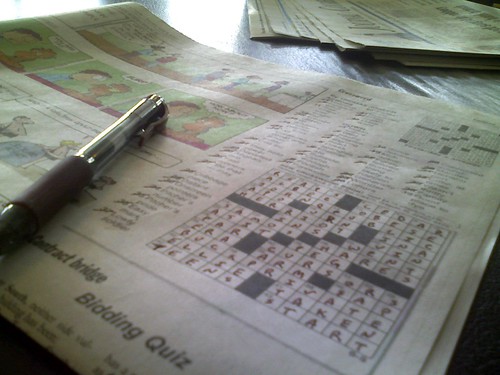
Crossword
{ photo via this kind soul on flickr. }

I think words are more interesting than paintings... but jigsaws can be just the thing if you've got the space and a few uninterrupted weekends with family.

so many kinds of puzzles, there are. once upon a time ten years ago friend Wilson introduced me to this infamously most difficult of all internet riddles. I didn't finish it.

a few days ago I ran across this maddening puzzle via twitter. I spent a few stop-and-go days getting up to level 31. I have been there for ages now. please, if anyone gets past this one... tell me the secret.
it must be solvable. I just can't figure it out yet.

regular life is not a jigsaw or a game, I don't think. definitely not one with neat, pre-cut, smooth-edged pieces. no... life is more like this image from a poem I read recently:
When the wind comes, and the snow repeats us,
 / how like our warped lives it is,
Melting objects, disappearing sounds,
Like lichen on gnarled rocks.
For we have lived in the wind, and loosened ourselves like ice
 / melt.
Nothing can hold us, I've come to know. 
it's from "My Old Clinch Mountain Home" by Charles Wright. his book Caribou was on the new books shelf (how I love new books shelves) at the library and I brought it home, not expecting much. I like it though. I didn't get the line spacing quite right in my excerpt, but hopefully the language conjures something poignant for you anyway. as I was thinking about puzzles and their solutions, this poem countered with its un-polished un-clear scenery. wind and water melting and eating away at everything, transforming and being transformed. all of that seems very, very beyond a puzzle.

we like puzzles so much because they have answers and we can hold those answers in our heads and hands and figure them out. this Vsauce video on games gets at this idea, comparing/contrasting life and play. we can win at Poker or Chess or Tennis... but how can we tell if anyone ever wins at Justice or Teenagerhood or Making A Difference? games and life don't work the same. unless they do...

unless it's only that nobody's figured out exactly how yet.

Saturday, April 12

visual visible visualized

have I mentioned this?

is it worth mentioning?

well at any rate it has now been mentioned. there it is: another little collection (reversely chronological, and filtered, and captioned) of Things I Decided to Photograph.

it is not the only one of its kind. there is also this one. and these.

photos are only one way we catalogue the world as we experience it. we come across things, we take notice, we document them, we point them out to others. we file away our notes, our memories, our bookmarks, our reflections or sketches or sloppy descriptions. sometimes we go back. sometimes the trail of our attention just keeps going, letting the previously-attended to fall deeper and deeper into the past.

this week I came across this kind of dramatic kickstarter page as I searched for interesting examples of promotional rhetoric to use in class. we didn't end up looking at it, but the ideas there, and the idea of Magritte's pipe-but-not-a-pipe, have been bumping up against other ideas, all rubbing off on each other in my head for the past few days. this universe of stimuli--so much of it visual and lit up with sunshine... what is it really? what is it we think we're looking at? what if it isn't what we think it is?

a colleague of mine was in the newspaper a week or so ago, and when I passed him on the stairs recently I nearly took the chance to say, "hey I saw you in the newspaper the other day," but then the moment crawled out from under me, moving much faster than the two of us on the stairs walking in opposite directions, so I didn't, and as more and more stairs came between me and him, I immediately began thinking that really, it wasn't Kamal I saw in the newspaper. he was there walking up the stairs; it had been only photographs of him in the newspaper. only a bit of colored ink and carefully arranged shapes all combining to evoke this person's name, to represent a few things he said, to show us something of his likeness.

an online snippet exists, too. but beware--that is not a newspaper. this is not a photograph, even. what is it you're looking at? light and pixels, arranged on a screen. not quite a set of pages, despite all our cyber-metaphors.

and that isn't your colleague who knows five languages.

those things are not what they might look like or act like.
but is anything?

all these realizations, far from so spelled out at the time, followed me down the stairs and I kept wondering. I cannot say I saw Kamal in the newspaper, not literally.

a photograph is only a representation.

what people look like is not what people are.

what anything looks like is not what it is. existence is a lot of other things on top of a visual presence. seeing is a wonderful thing to be able to do, but it could never be enough by itself.

I can say I see Kamal in the hallways and elsewhere on campus every once in a while. it's easier to say that and swallow the literal-ness of the statement. I see plenty of people at the office, on the streets, in my classes.

what makes all those prepositional phrases more immediate than "in the newspaper"? "on facebook"? "on skype" or "in my email"?

a newspaper photograph can't quite walk up or down stairs or respond if you say "hey, how are you?" I realize. but are these really any less superficial--the visible images of humans that get transported into my brain by the light reflecting off their actual skin and hair and clothes--even if they can look right back at me and smile or nod or shake their heads? is that picture, the one my brain puts together, really any more complete or accurate or accessible than the one made of light from a screen or a printed photograph?

Wednesday, January 22

co-

on New Year's Day I read this little post about the congealing associations we sometimes make when we have time to ingest plenty of culture and art and loveliness all at once. I have blogged about the author of this little post--the really interesting Russell Davies before, a few times. and in one of those previous ponderings (this one to be exact) I allude to the draft of the post you are now reading. at last I have sat down to write about all the overlap between Shakespeare + The Cardigans.

or something.

enjoy this grainy old music video of the song in question as a prelude:

almost three summers ago I saw Utah Shakespeare in the Park's performance of All's Well That Ends Well. my memories of the plot are stiff and frosted-over, but a quick review of the cast list reminds me that poor Helena here, she could have sung her own cover of "Lovefool" to this Bertram fellow and it would have matched so mournfully and beautifully and achingly.
it's a crazy hopeless mess of a story. what else would we expect of Shakespeare? this particular performance seemed to hover around that hopelessness, underlining all the trembly desperation of Helena's unrequited attachment to this arrogant, distant man who only reluctantly, and after plenty of trickery and chastisement, consents to act like he's married to her.
what kind of match is this? not quite a fairy tale, despite the rags-to-riches beginning and the magnanimous blessings of the King of France. will Helena be happy? is what she's dreamed of really what she wants? will she not care if he really loves her, as long as he can pretend well enough?

really this isn't quite what Davies was talking about. I've thought too much now about the play and the song, and since the pairing has sat for nearly three years collecting virtual dust, that means it lacks the casual, hey-look-at-that-ness of any more authentic, more serendipitous match.

but Davies's post struck a chord of sorts and this summers-old memory is only one example. I get it. sometimes certain things bring out little touches of nuance in each other at just the right moment, whether for obvious reasons or less obvious. kairos, those ancient Greeks might call it.

I recently finished proofreading a manuscript about 1960s college basketball and racism. my dad and brothers were watching O Brother Where Art Thou in the basement however many weeks ago that was. two stories set decades apart, tugging at each others' themes. one making the racist South into an easily knocked-at joke, the other using it for an important, relevance-boosting scholarly backdrop. the book and the film both mean something a little bit different when you put them next to each other.

so what else? I notice and want to match up the correspondences between Joseph and the Amazing Technicolor Dreamcoat  + Wilco's "Summerteeth." between the games Plato's Socrates seems to play so brutally in his dialogues + videogames like Portal. between the poetic but philandering character of Dr. Lyman in Bus Stop (which I saw and enjoyed at the local theatre last week with friend Liz) + the poetic but shallow character behind Nein Quarterly. maybe between everything and everything else. this, that, then, now.

that's what I think plenty of these little blogposts are--congealments of sort-of-hmmm-maybe-not-really-but-yeah-related-ish thoughts. I write them into togetherness. sometimes they stick. sometimes they stretch off into too-subtle-for-actual-text-but-just-right-for-hypertext directions. other times they are all so sticky I can't help but put them down in the same set of paragraphs.

Thursday, April 18

fragmented histories

I've mentioned before that I get a bit obsessed with notebooks. most of the blank ones I mentioned way back when are still empty, accompanied now by several new empty notebooks. I'd be happy to acquire more, even at the risk of running out of shelf space. currently, my journaling is nearing the last few pages of a nice little red one with a quote from Marjorie Hinckley embossed on the front: "Everything you are learning now is preparing you for something else."

I guess that must be true. this MA in Technical Communication? it's just a little stepping stone. the PhD in Rhetoric and Composition will be a slightly bigger stepping stone. and then what? we must wait and find out. the other side of that stepping stone is a long way off still.
a while back, colleague Angela, knowing my interest in copyright and the digital world, pointed me in the direction of one Dr. Brendan Riley, who writes this seemingly eclectic blog called Digital Sextant. he does reviews, talks about zombies, throws in occasional amusing photos (some in German?), posts about copyright controversies in the news, and every week or so compiles all the things he's lately posted on twitter.

all my notebooks (the paper kind and the non-paper kind) are just as eclectic, probably. some of them are easier to flip through than others. some of them reveal more of just what was going on in my life at certain times than others. there can be a kind of game in looking back. what sorts of things made it out of my head and onto the page one year ago? or two? is it useful to look for patterns?

so call this a crossover digital notebook flipbook flashback. yes, of course this kind of recycled post is a symptom of my end-of-semester busy-ness. yes, parts of me might feel a bit lame and self-absorbed using this space to puzzle publicly over her very own cryptic past. so what?

courtesy this searchable little javascript trick, built by one Felix Turner (way cool name, that), I've dug around in the past four years and plucked out a medley of past and present Aprils. (I did this lazy sort of thing a few years ago, but in June. maybe medleys-of-past-[blank]s will become a recurring thing. maybe.) I've put the longest-ago bits first, even though that may seem backwards compared to the standard bottom-up chronology of blogland. you may notice some themes. pizza. quotes. pointlessness. questions.

April 2009 - Seattle, Washington
(with a detour through Southern Utah and then California)

shaking the sand out of all my delusions Apr 23
reveling in placelessness Apr 19
i am about to encounter the absence of my grandfather in a house where he has always been Apr 16
"For a divine moment he had poised on the brink of revelation, and now it was gone, as miserably inglorious as a failed sneeze." Apr 16
what are the most important things to bring with you on a trip to california? hmm. answer: notebooks. lots of notebooks. and pens too. Apr 15
who the heck came up with this idea of resumes anyway? Apr 15
nobody told me there was seafood pizza... where can i get some? Apr 14

April 2010 - Salt Lake-ish, Utah
this day feels like three days all wadded together. Apr 19
naptime? Apr 19
to idaho and back in approximately sixteen hours. don't let me forget my toothbrush. Apr 19
lying awake. reliving dreams. Apr 18
i might eat this whole pizza. would that be bad? Apr 17
scanner, why won't you function? Apr 17
still sleepy. dreaming about oceans. Apr 17
i need ice cream. Apr 16
i wonder when this 'woah, the earth is not totally solid' feeling will leave. Apr 16

April 2011 - Salt Lake-ish, Utah
'in such a world... where every connection is so fragile & often so temporary... it makes me wonder how we make promises at all, to anyone.' Apr 18
rainy day retro-blogging. http://plaidsicle.blogspot.com/2006/09/do-or-die.html Apr 18
life. pain. sigh. Apr 18
something just sucked all the optimism out through my nose. what is up with that? Apr 15
eek, as i pace back and forth between precarious what ifs. Apr 13

April 2012 - Lubbock, Texas
what about the costs of inclusion? hmm? Apr 20
i'm going to get pouty and existential from time to time and start saying everything is pointless. just to warn you. Apr 19
so many emails. Apr 17
pajamas. japanese food. yoga. Apr 14, 2012
the anticipation is occasionally just a little bit electrifying. Apr 11, 2012

April 2013 - Lubbock, Texas
hmm. do all essays at this stage feel utterly forced and artificial? or is it just this particular one? Apr 17
i do not really know what this is for in the long run, but: a survey about salsa: https://t.co/BkvQdH7Muc Apr 17
thank you, universe, for this song: "Scandalous" by Hanneke Cassel. Apr 15
this friend-of-a-friend's startup is cool 'Periods can be lame--we're striving to make them a little more enjoyable.' http://t.co/mqecLPczjt Apr 15
so hungry. Apr 15
small car wreck. yay for that. will it turn out to have cured me of this string of awfully pointless-seeming days? we shall see. Apr 15
okay. intercultural values and authorship and plagiarism and copyright. sort yourselves into a brilliant essay-- ready set go. Apr 14
laundry and lunch and procrastinating alltheotherstuff. Apr 12
ich liebe. Apr 12

Wednesday, February 27

or dysfunctional nihilism

this is a bunch of small thoughts I've been collecting for a while. please, forgive the datedness and borrowedness of some of them and the existential generality of the others.
there is no shortage of tragedy in the world. perhaps this is because there is no end to our human ability to read our circumstances as deeply dramatic, emotional, and meaningful narrative. there is no shortage of tragedy at all. sometimes the tiniest things can dissolve away all the good things in your head, until it's hard to focus on anything but how little control you have over the way your life goes.

is it more depressing to think about how little control you have over the way anyone else's life goes?

for months and months I've wanted to blog something about this rather artistic video appeal concerning 'the leading cause of death in the world,' apparently, because... well, I guess because it seems clever. a clever and pathetic appeal to writers and journalists. and this kind of art and rhetoric intrigues me for some reason.

yesterday the grip of my own small tragic mood was loosened when I got out of bed and started cleaning my closet. a small thing. unimportant except in light of the fact that I'll be moving around the corner in a week or so, and need to put things in boxes and suitcases in preparation. anything, any mindless chore to distract us from the howling nothingness, eh?

I am totally up for wearing plaid with stripes. who cares anyway?

but we do. we care. we care about the silly details of what we wear every day and we care about the plight of illiterate children in Africa and lots of things in between. and we aren't exactly helpless puppets in the hands of fate, are we? I don't think so. there are things we can do. but do we? John Green provided me with the phrase 'functional nihilism' in this as-usual-enlightening video. we all wear a nihilist hat from time to time. but it isn't the only hat we can wear. we can get out of bed and do things. make stuff happen. change the world. in fact we can't really help changing the world. there is no running away. your breath, your apathy, your words, your footsteps. it's all here being mixed in with everyone else's.

are there reasons behind all this trite and inescapable no-man-is-an-island stuff? maybe. are they at all effable reasons? maybe not.

and this brings me to Ms. Rachel Botsman and her presentation on the the case for collaborative consumption. I can't remember where or when I came across this, nor am I certain exactly how it ought to connect with the above quote from Einstein or the Solidarités International video. maybe you all can help me out with that part.

a global village. trust mechanics. and this swap-trading stuff is the kind of thing my lovely, clever sister would get into and make awesomeness happen with, if she got half a chance.

maybe I'll read Botsman's book sometime. maybe I'll write one myself sometime...

Friday, February 22

what are the lyrics of that Incubus song again?

sometimes you cannot see the traffic lights. the other cars get in the way, or there are glares from the late afternoon sun, or you've come to a stop at just the right angle behind a large truck.

this happens to me and probably to everyone. who knows why I have been noticing and thinking about it so much lately.

when you cannot see the traffic lights, you can also not see when they turn green again.

and since you cannot see them turning green, you are left to trust the traffic around you. if that truck in front of you moves forward, and the cars in the next lane are moving too, then you probably needn't wait to look at the light above that intersection. it is probably, at last, green.

all of this seems very allegorical.

doesn't it?

a few days ago I was struck that there is a difference between observable events and observed events. the things that happen may not be the things that I see happen. I cannot see everything. even if I and the collected world around me try--even if all of us tried to look and watch and measure and record the things we see happening, there will still be gaps between what we see and the whole of what is real.

maybe being aware of that gap helps somehow. but it also seems so wobbly, wandering around with flaws in our perception that as far as we know cannot ever be jettisoned.

so is all we can do look around, remembering the patterns in the lights we've learned so far, and trust the general direction of the traffic in the next lane? is that good enough?

(I wanted to include some driving pictures in this little post. maybe I'll come back and add them if I find the adapter card for taking photos off my camera-phone.)

Wednesday, January 23

edens and angels

there is a segment of Zion National Park called Angels Landing. this is the place I described seven years ago with such pre-emptive longing. all that one-thing-at-a-time intensity. snow-soaked jeans, scraped knuckles, uncertainty and persistence, hovering.

Angels Landing has some great memories attached to it.

I always wonder about its name. if it's supposed to be the landing that belongs to the angels, then why on earth is there no apostrophe there? if it belongs to one lovely angel, you'd want the signs at the park and the notes on the website to say Angel's Landing. or if a large contingent of angels shares this part of southern Utah, Angels' Landing. but we have neither of these.

so if the place doesn't belong to anyone... I can only presume that its name refers to some (perhaps ongoing) event, and that angels visit this ledge of red rock from time to time. there must have been angels landing there. or maybe there still are? or maybe that is just what you'd expect, and everyone is still waiting for the angels to land.

I suppose it's strange of me to think so much about the name of an 8-mile hiking trail.
{ photo borrowed from this kind soul on flickr. }

there is a country music group called Edens Edge that gives my restless brain similar fodder for asking pedantic questions. do we have here an Edge within (and therefore metaphorically possessed by) Eden? why not then call it Eden's Edge? the alternative--what a face-value interpretation of the band's name's orthographic representation gives us, anyway--makes less sense. is there more than one Eden? and if so, how does a plural entity have one edge? is it some kind of border? a precipice? both? I just don't know. does anyone?

perhaps we could directly confront these country musicians and ask them. did they forget the apostrophe in their name? or are they being extra interesting just for pedants like me? does it matter?

Friday, November 9

fluidity

from Kenneth Burke's A Grammar of Motives--

"Distinctions, we might say, arise out of a great central moltenness, where all is merged. They have been thrown from a liquid center to the surface, where they have congealed. Let one of these crusted distinctions return to its source, and in this alchemic center it may be remade, again becoming molten liquid, and may again be thrown forth as a new crust, a different distinction" (in Bizzell and Herzberg 1300).

Bizzell (Patricia) and Herzberg (Bruce) are the editors of my giant, fat, rhetorical theory textbook, The Rhetorical Tradition. how they ever corralled all 1673 pages of that thing into a only-slightly-unwieldy and mostly quite readable codex is a mystery our whole class has been puzzling over.

this whole semester I've been fascinated by this idea that everything is in flux. we cannot rightly talk only of things, items, or substances. we must, if we ever want to understand things really, talk about processes. situations. events-in-progress. it's difficult. but I love it, for some reason. nothing ends, or begins, it just changes...

me included.

and now I'm off to volunteer in the letterpress lab for a little bit. and then: more grading. and then: research. and then: perhaps a nap...

Thursday, November 1

unseen universities

a line from one of the plays I was lucky enough to see last month:
"They say a dog sees God in his master. A cat looks in the mirror."
    - Dog Sees God: Confessions of a Teenage Blockhead
which are we? dogs or cats?

tonight there was a bit of discussion about blindness (the spiritual kind.) it brought to mind a few thoughts I've been stirring around off and on, all sprouted from the strangeness of the word 'problematize.' sounds vexing, doesn't it? a verb that essentially means to make problems? why on earth would you? to go around creating problems? isn't that crazy?

problematization is a word academics throw around like candy. we just can't take anything for granted, see? we've got to pick everything apart (which metaphor reminds me of a song by that brilliant fellow Joss Whedon, which I remember hearing on the radio once, long before I'd ever heard of Dr. Horrible) and ask a million questions. the questions only spawn more questions. what are we really trying to do?

we could problematize mirrors (the camera, the glass, this screen, calm water). what are they telling us? why do we believe them? does it matter who the fairest one of all is, really? and we could problematize our masters (our day planner, our boss, our friends, our biology). what are their motives? who are they working for, or against?

I do love questions, but do I love problems? (is there a difference? hm.)

maybe problematizing doesn't mean creating problems, but unearthing them. (is there a difference? hmm.)

but problems that don't actually exist and problems that we simply can't see don't look any different, do they?

mirrors. gods. invisible cats. hmmm.

speaking of plays, my silly little one-act script was rejected and my consolation prize was ten minutes with three members of the theatre department faculty. I thanked them (in a hopefully gracious manner) for their feedback, which in case you are curious, included words like "maddening," "Seinfield-esque," "circular," and "obtuse."

but they did encourage me to submit again next year.

I need to keep writing.
this is my new notebook of graduate school research. I'm going to need $265 of application fees for my birthday, plus however much the ETS wants for sending my GRE scores to four new universities, plus however much my alma mater and my alma-mater-to-be want for sending transcripts all over the country.

why?

there are a million more unanswerable whys behind that one, so maybe it's best to leave the seemingly inexorable gravity of a phd un-problematized.