Showing posts with label theory. Show all posts

Wednesday, June 1

lines from history (or, happy pride month)

last summer I was quite enamored of Robin Wall Kimmerer's Braiding Sweetgrass. so much of it resonated with elements I hope are part of who I am and plenty that I hope will eventually be part of who I am.book cover-- Braiding Sweetgrass
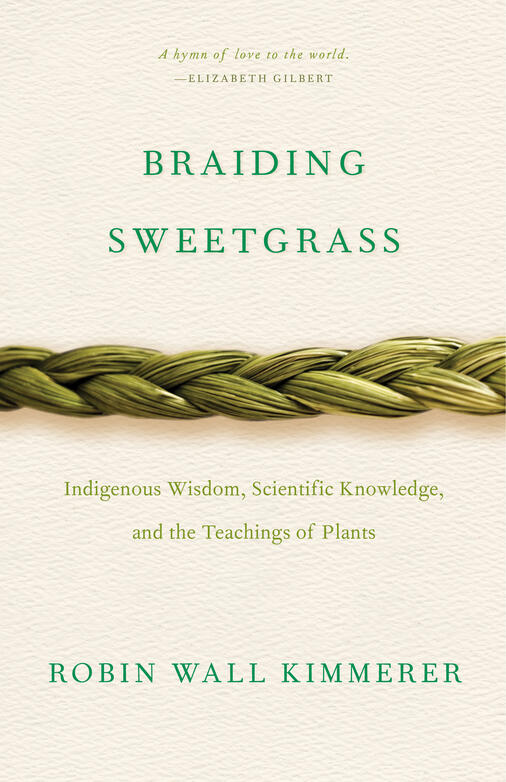
this is one of the former bits-- "My natural inclination was to see relationships, to seek the threads that connect the world, to join instead of divide." (Kimmerer, p. 42)

how are people, places, things, and ideas like other people, places, things, and ideas? how much can we commune, however briefly, with even the furthest-flung perspective?

I find it fun to connect things that don't seem (to most people) like they go together, just as much as to notice connections among things that do. juxtaposition is a useful direction for thinking. mash this with that, just to see what might happen. some of the weird combinations might not work for everyone. or some of them could be like tuna fish with pears. 

today, I finally finished up the audio edits for the last section of my Librivox recording of Angelina Grimké's Letters to Catherine E. Beecher, in reply to an essay on slavery and abolitionism. the collection was published in 1838, the same year Grimké got married to someone named Theodore Weld (also an abolitionist and writer-- maybe I'll read a Librivox version of his 1839 collection American Slavery As It Is: Testimony of a Thousand Witnesses sometime?)

so 1838 and 1839 must have been busy years for Grimké. but most of the letters are dated the year before that, 1837. 

that was 185 years before this one. almost five of my lifetimes ago, so far.

the penultimate letter, Letter 12, was one of my favorites of this little audiobook-to-be. it is so timeless. along with her abolitionism, Grimké wrote ardently about feminism, women's suffrage, and equality on all counts. race, gender, whatever-- all human rights should apply to all humans. 

none of her sentences out of context are as powerful as they are stacked together in this letter, but it seems silly to paste the whole thing here when you can more easily go read it yourself via Gutenberg.org (or wait a few days and then listen to it via Librivox.org, either way).

so to compromise, I will abridge the letter as best and as meaningfully as I can, keeping in what has been most impactful and resonant to my 21st-century brain. and then, carrying on in my own 185-years-later mode of asynchronous discourse, I'll add a few comments.

...The investigation of the rights of the slave has led me to a better understanding of my own. I have found the Anti-Slavery cause to be the high school of morals in our land—the school in which human rights are more fully investigated, and better understood and taught, than in any other. Here a great fundamental principle is uplifted and illuminated, and from this central light, rays innumerable stream all around. Human beings have rights, because they are moral beings: the rights of all men grow out of their moral nature; and as all men have the same moral nature, they have essentially the same rights. 

.... When human beings are regarded as moral beings, sex, instead of being enthroned upon the summit, administering upon rights and responsibilities, sinks into insignificance and nothingness. My doctrine then is, that whatever it is morally right for man to do, it is morally right for woman to do. Our duties originate, not from difference of sex, but from the diversity of our relations in life, the various gifts and talents committed to our care, and the different eras in which we live.

This regulation of duty by the mere circumstance of sex, rather than by the fundamental principle of moral being, has led to all that multifarious train of evils flowing out of the anti-christian doctrine of masculine and feminine virtues. .... Hitherto, instead of being a help meet to man, in the highest, noblest sense of the term, as a companion, a co-worker, an equal; she has been a mere appendage of his being, an instrument of his convenience and pleasure, the pretty toy with which he wiled away his leisure moments, or the pet animal whom he humored into playfulness and submission. Woman, instead of being regarded as the equal of man, has uniformly been looked down upon as his inferior, a mere gift to fill up the measure of his happiness. .... 

Measure her rights and duties by the unerring standard of moral being, not by the false weights and measures of a mere circumstance of her human existence, and then the truth will be self-evident, that whatever it is morally right for a man to do, it is morally right for a woman to do. I recognize no rights but human rights—I know nothing of men’s rights and women’s rights.... 

If Ecclesiastical and Civil governments are ordained of God, then I contend that woman has just as much right to sit in solemn counsel in Conventions, Conferences, Associations and General Assemblies, as man—just as much right to sit upon the throne of England, or in the Presidential chair of the United States.

Dost thou ask me, if I would wish to see woman engaged in the contention and strife of sectarian controversy, or in the intrigues of political partizans? I say no! never—never. I rejoice that she does not stand on the same platform which man now occupies in these respects; but I mourn, also, that he should thus prostitute his higher nature, and vilely cast away his birthright. I prize the purity of his character as highly as I do that of hers. As a moral being, whatever it is morally wrong for her to do, it is morally wrong for him to do. ....

Thou sayest, ‘an ignorant, a narrow-minded, or a stupid woman, cannot feel nor understand the rationality, the propriety, or the beauty of this relation’—i.e. subordination to man. Now, verily, it does appear to me, that nothing but a narrow-minded view of the subject of human rights and responsibilities can induce any one to believe in this subordination to a fallible being. Sure I am, that the signs of the times clearly indicate a vast and rapid change in public sentiment, on this subject. Sure I am that she is not to be, as she has been, ‘a mere second-hand agent’ in the regeneration of a fallen world, but the acknowledged equal and co-worker with man in this glorious work.... Then will it be seen that nothing which concerns the well-being of mankind is either beyond her sphere, or above her comprehension: Then will it be seen ‘that America will be distinguished above all other nations for well educated women, and for the influence they will exert on the general interests of society.’

I can't know what Angelina Emily Grimké would think about the power and influence of women in American society today. hopefully she'd be a little bit gratified, grateful, impressed by how far we've come.

from reading 13 small letters of hers (and maybe a speech or two in an old rhetoric textbook ten years ago, maybe), I really don't know what Grimké would think about trans and non-binary folks, but from her emphatic defense of human rights not being based on gender, I would like to assume she'd be cool and inclusive. she spent her life advocating for the suffering and marginalized in her world. she'd probably do the same now, in whatever ways she could.

progress pride flag-- white pink blue brown black and rainbow colors

here's to making and seeking relationships, connections, and love-- more and more every single sweet day.

Friday, January 29

I, pedagogue (spring semester, 2021)

back in the day, I thought I'd never want to teach. and then I realized that in some ways, everything everyone does can involve a layer of teaching somehow. even if it's a very subtle one.

even still, for these past seven years of wading deeper and deeper into teaching college writing classes of various kinds, the real practice of teaching (with all the planning and record-keeping and decision-making and performing and grading and authority-wielding it typically requires) has not often been my favorite part of academia. it's fine. but it's hard. and I never feel very good at it, so it simply can't be as naturally rewarding as all the other corners of academia where I feel far more skilled.

for better or for worse, my two full-time assistant professor jobs so far have been quite teachingcentric. twelve credit hours of teaching every semester, plus a few during summer semesters, until this year. dozens and dozens of students show up in August or January or June for whichever iteration of professional writing I'm teaching this time, working and sharing and hopefully learning, and then they disappear again.

this year, I have one course release for being brand new in town. it gives me a chance to get used to things a bit.

they also gave all the new faculty a copy of the book What the Best College Teachers Do, by Ken Bain. a few colleagues and I read through it together last fall semester and talked about ways to apply the findings in our own classrooms.

the book and our little faculty discussion group made me think much more intensely about my teaching than I've cared to thus far. it also gave me some concrete hope that maybe I can become better at this thing I don't feel very expert in at all. 

so. what am I trying to do a little better this spring? what have I begun to internalize from Bain's research?

possibly more things than I can articulate very well in a little blogpost. but here are a few:

> talk about your own learning journey with students. model or reenact the kinds of transformation you hope that they will undergo as a result of your class.

> trust students and treat them like whole humans with a million shifting priorities, just like you. this is something I already knew and practice decently, I think. but I took particular comfort in it this past year. my course is a small droplet in the ocean of everything these students are trying to learn and become. if my teaching isn't perfect, they probably won't notice or remember for too long.

> ask students big, meaningful, authentic questions--the kinds of questions that professionals in your field will ask and try to answer. (this is particularly tricky in writing because writing, for most people, in most important contexts, isn't very often about itself. its actual subject is the everything else that we write and communicate about.)

I think I do pretty well being authentic and open and compassionate as a teacher. but I have been guilty in the past of assuming students could never be all that interested in the big questions that I study. we don't have time for that, do we? especially at a fancy aeronautical university where nobody is an English major and everyone mainly wants to design or build or test or fly airplanes and other such contraptions-- how could any of those students care about a communications course?

but if Bain is to be believed, the enthusiasm of a teacher combined with the sparks of a big, meaningful question can draw students in, motivate them a little, even if they didn't think they'd care very much about a communications course. 

and I can be good at questions, surely. 

especially big ones! like: how do you know what anyone means? how do you know what anyone else thinks you mean? how people really ever understand each other enough to make good things happen in the world? and what does it mean to read? to write? or to do those things effectively?

the trick now becomes figuring out how much time to spend getting philosophical about definitions inbetween all the more "practical" work of practicing reading and writing and revising and all that. I still think students learn most from doing things, more than they can from reading about things or discussing them or whatnot.

but anyway, I added this little linguistics video to my list of assigned readings. I opened the first day of class reading from Celeste Headlee's book We Need to Talk, which recounts the tragedy of an ineffective conversation in an airplane cockpit. in technical writing we spent the first day exploring informal crowdsourced technical descriptions on Reddit.

and when I listened to this recent episode of So Many Damn Books with George Saunders I felt more affinity for Saunders's love of teaching writing than perhaps I might once have felt. his advice is to remember that you're never just teaching 20-somethings who barely know what to do with their adulthood when you meet them-- you're also teaching the 40-something-year-olds that they'll become. I like that. (not all college students are 20-somethings, but the concept holds. we are all humans-in-progress.)

maybe I'll go back and give the Pedagogue podcast another chance, too, now that I feel more hopeful and less grumbly about this whole teaching business.

Tuesday, July 28

under the bus

as promised, this blogpost delves randomly into a few rhetorical facets of the reality television show Hell's Kitchen, mostly it's about  some of the rhetorical commonplaces I noticed were shared among competitors across the show's 15-year run.

we finished watching the most recent eighteenth season of Hell's Kitchen last week, I think. (time is a giant blur because of summer and the pandemic, so who really knows when anything has happened.) it's quite a show. as uber-sensational as its episodes can get (emotionally-heightened music! suspenseful voice-over! dramatic pauses between every three words Ramsay says!), it's not too bad. my favourite segments are all the cooking challenges: de-vein as many jumbo shrimp as you can in 10 minutes exactly; cook 10 perfect mushroom and chive omelettes before the other team does; teach a semi-clueless college student or super model or Olympic athlete to cook your signature recipe using only words, no demonstrations; or create a delectable and perfectly-cooked dish using a random combination of one protein, one starch, one vegetable, and one "wild card" ingredient like truffle or blue cheese or something.

the challenges are always my favourite part of reality television. some people like all the interpersonal scheming and the drama of alliances and betrayal, but that's way less interesting to me than seeing how the variously credentialed guest judges will react to the contestants' cooking.

but anyway. the rhetoric of Hell's Kitchen. why not? there's a lot that could be analyzed along those lines. for this post, I'm dwelling on the idiom that stood out to me the very most among all eighteen seasons of carefully-edited contestant confessionals-- "to throw someone under the bus."

among the hundreds of chefs who have competed on Hell's Kitchen over the years, we see plenty of common rhetorical moves. chefs (especially in season premier episodes) insist that they're "not here to make friends, but to win." they refer to each other throughout as "dead weight" or "fat" that must be "trimmed" from their team. after any particular stressful dinner service (and they're all pretty stressful, no matter what), there is talk of so-and-so having gotten "in the weeds" and messing everything up for the kitchen. chefs hoping to prove their skill talk about "stepping up to the plate" to show the world what they can really do. these last two are sports metaphors, extended beyond the contexts of golf and baseball to describe competitive cooking instead.

if I was doing some serious rhetorical-linguistic analysis here, I'd need to track down transcripts of all these episodes and tally up the commonplaces I've noticed in order to properly see which were most used and when. that process would probably lead me to see others that my casual watching of the show didn't reveal, too.

but as it is, all I have is my gut sense that this particular phrase about throwing people under buses is the most interesting one to talk about.

why? mainly it comes down to the common usage of this phrase on the show illuminating its meaning with extra nuance, helping us understand how the saying has evolved. I suspect that the high-stakes context of a reality show is arguably a factor in distorting this odd little idiom from a term that evokes the blatant, dishonorable scapegoating of an otherwise generally innocent party into something a lot more ... flexible. 

the phrase "to throw someone under the bus" has a murky origin from what I have been able to find out. it's not that old, it seems-- first documented in the 1980s. Merriam-Webster traces its history back to British politics and similar "under the bus" phrases in use within that discourse. apparently "throwing people under the bus" has been regularly popularized by sports journalists in the meantime, which gives us yet another parallel between reality cooking shows and professional sports, I guess.

here, in any case, is the definition as summed up by everyone's favourite crowdsourced encyclopedia:
"to betray a friend or ally for selfish reasons; typically used to describe a self-defensive disavowal and severance of a previously-friendly relationship when the relationship becomes controversial, unpopular, or inconvenient."
how closely does the common usage of the phrase on Hell's Kitchen adhere to this dictionary definition? I'm not too sure.

the definition above gives us two core elements involved in "throwing someone under the bus":

1. a previously friendly relationship, or at least some kind of allyship.
2. a calculated movement in self-defense, to further one's own interests at the expense of someone else's.

usually the chefs on Hell's Kitchen accuse each other of throwing them under the proverbial bus as a defensive move in itself. does that mean the accused chef is guilty of truly, defensively, regardless of honor, throwing them under the bus? I'd argue not often.

given that most of the chefs on this show aren't there to make friends, that first element isn't so solidly present to begin with. however, the chefs are usually teammates, so that might count as an allyship, and thereby satisfy the first element of the definition. but still... as for the second element? this is trickier, and it often depends on a million things. in each chef's mind, they of course can't possibly be as horribly at fault as their competition, so naturally they insist that anyone calling for their elimination is doing so merely to save themselves. but is it really the case that those accused of throwing others under buses are always just as guilty of mistakes and incompetence and therefore just as likely to be eliminated by Ramsay at the end of the night? nope. of course not.

so what would be a more accurate term? well, the corollary commonplace in Hell's Kitchen discourse is "trimming the fat" or "removing dead weight" from the team. in that case, those being eliminated thoroughly deserve their fate and there isn't any defensive betrayal at all going on.

or at least that's one story we can tell. in reality, those who stay in the contest do benefit from every other aspiring chef's removal. it's convenient for some when others do poorly. and there must be a thousand shades of nuance between seeing someone as "dead weight" and seeing someone as an innocent bus victim. nobody is thoroughly one or the other, I imagine. 

{ image borrowed from the network that hosts the show, Fox }

as a postscript, I'd like to also note that Hell's Kitchen's creator and head chef/dictator, Gordon Ramsay, has catchphrases of his own aplenty. many are typically delivered in a screaming tone to function as humiliating insults. the more congenial of them are things like, "let me tell you" or "let's get that right" appended alternately to statements of praise or criticism. these are less rhetorical commonplaces in a bunch of shared discourse, and more habitual conversation fillers. they mark Ramsay's speech as his just as much as his accent does. I find the non-screaming ones pretty endearing.

there are, according to various entertainment news outlets, two more seasons of Hell's Kitchen planned for eventual distribution. but it may be a while before they come out on regular television, much less before they come out on any convenient online streaming services.

will the commonplace of "getting thrown under the bus" continue with seasons nineteen and twenty? I wouldn't be surprised if so.

Monday, July 20

more listening

what and who do you find easy to listen to vs. difficult to listen to? I've had reason to ponder this lately, mainly with regard to diversity and tolerance and such. but of course, as I tend to do, I'm getting broad and philosophical about it.

my favourite things to listen to include:
- rainfall
- string instruments
- well-structured podcasts while I'm working with my hands
- chill, lyric-less music while I'm working with my brain
- husband Jeremiah playing the guitar
- vegetables sauteing or sauce simmering on the stove
- soft, gentle pug snoring

there are probably many more that I can't think of right now, too.

sometimes there are voices I get really sick of hearing, or that I'm impatient about listening to. I tell myself that it's not because of the voice itself, but some quality in it or some context around it that makes it insufferable. the ponderous, over-thoughtful droning of too many academic podcasts. the hyper-critical griping of various YouTube reviewer guys. or the two-dudes-talking podcasts that for whatever reason can't seem to edit out even a shred of their blathering (ahem).

I have limited time in my life. I can't be expected to truly listen to everyone. being picky is not a bad thing.

but lately I'm thinking listening as activism. I'm thinking about who we listen to as a crucial moral and political choice. (it isn't always that, I hope, but it can often be that. the personal is political, they say.)

part of what sparked this thinking of late was my slowpokey journey through the Me and White Supremacy workbook. I've been going through each chapter, journaling as earnestly as I can about each prompt (me and tone policing, me and white superiority, me and white silence, and so on). along with a few of the prompts there are a videos from the workbook's author, uploaded back when the book was still just a daily instagram challenge. and the videos are long. some of them are over an hour long.

listening to a stranger talk to me for that long (and about a subject so potentially touchy, at that) takes some discipline. focus. commitment.

in the first section of her book, Layla Saad has said as much. love, truth, and commitment: we won't get through this workbook and its work without those things. and I feel like I need to re-read that section of the book every other day, to help me keep going and stay committed as the discomfort of unpacking all the ways I'm steeped in white supremacy soup intensifies.

listening to a voice that's so different and so passionate isn't easy. the videos that go with the book aren't totally unscripted, but they're conversational. they're personal. it is so easy to say I don't have time for all that.

for me, putting off this set of intense, fine-grained confrontations is convenient. I have every excuse to put it off for next summer or the summer after that, and very little pressure from the outside world to stick with it.

but... as Ms. Saad writes, in address to white people like me and almost everyone else I have ever closely interacted with,
"Whether or not you have known it, [white supremacy] is system that has granted you unearned privileges, protection, and power. It is also a system that has been designed to keep you asleep and 'unaware' of what you having that privilege, protection and power has meant for people who do not hold white privilege. What you receive for your whiteness comes at a steep cost for those who are not white. This may sicken you and cause you to feel guilt, anger and frustration. But you cannot change your white skin colour to stop receiving these privileges, just like I cannot change my black skin colour to stop receiving racism. But what you can do is wake up to what is really going on, challenge your complicity in this system and work to dismantle it within yourself and the world."
there are things I can't change and things I can change.

maybe I can't change my basic inclinations to choose Margaret Atwood's The Testaments off the digital library shelf instead of buying the more 'experimental' Girl, Woman, Other by Bernardine Evaristo's from an airport bookstore. but I for sure can reconsider those basic inclinations and push myself and my brain to include more non-white voices more often. even if (perhaps especially if) those voices seem strange to me.

in this vein of feeding myself more Black voices, I requested some Audre Lorde from the local library the other day. I mostly wanted to read the oft-recommended Sister Outsider, but the copy I found of that collection also included two other works of hers: Zami (semi-autobiographical loveliness) and Undersong (poetry and such). the blurb on the back cover about Zami, the first of the trio, didn't sell it in a way that grabbed me. but as everyone should do with any book they happen to find in their hands, I read the first few lines of it anyway. and it is loveliness. lyrical, thoughtful, evocative, full of allusion and depth and feeling.

previously, the only Audre Lorde I'd ever read was in an Argument Theory class during my first round of grad school: "The Master's Tools Will Never Dismantle the Master's House." (it might actually have only been a section of it; mainly I remember that we discussed-- fitfully-- whether or not one could discuss an argument's structure and effectiveness without discussing the argument's content). I'm looking forward to reading more of her.

I will keep reading and listening to Layla Saad, too. I've also added the more-conversational-than-I-usually-want-to-tolerate Pod Save the People and the deeply educational and impressive 1619 Project to my podcast queue. is it enough? who knows. it feels like barely, barely enough to be beyond tokenism. it's not likely to be enough to thoroughly crack through all the ways I've been conditioned to prefer and validate white voices over any others.

Saturday, July 11

from the air and from the sun


it was shady on the west face of Badger Mountain this morning. the inward corners between each ridge were especially cool. at the crests of each ridge I could look back north to see the whole town like a set of toy models, framed just so by Thumb Butte and Granite Mountain.


snippets of songs and past conversations and poems-to-be and a whole bunch of other ideas sewed themselves through my thoughts as I climbed. 


how to describe the sensation of one's body breaking spiderwebs. birds--I think it's a female bluejay but I'm not sure.

layers and layers of pine-scented Saturday. the striking, heavy-feeling color of smooth, dry, grey-white, dead trees.

oh how lovely was the morning. but what if there's no way of telling how virtuous or good-intentioned any historical figure truly was?

thinking of the outdoors as sacred. mountains and high places as extra sacred. the striking, smooth, dry, white-grey color of what once was a tree now feels like a symbol. persistence. potency. 

I give myself permission. or I take permission from the air and the sunshine like a plant takes oxygen and energy. permission to decide for myself and say what I want.

and what was the name of that book about forests? How Forests Think, by Eduardo Kohn. we read it for Thomas Rickert's class, almost five years ago. the most memorable thing about it to me now is the story the author tells about seeing a bird near a river and being suddenly, beautifully, drawn out of himself and his troubles.


conincidentally when I sat down to blog for today I found in one of my old drafts a copy of a paper I wrote for that class, mainly drawing on Kohn's book. much of the paper is semi-cringy, flippant grad school pretentiousness, connecting what Kohn writes with my own thoughts about food and food media. but even so, some of it might be worth remixing here.

it starts with food and eating, but then goes beyond that into where all the food comes from.

Kohn’s bit about “managing a variety of ecological assemblages” stood out to me most. at first glance, management has such a one-way connotation... but I want to pick that apart. ecosystems manage us back, after all, and have done for millions of years. we and world are meshworked together. one process.

James Gibson writes that “The possibilities of the environment and the way of life of the animal go together inseparably” (p. 143). my own management of eco-assemblages is pretty indirect these days, unless I’m home digging in my dad’s garden. as a non-hunting, non-fishing academic person, I take advantage of grocery stores and farmers' markets full of already-managed things to cook and eat—things that I will probably never need to learn to procure from the earth or the sea for myself. maybe that means my involvement with ecosystems is less intimate, but maybe not. the groceries I buy and cook and eat still matter, not only to my body and my kitchen but to the world I am a part of. every purchase makes marks and leaves traces in a hundred directions. the infrastructures that support grocery stores afford certain possibilities, and those are inseparable from my way of life, so far.

we could make a long list of specific ways non-human lives support our dietary habits. Ingold makes note of this mutual support in a broader way:
“Moreover, granted that not all producers are human, it is easy to turn the argument around and show how various non-humans contribute, in specific environments, not just to their own growth and development but also to that of human beings. … living beings of all kinds, in what they do, constitute each other’s conditions of existence, both for their own and for subsequent generations” (Ingold, p. 8).
A line before this lovely acknowledgement, Ingold writes rather simply (even naively? nostalgically?) that “The farmer’s work on the fields, for example, creates favourable conditions for the growth of crop plants, and the herdsman’s does the same for domestic animals” (8).

doesn't that just sound so symbiotic and peaceful. idyllic, even. but how exactly do we define favorable? whose favor are we most concerned about? Gibson’s observations on how much humans muck around with what our environments afford reinforce this tragic mess: “In making life easier for himself, of course, he has made life harder for most of the other animals” (p. 130). we don’t think about this very deeply very often. often we sometimes actively avoid thinking about it.

what one does or does not put into one’s body makes marks. dietary strictures may be religious, political, ethnic, personal, health-related, or any combination. the forbidden substances seem to make the deepest, most obvious marks: no dairy, no carbs, no pork, no coffee, no alcohol, because this is who we are.

or is it the other way around—this is who we are, because we can’t eat gluten or we won’t eat meat or we’d rather not support Chick-fil-A?

either way, as Ingold pulls from Marx and José Ortega, “what we are, or what we can be, does not come ready made. We have, perpetually and never-endingly, to be making ourselves” (p. 7). and for Thompson, these processes are about “I-ing,” but it seems just as important to think about “we-ing.” It matters who/what we tend to include in “we” and who/what we do not. our human management of eco-assemblages (and maybe of everything else) has been too shortsightedly human-centric for too long.


and then the paper quotes from Roy Scranton's “Learning How to Die in the Anthropocene,” and I question his rhetorical dichotomization of nations and markets vs. "our sense of what it means to be human."

it's not so separable, I say. organisms and their environments can’t really live without each other. it's too connected.

none of us can deny our intimate interactions with things we eat, even if we don’t think about them very deeply all the time. even if we actively avoid thinking about them.

{ apologies for my incomplete citations throughout this refurbished text. if I get a chance I'll update them here to specify titles and other info that was taken for granted when I wrote this for Posthumanism in 2014. }

Tuesday, July 7

thread count (1/1132)

the "twitter thread" as a genre fascinates me. I have so many curious questions about it. when was the first cohesive thread of posts created on twitter? who wrote it and about what?

threaded tweets are a reaction to the restrictions of the platform. it's like adapting the limited microblogging form to serve a longer form of writing. combining a handful of tiny posts into something bigger-- like building a tower out of toy blocks.

twitter added an official thread-making feature to its platform not that long ago. but threads (in the computer/internet sense) have been a thing for way longer than that. although etymonline doesn't mention this newer usage--perhaps it's too new-- in its word history of "thread," Merriam Webster does, interestingly. I guess regular dictionaries have a stronger incentive to keep up with the times than etymological dictionaries do.

I learned the internet meaning of thread on online bulletin boards, where a thread is an asynchronous conversation contained under a heading within a specific discussion forum. multiple people can post to a forum thread. everyone's replies are timestamped, linkable, quotable, reply-to-able, and it's all very organized.

a twitter thread is different. sure, the usual "any string of posts-and-replies" does technically constitute a twitter thread... but that's not really what anyone is talking about when they use "twitter thread" as a specific noun. any old string of posts and replies on twitter is more likely to be referred to as a conversation or an exchange. the connotation of "a thread" (often with an introductiony colon, like "a thread:") on twitter involves a string of posts written by a single author, on some focused topic, typically (but not always) within a short span of time. there can be replies, but they feel separate from the twitter thread itself.

so if we want to delineate the twitter thread genre, what are its requirements and hallmarks? and what are its conventions? every genre has conventions-- sometimes very strong ones. memos and emails should have subject lines, letters can have letterhead, and academic articles have references lists at the end. twitter threads have their own rules, too.

we expect a twitter thread to include at least three tweets linked together by topic, structure, and the platform's formatting. there are usually twice that many, if not more. sometimes there is a narrative feel to the thread, and other times it's more list-like. often the thread is announced and introduced as such in the first post, whether or not the ensuing thread is planned out or more off-the-cuff. at the end, especially if the thread has been shared repeatedly and garnered a lot of attention, the author may add a concluding postscript with a link to somewhere readers can donate or otherwise compensate the author's writing work in some way.

but the really interesting and evolving convention I want to talk about is the numbering. there are different ways to number the individual tweets in your twitter thread. in my experience, the numbers most often come at the end of each post, as in the following variations:
[content of tweet...] 1/12
[content of tweet...] (1/12)
(when the total number of tweets is known at the outset)

[content of tweet...] 1/
[content of tweet...] 1/x
[content of tweet...] (1)
(when the total number of eventual tweets is not known-- this mode seems more common)
I've been collecting twitter thread examples (a whole sixteen of them!) for a while now in anticipation of exploring these numbering conventions a bit more. the end-of-the-tweet positioning is the most common numbering style I've seen, overall. but it's not the only one. on rare occasion, the numbers may come first. plenty of threads don't including numbering at all.

so I have sixteen tabs-worth of twitter threads open next to this blogpost draft right now (I'll link them all at the bottom, pseudo-reference-list-style), and while such a random sample of course can't be truly representative of all the twitter threads that have been created in recent months, they at least give me the beginnings of some general insights into twitter thread numbering conventions.

my main finding? the convention of numbering the tweets in a thread on twitter is dying.

at the very least, it's become a marker of formality, more than a useful signal to readers about the order or length of the composition. numbers seem to be less important to a thread's legibility now that the twitter platform supports and displays threaded tweets so smoothly for most people.

I'm surprised by this, for some reason.

but of these sixteen example threads, only 4 include fully numbered tweets (3 at the end as shown above, and 1 at the beginning). another 10 forego numbering altogether, and 2 include numbering for content within the thread, but not as a marker for each separate tweet.

so there you have it. some really, really informally-gathered data about a quirky little internet genre.

it's interesting, right? it is to me. twitter is a culturally powerful and maddeningly ephemeral discursive space. how conventions emerge and spread and morph a little over time is fascinating in any genre or medium. looking at how it seems to be working on twitter helps me think of twitter as not so special. sure, it's different, but it's mostly made of humans just the same way email chains and academic journals are.

as promised, the twitter threads I referenced in this random exploration of mine, listed here in chronological order. I'll add a note that linking them here like this takes them out of context. they may or may not make as much sense from outside the constant/endless/fast-paced nature of twitter as experienced by those who spend too much time scrolling around within it.


Thursday, July 2

on being intellectual in public

sometimes you hear about the dearth of brilliant public intellectuals these days. where is our 21st-century Marshall McLuhan or Noam Chomsky or Susan Sontag? headlines like this one seem to resonate, recurr. how nostalgic and melancholy for us, that somehow the world's society is just too big and fractured now for anyone to uniformly celebrate and respect any public figure. everything and everyone is too much undermined by shadows of problematicalness.

but at the same time, it's easier now to be a intellectual in public with the internet. public doesn't just mean on mainstream television or at the top of the best bestseller lists or in the biggest newspapers anymore. you can be intellectual on twitter (like this historian who has a pet bunny), or on Twitch (like these climate scientists), or on your own little blog (like Sara Ahmed).

all of us on the internet are more or less in public, whenever we want to be and sometimes even when we don't want to be.

do I count this little blog as part of being a public intellectual? not really. it's not quite public enough. it's not always very academic either, despite its humble ivory tower origins.

but is academic the same as intellectual? not always. you can have one without the other. academic seems more of a form to be followed-- conventions and styles you expect scholars to use. intellectual feels more inward, more spiritual almost-- of the mind. regardless of outward form, we can be intellectual as long as we're sharing our understandings of things or exploring our thoughts and reasons.

this brings me back to Sara Ahmed. she's someone I'd vote for in the category of admirable public intellectual for this century. since 2016 she's worked as an independent scholar, which makes her an academic intellectual without a formal academy. that takes guts and clout and determination. very admirable.

I'm glad she does the work she does in public. someday, hopefully, I'll get a chance to hear her speak. until then, her writing is all over the internet, and in some books and articles, and I really should read more of it.

who gets your vote for coolest public intellectual? I feel like this post could've been much longer and ramblier, full of disjointed musings about other public figures who work with thoughts and ideas in front of large audiences. Neil deGrasse Tyson probably counts, though he says some wacko things about the arts and humanities from time to time. Gloria Steinem and Jane Goodall too, though they seem like figures from the core of the 20th-century even though they are surely still using their intellects today. do John Oliver and Trevor Noah count? Oprah? what about YouTube personalities like this lawyer or the Green brothers? are they all public enough? intellectual enough? I think they are, at least some of the time. let's not pretend we have to separate intellectualism from entertainment.

maybe anyone can be a public intellectual for at least 15 minutes. and hopefully those who get more lasting attention are those who really deserve it.

Friday, April 19

playing opposite

thinking today about the word "work," particularly all the times it gets linked up as a prefix or suffix to other words.

so I made a list (it's not as comprehensive as this list, but oh well). it would surely look better as a wordle or other word-art-blob, and maybe I'll eventually use this list to make such a thing. for now, it is merely a list.

coursework, coworker, co-working
framework, meshwork, metalwork, network
paperwork, post-work, workaround, workbench
workday, worker, workflow
workforce
workout, workplace, works cited, workshop
workspace, workstation

(I know "works cited" isn't a single word, but the idea is a single idea, and its particular sense of the noun is intriguing today.)

someday I'll go look up the etymologies of all these words, too. what history do they share? what do they not share? and why?

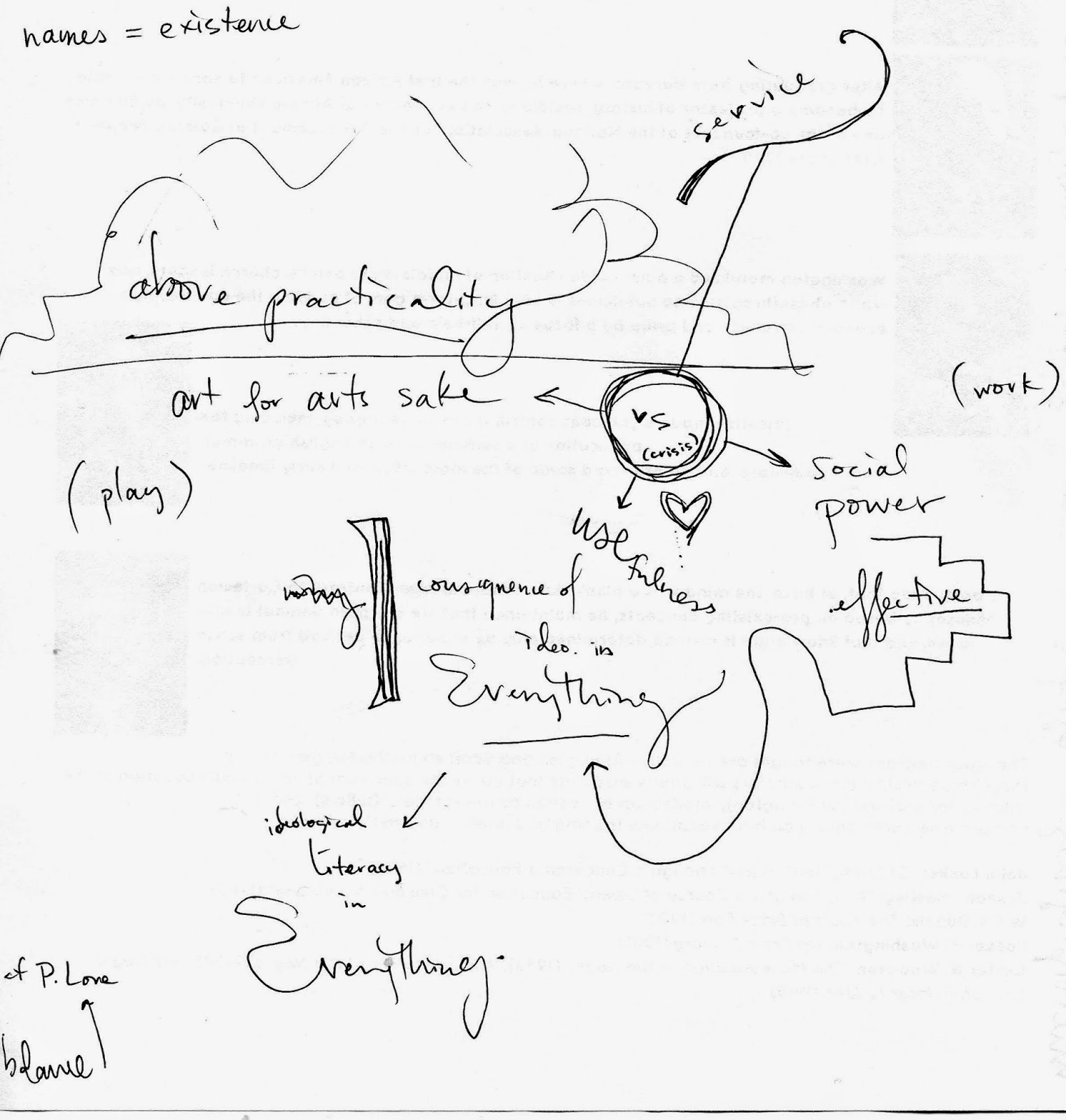
scribbly doodle with phrases like "above practicality" "art for art's sake" "ideological literacy in everything" "service"

something else I'm thinking about is all the stuff that isn't work, or the stuff that at least gets talked about as the opposite of whatever it is we mean when we talk about work.

work vs. play
working vs. unemployed
going to work vs. going to school
hard at work vs. taking a break

and then there are all the synonyms for work. labor. effort. striving. functioning. succeeding. trying.

the word (or suffix or prefix) "work" shows up in my (newly resurrected) file of daily writing 1183 times. I sense that the word, its synonyms, and whatever we mean by it are all going to show up a lot in my future scholarship. my scholarly brain is quite obsessed with the concept lately. partly because
of dissertation residue and many of the ideas I reference in this piece, and partly because in the past month or so I've been consumed with Asao Inoue's book Labor-Based Grading Contracts: Building Equity and Inclusion in the Compassionate Writing Classroom.

I have so many thoughts and so many tenuous hopes that the thoughts might connect into something bigger. if there are meaningful lines to draw around and among the ideas of working to learn, working to live, working to play, workplaces, networks, and the ways we share the world with a million forms of black-boxy technology, then I'm going to find them. write them.

Monday, February 11

professor-ing, spring 2019

there were at least a dozen robins out in our backyard a minute ago, chirping away and pecking things out of the damp dirt.

I didn't notice when they left and I don't know where they've gone now. to someone else's backyard? some other patch of damp ground?

I'm working from home today, with the window in the den half-open and a dish of homemade granola (too crumbly to be bars, but I tried) on the table next to me.
 
there are revisions to focus on, but mainly I've been writing emails to send and posting comments on the blog for my graduate course.

did I write last semester about all the courses I was teaching? it looks like I did not-- not specifically anyway. not the way I've done for all my many semesters as a student. I'll make up for it now.

English 3230: Technical Composition
I taught two sections of this last fall as well, and I'll be teaching 3 sections this semester. Two are face-to-face, Tuesdays and Thursdays, and we've almost reached the end of our first major project. Our next project will be a service-learning/community-engagement project built around a partnership with our university library. who knows if it will spark for my students the kind of gushy enthusiasm I felt about my first service-learning project way back in 2005/2006... but I'm excited about it anyway.

English 6560: Digital Cultures - Theory & Practice
this is my online graduate course, in which four delightful graduate students are enrolled. we are discussing various aspects of and scholarship and theorizings about digital culture over at https://engl6560.hcommons.org/ and meeting for video conferences every other week to discuss further. I'm enjoying it quite a lot and can't wait to see what kinds of projects these students come up with for the rest of the semester.

I have more new and exciting courses (undergraduate and graduate) lined up ahead of me for the next few terms. most of them are technical-writing-related, though I also get to adapt the digital cultures course for undergraduates next fall. I'll get to teach an advanced tech writing and editing sometime in 2020...  lots to look forward to.

being a teacher and not simultaneously a student is pretty much a million times better than doing both at once. teaching is still difficult, but I think I'm somehow slightly more sure of myself now that I have a different focus. my own scholarship has not been set aside, of course (in fact, I should be working on article revisions instead of blogging, probably), but rather than having all the pressure of three reading lists for grad classes + seminar papers to draft + my own scholarship to advance + teaching, it all feels more manageable and spacious and steady.

Saturday, December 23

stories and truths of many sizes

I was just barely thinking about Jean ­Francois Lyotard, and then about Clay Shirky, and then about blogging, and when I opened up all my draft blogposts I found this one. what an odd little coincidence, it seemed.

this post began as notes copied from a reading response I must have written and turned in for my Postmodernism course several semesters ago. I'm going to revisit it and see what happens.

that semester, I wrote rather candidly that I'd thought I would tiredly skim Lyotard's The Postmodern Condition. it is a short treatise, but nonetheless skimming is fairly expected in graduate school. however, apparently I almost couldn’t put Lyotard down that week. something about his little exploration of The Postmodern Condition sparked against my jumbly thoughts and I just had to finish it. and I wanted more.

my reading response post for the class eventually congealed around two main topics: technology and money. I'm going to reverse the order for this post, and put money first. mostly this is because I'm smiling at the memory of the Megan I met on a train, and I want that very small story to exist here on my blog.

the other reason is that the technology thoughts seem to loop back nicely into the current and future trajectories of my scholarship, and ending with them will perhaps as more light and insight to that trajectory as it continues unfolding for me and my brain.

money
in his section 11, "Research and Its Legitimation through Performativity," Lyotard leads us, his readers, around to a (by now fairly obvious) perspective on power and truth:
“A new problem appears: devices that optimize the performance of the human body for the purpose of producing proof require additional expenditures. No money, no proof—and that means no verification of statements and no truth. The games of scientific language become the games of the rich, in which whoever is wealthiest has the best chance of being right. An equation between wealth, efficiency, and truth is thus established.” (44-45)
I found this obvious then because I'd read various other bits and pieces about the construction of proofs and the materialities of epistemology. I would go on to read more, too. Barad's Meeting the Universe Halfway gets at many of the same conundrums. what it means to know something, to make known something, to verify and prove to others that you have verified it-- these are huge questions. Lyotard says that money makes it easier. money is very persuasive stuff. material. rhetorical. powerful.

and Lyotard puts this thought to us in such a clear, direct way. resigned, almost, but thoughtfully so. I was reminded by this section of a conversation I had with a medical student named Megan on a train from Dundee to Oxford this summer. she sat across the table from me and offered to share her gummy sweets, and eventually we both looked up from our studying and fell into a gloriously fluid conversation about who knows how many interesting thoughts.

one of our many topics was medical research, and Megan explained how unfortunate she found it that most useful, successful medical research is driven by capitalist, consumerist ideals. developing nations don’t have the resources to carry out their own research, nor the resources to pay for research on any of the diseases or treatments that make the most difference to them. the citizens of developing nations won't have the resources to pay for such treatments, so why should medical researchers invest their time there? no money, no science. no truth. and on the other hand, in developed countries, we have plenty of time and money with which to worry about cancers and heart diseases and such, and those are the things that get studied.

I’d never really thought about that manifestation of privilege. and it is just one example of what Lyotard points out about how power and proof and rationality and funding and research are all tied very tightly together. I have been lucky to have funding and support from handfuls of institutions, and having that has allowed all the thinking and making that I've been doing as an adult. so far I think I can count on that support remaining, in some form or another, as long as I can make myself useful in some way to the institutions providing it.

anyway-- I think the “no money, no truth” slogan, paraphrased from Lyotard, should go on an ironic t-shirt or something. somebody make one.

technology
in an earlier section of the book, Lyotard makes a bewilderingly simple (to me) claim about technology-- that it only has two principal purposes. the line appears in section 1 in the context of the sciences/technologies of language and communication, where he says this: “Its two principal functions— research and the transmission of acquired learning—are already feeling the effect, or will in the future” (4). I had to stop there, puzzled and frozen and what? The vague pronoun and the bold claim both held me up for several minutes.

in the margin, I added this note: what?

I wondered and puzzled over this claim. technology is principally for gaining knowledge and sharing knowledge? who says? since when? in what arena?

I wasn't sure, that semester, why I was so skeptical here. (husband dearest would say it's because such a stance is my habit, and I can't help myself. maybe he is right.) mainly it seemed to be because I hadn't thought about the idea before. it was new. while I reveled in the puzzlingness of it, I questioned myself too. if Lyotard means communicative technologies, not all of them, does his claim make more sense then? but then again, which technologies aren’t at least a tiny bit communicative? really? as a rhetorician I take a position that everything sends some kind of message. are those messages always based in "acquired learning" somehow? perhaps they are. everything around us is teaching us, even if we aren't paying attention. perhaps especially then.


as a rhetorician, it is my habit and my training to notice what the everything is teaching us, and then to try analyzing how it does so. right now with my dissertation work I'm pondering what the crowdsourcing work of LibriVoxers may have to teach us, and trying to connect that to professional/technical writing scholarship and practice generally. the ideals and methods of LibriVox are inspiring, I think. every voice is welcome. every tiny contribution valued alongside the tiny (and not so tiny) contributions of thousands of others.


one of Lyotard's more memorable contributions (at least as far as my brain is concerned) is the idea of the petit récit or 'small story' in contrast to the grand narratives of epic myths and stereotypes that sometimes dominate our ways of thinking about ourselves as humans. that idea--many small stories bubbling around, opening up many new perspectives, adding difference and color to places that looked old and flat before--seems important. right now, in this early 21st-century digitally networked time, we have space for millions of small stories. millions of different voices. it can seem an overwhelming abundance sometimes. what do we do with it? how do we handle the abundance? is this a chorus of voices or a chaos of noise? these questions seem worth asking. one person's chaos may be another's chorus, I imagine.

I may need to go reread Lyotard, and this time I might skim.

{ photos taken by Dr. Michael Salvo, over a year ago, in room 306 of Heavilon Hall, where I defended my dissertation prospectus using my voice and some words and chalk }